Servants, Tea Vendors And ₹700 Crore In Government Contracts. The Alleged Medical Procurement Scam Around Rajiv Rangila. How Did Delhi’s Government Hospital Procurement System Allegedly Go Wrong?
Servants and tea vendors allegedly linked to companies winning government contracts. Medical supplies reportedly bought at multiples of their market prices. And ₹700 crore under the scanner. The Rajiv Rangila case raises an uncomfortable question: how did Delhi’s government hospital procurement system allegedly allow this to happen?

Rajiv Rangila’s arrest in September 2026 brought a key private player in Delhi’s alleged ₹700-crore medical procurement scam back into the hands of investigators.
The pharmaceutical trader, accused of helping manipulate government tenders and using firms allegedly registered in other people’s names, surrendered before the Anti-Corruption Branch (ACB) after remaining untraceable for months, according to The Indian Express.
He was arrested on September 24 and sent to four days of police custody the following day. The arrest came days after the ACB filed a chargesheet against him and other accused in the case.
The case concerns purchases of medicines, surgical items and medical equipment for Delhi’s government hospitals through the Directorate General of Health Services (DGHS) and the Central Procurement Agency (CPA). The allegations go beyond inflated prices.
Investigators suspect that tender conditions were tailored to favour selected suppliers, that competing bidders were discouraged, and that payments were channelled to firms allegedly linked to the accused. The ACB has also alleged that money moved through accounts belonging to people with no apparent connection to the supplies.
The ₹700-crore figure gives the case its scale, but it needs to be understood carefully. Rangila is alleged to have been a central link between private suppliers and the government procurement machinery. But the case also names public officials who were responsible for different stages of the process, from tender specifications and approvals to financial scrutiny.
The question, therefore, is not simply how one trader allegedly benefited from government contracts. It is how the procurement system was allegedly made to work in favour of selected firms – and whether the records and money trail can establish who made it possible.
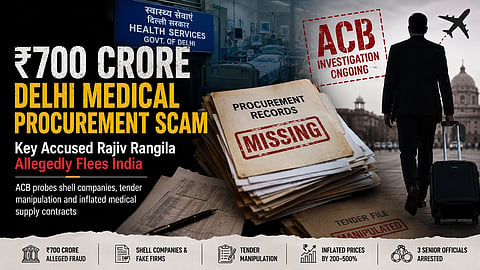
Servants, Tea Vendors And Companies Allegedly Controlled From Behind The Scenes
One of the most striking allegations in the case concerns the people whose names appeared on the paperwork of companies that allegedly secured government medical supply contracts.
According to the Vigilance Department complaint firms linked to Rangila were registered in the names of other people, including servants and tea vendors, while investigators alleged that Rangila was the person actually operating them.
The companies named in the complaint included F Med Devices, Technocrats, Raj Shree, Ashi Surgical and Pharmaceuticals, and M Sahib and Sons Pvt. Ltd. Investigators suspected that these firms were used to participate in government tenders and create the appearance of multiple suppliers, even when the businesses were allegedly under common control.
If established, such an arrangement could make it harder to determine who was genuinely competing for a contract and whether the tender process was delivering meaningful competition.
The alleged arrangement becomes more consequential when placed alongside the ACB’s account of how the tenders were prepared.
Investigators alleged that Rangila worked with medical equipment manufacturers to formulate restrictive technical specifications and supply conditions favouring selected firms.
Those documents were allegedly routed to Dr Vinod Kumar Ranga, then head of office at the CPA, before being placed before tender committees. The FIR further alleged that committee members were pressured to approve the specifications, with former DGHS chief Dr Vatsala Aggarwal allegedly giving final approval to the disputed conditions.
How The Tender Process Was Allegedly Manipulated
The allegations against Rangila become more serious when the focus shifts from the ownership of supplier companies to the way government contracts were allegedly awarded.
According to the ACB’s case, the problem was not simply that certain firms received large orders. Investigators alleged that the tender process itself was manipulated to favour selected suppliers, with restrictive specifications and eligibility conditions making it difficult for competing businesses to qualify.
The Central Procurement Agency, which operates under the DGHS, is responsible for procuring medicines, vaccines and medical equipment for Delhi government hospitals and healthcare facilities.
Its procurement process is supposed to establish the technical requirements of a purchase, invite eligible suppliers to bid, evaluate their offers and award contracts in accordance with the applicable rules. These checks are meant to ensure that the government gets suitable products at competitive prices rather than awarding business on the basis of private connections.
The ACB alleged that Rangila worked with selected manufacturers to prepare technical specifications that favoured particular suppliers. These specifications were allegedly passed through CPA officials and presented to tender committees for approval. Investigators further alleged that eligibility conditions relating to turnover, prior experience and performance were set at unusually high levels, discouraging other bidders from participating. The agency has also alleged cartelisation among selected participants.
The significance of these allegations lies in how procurement competition can be weakened without necessarily making a tender appear irregular at first glance. The question is whether the requirements were proportionate to the goods being purchased or were designed to exclude otherwise capable suppliers.
The Government e-Marketplace (GeM) adds another layer to the investigation. The ACB has alleged that contracts were awarded to firms linked to Rangila and his associates in violation of procurement procedures.
The relevant question is how those contracts moved through the platform or associated procurement processes, whether the prescribed safeguards were followed, and whether any irregularity occurred before or after bids were submitted.

The Prices, The Contracts And The ₹700-Crore Question
The price discrepancies cited in the investigation are among the most consequential allegations in the case – alleged that several medical supplies and equipment were purchased at prices substantially higher than those paid by other hospitals for comparable items.
The figures cited in the complaint included alleged price inflation of 230% for portable X-ray machines, 200% for bed sheets, 340% for C-arm radiological equipment and as much as 500% for oral rehydration solution (ORS).
The examples are striking. According to an FIR-based account published, portable X-ray machines that reportedly cost around ₹10 lakh at other hospitals were allegedly purchased by the DGHS for approximately ₹33 lakh each. The report said 448 machines were procured at a total cost of about ₹148 crore, compared with an estimated value of roughly ₹45 crore at the cited benchmark price. These are figures attributed to the complaint and should be verified against the actual procurement contracts and comparable product specifications.
Bed sheets were another category under scrutiny. The complaint reportedly compared purchases at around ₹450 per sheet with prices of approximately ₹150 at other hospitals. It alleged that nearly ₹75 crore was spent under the relevant tender, although the supplies were valued at around ₹25 crore using the comparison cited in the report.
The figures for specialised equipment were also substantial. The complaint alleged that C-arm radiological equipment available at around ₹25 lakh per unit was procured for approximately ₹1.10 crore per unit. For ORS sachets, the reported comparison was around ₹15 per sachet against a benchmark of roughly ₹2.05 to ₹2.50. The complaint also raised questions about payments for surgical supplies, alleging that nearly ₹100 crore was paid for materials estimated to be worth considerably less.
The Officials At The Centre Of The Procurement Process
If private suppliers allegedly benefited from the medical procurement contracts, the next question is what happened inside the government departments responsible for awarding them.
The Anti-Corruption Branch’s investigation has placed three former public officials under scrutiny: Dr Vinod Kumar Ranga, former head of office at the Central Procurement Agency (CPA); Dr Vatsala Aggarwal, former Director General of Health Services (DGHS); and Neeraj Chopra, former deputy controller of accounts at the CPA.
The Delhi government sanctioned their prosecution on September 30, 2026, following the filing of a chargesheet earlier that month.
Their positions placed them at different stages of the procurement process.
—The CPA was responsible for the operational work of purchasing medicines, medical equipment and other supplies for Delhi government hospitals. Its functions included procurement operations, bid formation, tender evaluation and management of the tender portal.
—The DGHS, meanwhile, exercised authority at the directorate level, while the accounts function was responsible for financial scrutiny and the processing of payments.
The ACB has alleged that Dr Ranga played a central role in the tender process, including the handling of specifications that allegedly favoured selected suppliers. Investigators have also alleged that the procurement machinery was used to award contracts to preferred entities in violation of prescribed procedures.
Dr Ranga has disputed the allegations and, in earlier bail proceedings, argued that decisions were taken with the approval of his superiors. The prosecution, however, has sought to establish whether his position within the CPA enabled the alleged irregularities to take place.
Dr Aggarwal’s position raises a different question: what responsibility did the head of the directorate have for the procurement decisions made by the agency operating under it?
The ACB has alleged that she approved disputed specifications and was part of the wider conspiracy. Her defence has rejected the allegation of collusion and argued that her role was limited to approving decisions processed by the CPA.
In her bail plea, she contended that the chargesheet did not establish that money from the questioned transactions reached her or an account connected to her. She also argued that she did not have access to the tender portal and that procurement files were held by the CPA.
Neeraj Chopra’s alleged role concerns the financial side of the procurement process. As former deputy controller of accounts at the CPA, he was associated with the scrutiny and processing of payments.
The scale of the case is reflected in the chargesheet, which reportedly ran to nearly 12,000 pages and relied on 84 prosecution witnesses and 123 documents.
The Money Trail And The Missing Procurement Files
The alleged manipulation of tenders is only one part of the investigation. The other is the movement of public money after contracts were awarded. The ACB has told a Delhi court that payments for supplies were allegedly routed through hundreds of bank accounts belonging to individuals who had no apparent connection with the goods delivered to the DGHS or the CPA.
According to the agency’s submissions, money running into crores was subsequently withdrawn in cash or transferred to other accounts. Investigators suspect that these transactions formed part of a process to divert government funds.
The alleged transactions raise several questions.
—Were the accounts used to pay legitimate suppliers, intermediaries or individuals with a documented role in the procurement chain?
—Were the account holders aware of the source and purpose of the money?
—Did funds move through several accounts before reaching their ultimate beneficiaries?
—And can the investigators link any transfers to specific contracts, officials or private companies?
The ACB has also alleged that payments to other vendors were kept pending for as long as two years after supplies had been delivered. If substantiated, that detail could help explain how the procurement process allegedly operated in practice. Delayed payments to some suppliers, alongside rapid or preferential payments to others, could indicate unequal treatment.
The investigation has encountered another serious problem: missing procurement records. In August, the ACB told the court that important files relating to purchases of X-ray machines, C-arm equipment, linen and other supplies had allegedly been intentionally destroyed.
These files were said to contain details of the officials who prepared tender documents, framed the terms and conditions, and participated in technical and financial evaluations. If the records were deliberately destroyed, their loss could make it harder to reconstruct who took particular decisions and why.
The defence has also challenged the prosecution’s financial case. Dr Aggarwal’s bail plea argued that the chargesheet traced payments to five supplier firms but did not identify a single rupee reaching her or an account connected to her. It also claimed that searches of her residence did not recover unaccounted cash or documents connected to the questioned procurements.
The court’s scrutiny of the investigation adds another layer of uncertainty. In late September, a Delhi court flagged apparent copy-and-paste entries in the ACB’s case diary and two undated disclosure statements attributed to Rangila.
The Government E-Procurement System And Its Alleged Failure
Government procurement is supposed to leave a trail. From the moment a department identifies a requirement to the day a supplier receives payment, there should be records showing what was purchased, why a particular specification was chosen, which companies bid, how the bids were evaluated and who approved the final expenditure.
In Delhi’s alleged ₹700-crore medical procurement scam, the central question is whether those safeguards were followed in substance or whether the paperwork concealed a process that allegedly favoured selected suppliers.
The Government e-Marketplace (GeM) was established to make public procurement more transparent, standardised and competitive. Its digital framework allows government buyers to source goods and services, compare offerings and conduct procurement through prescribed processes.
What Happened To The Supplies Meant For Government Hospitals?
The public-interest dimension of the alleged procurement scam begins with a simple question: what did Delhi’s government hospitals receive for the money they spent? The contracts under investigation covered medicines, surgical supplies, medical equipment and other items required to run public healthcare facilities. If procurement prices were inflated or contracts were awarded without adequate competition, the consequences could extend beyond the government’s accounts.
Public funds that could have paid for additional equipment, medicines, maintenance or other services may instead have been spent inefficiently.
The concern is not merely theoretical. Public hospitals operate under budget constraints and must balance competing demands for equipment, medicines, staff, maintenance and patient services. Procurement decisions determine how far those resources go.
If the government overpays for supplies, the immediate financial consequence is a loss of purchasing power: the same budget buys fewer items or leaves less money available for other needs. If the supplies are also deficient or delivered late, the impact could be greater.
There is also a question about the role of hospital administrators and end users. Did the facilities report delays, quality problems or shortages? Were products inspected before acceptance? Were complaints escalated to the procurement agency? Were suppliers required to replace defective items or meet contractual obligations?
The answers could help distinguish failures in tendering from failures in delivery, inspection and contract management. They could also establish whether the alleged irregularities were confined to the award of contracts or extended through the entire supply chain.
For the public, the central issue is whether government spending translated into the medicines, equipment and services that hospitals needed. A procurement contract is not an end in itself; its purpose is to deliver usable goods at a fair price and within the required timeframe.
The Chargesheet, The Court’s Concerns And The Defence
By September 2026, the investigation had moved beyond arrests and allegations into a substantial prosecution case. The Anti-Corruption Branch filed a chargesheet running to nearly 12,000 pages before the Rouse Avenue Court, naming former DGHS chief Dr Vatsala Aggarwal, former CPA head Dr Vinod Kumar Ranga and former deputy controller of accounts Neeraj Chopra.
The chargesheet was filed on September 16, with Rangila also named in the case. The allegations concern procurement contracts worth around ₹700 crore and suspected irregularities in the purchase of medical equipment and other supplies for Delhi government hospitals.
The size of the chargesheet reflects the volume of material investigators say they have assembled, but the number of pages is not, by itself, a measure of the strength of the evidence.
Who Was Supposed To Protect Public Money?
The alleged ₹700-crore medical procurement scam is ultimately a test of how Delhi’s government purchasing system functioned when large contracts were awarded for medicines, medical equipment and hospital supplies.
The ACB alleges that selected firms benefited from manipulated tender conditions, that public officials helped facilitate irregularities, and that payments moved through accounts that investigators suspect were used to divert funds.
If established, those allegations would point to more than the conduct of a single supplier. They would raise questions about the safeguards meant to protect public money at every stage of procurement.
The second question concerns accountability within the departments responsible for procurement. The CPA, DGHS, tender committees and accounts officials each had distinct functions. A proper investigation must establish who was responsible for framing specifications, evaluating bids, approving contracts, verifying deliveries and authorising payments.
It must also determine whether concerns were raised, whether officials acted on them, and whether any person knowingly helped an irregular arrangement continue. Responsibility cannot be established merely by identifying who held a particular post, but neither should the existence of an administrative hierarchy prevent scrutiny of decisions made within it.
The third question is financial. The reported price comparisons have raised concerns about whether the government received value for money. But the final calculation must distinguish the total value of contracts under investigation from any excess payments, suspected diversion and loss that can be established through evidence.
The fourth question concerns the records. The ACB’s allegation that important procurement files were intentionally destroyed, together with the court’s concerns about aspects of the case diary and disclosure statements, makes documentation central to the case.
There is also an immediate administrative question. On October 9, it was reported that Delhi Health Secretary Rupesh Kumar Thakur had been removed from his post amid the continuing controversy. The report referred to concerns over procurement oversight and substandard medical supplies, including allegations involving supplies to government hospitals.
For hospitals, the issue is whether public expenditure translated into usable supplies delivered at justified prices and within the required time. For taxpayers, it is whether the government can demonstrate that procurement decisions were fair and that any loss caused by wrongdoing is identified and addressed.
The central question is therefore larger than Rajiv Rangila’s arrest or the value attached to the contracts under investigation. If the allegations are substantiated, how did a procurement system designed to protect public money allegedly become vulnerable to manipulation – and what will ensure that the same failures do not recur?