Delhi’s 25,000-strong police fortress against a denied CJP sit-in: Where was this wall when minors were being raped in parks and on buses?

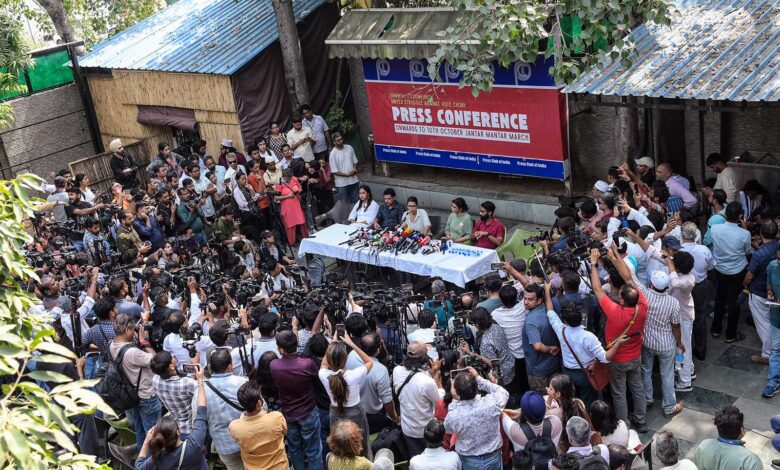
On the eve of a Cockroach Janta Party (CJP) mobilisation at Jantar Mantar on 10 October 2026—permission refused days earlier for late application, prior law-and-order concerns, and traffic impact—Delhi was sealed like a garrison. Roughly 25,000 police and paramilitary personnel blanketed the capital. More than 6,500 sat inside a 1.5-km sensitive zone covering Jantar Mantar, Janpath, the Election Commission, and police headquarters. Over 300 CCTV cameras with audio-video capability, body cameras for senior officers, multi-layered barricades, 12 detention centres, border checks, metro restrictions, cancelled leave, and forces pulled from Jammu & Kashmir, West Bengal, and Chhattisgarh anti-Naxal operations formed the grid. Reports put total CAPF companies at around 221 (roughly 23,000 personnel) plus substantial Delhi Police deployment, with some estimates pushing the combined presence toward 35,000–45,000. Section 163 prohibitory orders stayed in force. The message was unmistakable: this crowd would not move freely.
The same city that can mobilise this in days for a protest whose permission was already denied cannot keep a park safe after dark or intercept a bus travelling dozens of kilometres. National Crime Records Bureau (NCRB) Crime in India 2024 data, released in 2026, place Delhi at the top among metropolitan cities for crimes against women (13,396 cases) and rape (1,058). It also led in crimes against children (7,662) and POCSO cases. Delhi Police’s own figures show roughly 2,076 rape cases in 2024 and 1,901 in 2025—averaging more than five a day. These are registered cases only; under-reporting is well known. Nationally, NCRB and related data show rape cases against minor girls rising sharply over a decade, with the large majority of accused known to victims. Delhi’s absolute numbers remain the highest among metros.
September 2026 made the contrast concrete. At least 13 rape and sexual assault cases were reported across Delhi-NCR in the first weeks of the month alone. On 21 September, a 17-year-old celebrating her birthday with a male friend in Aastha Kunj Park (near Kalkaji Temple and Lady Shri Ram College) was allegedly gang-raped by three men who posed as police officers, separated her from her companion, and held a knife to her neck at multiple spots inside the park. Police arrested the accused within hours using CCTV and technical leads; one was shot in the leg after allegedly firing at officers. That is efficient reactive work. The preventive failure is the point: three men could impersonate police, trail the pair, and assault her in a public park with no immediate intervention. Other September incidents included a gang-rape and murder in Swaroop Nagar and an assault on a minor inside a moving sleeper bus that travelled nearly 47 km from Greater Noida without interception.
The Supreme Court took suo motu cognisance on 28 September 2026. Justices J.B. Pardiwala and K. Vinod Chandran drew “painful parallels” to the 2012 Nirbhaya case and stated that the incidents “starkly underline a systemic failure on the part of law enforcement and civil administrative authorities to guarantee basic public safety.” Public spaces, they observed, cannot become “zones of high risk” because of inadequate illumination, poor surveillance, and “lax patrolling.” The Court ordered district-level vulnerability mapping, intensified beat patrols (especially around educational institutions), lighting and CCTV audits, driver verification for buses and cabs, and other measures within weeks. It later directed “war rooms” for real-time monitoring and criticised protocols that remain on paper. Fourteen years after Nirbhaya, the apex court is still ordering the basics.
Delhi Police’s sanctioned strength stands around 92,000, with vacancies reported at over 9,000 (roughly 10%) as of late 2025, including significant shortfalls at inspector, sub-inspector, and constable levels. The force enjoys one of the country’s higher police-to-population ratios—around 380–410 per lakh versus the national actual average near 155—yet Delhi leads metros in absolute crimes against women and children. Budget allocations for Delhi Police hover near ₹12,500 crore for 2026-27. Women’s safety schemes, including Nirbhaya Fund components, receive hundreds of crores, but utilisation and on-ground impact have long been uneven; historical data showed large portions of the fund under-spent or diverted into broader infrastructure. The force maintains specialised units for crimes against women and children, pink booths, and Shishtachar squads. The Court has now asked for weekly operational reports because paper protocols have not delivered visible presence where it is needed.
Compare the machinery. For the July 2026 CJP “Chalo Sansad” march over NEET irregularities, police said roughly 5,000 personnel managed more than 30,000 protesters spread over about three kilometres. Barricades were breached; graded force followed—lathi charges, tear gas, and allegations of pellet use. Both sides reported injuries (police figures: over 240 personnel, around 200 protesters). An affidavit to the Supreme Court denied excess force and cited the scale and alleged infiltration. Videos and Amnesty International’s later verification documented batons, tear gas, and pellet weapons. Plainclothes “spotters” were present. The October deployment dwarfs even that. Forces were airlifted or redeployed from counter-insurgency and border duties. Detention centres, facial recognition tracking of prior participants, and real-time recording teams were readied. Leave was cancelled. The capital can treat an unauthorised sit-in as a near-siege.
Taxpayers fund this apparatus. The question is priority and outcome. Democratic protest—even when permission is denied and even when past events involved violence—triggers layered barricades, thousands of personnel, and cross-country force movement. A 17-year-old in a south Delhi park, or a minor on a long-distance bus, does not. Post-incident arrests happen; the Court is now demanding the preventive architecture that has been promised since 2012. High police density, specialised units, CCTV expansion, and multi-crore budgets have not produced streets or parks where young women can move without calculated risk. Most sexual violence remains by known perpetrators, yet public-space failures keep recurring and keep generating national outrage.
The October deployment shows capacity exists when the target is a political mobilisation at a designated protest site. The September cases and the Supreme Court’s language show that capacity is not reliably present when the target is a girl walking through a park after temple visit or a bus passenger. Indians pay for both law-and-order control and basic safety. The disparity in visible, sustained effort between the two is not subtle. It is measurable in personnel numbers, in the speed of fortress-building versus the persistence of “lax patrolling,” and in the Court’s continued need to order the same fundamentals fourteen years after the case that was supposed to change everything.