1.82 Lakh Railway Employees Flagged Over Free Ration Benefits Despite Government Jobs, Railway Board Orders Card Surrender
The question of who actually receives India's welfare benefits has come under scrutiny after over 1.82 lakh railway employees were found availing themselves of free ration despite being government employees. The Railway Board has now stepped in, directing staff who do not meet the eligibility criteria to surrender their ration cards.

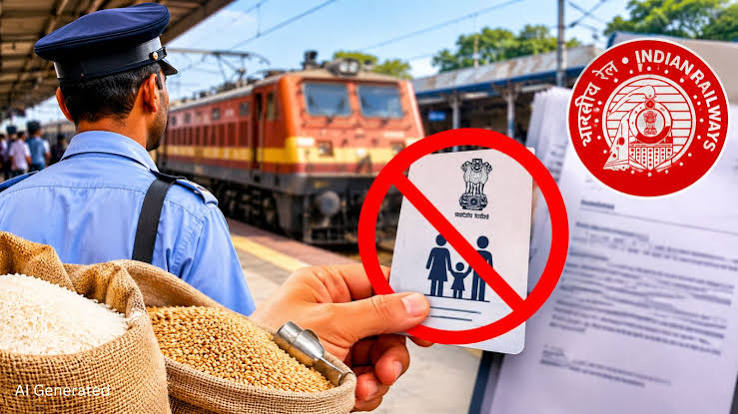
Over 1.82 lakh railway employees across India have been found availing themselves of benefits under the free ration scheme despite being government employees and falling within the income tax bracket.
Following the findings, the Railway Board has issued a strict directive to all zonal railways, including North Central Railway, and production units, asking eligible and tax-paying employees to surrender their ration cards immediately.
The irregularities came to light during an eligibility verification exercise conducted by the Union Ministry of Consumer Affairs, Food and Public Distribution. The review found that a significant number of railway personnel were receiving free and subsidised food grains intended for economically weaker sections of society.
Taking note of the violations, the Railway Board has directed general managers across all zones to take corrective action and ensure that ineligible employees are removed from the beneficiary list without delay.
Eligibility Verification Exposes Widespread Violations
Under government welfare guidelines, employees working in government departments, public sector undertakings (PSUs), autonomous bodies and local authorities are not eligible to receive subsidised food grains under public distribution schemes. Individuals who pay income tax are also excluded from accessing free ration benefits.
However, the eligibility verification exercise found that more than 1.82 lakh railway employees had continued to avail themselves of these benefits despite falling outside the prescribed eligibility criteria.
The free ration scheme is intended to provide food security to economically disadvantaged households. The inclusion of financially secure government employees in the beneficiary list defeats the purpose of the programme and raises questions about the monitoring of welfare allocations. The ministry’s findings have now triggered administrative action to prevent the misuse of public subsidies and ensure that benefits reach those who genuinely need them.
Railway Board Orders Card Surrender and Self-Declaration
In an official communication issued by SK Roy, Deputy Director (Establishment) at the Railway Board, all zonal railways and production units have been instructed to ask employees to voluntarily surrender their ration cards. The directive also cautions staff against claiming such subsidies or welfare benefits in the future if they do not meet the eligibility requirements.
As part of the compliance exercise, railway officials have been asked to conduct internal checks to identify employees who have availed themselves of the free ration facility. Employees who have not used the scheme will also be required to submit formal self-declarations confirming that they have not benefited from it.
The verification process, combined with mandatory self-certification, is intended to establish a clear record of employees who have accessed the scheme and ensure that those who do not qualify are excluded from the food security programme.
North Central Railway Reviews Implementation
Confirming the development, Dr Shivam Sharma, Chief Public Relations Officer (CPRO) of North Central Railway (NCR), said the zone had received the Railway Board’s official communication. He added that the administration was examining the instructions and would soon determine the steps required to implement them across its divisions.
With the directive now circulated to general managers across railway zones, administrations are expected to begin scrutinising employee records, verifying ration card ownership and collecting the necessary declarations.
Through the exercise, the Railway Board aims to enforce existing eligibility requirements and prevent public resources allocated for food security from being diverted to beneficiaries who do not qualify under the scheme.
India’s Free Ration Programme And The Question Of Eligibility
India’s free food grain programme is among the world’s largest food security initiatives, operating under the National Food Security Act (NFSA), 2013. Through the Public Distribution System (PDS), the government provides subsidised or free food grains to eligible households, with the objective of protecting economically vulnerable sections from food insecurity.
The programme covers two principal categories of beneficiaries: Antyodaya Anna Yojana (AAY) households, considered the poorest among the poor, and Priority Households (PHH), which receive food grains based on individual entitlements.
Under the Centre’s extended free food grain programme, approximately 81.35 crore beneficiaries are entitled to receive food grains at no cost for five years beginning January 2024. AAY households receive 35 kg of food grains per month, while PHH beneficiaries are entitled to 5 kg per person every month.
The government has estimated an expenditure of approximately ₹11.80 lakh crore over this five-year period, making accurate identification of beneficiaries particularly important.
Eligibility, however, is governed by prescribed inclusion and exclusion criteria, with states responsible for identifying eligible households under the NFSA framework. Government employment and income-tax payment are among the exclusion considerations relevant to the present controversy.
The identification of railway employees against ration card records therefore raises questions about how beneficiary databases are maintained, how frequently eligibility is reviewed and whether employment and income records are adequately cross-checked.
The latest verification exercise also illustrates the distinction between appearing on a beneficiary database and actually drawing food grains. While the identification of 1.82 lakh railway employees has prompted the Railway Board to initiate corrective measures, further checks are necessary to establish how many employees actually availed themselves of the benefits.
The exercise ultimately brings attention to a larger administrative challenge: ensuring that welfare resources intended for economically disadvantaged households reach the people they are meant to support.