856 Days And The Adani-Hindenburg-Buch Saga Is Over Forever, Leaving SEBI To 3 Questions Of Institutional Integrity And Public Scrutiny!


The Lokpal on Wednesday, 28.5.2025, 856 days after hindenburg-adani saga started in 24.01.2023, disposed of complaints alleging impropriety and conflict of interest against former the then Sebi chairperson Madhabi Puri Buch. The anti-corruption ombudsman said the allegations against Buch are based on “‘presumptions and assumptions’ and not supported by any verifiable material” to direct an investigation. The six- member bench headed by Lokpal chairperson Justice AM Khanwilkar, while disposing of three complaints by different complainants including TMC MP Mahua Moitra, said the allegations are untenable, unsubstantiated and bordering on frivolity. Allegations of conflict of interest and financial misconduct were levelled against Buch by Hindenburg Research and the Congress party.
The Lokpal of India, the country’s apex anti-corruption ombudsman, recently issued a clean chit to former SEBI Chairperson Madhabi Puri Buch after reviewing complaints related to alleged conflicts of interest and undisclosed links with offshore entities connected to the Adani Group.
While this decision has been celebrated in some quarters as a vindication of her tenure, it raises pressing and uncomfortable questions about transparency, independence, and institutional accountability. While this decision ends the hindenburg-adani-sebi saga, this leaves the matter to institutional integrity and public scrutiny!
This is not an indictment of Buch’s personal integrity. Rather, it is a critical analysis of the circumstances, process, and optics surrounding the exoneration; one that risks undermining public faith in the very watchdogs meant to uphold accountability in high places.
The following question remain unanswered!
Question 1- Who Chose Buch, and Why Was It a Secret?
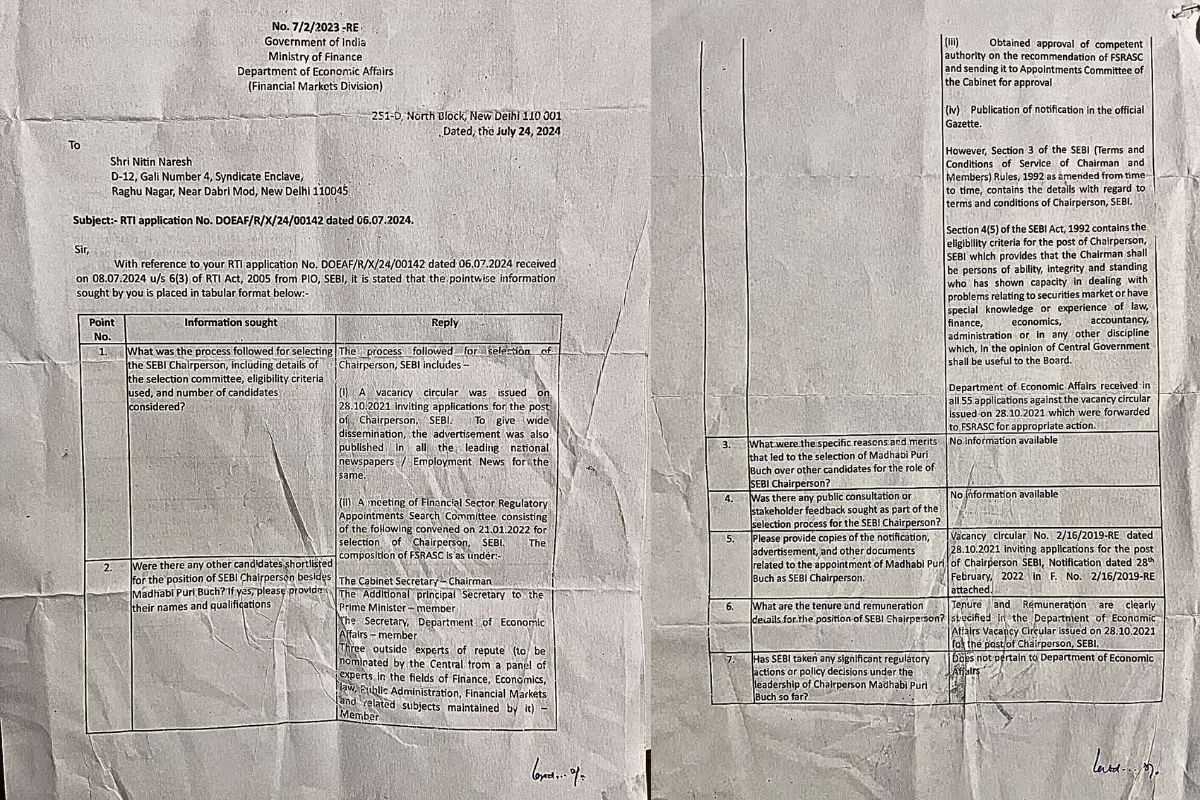
Though she was a competent authority, having a diverse career in banking and financial services, yet there remains no record on how and on what grounds, she was appointed as SEBI? An RTI to her selection as SEBI chief answered ‘no information available’.
So it hangs us to a question, is she deliberately chosen by some who are in power? Earlier also, such incidents have been seen where institutional heads are chosen in such a way that they have close connections with the people in power.
There is evidence suggesting that some university vice-chancellors in India have affiliations with the Rashtriya Swayamsevak Sangh (RSS), a Hindu nationalist organization. Critics, including opposition leaders, have raised concerns about the increasing influence of the RSS in academic appointments and university governance.
For instance, in March 2025, Congress leader Rahul Gandhi alleged that “all the Vice Chancellors in various Central universities were the nominees of the RSS” and warned against the potential consequences of the RSS controlling the education system . Similarly, Congress president Mallikarjun Kharge accused the BJP-RSS of undermining higher education in India, claiming that the government’s education policy seeks to control universities and impose RSS ideology.
Nobody is saying that choosing someone from known lists is wrong. But a selective and arbitrary crusade is dangerous.
Question 2- The Adani Connection—Too Close for Comfort
The six- member bench headed by Lokpal chairperson Justice AM Khanwilkar, while disposing of three complaints by different complainants including TMC MP Mahua Moitra, said the allegations are untenable, unsubstantiated and bordering on frivolity. Allegations of conflict of interest and financial misconduct were levelled against Buch by Hindenburg Research and the Congress party. Hindenburg alleged that Buch and her husband had investments in offshore funds controlled by Vinod Adani, the brother of Adani Group chairman Gautam Adani, which were allegedly used for manipulating funds and inflating stock prices of the group’s listed entities in India.
“In that, the named RPS (Madhabi Puri Buch) had already redeemed the investments from the fund much before the investigations” into the allegation of manipulations of stocks against Adani Group of. companies had begun by Sebi; and it is evident from investigations by Sebi that the GDOF Cell 90, or IPE Plus Fund, in which the RPS and her husband had invested, had not made investments through EIFF and EMRF in any Adani Group shares,” the order said.
)
“In any case the RPS (Buch) and her husband were not in control of the decision of the fund to make investments. They were only passive investors in the fund, which they had already redeemed in 2018,” the order said.
These are not trivial claims. If true, they would indicate a textbook case of conflict of interest and regulatory compromise—allegations that demand rigorous investigation, not hurried dismissal. So, buch and her husband having stakes in adani’s complex web of companies, that too in tax haven countries is a mere coincidence- remains unanswered!
Question 3- Justice Khanwilkar’s Shadows and the Politics of Adjudication. This Is Not The Problem of Perception, But It’s About Conflicts and Coincidences
The now chairperson of Lokpal, Justice A.M. Khanwilkar, has been seen connecting incidences with current governance in the past. His certain decisions have been aligned with the current government’s stance, particularly in cases upholding PMLA and dismissing petitions related to the 2002 Gujarat riots. Can this be considered that he will take decisions that go in favor to the current government?
Should we not interpret that he doesn’t have any political or ideological affiliation? Though a judge having political connection is not wrong, but the connection impacting decisions is questionable? The decision to give Buch a clean chit, when viewed through this lens, appears more like an act of institutional shielding than a dispassionate adjudication. While this doesn’t prove bias, the perception of proximity to power cannot be ignored!
Further compounding concerns is the fact that Buch’s husband, Dhaval Buch, has held senior roles in multinational corporations and sits on boards of companies with substantial investment footprints in India. One such entity, Gildan, was cited in financial disclosures linked to the same offshore fund under scrutiny. While these may be circumstantial, their relevance to the investigation demands deeper scrutiny, not superficial clearance.
A Clean Chit—But How Clean?
The Lokpal panel, led by former Supreme Court Justice A.M. Khanwilkar, concluded that the complaints were “unsubstantiated” and “politically motivated.” But this summary dismissal raises more questions than it answers.
- Where is the detailed reasoning?
- Was there a full forensic audit of the financial transactions involved?
- Were independent experts consulted?
- Was there cross-verification with offshore financial intelligence units?
The opacity of the process is itself a red flag! In a case involving potentially sensitive financial linkages between a regulator and the country’s most controversial corporate titan Gautam Adani, transparency should have been paramount. Instead, the Lokpal’s verdict was swift, secretive, and sparse in public disclosure.
The Adani Factor
At the heart of this controversy lies the Adani Group, the corporate behemoth that has repeatedly found itself at the crossroads of political economy and regulatory oversight. The Hindenburg report earlier accused the Adani Group of brazen stock manipulation and accounting fraud, with offshore shell entities allegedly used to funnel billions of dollars into its listed companies.
That SEBI, under Buch’s leadership, was tasked with investigating these claims while her household allegedly held past financial interest in a fund linked to Vinod Adani, presents a glaring ethical dilemma. Even if the Buchs exited the fund years before the investigation, as the Lokpal claims, the fact remains: a perceived conflict existed, and SEBI did not proactively disclose this to the public.
When regulators are tasked with probing the most powerful corporate players in the country, even the faintest appearance of bias or impropriety erodes public trust. Dismissing these allegations without thorough public inquiry undermines the legitimacy of SEBI’s own investigations into Adani-related irregularities.
Who Watches the Watchdogs?
This case exemplifies a broader malaise afflicting India’s anti-corruption architecture of a reluctance; if not inability to act against individuals in powerful regulatory or political positions. The Lokpal was envisioned as a potent independent entity to fight corruption at the highest levels. Yet, since its inception, it has been mired in inactivity, secrecy, and questionable appointments.
In nearly six years of operation, the Lokpal has not filed a single FIR against a sitting or former minister, bureaucrat, or regulatory chief. Its proceedings are not subject to RTI. Its findings are often not made public. And its appointments are controlled by a committee dominated by political appointees, including the Prime Minister. In such a framework, how independent is the Lokpal, really?
The Silence of SEBI
Even as the Lokpal exonerated Buch, SEBI itself has not addressed public concerns around these allegations. There has been no internal probe made public, no formal statement clarifying the timelines of the Mrs Madhabi Puri Buchs’ financial disengagement from the IPE fund, and comparatively doubtful and questionable effort to ensure that institutional safeguards are in place to prevent such conflicts in the future!
This silence is damaging, not just to SEBI’s credibility but to investor confidence at large. For a market regulator that commands immense influence over billions in domestic and foreign investment, even the perception of regulatory capture can be catastrophic.
Doesn’t ‘WE, THE PEOPLE OF INDIA’ demand A Call for Independent Inquiry?
Given the stakes, it is imperative that this matter not end with a Lokpal dismissal. A truly independent inquiry, ideally by a Joint Parliamentary Committee (JPC) or a judicial commission must examine the full scope of the allegations, financial trail, and decision-making protocols followed by SEBI during Buch’s tenure. Public confidence in institutions can only be restored through transparency and accountability, not secrecy and immunity.
At the End: What Is The Cost of Complacency?
The Lokpal’s clean chit to Madhabi Puri Buch may be final in the legal sense, but it fails the test of institutional integrity and public scrutiny. In a democracy, justice must not only be done; it must be seen to be done. And in this case, justice appears to have been quietly buried beneath layers of bureaucracy, legalese, and political convenience.
If the Lokpal cannot hold the powerful to account, and if regulators operate without accountability, India risks becoming a country where watchdogs turn into lapdogs, and where power, not law, dictates the rules of the game.