“Dhandhewali”: Is That How ‘Dilliwale’ Welcomes Their Northeastern Neighbours?
Three young women from Arunachal Pradesh came to Delhi — the capital of India — with simple hopes, just like millions of others who move to big cities every year. They came looking for jobs, better opportunities, and a chance to build a good life for themselves. But one ordinary Thursday evening in a residential colony in Malviya Nagar, an upscale area in South Delhi, they faced something deeply painful. Instead of feeling welcomed in their own country, they were made to feel like outsiders. What they discovered that day was not about the modern buildings or the bright city lights. It was something much older and more troubling — the harsh reality that, in the eyes of some of their neighbours, they were not even seen as Indians.

“Dhandhewali” — The Word That Tore Open India’s Deepest Wound, Again
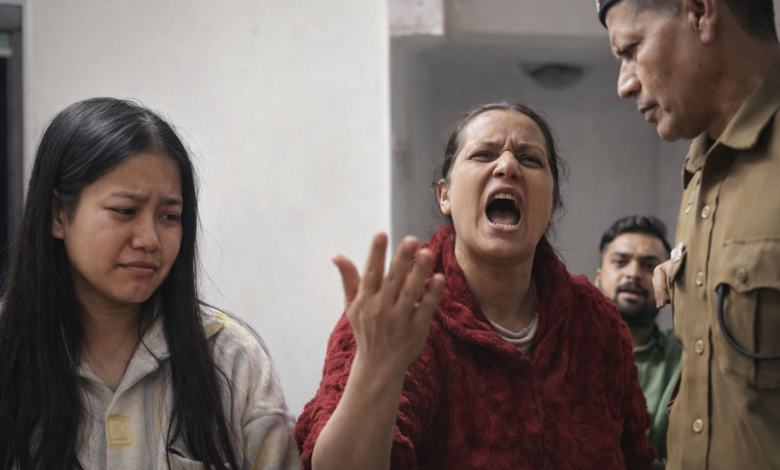
It started, as so many catastrophic moments in India do, over something mundane. The three women had called an electrician to fix something at their rented accommodation in south Delhi’s Malviya Nagar. A dispute broke out with their neighbours — a couple, Ruby Jain and Harsh Singh. What followed was not an argument between two neighbours.
What followed was a window thrown open into the rotting interior of a prejudice that India has been papering over for decades, and what flew out of that window — captured on video, watched by millions — was a barrage of racial slurs, dehumanising language, and the word dhandhewali, meaning sex worker, hurled at three young women, who hail from northeast India, whose only crime, in the eyes of their abuser, appeared to be the way they looked.
The three women from Arunachal Pradesh were allegedly subjected to racial slurs, humiliation, and intimidation by their neighbours during a dispute over repair work at their rented flat.
The videos went viral. The country, briefly and loudly, expressed outrage. Union Minister Kiren Rijiju condemned the incident and said Delhi Police must take immediate action. Arunachal Pradesh Chief Minister Pema Khandu called it “shameful” and said he personally spoke to top officials of the Delhi Police. Delhi Chief Minister Rekha Gupta wrote that Delhi belongs to everyone and that the dignity, respect, and safety of every citizen is paramount.
And then, because this is India and this is how we process our crises, the cycle of collective outrage began its usual rotation — a few days of trending hashtags, a few political statements, an arrest or two, and then the quiet return to normalcy, until the next video, the next incident, the next set of young women from the Northeast standing before the camera with tears drying on their faces, wondering what exactly they did wrong by being born in a part of India that mainland India has never fully accepted as its own.
Ruby Jain and her husband Harsh were taken into custody after an investigation into an FIR lodged at Malviya Nagar Police Station. The relevant provisions of the Scheduled Castes and Scheduled Tribes (Prevention of Atrocities) Act were invoked based on the material available on record, and the investigation has been entrusted to an ACP-rank officer. The law has been applied. The machinery of justice has been set in motion. Good. That is the bare minimum that was owed to these three women. But an arrest is not an answer. It is a Band-Aid on a wound that has been bleeding, quietly and steadily, for as long as any of us can remember.
Are We Becoming A Country That Cannot Recognise Its Own Face?
There is a particular kind of cruelty specific to India’s treatment of its Northeastern citizens — and it is the cruelty of erasure. The people of Arunachal Pradesh, Manipur, Nagaland, Mizoram, Meghalaya, Sikkim, Assam, and Tripura are not immigrants. They are not guests. They are Indians — constitutionally, historically, and irrevocably. They pay the same taxes, cast the same votes, serve in the same armed forces, and bleed the same blood when the country asks them to.
And yet, in the lanes of Delhi and Mumbai and Bengaluru, they are routinely called chinki, told they look like foreigners, denied rented accommodation, charged extra by autorickshaw drivers, stared at, groped, mocked, and — as happened in Malviya Nagar on February 20th — called sex workers by people who look at their faces and see something that is not quite Indian enough.
This is not a new story. It is an old and exhausting one. It is the story of Nido Tania, the 20-year-old student from Arunachal Pradesh who was beaten to death on a Delhi street in 2014 after being mocked for his appearance. It is the story of the countless unnamed women from the Northeast who do not file FIRs, who do not go viral, who quietly absorb the slurs and the stares and the casual daily degradation of being treated as strangers in their own country.
It is the story of a national imagination so deeply colonised by a narrow idea of what an Indian looks like, that an entire corner of the country — eight states, more than 45 million people, a treasure trove of culture, language, ecology, and history that the rest of India is largely ignorant of — has been reduced, in the popular consciousness, to a stereotype associated with otherness.
And this erasure has a geography. It has a social address. It lives most comfortably in the exact kind of urban middle-class neighbourhood that Malviya Nagar represents — educated enough to know better, comfortable enough to feel entitled, and insulated enough from consequence to believe that the law is something that applies to other people.
It’s Pathetic That We Are A Nation Arguing About Potholes While Stepping Into a Moral One!
Here is the context that makes this particular moment so deeply, achingly ironic. In February 2025, India is not a poor, struggling, pre-modern country trying to find its footing. India is the world’s fifth-largest economy. India is building bullet train corridors, launching satellites, hosting G20 summits, and presenting itself to the world as a rising superpower with demographic dividends and digital infrastructure that the West can learn from. India’s middle class is the largest it has ever been. India’s aspirations have never been higher.
And yet, in a rented flat in Malviya Nagar — in the capital of this rising superpower — three young women were called sex workers because of the shape of their eyes and the geography of their birth.
The taxpaying citizens of this country are simultaneously furious about potholes that swallow motorcycles whole, about electricity bills that arrive before the electricity does, about public hospitals where patients sleep on floors because there are not enough beds, about an inflation that has quietly hollowed out the household budgets of people who did everything right — studied hard, worked harder, and still cannot afford to live with dignity in the cities they helped build. India’s material frustrations are real and legitimate and enormous.
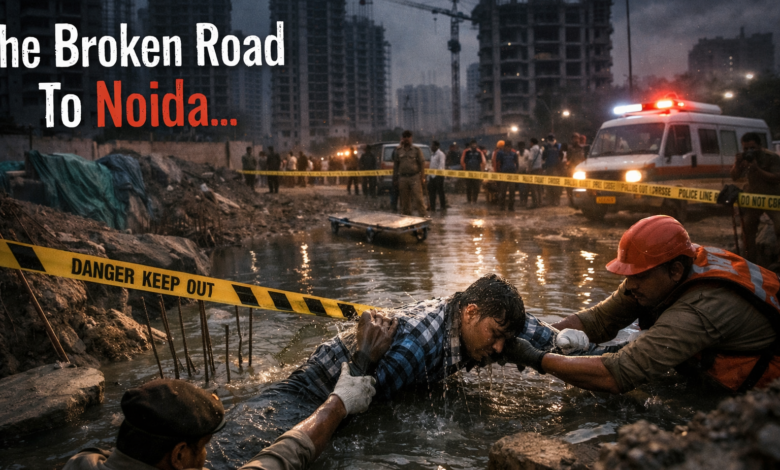
But here is the question that this moment forces into the open: what is the point of building better roads if the people travelling on them cannot travel safely because of who they are? What is the meaning of a rising GDP if the people contributing to it are being humiliated in their own rented homes for having the wrong kind of face? What kind of development are we celebrating if a young woman from Arunachal Pradesh cannot call an electrician without being called a dhandhewali by her neighbour?
A nation that cannot treat its own citizens with basic dignity is not a developing nation. It is a nation developing in the wrong direction entirely.
The Law Exists. The Prejudice Precedes It- The SC/ST Act Was Made Because India Knew It Needed It. The Malviya Nagar Case Shows It Still Does…
The SC/ST Act is, in principle, one of the most important pieces of legislation in India’s legal history. It was created because the makers of independent India understood — with a clarity that subsequent generations have sometimes forgotten — that legal equality on paper means nothing if social reality punishes certain citizens the moment they step outside their homes. The Act exists because India looked at itself honestly in 1989 and admitted that legislation was necessary to protect its own people from its own people.
The fact that this Act has now been invoked in the Malviya Nagar case is significant. It signals that the police and the courts are taking this incident seriously as something more than a neighbourhood dispute — as the targeted, identity-based attack on human dignity that it actually was. That is correct. That is how it should be treated.
But consider what the existence and repeated invocation of this Act actually tells us. It tells us that seventy-eight years after independence, India still needs a special law to prevent some of its citizens from humiliating, degrading, and physically harming other citizens based on their caste, tribe, and identity. It tells us that the prejudice is so deep, so socially entrenched, so woven into the fabric of ordinary daily life that ordinary criminal law is not sufficient to address it — you need a special, stricter, specifically targeted framework just to make the point that this behaviour is not acceptable. The law is an admission of a social failure that we have never fully reckoned with.
And here lies the most uncomfortable truth of this entire conversation: Ruby Jain did not become a person who could look at three young Indian women and call them sex workers in a vacuum. She was produced by a social environment — a system of beliefs, assumptions, hierarchies, and unexamined prejudices — that is not unique to her. It is present in drawing rooms and WhatsApp groups and dinner table conversations across India’s cities and towns, humming quietly beneath the surface of a society that congratulates itself on its unity while practising its divisions with extraordinary precision.
The Northeast Is Not a Foreign Country
It needs to be said plainly, because apparently it still needs to be said: Arunachal Pradesh is India. Its people are Indian. Their languages are Indian languages. Their forests, their rivers, their mountains — every inch of them is Indian territory, territory that the government of India defends vigorously in its diplomatic relationships with China, territory that Indian soldiers guard with their lives. You cannot claim the land and reject the people. You cannot invoke Arunachal Pradesh when you need to assert territorial sovereignty and then look at an Arunachali woman in your neighbourhood and see a foreigner.
The Northeastern states have given India some of its most decorated military officers, some of its finest athletes, some of its most innovative entrepreneurs. They have contributed to the national story in ways that the national story has been spectacularly ungrateful for. In return, their citizens travel to India’s cities and are denied houses because landlords fear their food habits, denied jobs because their accents sound unfamiliar, denied basic human dignity because mainland India never bothered to learn who they actually are.
This is not a border problem. This is not an infrastructure problem. This is a civilisational problem — a failure not of policy but of imagination, empathy, and the basic national commitment to seeing every Indian as an equal participant in the project of this country.
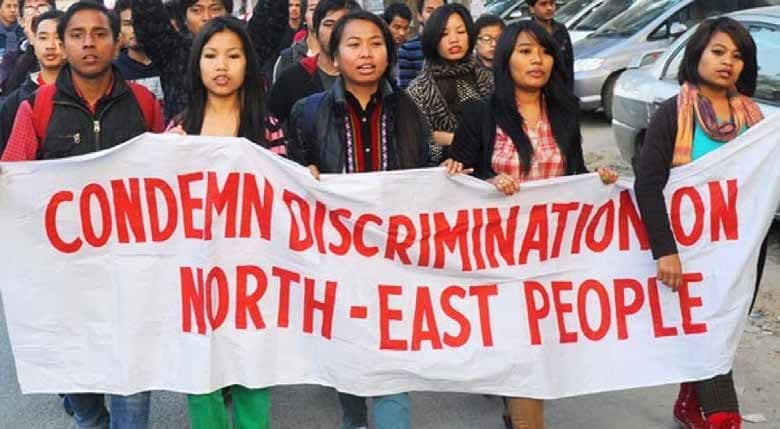
Only Arrest, Is This What Justice Actually Looks Like For Such A Heinous Crime?
Harsh Singh has said that the incident happened in the heat of the moment and that the couple is ashamed, asking people to hear their side of the story and avoid media trials. Shame, if genuine, is a start. But shame is not justice, and a heat-of-the-moment explanation for racial abuse is precisely the kind of explanation that must be refused — because prejudice does not spring into existence in the heat of a moment. It lives in a person for years, quietly, and it surfaces in the heat of a moment. The moment is the symptom. The years of accumulated contempt are the disease.
Real justice here is not just an arrest, though the arrest was necessary. Real justice looks like a society that stops treating its Northeastern citizens as guests who must earn their welcome in their own country. It looks like school curricula that teach every Indian child something real about the eight states of the Northeast — their history, their cultures, their languages, their faces. It looks like landlords who rent to people without demanding their food preferences change. It looks like cities that are genuinely safe for women who look different from the majority.
It looks, ultimately, like an India that has finally, genuinely decided that its diversity is not a problem to be managed but a gift to be celebrated — loudly, consistently, and without needing the trigger of a viral video to remember it.
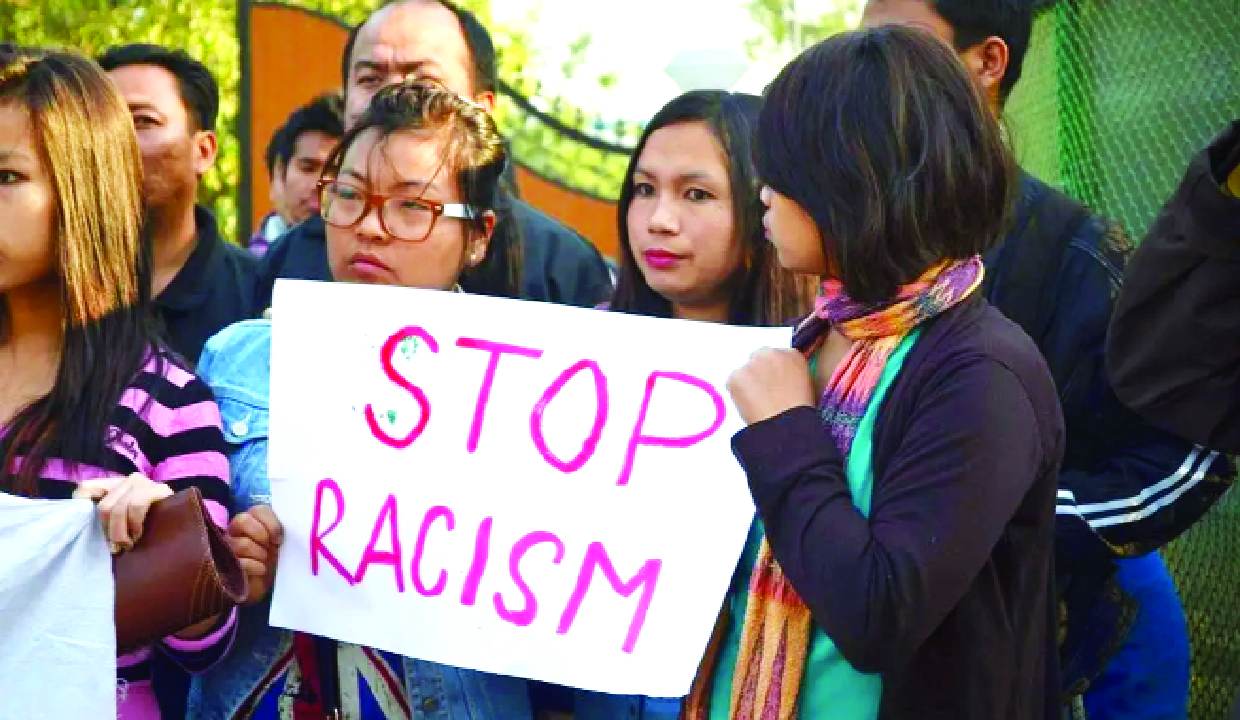
Three young women from Arunachal Pradesh came to Delhi for a better life. They deserve one. So does every Indian, in every part of this vast, complicated, beautiful, broken country that we are all — regardless of what we look like or where we were born — equally responsible for building into something worthy of its own promises.
The least we can do — the absolute minimum — is stop calling each other foreigners first.
The Malviya Nagar incident is still under investigation. FIR No. 68/25 has been registered at Malviya Nagar Police Station. The case is being supervised by an ACP-rank officer. The victims are receiving support from political representatives of the Northeastern states.