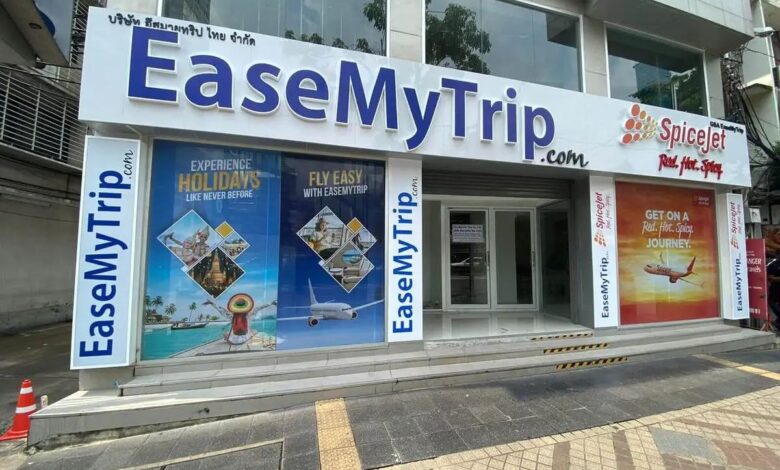
The November 2025 quarter revealed a stark reality. EaseMyTrip, once a darling of India’s post‑pandemic travel boom, has stumbled badly. In Q2 FY26 (quarter ended September 2025), the online travel aggregator’s operating revenue plunged 19% YoY to ₹118 crore, while expenses grew, dragging the company from a ₹27 crore profit a year ago into a ₹36 crore net loss. Stripped of its “other income”, total revenue fell from ₹150 crore to ₹126 crore. The sharpest declines came in its core flight-booking segment – air ticketing revenue fell 22% to ₹72 crore. In short, EaseMyTrip is now spending ₹1.02 to earn a rupee of revenue, a troubling unit economy for the Delhi‑based OTA.
These drab results triggered a market rout. EaseMyTrip shares plunged to 52-week lows around ₹7.60–7.80 (down over 50% YTD), wiping out years of gains. By mid‑November 2025 its market capitalization had halved to roughly ₹2,800–2,900 crore (~$320m) – a far cry from its pandemic‑era peak. This collapse has shaken investors. One analysis bluntly compares EaseMyTrip today to “a penny stock – a low-value company with too much risk,” noting its market cap is a fraction of the $1.5 billion (₹12,000 cr) zenith reached earlier. As The Morning Context put it, the OTA’s promoters have been engaged in “pump and dump” share deals, doing little to reassure beleaguered shareholders.
The Q2 numbers themselves tell a story of fading momentum and growing pain. According to Entrackr/FinTrackr, EaseMyTrip’s operating revenue slid to ₹118 cr from ₹145 cr, while total expenses ticked up 6% to ₹120 cr. Concretely, airline ticket sales – once 61% of revenue – crashed 22% to ₹72 cr.
Hotels and holiday packages (27% of revenues) managed only ₹32 cr. Payroll costs surged (employees earned 26% more YoY) and even fintech fees climbed. In the end, the firm reported a ₹36 cr net loss versus a ₹27 cr profit in Q2 FY25. On Nov.14 the company disclosed that it had also taken a ₹51 cr exceptional hit from a failed airline “GSA” (general sales agent) deposit under a government Udaan scheme. The stock market clearly did not buy the upbeat corporate spin: the day after results hit, shares briefly fell 3–4% intra-day to fresh troughs.

Amid this carnage, management scrambled to reassure. The board announced heavy senior hires – a new CTO and CMO – and even a massive fund raise. On Nov.15 the company revealed it would issue 55.93 crore new equity shares for ₹514 cr via preferential allotment to outside investors (at about ₹9.20/share). But this capital infusion raises its own questions: 55.93 crore shares is an enormous dilution for a company now trading sub‑₹8, and the buyers include an eclectic mix (pension funds, realty firms, a golf course developer, etc.). Regardless, markets remain skeptical. EaseMyTrip’s fundamentals are under scrutiny like never before – and its road back to profitability looks daunting.
The Market’s Verdict: Crash and Caution
Investors have not taken EaseMyTrip’s skid lightly. By mid-November, the stock was hovering around ₹7–8, a 52-week low, roughly half of its value at the start of 2025. (Incidentally, this is despite multiple bonus-share issuances – which should have mechanically boosted price per share – underlining how deep the rout has been.) The decline is shocking: the company’s market cap has slid from roughly $610 m (₹5,500 cr) in early 2025 to ~$320 m (₹2,900 cr) now. That means a large percentage of retail shareholders have lost money even as travel demand boomed around them.
Brokerages have grown so pessimistic that many have stopped covering the stock altogether. Analysts now openly question every move of the promoters. As one Inc42 report noted, experts are “bemused by [co-founder] Nishant’s stake sale and other moves” (with the result that “promoters now hold below 50% in the company and mutual funds have lowered their exposure”).
In fact, public filings and media reports in late 2024 and 2025 reveal that all three Pitti brothers have been unloading shares: co-founder Nishant even stepped down as CEO after selling a 1.41% stake in Dec 2024, reducing his holding to 12.8%. During the Q2 FY25 earnings call, the brothers were grilled about selling “almost 25% of their stake since March 2023”. After the last sale, they promised no more stake dilutions – but the very fact of those sales has damaged confidence. A skeptical investor asks: if the founders are cashing out, why shouldn’t the average shareholder worry?
Top of mind for many is this: if promoters really believed in the business, why sell? Critics see “pump and dump” patterns: the Morning Context even headlined that EaseMyTrip’s promoter stake sales “reveal a pump and dump pattern that does little to ease shareholders’ concerns”. (In other words, insiders were partially cashing out at elevated prices while the stock still rallied on travel-sector sentiment, then the inevitable fall came.) It didn’t help that in early 2025 the Pitti brothers announced all would forego salaries until the company returned to profit, which on paper is praiseworthy but was seen by skeptics as too-little, too-late when the core business was already in tailspin.
Key Financial Signs (Q2 FY26 vs Q2 FY25)
- Operating revenue: ₹118.0 Cr vs ₹145.0 Cr (–19% YoY).
- Total income (incl. other receipts): ₹126.0 Cr vs ₹150.0 Cr.
- Total expenses: ₹120.3 Cr vs ₹113.0 Cr (+6% YoY).
- Net profit (loss): –₹36.0 Cr vs +₹27.0 Cr.
- Air ticketing revenue: ₹72.0 Cr vs ₹92.5 Cr (–22% YoY).
- Employee cost: +24% YoY (26% of costs) – ₹31 Cr this quarter.
- Operating ratio: Rs 1.02 spent for each Rs 1.00 revenue.
These tell a simple story that revenues are crashing, costs are up, profits are gone. Even including a one-time write-off last quarter, the underlying trend is clear. As one broker put it during the earnings season, “easy profits turned elusive; growth stalled and every cost head ballooned.” The share-price slide (52-week low of ₹7.58 intraday on Nov 17) simply reflected this fundamental reversal.
Unrelated Experiments or Strategic Expansion?
An element compounding investor worries is EaseMyTrip’s aggressive leap beyond its core flight-booking business. Rather than refocusing on travel now, management has opted for an expansive “EaseMyTrip 2.0” strategy – a media-friendly vision of becoming a travel-and-lifestyle conglomerate. In practice this has meant big-ticket acquisitions and investments in non-core sectors. Just months before the Q2 results, the board greenlit five new deals totaling ₹514 crore. These include:
- Hospitality & Real Estate: 100% acquisition of AB Finance’s premium Gurugram property portfolio (₹194.4 Cr), and a 50% stake (for ₹175 Cr) in Three Falcons, a boutique hotel in London.
- Sports & Entertainment: 49% of Javaphile Hospitality (₹19.6 Cr), an experience-based dining/entertainment company.
- Wellness & Beauty: 49% of Levo Beauty (₹24.5 Cr), which runs spas and salons (touted as a tie-in to corporate/Luxury travel packages).
- Real Estate Brokerage: 49% of SSL Nirvana Grand Golf Developers (₹100.5 Cr).
All these deals are equity swap transactions. EaseMyTrip will issue new shares to the sellers, but they dilute equity and complicate the narrative. Management insists these move “strengthen our portfolio, expand customer reach, and create new avenues for growth”. As Nishant Pitti put it, they are “vertical expansions in the travel ecosystem…designed to complement the core business”.
However, critics see them as “unplanned experiments” that have distracted from fixing the main engine. One inc42 columnist bluntly noted that EMT shares have halved YTD “amid a slowdown in its air ticketing business, unplanned experiments and corporate governance issues”. Indeed, over the last year EaseMyTrip even launched an insurance-broking subsidiary and invested in electric bus manufacturing – ventures far afield from simple OTA services. By contrast, rival MakeMyTrip has largely stuck to travel segments (flights, hotels, packages, and mobility) and doubled down on tech.
To further illustrate, industry observers point out that just as EaseMyTrip announced expansions, a competitor like ixigo (backed by Prosus) was scaling up its core travel platform. Ixigo’s latest results showed a 73% YoY jump in quarterly revenue (to ₹314.5 Cr) by leveraging its diversified offerings (trains, buses, and flights). EaseMyTrip, heavily reliant on flights, couldn’t keep pace – its airline revenue was down while ixigo’s flights soared 149% YoY. In essence, Ixigo’s broad model kept growth robust while EaseMyTrip’s narrow focus blunted its recovery.
In fairness, the OTA is still trying to capture more non-flight travel. Management highlighted that hotel, holiday-package, and other verticals “grew leaps and bounds” in Q2. Yet paradoxically, the income statement shows all segments falling. EaseMyTrip now derives only ~half its revenue from air (compared to 61% in FY25) as it touts gains in trains and bus bookings. However, the reality is that revenues in every segment declined significantly this quarter. Unless these new ventures can start contributing near-term profits, the financial strain will continue.
Major Acquisitions and Diversifications:
- Hospitality/Real Estate: 100% of Gurugram property developer AB Finance (₹194.4 Cr).
- Luxury Hotel: 50% of London’s Three Falcons (₹175 Cr).
- Golf Resorts: 49% of SSL Nirvana Grand Golf (₹100.5 Cr).
- Beauty & Wellness: 49% of Levo Beauty (salons/spas) for ₹24.5 Cr.
- Dining/Entertainment: 49% of Javaphile Hospitality for ₹19.6 Cr.
Each deal involves fresh EaseMyTrip shares to outsiders – meaning more dilution just as share price languishes. An image emerges of a cash‑hungry stock shuffling paper. Indeed, when asked, company spokespeople keep repeating that “our growth story is intact, our fundamentals are strong”. Yet Morgan investors wonder: are these risky diversions or visionary moves? Only time will tell if the strategy pays off, but in the short term it’s hard to see how these bets help the primary goal of booking flights and hotels profitably.
Travel-Tech Context: Giants and Underdogs
EaseMyTrip’s troubles stand in relief when we examine the broader travel tech sector. Other players showcase both opportunities and warnings. The biggest rival, MakeMyTrip (MMT), is a Nasdaq-listed behemoth: it is still largely a flight/hotel bookings engine (having absorbed Goibibo and Redbus). In Q2 FY26, MMT reported revenue up 9% YoY to ~$229 million, with leisure demand holding up. It did report a net loss (–$5.7m) vs +$17.9m last year, but that was mostly accounting noise from its massive capital restructuring, not core business weakness.
Crucially, MMT’s adjusted operating profit jumped 18% YoY to $44.2m. In plain terms, the underlying travel marketplace remains healthy for the leader, even as one-time financing costs hit the bottom line. MMT executives note strong hotel and bus segments and see international travel recovering. This highlights that deep-pocketed incumbents can ride out short-term shocks, which smaller EaseMyTrip cannot.
At the other end, startups like Ixigo are thriving by targeting niche travel categories. The Prosus-backed OTA saw bus ticket sales surge 35% and flight-bookings explode 149% YoY in one recent quarter – riding a wave of pent-up demand. Even smaller platforms like Holidify or TravelTriangle have reported seasonal upticks. The point is: demand is there, broadly. So when EaseMyTrip underperforms so drastically, it suggests company-specific issues, not market absence.
We should also mention Yatra Online, once India’s top local OTA, now fighting to regain relevance after near-bankruptcy. Yatra’s latest numbers (FY26 Q1) showed higher revenues but still losses; it has refocused on corporate travel and services. While Yatra’s comeback is a separate story, its wobbles underscore that no travel player is bulletproof. The industry is consolidating – investors have grown wary of fringe players. In this landscape, only those with clear scale or differentiated offerings win. EaseMyTrip, by contrast, remains smaller (₹13,000 cr m-cap at peak) and is now diluting focus.
Comparative Highlights:
- MakeMyTrip (NASDAQ: MMYT): Q2 FY26 revenue $229m (+9% YoY), underlying EBIT +18%. Lost $5.7m on paper due to financing, but core demand strong.
- EaseMyTrip (NASDAQ: ETRIP): Q2 FY26 revenue ₹118cr (–19% YoY), net –₹36cr. No big sponsors to absorb losses; stock halved YTD.
- Ixigo (Prosus stake): Q1 FY26 revenue ₹314.5cr (+73% YoY). Diverse mix (trains, flights) enabled growth even as flights alone were down in the market.
- Yatra Online: Smaller base, focusing on enterprise; still losing money but stabilizing. Not a direct current competitor to EaseMyTrip, which is more consumer-focused.
Ultimately, MakeMyTrip’s response to EaseMyTrip’s accusations in May 2025 was telling. EaseMyTrip’s Nishant Pitti publicly accused MMT of being “majorly owned by China” and threatening soldier data – a thinly veiled appeal to nationalism. MMT’s CEO Rajesh Magow and spokesperson swiftly rebuked this as “malicious” and reminded that MMT is proudly Indian-led with strict governance. This spat, while media-dramatic, highlights how EaseMyTrip is being forced into a David-versus-Goliath marketing gambit rather than focusing on business fundamentals.
Corporate Governance Under the Microscope
EaseMyTrip’s fall has drawn regulatory scrutiny and governance questions – not surprising for a public company in crisis. In May 2025, the Enforcement Directorate (ED) – India’s anti-money-laundering agency – revealed it was investigating the Mahadev app betting scandal and named EaseMyTrip’s chairman Nishant Pitti as an alleged participant. The ED claims digital evidence links Pitti to Sky Exchange (an online betting platform) and shell companies involved in laundering betting proceeds into stock-price manipulation. Specifically, it alleges EaseMyTrip paid two mysterious “entry-providing” firms connected to the scam, and even notes Rs.7 lakh cash seized at Pitti’s home. While these are only allegations in an ongoing probe, the news rattled investors, who fear any regulatory risk.
EaseMyTrip’s board and Pitti personally have categorically denied everything. The company’s statement called the Mahadev links “entirely baseless, misleading, and devoid of factual merit”. Pitti himself took to social media, insisting he had “no involvement… with any illegal betting operations,” and that the Rs7 lakh found at home was “fully accounted for” personal cash. Hindustan Times notes that the company reaffirmed in April 2025 that it had “no direct or indirect association” with the betting app, even as ED raids were underway. Still, the saga has been an unwelcome distraction. For long-time investors who once touted EaseMyTrip’s “highest standards of corporate governance”, seeing their leader entangled in a money-laundering probe is extremely uncomfortable.
This was not the only governance storm. Media reports have chronicled an inside-the-family power shuffle. In January 2025, Prashant Pitti unexpectedly resigned as MD, with brother Nishant (already co-Chairman) stepping in as CMD. At that point, Rikant Pitti, the third brother, continued as CEO. The official line was that Prashant wanted to “focus on mentoring startups and public-good initiatives”, but many wondered if internal conflicts or the stress of the ED case played a role.
To soothe jitters, the company announced all promoter salaries would remain zero and pledged that no promoter would sell any more stock. Yet, as noted, those promises came after a string of stake sales in 2023–2024 and did little to erase doubts. One analyst wryly commented: “First they tout corporate social responsibility on one hand, while on the other they are pledging shares and riding high on nationalistic rhetoric” – a sign that trust has been fractured.

Among retail investors, murmurs of “pump‑and‑dump” and insider dealing have circulated on social media. The Morning Context even published that key stakeholders compared the Pitti brothers’ recent moves to typical manipulative tactics. This narrative – founders raising cash by selling chunks of stock and then announcing grand new projects – understandably sparked unease. Some shareholders feel misled by the glossy picture management paints. As one harsh assessment in inc42 asked bluntly: “Will the company resolve these governance issues and actually get back to earning revenue again?”.
Governance Red Flags Raised by Analysts
- Founder Stock Sales: From Mar 2023 to Dec 2024, the founding Pitti brothers offloaded nearly a quarter of their holdings. Nishant’s December stake sale (1.41%) was followed by a vow of “no more” sales – but the damage to credibility was done. Prashant meanwhile diluted his ownership to fund a related lending venture (Optimo Loans).
- Tied-Up Founder Resumes Salary: After years of drawing ₹0 salary, the promoters took symbolic “zero salary” paycuts; but later filings show Nishant even pledged shares to secure loans for personal use. Analysts note this contradictory behavior.
- Regulatory Scrutiny: The ED’s widening Mahadev probe names EaseMyTrip’s CEO and subsidiary payments – raising money‑laundering questions. Though unproven, these allegations cannot be ignored.
- Board Independence: With Nishant now CMD, Rikant as CEO, and Prashant simply “promoter”, all decision-making rests with the family. Outside directors are few. Coupled with aggressive share issuances to relatives (via share swaps to acquaintances), critics say shareholder interests might not have true checks and balances.
On the corporate governance front, regulatory filings offer a silver lining: the board insisted in late 2025 that no new promoter share sale was planned and all founders continued unpaid. But markets remain unsatisfied. After all, it’s one thing to announce alignment with shareholders; it’s another to demonstrate it with stable earnings and prudence.
A Cautionary Tale for Travel-Tech Investors
EaseMyTrip’s saga is a textbook example of a rising-star startup losing its footing amid shifting markets and risky strategy. Just a few years ago, its narrative was almost a fairytale. The Pitti brothers had built a ₹0-funded travel platform from scratch, achieving steep growth (70–90% annual revenue jumps through FY2023) and breakeven margins. Its IPO was 160X oversubscribed, and the stock soared 6-fold as investors heralded it as “the MakeMyTrip killer” of India. With no debt and frugality as its mantra, EasyTrip Planners (EaseMyTrip’s parent) was initially admired for “superior corporate governance and low-burn ethos”.
But something changed. Travel demand did rebound post-COVID, yet EaseMyTrip’s core airline bookings never revived to pre‑pandemic trajectories. Instead of doubling down on the lucrative flight market, management began diversifying aggressively. What once seemed visionary (offering one-stop-shop travel and travel-related services) now looks scattershot: EV buses, five-star hotels in Ayodhya, venture funds, even a branded cosmetics accelerator. As one Inc42 feature wryly titled it, the company took a “wrong turn,” venturing from “bootstrapped startup” to a business empire stretched in “random directions”.
History suggests this is perilous. Countless tech and travel companies have hit their peaks only to stumble when growth evaporates. In the dotcom bubble of the late ’90s, many overpriced online travel sites made grand claims before merging or vanishing. More recently in India, we saw companies like Oyo and ixigo (initially a hostel aggregator) ramp up aggressively, only for some to later retrench or find themselves outpaced by leaner rivals. Today, a sober investor demands a clear path to profit: high growth alone cannot justify endless spending.
EaseMyTrip’s current slide bears resemblance to other cautionary tales. Its stock price trajectory – from hyped unicorn‑like valuation down to “penny stock” status – echoes those of companies that over-leveraged hype. In some ways, it mirrors what happened to Oyo Rooms (missing sustainability) or earlier to microblogging startups that forgot to monetize. The lesson: financial discipline trumps hype. EaseMyTrip once rode the “revenge travel” wave brilliantly, but waves subside. The firm’s latest forays into lifestyle verticals remind us of Facebook’s pivot to hardware (Oculus), or Amazon’s Experiment 1‑click – interesting R&D gambles that needed real returns.

What is our “prophecy” for EaseMyTrip? The data-driven view is clear: short term pain ahead. With promoter control dipping below majority, public float high, and banks/analysts advising caution, the stock may linger in the single digits. Recovery hinges on stop‑gaps: cutting costs, boosting air sales, and proving the new ventures can turn profit. Yet every quarter the core OTA business underperforms, the harder that road back becomes.
On the positive side, EaseMyTrip’s foundation isn’t worthless. The founders are consummate entrepreneurs: they have rebuilt travel businesses before, even thriving during COVID when everyone else was burning cash. One could argue the current trough is “difficult but surmountable,” as even insiders suggest. The world still needs travel bookings and curated experiences – and EaseMyTrip still has a large user base and brand name. If managed prudently, it might carve a niche as a hybrid travel-lifestyle service, leaving competitors to focus on traditional segments.
But such a turnaround would require sheer discipline. Imagine if the company had hit pause on big acquisitions while flights recovered: it could have used profits to buy back shares or innovate the platform. Instead, it risked cash and credibility chasing ambitious but uncertain bets. For investors who’ve stuck around, the message is blunt: don’t give power to companies that appear to be chasing hype over fundamentals. And for corporate India, EaseMyTrip is a reminder that governance matters as much as growth. Whistleblower or not, the facts remain: trust is fragile, and when travel mayhem subsides, only those with real profits survive.
In the swirl of spin, one thing is certain: the travel boom alone won’t save EaseMyTrip. The company must fix its broken core – better user experience, smarter marketing, tighter margins – or risk being left behind by leaner rivals. Otherwise, it may join the annals of once‑hailed startups that couldn’t withstand reality. The broader sector’s trends – consolidation around scale, technology upgrades, and cautious capital allocation – indicate we are moving past the freewheeling growth era.
EaseMyTrip’s fate will likely be viewed as a case study on corporate strategy and governance for years to come: a celebrated success story, tarnished by scope creep and suspect stewardship, now desperately trying to reclaim its narrative amidst data that tells a different story. Only time (and next quarter’s numbers) will tell if it can do so.