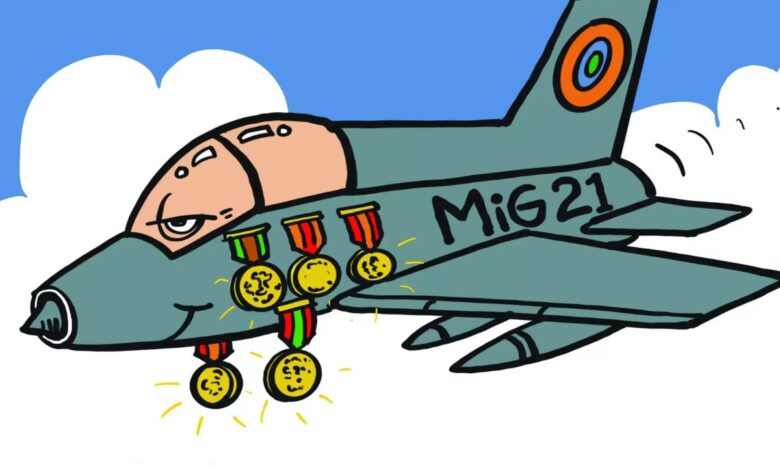
On 19 September 2025, the Indian Air Force (IAF) will give a special farewell to its final MiG-21 squadron, the 23rd Squadron, the Panthers, at the Chandigarh airbase. The MiG-21, India’s first supersonic fighter, which has flown for over six decades, will be retired. The plane has been very significant to the IAF since its establishment in 1963 and has a rich history, with acts of bravery in Indo-Pakistani Wars in 1965 and 1971, and in Operation Swift Retort in 2019.
But, its history is also tainted with over 400 crashes that have killed over 200 pilots and at least 60 civilians. It is notoriously nicknamed the “Flying Coffin” and “Widow Maker,” and its crash record is a concern: who will answer for the lives lost due to an aircraft that should have been phased out years ago?
The MiG-21, aka The Flying Coffin: A Legacy Built on Valor, Stained by Tragedy
The Soviet Union’s Mikoyan-Gurevich Bureau’s MiG-21 was a marvel of its era. Launched in 1959, it went on to become history’s highest-produced supersonic fighter, flying in over 60 air forces across the globe. For India, the MiG-21 was a game-changer when it joined the IAF in 1963, providing unprecedented speed and agility. It was instrumental in the 1971 Indo-Pak War, its precision bombing and air-to-air combat capabilities ensuring air supremacy. India inducted 874 MiG-21s over decades, of which over 60% were produced indigenously by Hindustan Aeronautics Limited (HAL). The aircraft, in its different avatars, Type-77, Type-96, and the upgraded Bison,was the backbone of the IAF for almost half a century.
But this popular history is hidden under a heavy price. Since it went into service, more than 400 MiG-21s have crashed, and official figures indicate that over half of the 872 aircraft purchased have been lost to crashes. Over 200 pilots, 39 civilians, and eight other military personnel have lost their lives in these crashes, according to figures presented by former Defense Minister A.K. Antony in 2012.
The statistics are appalling: between 2003 and 2013 alone, 38 MiG-21s were lost in crashes, and in the next five years up to 2023, at least 10 more were lost. The sad nickname of the aircraft, “Flying Coffin,” is not media hyperbole but reflects the anguish and loss felt by families, friends, and communities.
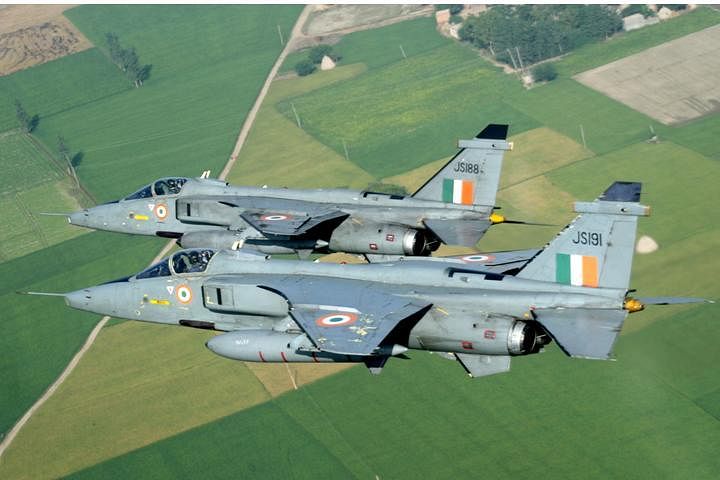
Just Evaluate The Human Cost By The Stories of Losses!
Every crash is a number but a tale of shattered lives. Consider the example of Squadron Leader Abhinav Choudhary, a 28-year-old pilot who perished in May 2021 when his MiG-21 Bison crashed near Moga, Punjab, during a routine night training flight. His body was recovered 2 kilometers from the site of the crash after a four-hour search, his parachute deployed but his life gone.
Or consider the case of Group Captain Ashish Gupta, a seasoned pilot who was killed in March 2021 when his MiG-21 crashed during takeoff from Gwalior airbase. Gupta was set to command a frontline squadron, his expertise honed at the IAF’s Tactics and Air Combat Development Establishment. These were not beginner pilots but experienced experts, entrusted with an aircraft that betrayed them.
Then of course there are the civilians who are swept up in the wreckage. In May 2023, a MiG-21 crashed into a residential home in Hanumangarh district, Rajasthan, killing three women on the ground as the pilot ejected to safety. This accident showed how these accidents kill not just pilots, but innocent people on the ground too. More than 40 civilians have died in MiG-21 crashes since 1970, including eight in a 2002 crash when a jet crashed into an office block in Jalandhar, injuring 17 others.
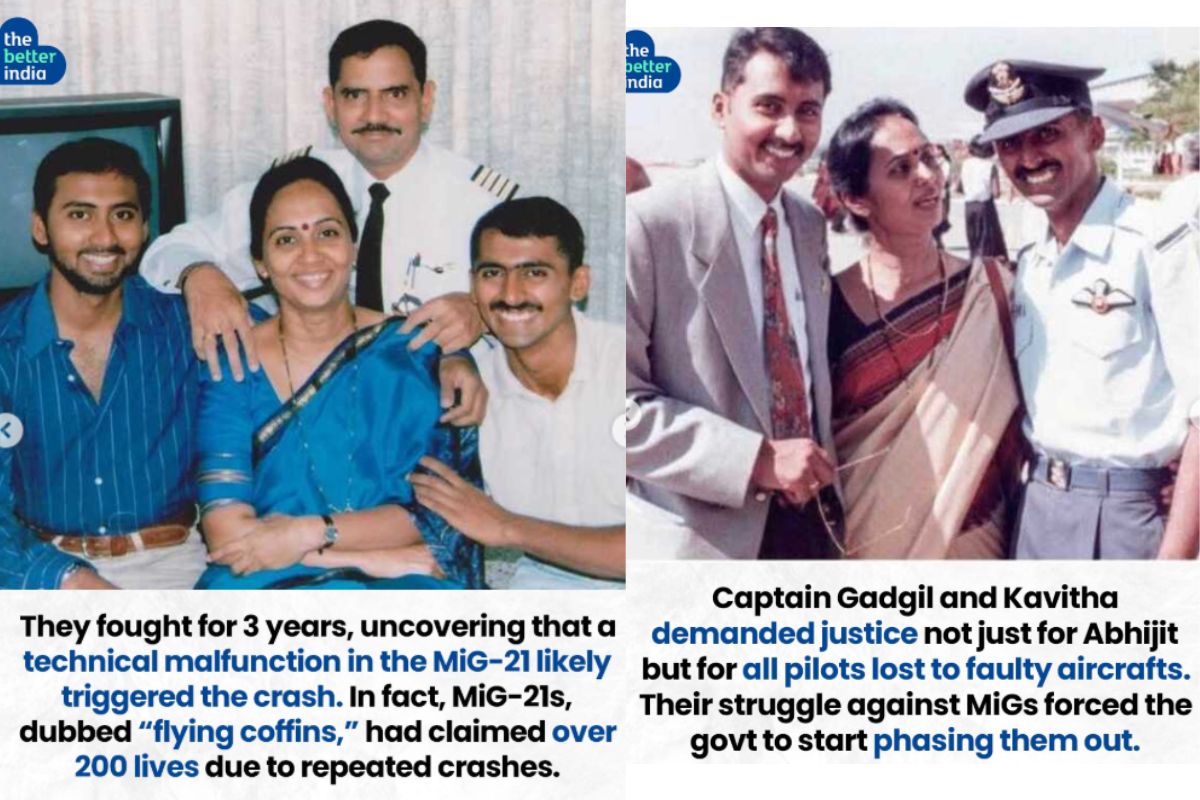
One of the most poignant voices is Kavita Gadgil’s, whose son Flight Lieutenant Abhijit Gadgil died in a MiG-21 crash in 2001 at Suratgarh, Rajasthan. In a tearful Facebook update after a 2025 Jaguar crash, she wrote, “My son… died the same way. In 2001. Since then, more than 340 Indian Air Force planes have crashed. More than 150 pilots have lost their lives. The numbers are ghastly.
The silence surrounding them, worse.” Her words are a biting criticism of a system that has failed its pilots, leaving families to weep in silence and despair. Gadgil’s family began the Abhijit Air Safety Foundation to advocate for safer aircraft, but their voices, like those of many others, have often been drowned out by bureaucratic indifference.
Why the MiG-21 Became a “Flying Coffin”?
The MiG-21 has a bad safety record for a number of technical and systemic reasons. It was developed in the early 1950s as a short-range interceptor and was not built to last so long as required by the IAF. The high landing speed, single engine, and insufficient cockpit visibility,particularly the canopy design that obstructs the runway for landing, have been frequently cited as safety hazards. The pilots have reported that the sensitive aerodynamics of the plane call for extremely accurate handling at high speed and do not allow much margin for error.
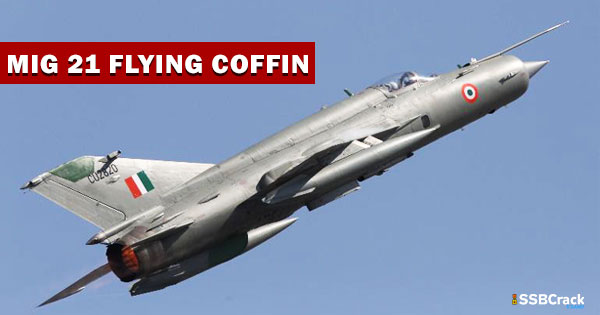
The fleet’s age exacerbates these problems. The MiG-21 was supposed to have been phased out in the mid-1990s, but the tardiness in procuring new aircraft saw the IAF continuing to operate it by making upgrades, the Bison version being one example brought in in 2000. Although the upgrades enhanced the electronics and weapons, they could not correct fundamental flaws with the aircraft’s body and its engine. According to a 2014 BBC report, pilots had been complaining about the high landing speed of the aircraft and the low cockpit visibility, problems that continued even after the upgrades. Also, using old or substandard spare parts from countries like Israel and Ukraine, despite Moscow’s warnings, has been blamed for mechanical failure.
Human error and inadequate training also come into play. MiG-21 is a complex machine, so the pilots have to switch from slower planes to a high-speed plane with minimal practice in between. In a 1998-99 report by the Standing Committee on Defence, the government was late in acquiring Advanced Jet Trainers (AJTs) and this compelled the IAF to train on MiG-21s, which were ill-suited for the purpose. During 1991-2000, 100 of the 221 aircraft lost in IAF crashes were MiG-21s, most of the crashes being due to pilot errors caused by inadequate training.
The primary issue arises due to system failures. The IAF was to have 42.5 fighter squadrons, but it has fallen to 31. This shortage worsened due to the delay in the Tejas Light Combat Aircraft program and issues with the Rafale deal. These delays forced the IAF to rely on ageing aircraft, with the MiG-21 bearing most of the burden. A top IAF officer spoke to The Times of India in 2023, “What can the armed forces do in the absence of new inductions?” The MiG-21, which was intended to be an interim measure, was used all the time, and its issues worsened as it was overworked and underfunded.
The Government’s Complicity Is A Mirror Of Failure Of Accountability.
The Indian government’s role in continuing the MiG-21’s lethal legacy is obvious. Successive administrations have not responded to the IAF’s requirement for upgrades, opting for political expediency over pilots’ lives. The Tejas program, initiated in the 1980s to replace the MiG-21, faced various delays due to technology issues, bureaucracy, and a lack of private sector backing. The Rafale deal to enhance the IAF’s power was mired in political controversy, and the procurement of aircraft was delayed. A short-term proposal to acquire 100 foreign aircraft has been pending for years, leaving the IAF with no option but to retain the MiG-21.
The government reaction to crashes has been unsatisfactory. Each crash is followed by a Court of Inquiry, but these rarely result in real reform being acted upon. The 1998-99 Standing Committee on Defence condemned the government for “procrastinative techniques” and “inventing alibis” for not addressing the AJT shortage. The 29th report of the Public Accounts Committee put it that the MiG-21 was a “sad compromise” between being inexpensive and old, but nothing tangible was done. Kavita Gadgil’s 2025 post said this in frustration: ministers and bureaucrats make “lofty” promises of innovation while defense public sector units (PSUs) and research laboratories don’t.
Political posturing has typically deflected attention away from accountability. When Wing Commander Abhinandan Varthaman’s MiG-21 was shot down by a Pakistani F-16 in 2019, the IAF and the government fostered a drama of his bravery, claiming to have downed an F-16; a claim uncorroborated by international witnesses. Such media spin, while boosting popular morale, deflected attention away from the weaknesses of the MiG-21, which become glaring when compared to new-generation aircraft. Likewise, IAF chiefs have flown MiG-21s to “demonstrate confidence,” a hollow gesture which does not meet the challenges of the old jets or comfort grieving families.
What Is The Cost Of Nation’s Broken Promise- Nothing Just The Toll on Families!
For the families of slain pilots, the retirement of the MiG-21 is relief and sorrow; it was overdue but comes after decades of neglect. It is not a personal loss but a loss of promises broken. These courageous men and women, who lay down their lives to serve the country, fly fighter jets that are known to be faulty. Kavita Gadgil’s words strike too close to the heart: “And we gave him a coffin masquerading as a cockpit… They deserved better. We owe them better.” Her sorrow, shared by scores of others, is compounded by a lack of transparency and accountability. Families are offered nothing but condolences and patriotic clichés, and their demand for change is on deaf ears.
The financial and psychological burden is very high. Widows and orphans have an uncertain future, typically being confronted with complicated rules to get assistance or funds. The Gadgil family started the Abhijit Air Safety Foundation to show determination, but it also shows the absence of institutional backing. For civilians, it is even worse. The families of the three women who died in the 2023 Hanumangarh crash did not get much attention, and their misfortune was overshadowed by the general narrative of military martyrdom.
The psychological impact on the pilots is very profound. The term “Flying Coffin,” some find objectionable, indicates the fear the MiG-21 pilots harbor. A Times of India news report in 2022 had cited a retired IAF chief as saying the plane is safe to fly because technical teams take good care of it. But in 2023, retired naval pilot Commander K.P. Sanjeev Kumar described the situation as, “The outlook seems grim… Dwindling squadron strength mounts pressure on ageing fleets.” Pilots are aware of the risk and are burdened with the reality that every mission can be their last, which impacts their morale and faith.
How Could You Forget The Political Favors And Systemic Neglect?
The persistence of the MiG-21 in IAF stocks is a story not just of logistical failure but also of political brinksmanship. Relying on Soviet and Russian hardware, a legacy of Cold War alignments, has ingrained an “import culture” within India’s defense industry, as a 2023 South Asian Voices article illustrates. Domestic defense production, led by HAL, has suffered from inefficiency and quality control issues, particularly in the license-produced MiG-21s. Over half of these have been written off in crashes, a number that speaks less to operational fatigue than manufacturing flaws.
Political patronage has added to the problem. The sluggish speed of defense procurement, bogged down often by corruption or favoritism charges, has kept modern fighters out. The Rafale contract, for example, turned political, with cost and offset arguments dominating the discussion, eclipsing the imperative for new aircraft. The Tejas project, meanwhile, hyped as a showcase of self-reliance, has been slowed down by low production capacity and technology challenges. These failures have led the IAF to rely on the MiG-21, a decision that is more about political image than human lives.
It does not wish to confront these challenges head-on, and that is clear from how it handles public outcry. It pays lip service to “deep regret” and “standing with bereaved families” after each crash, but substantive reforms are few and far between. The IAF’s proposal to retire the MiG-21 by 2025, made in 2022, is a step in the right direction, but far too little, far too late for many families who have already suffered so much.
Don’t ‘We, The People Of India Deserve A Call For Accountability?
As the MiG-21 says goodbye, the nation has to confront the record of its troubles. Retirement of the “Flying Coffin” is not just a question of pragmatism, but of ethics. The IAF requires new, reliable aircraft that do justice to the valour of its pilots, not outdated planes that risk their lives. The government has to accelerate the acquisition of Tejas jets and seal foreign deals to increase the IAF’s squadron strength. Regular checks and balances, as proposed by experts such as Commander K.P. Sanjeev Kumar, need to be put in place to prevent further accidents.
For the families of the dead, justice is not merely money, it is accountability. The government must own up to the fact that it kept the MiG-21 airborne too long and commit to making actual changes. Transparent investigations of crashes, with findings made public, are a good start. So is investing in new defense concepts, reducing reliance on old hardware, and ensuring that no pilot ever flies into the air in a “coffin disguised as a cockpit.”
The MiG-21 farewell on 19 September 2025 will be an emotional occasion, says aviation expert Angad Singh. It marks an era for an aircraft that protected India’s skies for more than sixty years. But as the Panthers fly out for the final time, the country must remember the price of its long service. The lives lost, pilots, civilians, and dreams they placed in them deserve more than a farewell. They deserve answers, action, and a promise that no families will have to suffer the avoidable loss of their loved ones again. Who will be responsible for the lives lost? The answer is in the bravery to face the past and build a safer tomorrow.