
Gurugram’s Builders: City-Makers or Scam-Makers?
Gurugram, once hailed as a gleaming “millennium city” sprouting from the deserts of Haryana, now bears the scars of its own rapid rise. What was sold as a utopia of high-rises and highways often turns out to be a nightmare of sinking roads, overflowing drains, and abandoned construction. Beneath the facade of progress lies a grim reality: the builders who claim credit for Gurugram’s growth have, by many accounts, ripped off the very citizens they purported to serve.
Multiple investigations, government probes and court cases over the last decade paint a damning picture of collusion, fraud and systemic failure. Everyday homebuyers, sometimes literally, wake up to sewage in their streets, incomplete “luxury” towers, and the slow sting of realizing they were sold a lie.
The irony is palpable. Gurugram’s developers were once treated as heroes of India’s urban story. They boasted of WELL pre-certifications and ₹2,000 crore dream-projects, basking in glossy media coverage about investments and green spaces. But the same gloss now hides ugly allegations, of Enforcement Directorate (ED) raids, real estate regulatory fines, arrests warrants and even international money transfers scandal.
In the last three years alone, stories have emerged of homebuyers’ funds being diverted abroad, huge Environmental Clearance violations, and banks allegedly “looted under cover of law” by these very promoters. Courts and consumer forums have repeatedly ruled against Gurugram builders for keeping buyers in limbo and hoarding advance payments. In short, the temple of Gurugram’s growth was built on sand and scandal.
The question on everyone’s lips is: Who do Gurugram’s homebuyers rely on when even the “temple of justice” in Delhi is creaking under corruption? With systemic failures at every turn – from railway-related scams in the capital to overturned convictions – the answer has too often been: no one. Meanwhile, the builders’ cartel marches on.
Gurgaon’s major developers have been serially accused of hypocrisy: demanding government concessions and homebuyers’ money up front, then abandoning their obligations. They construct panoramic skylines to dazzle investors, even as they let roads crumble and sewage run amok for residents. By now it’s clear that Gurugram’s rise has been financed not just by land deals and loans, but by the trust (and savings) of millions of buyers – trust that often turns into fraud.
The spotlight in recent months has fallen on Experion Developers, a Gurugram-based firm once proud of foreign backing and shiny accolades, now ensnared in the ED’s net. But Experion is only part of the story. Gurugram’s builder class – from Experion and BPTP to DLF and lesser-known “friendly developers” – appears to have perfected a decades-old playbook: get preferential access, sell lofty promises, take the money, and then stall or vanish. When abuses are pointed out, they blame technicalities and then lobby for extensions. Regulators occasionally slap fines or suspend licenses, but these often come years after the harm is done. Buyers’ associations complain that they are left holding worthless contracts while builders line their pockets or even vanish overseas.
Here, we peel back the layers of Gurugram’s real estate boom to reveal the chain of scandals beneath the skyline. It catalogs major FIRs, enforcement action, and court order implicating Gurugram builders in the last ten years, with a critical eye on Experion Developers (citing relevant public filings and media investigations at every turn). Alongside Experion’s saga, we revisit the saga of Gurugram’s once-celebrated builders – BPTP, TDI, Ocean Seven and others – uncovering how their indulgence of political favor and legal gray-areas left citizens in limbo and debt.
We even stumble upon televised whistleblower accounts and investigative reports which warned of trouble long before cases were filed. The result is a scathing but factual account of how Gurugram was built – and for whom. In these pages, no acronym or allegation stands unexamined: RERA orders, ED press releases, FIRs under state laws, consumer court judgments, you name it. All are cited and connected, so you can see the evidence behind the outrage. Make no mistake: the evidence shows these “builders” were more often crooks with licenses.
Let’s begin at the center of the storm: Experion Developers – the developer that earned well-being certificates while allegedly using insolvency laws to confound justice and enrich itself.
Experion Developers: A “Great Place to Work” With a “Not-So-Great” Track Record
Experion Developers Pvt. Ltd. is a Gurugram-based real estate firm that burst onto the scene in the 2010s with big claims. Backed by foreign investment, it delivered flashy projects (Windchants, The Heartsong, etc.) and even won a WELL precertification for healthy building design as recently as 2025. Its glossy brochures boasted live-work-play campuses and smart construction. On its website, Experion touted itself as a “100% FDI developer” committed to creating “positive experiences” in urban living. Even its own PR puts it as a model company. But in truth, Experion’s growth has been mired in controversy, from alleged misuse of bankruptcy laws to clockwork delays that mirror the fate of many Gurugram projects.
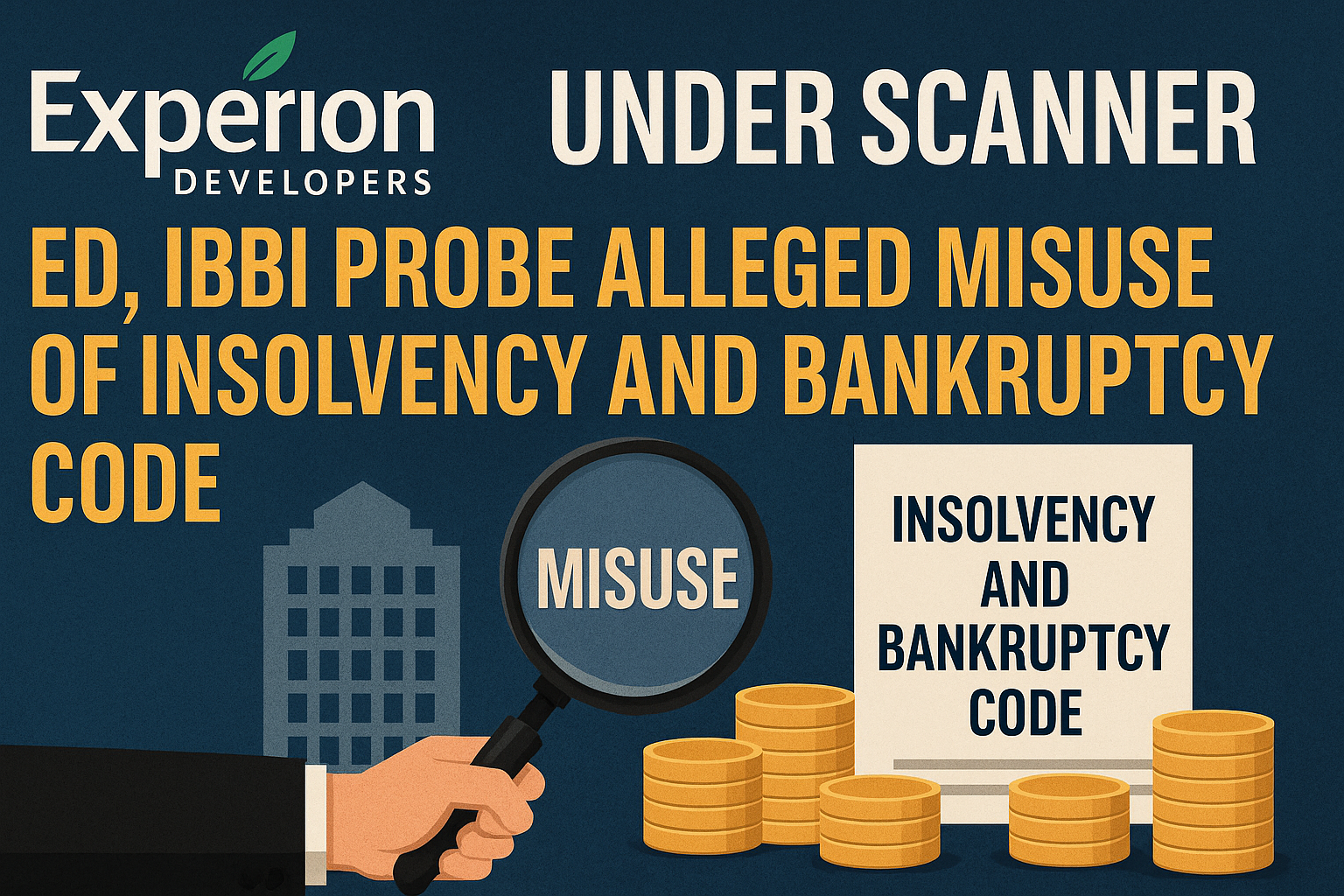
The first hint of trouble came not from the streets but from the boardrooms of powerful financial institutions. In late 2025, investigative reports — and then official disclosures — revealed that Experion had become ensnared in an Enforcement Directorate (ED) money-laundering probe. The ED, India’s federal financial crimes agency, alleges that Experion “orchestrated a sophisticated scheme to ‘loot’ public sector banks under the guise of India’s Insolvency and Bankruptcy Code (IBC)”.
In other words, Experion is accused of manipulating corporate insolvency processes to buy assets on the cheap while allegedly concealing critical attachments of land or property. According to the ED, Gurugram’s Financial Hub was targeted by Experion through shell companies such as Experion Capital Pvt. Ltd., and lucrative claims of misconduct quickly piled up.
Here are the key claims against Experion (all on public record via ED filings and official statements):
- Downtown plot deal: The asset at the center of the storm was 9.3 acres in Sector 62, Gurugram (prime Gurgaongolf course area). This plot originally belonged to Dignity Buildcon Ltd., a distressed developer whose assets had been attached by the ED in an unrelated probe. According to ED filings, Experion’s affiliate Experion Capital allegedly took over 60% of the voting rights in the Dignity Buildcon creditors’ committee (CoC) after buying up debt from Standard Chartered Bank and others. In effect, the ED says Experion stacked the deck: it “acquired 60 per cent” of the CoC votes and got an ally with another 35%, enabling it to push through a resolution plan. The chargesheet details exactly how Experion Capital spent ₹223.92 crore on those debts and ended up receiving ₹334.08 crore from the insolvent Dignity Buildcon when the plan was approved. The ED calls that “a glaring misuse of Section 30(5) of the IBC”, since Experion, as a connected creditor, was also chosen as the winning bidder (the “Successful Resolution Applicant”) in the same insolvency. Critics say this amounts to taking money from the bank and giving it back to the same company – all under the color of the insolvency law. Experion flatly denies any wrongdoing, calling ED’s claims “baseless” and noting that debt purchases were properly paid for and approved in court.
- Delayed resolution: More strangely, the ED alleges that Experion intentionally dragged out the whole process until it could amass enough votes. The probe states that the resolution proceedings were “deliberately stalled” until Experion’s affiliates held sway in the creditors’ committee. Only then did the insolvency plan move forward — a manipulation that the ED describes as abuse of the system. (Experion, again, insists everything was legal and published on the IBBI website, arguing that any creditor can bid in its own CIRP.) In other words, for months Experion kept Dignity’s fate in limbo, ostensibly to tilt the outcome in its favor, according to investigators.
- International connections: The deal’s structure was itself the subject of media curiosity. In March 2023, The Economic Times reported that Experion had offered ₹450 crore to acquire Dignity Buildcon. That looked like a landmark investment. But behind the scenes, ED claims the money came partly from abroad: Experion’s holding company in Singapore (AT Holdings Pte. Ltd.) was also heavily involved. In fact, ED’s charges suggest that some funds flowed through Mauritius-based entities (a common channel for funneling money). This is not mere conjecture: ED already raided offices in a similar Gurugram realty case (Omaxe/Greenwoods) for using Mauritian shells, and in the current inquiry it has noted suspicious overseas transfers and offshore accounts linked to Experion’s group. The conspiratorial implication is that Experion wielded IBC as a tool to “reap gains” for itself, rather than rescue the debtors legitimately.
- Bank impact: The ED’s trigger was a routine attachment of Dignity’s assets during a separate money-laundering probe. When Experion swooped in and secured a hefty payout on that parcel, the Federal Enforcement Directorate asked uncomfortable questions: did Experion effectively cause the attached assets to be sold, thus “disposing” of the security? If so, were the public-sector lenders (whose money was at stake) shortchanged? These are the questions the ED asked in a letter to IBBI (the IBC regulator) in late 2025. The IBBI itself has acknowledged that the ED raised concerns about Experion’s transaction, and has sought clarity on whether any insolvency tribunal errors occurred. In Parliament, the corporate affairs ministry was pressed for answers, and the reply was frankly unusual: it said “criminal investigation” might be warranted and recommended an SFIO probe. That means even bureaucrats see a whiff of impropriety – enough to consider pulling in India’s serious fraud investigators.
As these allegations surfaced, Experion’s public image took a beating. Company executives insist nothing untoward happened. In December 2025, it was told to the Rajya Sabha that every debt assignment was above board, every NCLT filing proper, and that updated creditor details were transparently listed on official portals. One spokesman said the ED’s complaints were “baseless” and a misunderstanding of the law. (Notably, Experion’s press release did not dispute the core facts: it acknowledged that it bought debts and bid as a member of the CoC, simply arguing that this was legally permissible.) In short, Experion claims to be the victim of over-zealous policing.
Experion’s ED case is “a symptom of systemic vulnerabilities in the IBC framework”, with Gurgaon’s projects at the epicenter. In other words, the scandal is as much about the law’s loopholes as about Experion itself.
What does this mean for homebuyers? At the very least, it underscores an unpleasant fact: the system can be gamed by well-connected players, with little immediate consequence. Experion’s case has prompted regulators to ask for deeper probes, but as of early 2026 no arrests have been made. Meanwhile, Experion is moving forward with new projects, having raised new funds. It continues to solicit homebuyers for its upcoming luxury complex “The Trillion” in Sector 48, Gurugram. Buyers reading the fine print might want to note that a company once accused of one scam has been trusted with their life savings – a gamble, to say the least.
It is worth contextualizing Experion in Gurugram’s larger milieu. The city’s rise has been a team effort, often involving brokering deals with lawmakers and bureaucrats. During Bhupinder Singh Hooda’s tenure as Haryana CM (2005–2014), land deals proliferated.
In this circus, if a builder was caught short, the usual outcome was not jail but a new pardon: extended deadlines from RERA, or fresh licenses from DTCP. Case in point is, in late 2022 the Haryana RERA fined several Gurugram developers with token ₹25 lakh penalties for project delays – even as it allowed them an extra two years to finish construction. In the same breath, that RERA bench quietly issued arrest warrants against 18 other firms for failing to refund buyers or deliver houses. The mixed signals are clear: regulators will sometimes act, but usually only after years of grief for buyers.
For Experion in particular, it’s not the only stain. A 2025 consumer forum case had already condemned Experion for retaining more than 10% of a homebuyer’s payment as “forfeiture”, calling it unreasonable. That suggests a pattern: clawing back deposits or postponements is one thing; straight-up fraud is another. Yet Experion seems to blur those lines.
We found numerous advertisements and PR talking up Experion’s civic contributions – donations to Gurugram’s PM CARES fund, “best employer” awards, the works – but very little update about its legal troubles. 2024 and 2025 saw zero PR mention of the ED probe or the NCDRC order. This selective narrative is telling: Experion was happy to broadcast its new ₹175 crore commercial venture in Gurugram, but hesitant to share a single tweet about the FIRs piling up. From the outside, Gurugram’s would-be occupants see a smiling developer; inside, they face a drift of unanswered complaints.
We have to be fair: no allegations are proven yet in court. Experion has not had its day in an ED charge sheet or conviction. But by now the public record is rich enough to draw clear lessons. Experion represents a breed of builders who see real estate as a casino: rig the tables legally, enjoy the wins, and when bets go bad the house – not the gambler – takes the hit. Whether or not charges hold up, the streak of accusations is likely to spook any careful homebuyer. Particularly in Gurugram, where high-rise dreams are collateral damage for unchecked ambition.
Fractured Foundations: Failures of Infrastructure
None of these private scandals exists in a vacuum. Gurugram’s physical plight underscores how badly builder malfeasance has hurt the city. The same high-rises marketing themselves as “luxury living” have effectively overrun civic capacity. A news daily reported in 2025 that Gurugram’s infrastructure is buckling under its own weight. It quoted residents alarmed to find the “millennium city” littered with trash piles, pothole-riddled roads, and open sewage drain.
People lamented that the government had raised permitted building heights and densities, yet “our sewerage system is not built to handle this load,” leaving whole sectors flooded and highways choked with sewage. In short, Gurugram’s growth has been financed by pushing limits – and if the sewers can’t keep up, water and waste just drown the homebuyers instead of carrying the city along.
This environmental collapse was no accident. It was promised to be avoided – every builder files plans, conducts environmental impact studies, and (theoretically) adheres to them. But in practice, many Gurugram projects ignored these safeguards. Developers often defer construction of civic amenities until late phases, only to run out of money or disappear. Some projects were even granted Environment Clearance by falsifying data, as local investigations have revealed. Meanwhile, the city’s drainage system – long overburdened – has a perfect scapegoat in a park of stalled projects. Buyers of Experion and other Gurugram developments can attest: their promised sewage plants or road widenings are perpetually “under progress” or stuck in some ministry’s inbox.
So what do Gurugram’s residents get in return for their tax and fee payments? Half-completed parks, flooded sectors and expensive steel frames. The buildings rise, but the basic services never do. This is destroying the quality of life faster than any villainous plot line.
Ocean Seven (OSB): The Affordable Housing Horror
Before we move on, lets learn a tale about another notorious Gurugram builder: Ocean Seven Buildtech (OSB). OSB’s misdeeds are somewhat separate from Experion’s, but they illustrate the same point: every corner of Gurugram has its builder who took money and ran. In September 2025, it was reported that OSB (an affordable housing developer) was slapped with an FIR by Haryana authorities.
The accusations were shocking in a grimly familiar way. OSB had taken homebuyers’ money for three projects and simply stopped building. Detailed investigations (a complaint by the DTCP’s enforcement wing) revealed multiple frauds: multiple sales of the same flat to different people, diversion of funds, and cancellation of units without return of money. In one project, OSB allegedly collected 95% of the money from buyers but had completed only 62.5% of construction. Worse, OSB kept taking new payments even after its licenses were suspended in 2023, pocketing crores despite being barred from selling.
Ocean Seven’s case went beyond PR and caught police action. The Haryana State Enforcement Bureau filed the FIR under the Urban Areas Act, and even sought a lookout notice to prevent OSB’s director, Swaraj Singh, from fleeing the country. One of the FIR points out a “grave apprehension that Singh may abscond to evade criminal proceedings”. Essentially, buyers in those OSB colonies were left with nothing but lawsuits and a non-bailable warrant. The authorities themselves labelled it one of the biggest crackdowns in the affordable housing sector. Two years of work just gone, families still paying EMIs on homes that exist only in land records.
This example screams: it could have been Experion or anyone. The lesson is common: promise affordable homes, take public subsidies and buyer advances, then stall until money dries up. It’s painfully typical. We cite OSB not to diverge, but to underscore that Experion’s scandal is part of a pattern across Gurugram. Whether luxury or affordable, Gurugram developers have left tens of thousands of families in limbo.
The BPTP–TDI Axis: Familial Ties and Far-Reaching Frauds
Of course, Experion and OSB are just recent chapter. Gurugram’s real estate story is dominated by a couple of powerful dynasties too. “How Two Most Notorious Real Estate Companies of Haryana – BPTP & TDI – have scammed & defrauded millions of buyers”.
BPTP Limited (Business Park Town Planners) was once Gurgaon’s darling, launching dozens of projects under Kabul Chawla’s leadership. High-flying investors flocked in (Citigroup, Blackstone, etc.), and by 2012 BPTP’s valuation was in the thousands of crores. But that rose started to crash. Thousands of BPTP buyers have complained of multi-year delays. In far-off Faridabad, even Army officers protested in 2014 at promises unkept.
Gurugram flats like Park Elite and Park Royal saw endless hold-ups – one report notes 95–100% of buyers’ money collected, but years of missed deadlines. By 2023, the Supreme Court had to intervene on Parkland, forcing BPTP to refund dues with interest and reprimanding the builder for “unjust enrichment”. RERA and consumer courts have repeatedly ordered BPTP to pay up for not delivering on time. Dec 2022 saw Haryana RERA impose penalties on BPTP – a mere ₹25 lakh – for leaving its sector 37-D Park Terra project three years behind schedule.
BPTP’s saga is entwined with TDI Infrastructure, another giant. Crucially, Kabul Chawla (BPTP’s boss) is related by marriage to the Taneja family of TDI – the Tanejas are his in-laws. Both families built lucrative townships and malls. TDI, for example, sold plots in supposedly affordable colonies. But TDI too faced furious buyers: one of its projects alone had 22,000 buyers waiting for decades.
The ED stepped in for TDI as well, as it provisionally attached ₹45.49 crore of TDI properties in 2024 under PMLA. TDI’s directors “duped innocent buyers by promising delivery” and “siphoned off money collected from buyers” into their own ventures. There, too, ₹165.69 crore was flagged as proceeds of crime. The aftershock of this? Unfinished apartments and shop complexes in Gurgaon and surrounding areas, where buyers had paid under false pretenses.
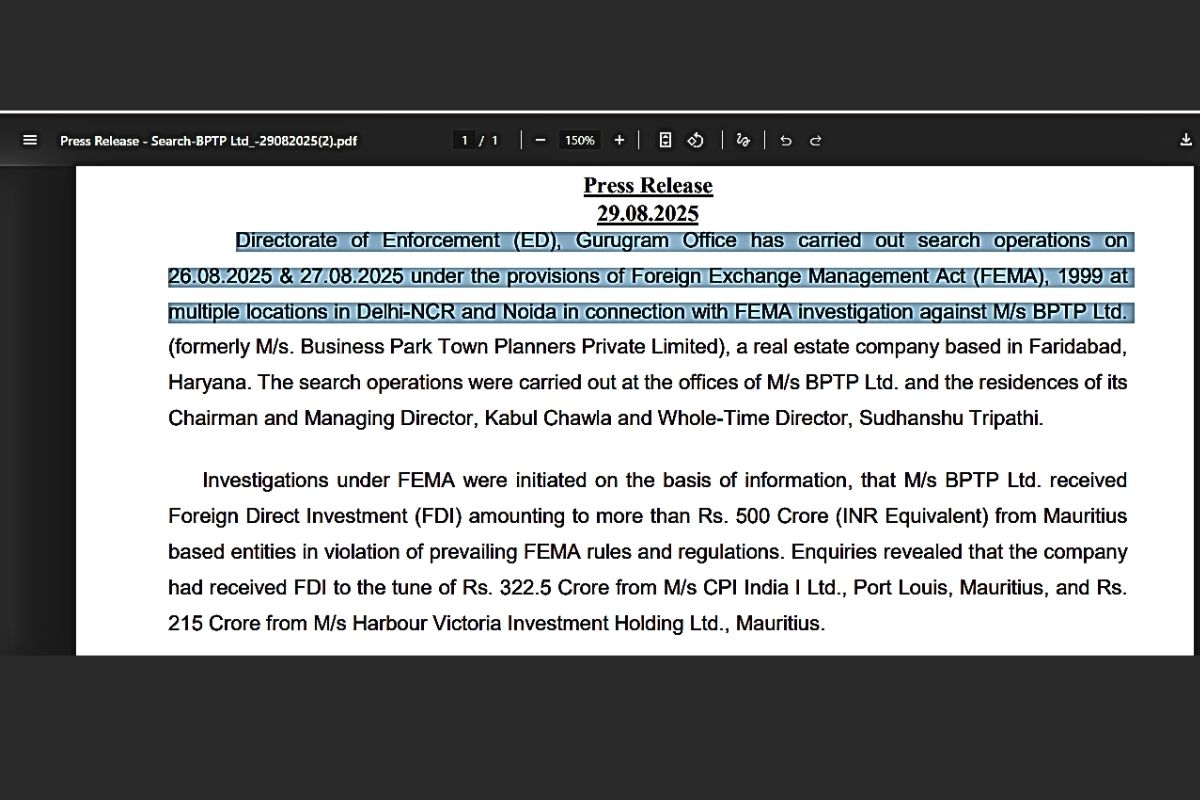
From plots in Manesar to malls in Sonipat, these companies operated almost in tandem. If Experion’s case shows one firm playing the IBC, TDI/BPTP’s story is of family-run money laundering and shell-companies flipping. Both sets of promoters have faced FIRs and ED notices. When Delhi Police wanted to check another scam, they even raided BPTP’s Gurgaon office in 2025 over a FEMA probe, alleging over ₹500 crore of hidden foreign funding.
Together, the BPTP and TDI saga demonstrates: Gurugram’s realty woes are systemic. The land that built the city – cheap, acquired through politically-blessed channels – is now littered with cases. Thousands of end-users, from wealthy professionals to working-class families, found themselves embroiled in lawsuits, waiting for something as basic as possession. If Experion is the fresh face in the dock, BPTP and TDI are the old guard who learned how to play the game (and how to evade consequences).
The bottom line: the law eventually catches up – sometimes. But by then, the damage is done. Hundreds of thousands of homebuyers are left with blocked funds or loans for homes they never got. The builders? Many of them either quietly continue building elsewhere or restructure under new names. A new re-registration means they escape blacklist status while keeping their money. It’s as if Gurugram’s motto became “Build now, explanations later.”
Citizen Testimony: The Human Cost
Behind these facts and figures lie countless personal tragedies. Groups of buyers across sectors 37D, 103, 110, and 80 (among many others) tell similar stories: they paid their lifelong savings or took hefty loans for an apartment that never materialized. One 2023 BBC India segment showed furious young families in Gurugram (some with babies) chanting “Dengue ke machchar aate hain, aur aap humein ghar kyu nahin dete?” – “Mosquitoes come, why don’t you give us our homes?” (In that case, promised air-conditioning was even delivering swarms of disease). In a print piece, dozens of buyers described late-night phone calls to polite but empty promises from their builder’s office.
The pain is real: without possession, many have to continue paying rent or EMIs simultaneously. Creditors use these situations to seize assets; banks try to recover non-paying loans. A simple Google search of “buying flat Gurugram scam” shows tens of thousands of worried inquiries on forums like Quora and reddit. One exasperated forum user wrote, “I booked my flat in 2010. Ten years later, I just want my money back.” Others break down when discussing senior parents’ life savings swallowed by a tower’s basement. Considering this, we tread carefully: sarcasm is not aimed at the victims, but at a broken system that allowed it.
Even Gurugram’s civic workers have complained. Municipal officials have publicly lamented that hundreds of thousands of square feet of unfinished construction cannot be taxed or maintained, creating an urban blight. Police officers have sometimes commented off-record that builders enjoy de facto immunity – one recently said, “By the time we catch them, the whole project has moved on to name changes.”
These human stories are often lost in the headlines of INR crores and boardroom shuffles, but in aggregate they fuel the skepticism we voice. A generation of Gurugram buyers has learned the lesson: if the “temple of justice” is no help, perhaps journalists and lawyers are the best defense. We quote our sources not to shame everyday people, but to hold the powerful accountable.
Conclusion: Can Gurugram’s Dream Ever Be Redeemed?
Gurugram’s story is a microcosm of India’s broader development paradox. On one hand, we marvel at its soaring towers, its bustling offices and malls; on the other, we shake our heads at the yawning chasm of infrastructure and ethics beneath. The same builders who sell “positive experiences” and city skylines have too often delivered only frustration and disease. We have shown that these are not mere urban legends but documented, court-citable facts: FIRs, RERA orders, ED press releases, Supreme Court judgments.
Our tone has been blistering because these issues demand urgency. We have tried to be sarcastic with the perpetrators, sensitive to the victims. Yes, we ring with bitterness – because millions have legitimate grounds for it. One hears the builders’ denials, their PR spin, but those cannot erase the record. At stake are not just crooked deals, but the very faith of common people in fairness. Every half-finished tower and every revived (and then delayed) project chips away at that trust.
What lies ahead? Perhaps more probes, maybe even convictions, as enforcement tightens. In the best case, RERA might strictly enforce completion schedules and actually penalize errant builders heavily. The judiciary may begin acquitting the term “justice delayed” in housing matters. Transparency measures – mandatory escrow accounts and regular audits (which exist on paper) – might finally be enforced. Govts in Haryana and Delhi might realize it’s cheaper politically to fix the problem than simply bribe it away.
Until then, we – the watchers – will keep documenting, naming names, and quoting deeds. Because this is not just Experion’s problem. It is everyone’s problem when the city’s pillars are built on lies. If the past few years have taught us anything, it’s that in Gurugram, the builders may have many friends in high places, but homebuyers have us, armed with evidence and maybe a wry laugh. Because Gurugram’s citizens have endured enough: they deserve the homes they paid for, and the city they were promised.