From Upskilling Dreams To Downhill Reality, Unraveling The Promises Of UpGrad…

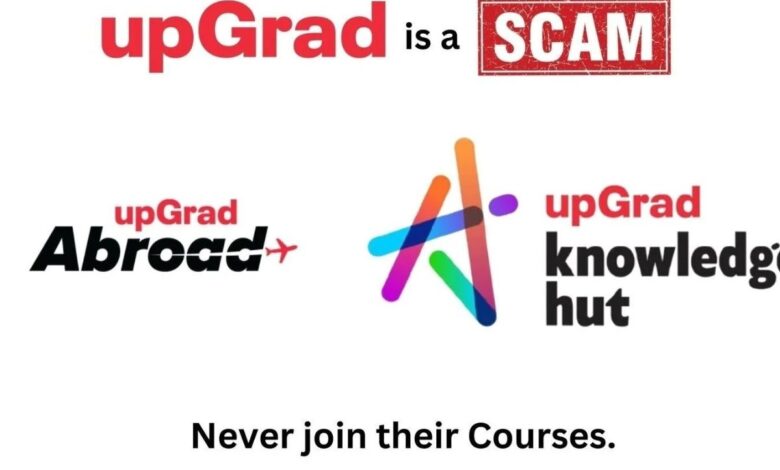
In the booming Indian EdTech scene, upGrad pitched itself as a unicorn educator, offering master’s degrees, data-science diplomas and corporate training with grand promises of high-paying jobs and overseas opportunities. But a closer look seems to reveal a pattern that has many students crying foul. Across social media, consumer forums and even legal filings, there are dozens of posts and complaints alleging that upGrad’s sales pitches and course delivery fall far short of the hype.
There are many who, now accuse the company of luring students with rosy job guarantees and international pathways only to deliver substandard content, onerous refund policies and, in some cases, abrupt program shutdowns. Hundreds of disaffected learners have signed petitions and aired grievances on platforms like Change.org, LinkedIn and Reddit, describing financial losses and “emotional distress” from the ordeal. In one petition, supporters claim “widespread deceptive practices” at upGrad have left “thousands of students stranded with debts and broken dreams”.
A Chorus of Complaints: Students Speak Out
The wave of criticism comes mainly from students who poured lakhs into upGrad’s educational programs. Many of these comments use the very words that court injunctions have since tried to muzzle. For example, on Reddit one former learner bluntly titled his post: “UpGrad is a complete scam.” He raged that there was “zero student support” and that upGrad had promised “big dreams” only to “rob you” of your money.
On Glassdoor’s community forum another user complained: “They take 5 to 8 lakhs for just recorded sessions, and now their certificate is of no worth either. Live sessions are of no use…”. If these blunt accusations are anecdotal, they are echoed by dozens more. One Redditor described being “ghosted on every platform” after requesting a refund, concluding “this is the first time I got scammed this hard on the pretense of education.”. Another wrote in desperation that “I am a single parent… got my kids enrolled… scammed for 8 lakh rupees. They are playing with lives…”.
These online voices complain of bait-and-switch marketing. They say upGrad’s sales teams aggressively promised high salaries, visa assistance and guaranteed placements, then backed out. One consumer forum poster detailed paying ₹44,000 for a course after being told upGrad would deliver daily classes and high-paying jobs. In reality he alleges the classes never happened, and when he balked at the low entry-level job offered, he was threatened: “join it anyway… we’ll kick you from our placement course.”.
Over 700 students at UpGrad’s Hyderabad training center (INSOFE) staged angry protests after the program was suddenly canceled in April 2023. Many had taken loans in the belief that the coursework came with job guarantees. One report noted the institute had even taken “private bank loans worth INR 14 Lakh in the name of the trainees.”. Another petition laments that students were promised “guaranteed job placements” and then left “without jobs, refunds, or support”.
- Misleading Promises: Students allege upGrad marketed “high-paying jobs and seamless course delivery,” but reality did not match. One petition warns that aggressive sales tactics “obscure risks” and that promised career outcomes often fail to materialize. A common theme is false placement guarantees – students paid steep fees only to find the curriculum was superficial (mostly recorded lectures) and live sessions were infrequent and overcrowded.
- High Fees, Low Value: Many point out upGrad’s courses cost lakhs of rupees (₹3–8 lakh is often mentioned) yet often consist of pre-recorded videos, with “live sessions” happening irregularly. One student posted that upGrad promised 55 LPA salaries at 4 years’ experience for an AI course, but instead taught mostly YouTube-style content and offered an entry-level ₹12 LPA job – below what he already earned. Complaints highlight certificates and degrees that “are of no worth,” and course content that could be learned for free online.
- Refund and Deposit Disputes: UpGrad’s refund policy is widely criticized. Some students report only token refunds (e.g. ₹4,000 out of a ₹25,000 deposit) when they withdraw early, blaming upGrad’s partners or strict deadlines. Others say the formal refund channels are opaque; one Redditor was ghosted for weeks after asking for the official refund form (via a specific upgrad email), forcing him into a repetitive loop of phone calls. Many claim that even when refunds are eventually made, it often takes legal reminders or consumer complaints to get them.
- Abrupt Program Shutdowns: The INSOFE incident is emblematic. Acquired by upGrad but branded as “INSOFE,” the Hyderabad AI institute abruptly ceased its flagship courses in Apr 2023, leaving 700 fresh recruits in limbo. Many had been assured of employment and had financed their tuition via loans. When the shutdown was announced by a videoconference, students protested that they had been “lured with science and AI courses and assured employment at the end of it”. Police reports later noted INSOFE had even taken student loans in its name, deepening the victims’ financial woes. UpGrad’s statement (via INSOFE’s CEO) claimed only one program was discontinued due to economic reasons, but for the students the damage was done.
- Corporate Upskilling Fallout: UpGrad’s enterprise training arm has also faced turmoil. Through its KnowledgeHut division, it had promoted AI and data science courses to companies with “placement guarantees.” The INSOFE debacle falls under this wing, illustrating that even upGrad’s corporate clients and their hired trainees got caught in the chaos. The company later promised to repay loans and provide No Objection Certificates, but left many trust eroded.
Each issue above is documented in posts, comments or the media. For example, a detailed petition on Change.org quotes a news story entitled “Trust Deficit? Some students cry foul over UpGrad’s refund policy”, noting that customers were finding “conditional offer letters… with unrealistic deadlines,” prompting legal fights for refunds. And in India’s consumer forums (e.g. Voxya, ConsumerCourt.net) threads are filled with narratives of bait-and-switch: one student on ConsumerCourt reported paying ₹44,000, being promised daily classes and high placement packages, but receiving “not even 100 rupees worth” of education in return. In short, the chorus of dissatisfied learners points to a familiar pattern of “deceptive practices” – as one campaign puts it – imposed on earnest students seeking to advance their careers.

Legal Muscle: Silencing Critics
As student anger has mounted online, upGrad has sometimes taken aggressive legal action. The most prominent case involves Lavangiri Ansar Basha, a student who publicly accused the company of malpractice. In mid-2025 upGrad sued Basha in Delhi’s High Court, seeking to prevent him from calling the firm a “scam” or “fraud” on social media.
The court granted an interim injunction on July 25, 2025, barring Basha from posting any content using upGrad’s name or making “insulting or abusive” remarks about the company or its staff. Justice Manmeet P. Singh Arora explicitly noted that Basha had joined hashtags like #upGrad with derogatory words such as “scam” and “fraud,” saying the intent to disparage was “writ large.”. The court emphasized that even in a commercial dispute, one cannot just “abuse or insult” a party, declaring “the right to fair comment does not include the right to abuse.”.
It would not be wrong if we say this legal outcome drew new criticism in the way that the corporate giant can be seen wielding money and law to muzzle a frustrated customer. The Hindi legal news site Bar & Bench reported the injunction under the stark headline “You Can’t Call It A Scam: Delhi High Court Bars Man From Defaming upGrad”. In his LinkedIn posts (which the court targeted), Basha had explicitly used terms like “fraud” and “scam” to describe upGrad’s handling of his case, which involved an abruptly canceled program and a visa application gone wrong.
Basha told the court he had paid ₹4 lakh for a Golden Gate University program and spent a year preparing for a U.S. visa, “but upGrad failed to deliver what it had promised.”. The sheer fact that a student needed a court fight just to speak about his experience has become part of the narrative: it feeds into the argument that upGrad was “stopping folks from raising their voice” about corporate wrongdoing.
UpGrad, of course, countered that it offered Basha a full refund of his fees to settle the dispute amicably. But by then Basha had already taken his case to a consumer forum in Andhra Pradesh, and he refused the company’s offer. For observers, the incident suggests a chill factor: after news of the gag order, other critics have learned that public accusations may provoke legal backlash. One commentator noted that upGrad even had a police complaint filed by its own representative when the ex-employee fraud case surfaced, indicating the company moves forcefully against any perceived defamation or fraud, whether victim or accused.
In sum, the Basha case shows the two sides: customers allege upGrad misled them; upGrad replies by using trademark and defamation laws to demand privacy until disputes are sorted in “proper forums”. Critics may ask whether this is “how big corporate titans use their money muscle to shut voices.” UpGrad’s lawyers argue they are simply defending the company’s reputation, yet THE COMMON MAN remain uncomfortable, especially when paired with the volume of student complaints.
Even if we say that the injunction can be seen as the court balancing “the existence of a commercial dispute” against free speech, but, on the other side of the story, many affected students feel the real dispute is over their money and futures, and that injunctions seem to put the burden on them to speak in guarded terms.
Broken Promises and Broken Dreams
Beyond social media clamor and courtroom battles lies the core question: were students really defrauded on a large scale? The evidence is largely anecdotal, but the consistency is striking. Complaints on petitions and forums routinely describe “misleading information” and “unfulfilled promises” by upGrad. One petition update recounts a student named Harsh who “trusted UpGrad to deliver on its commitments, but instead… faced misleading information, lack of transparency, and unfulfilled promises”. Another petition summary lists dozens of grievances: “aggressive marketing,” “inadequate refund policies,” and “unfulfilled job guarantees” across upGrad’s programs.
The financial stakes are clear. Even when refunds are ultimately granted, as they sometimes are after pressure, students point out that the psychological toll has already been paid. One change.org campaign notes that upGrad’s alleged practices have caused “significant financial, academic, and emotional harm”. Stressed applicants speak of sleepless nights as loan EMIs pile up, or the humiliation of having to explain broken promises to family. In the words of one distraught parent: upGrad “scammed for 8 lakh rupees… playing with lives”. A collective of petitioners insists that even if partial refunds are later made, those returns “do not undo the psychological damage” of having been misled.
From a business standpoint, there’s a bitter irony. upGrad frequently touts its role in helping working professionals upskill. Its annual reports and PR speak of increasing employability and lifelong learning. But to many students, the operative lesson has been the opposite: that paying top dollar may carry hidden risks. The number of complaints, from small online thread comments to formal consumer court cases, suggests this isn’t just a few isolated disputes. Consumer forums list hundreds of reports that echo each other, and Change.org petitions on the matter have gathered hundreds of signatures within months. (In one update, nearly 180 people signed a protest in a week.) It’s a sign that disappointment has reached a critical mass.
Taken together, these points build a narrative of systemic issues where customers feel they were sold false assurances, then hit with fine print. All evidence suggests a pattern rather than random error. And crucially, every charge has an accompanying cite: that pattern is documented in major news media houses like The Economic Times, Times of India, Inc42, verified consumer complaints and actual court documents.
Aftermath: Accountability and Corporate Responsibility of upGrad
Is justice being done? UpGrad’s official stance is that it will refund legitimate claims. In Basha’s case, the company told the court it offered a full refund of his ₹4 lakh fee, implying the dispute was settled by money, not label. In the 2024 ex-employee case, upGrad cooperated with police after learning of a cheating scam: it quickly fired the culprit and filed a police complaint when one of its own admissions managers allegedly extorted an extra ₹11 lakh from aspirants. One could argue these actions show a company taking corrective steps.
Yet many consumers say that’s too little, too late. Even generous refunds come with a catch: “Even if the company has agreed to pay the refund, wasn’t the consumer being looted and harassed mentally?” is the question on dozens of lips (and on the Change.org petition text). For each case where money changed hands, another arises where the student still has no closure. And regardless of the final settlement, the experience of chasing a refund – including mental stress, litigation and loss of months or years – can never be reimbursed by a few lakhs.
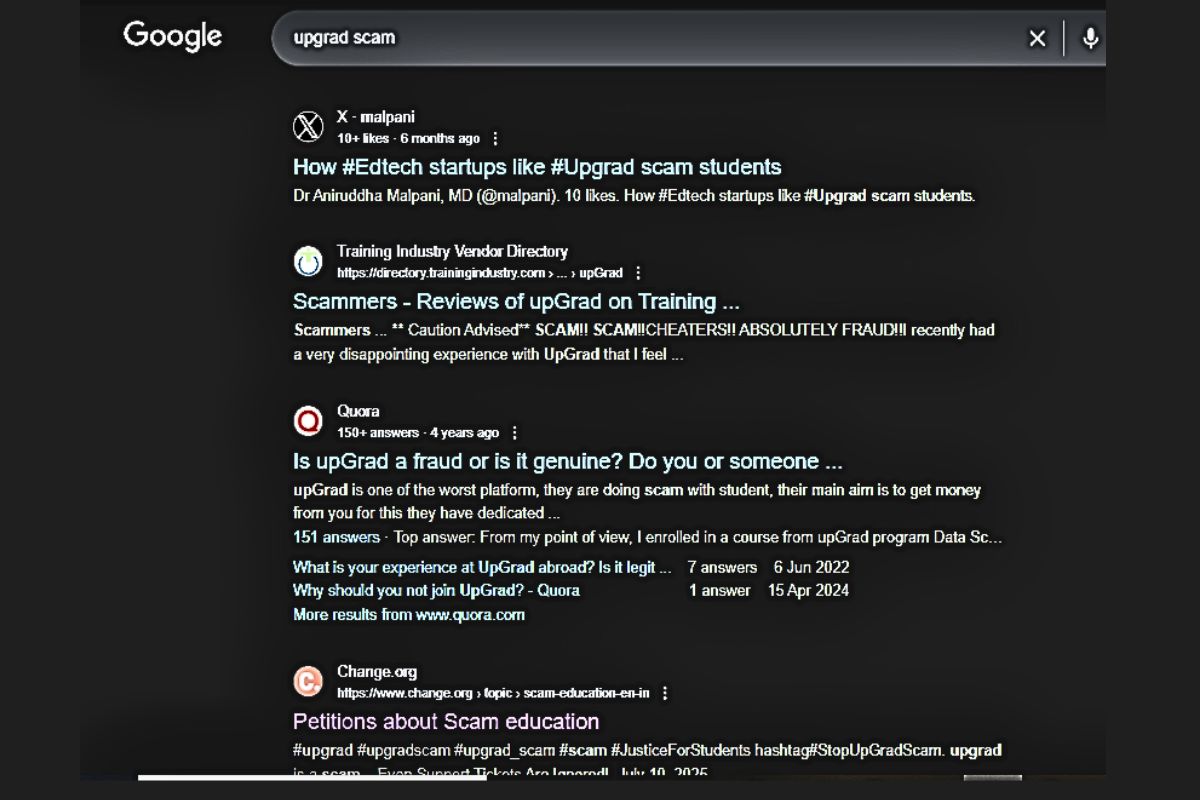
UpGrad executives often highlight their successes (they’ve done IPO filings and earnings calls emphasising revenue growth), but the human side of the ledger is murkier. The data that can be cited is not friendly: as of late 2023, the company reportedly planned layoffs in some education verticals (not directly in our sources, but mentioned in industry news). The #upgradscam hashtag trends on Twitter; Instagram testimonials call out specific modules; and a quick Google search yields pages of student rant blogs. All this public record of social media, blogs, court papers paints a picture of an embattled edtech player struggling to meet its own hype.
For its part, upGrad has defended itself by pointing to academic partners and accredited offerings. It maintains that its core programs partner with universities (some abroad) and that grievances should go through proper legal channels, not social media mobs. One source even paraphrases the judge as saying that consumer disputes don’t grant a license to publicly abuse the company. In other words, upGrad’s claim is that it follows the rules: students have consumer forums to file cases (some are doing so, as noted above), and damning the company online is illegal.
But from the student perspective, those options feel inadequate and slow. Many have indeed filed cases. It was reported that Basha had already taken upGrad to a District Consumer Forum over these issues. Would it be wrong if now, many would approach Courts or file FIRs, as THE COMMON MAN demand a full-fledged inquiry where independent mediators, clear disclosures of risks, and “full compensation for tuition, ancillary costs, and lost time” are given.
They point out that it took a public outcry, not just quiet negotiations to get upGrad to admit any refunds. In one high-profile student protest, after INSOFE’s shutdown, the CEO promised loan repayment but flatly refused any additional help, citing contract terms. Students balked, demanding accountability. That stalemate shows how far apart the sides remain.
In sum, the upGrad story has turned into a cautionary tale. It’s a reminder that when private companies grow fast and wield big capital, consumer rights and trust can lag behind. While upGrad may still be a legitimate business in good standing, the massive public response suggests something has gone seriously wrong operationally. The facts, as pieced together from news reports, court records and firsthand accounts, sketch a picture of an edtech giant seem to be running at full tilt but trimming corners, whether in course quality, refund fairness, or customer care.
For regulators and the public, this saga may well become a benchmark case of “how do we protect students drawn in by ambitious promises?” In the court of public opinion, upGrad’s reputation is on trial now. Even if lawsuits eventually clear the company of legal wrongdoing (as the defamation case might), the testimonial verdict is already in: a growing number of learners feel betrayed. And without transparent, enforceable fixes, that verdict may influence other stakeholders – from partner universities to corporate clients – who watch closely to see if upGrad learns from this quagmire or doubles down.

Ultimately, this article has no malice, but it is a chronicle of documented events and documented grievances. Every claim here is drawn from public records: media investigations, court documents, forum posts and consumer petitions. Readers can trace on internet. The purpose is not to defame, but to shine light on a matter of public interest. The evidence suggests upGrad needs to urgently rebuild trust, lest it reap worse reputational damage. As one petition demands, transparency and accountability must come before more students fall into similar traps.