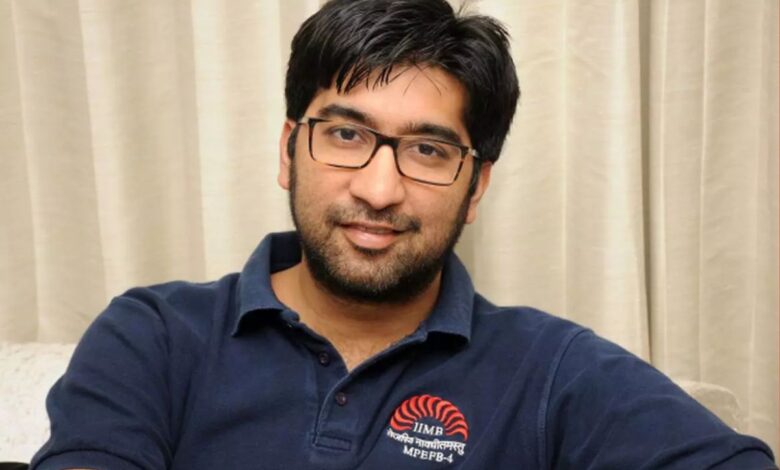
Mithun Sancheti’s journey into the world of diamonds and gold began like many family successions, but his path took an unexpected—and ultimately groundbreaking—turn.
Raised in a family that owned Jaipur Gems, Mithun inherited not just a business but also the legacy of traditional jewellery retail. Yet, this legacy didn’t align with his vision. After studying gemology in the U.S., he returned to India and found himself yearning to step out of the conventional mould.
Traditional jewellery shopping in India had long followed a predictable format: well-known local stores, trusted family jewellers, and a slow, ceremonial buying experience. No one had thought to make high-quality jewellery more accessible, more transparent, or more modern. Mithun Sancheti saw a gap—a glaring one. Jewellery buying in India was almost always offline, and there was no major player bringing it online. Why not change that?
It wasn’t a casual decision. Mithun needed backing. In a move that would change his life and reshape the industry, he approached his father with a bold request: ₹75 lakhs and four years. He promised that if he couldn’t prove his vision by then, he would walk away. With his father’s reluctant blessing, the funds hit his account. In 2008, Caratlane was born.

Like any new venture, the early days of Caratlane were rough. While Mithun Sancheti had a clear vision, the market was not immediately receptive. The website went live, but no sales came through. For the first two weeks, it seemed like the idea was a flop. Skeptics circled. Competitors didn’t take him seriously. Venture capitalists dismissed his pitches outright, and losses quickly piled up. By the time Caratlane hit ₹12 crore in losses, even Mithun had to pause and reassess.
And then, when hope was running thin, came the break he needed. Lee Fixel of Tiger Global heard about Caratlane and set up a meeting. That meeting lasted less than an hour—50 minutes, to be exact. By the end of it, Mithun Sancheti had a term sheet for ₹27 crore in funding in exchange for a 33% stake. It was a shocking turnaround. For two years, every investor he met had said no. And now, in less than an hour, someone believed in him.
With renewed energy and funding, Mithun went all in. He poured ₹4 crore straight into marketing. Orders started flowing in, and Caratlane began gaining traction. But Mithun Sancheti quickly realized that scaling would require more than just a solid online presence. So, in a move that seemed counterintuitive for a digital-first brand, he opened Caratlane’s first physical store in Delhi’s GK-1 market. This wasn’t a retreat from digital; it was a calculated expansion into an omnichannel model. Shoppers could browse and try jewellery online, then visit a store to complete their purchase or pick up their order. The strategy clicked.

By 2013, Caratlane was a ₹100 crore company, posting triple-digit growth. More funding followed, with Tiger Global leading the charge, pumping in ₹30 crore in 2012 and another ₹45 crore in 2013. Mithun was proving that his blend of online convenience and offline assurance was a winning formula. Innovations like the Perfect Look virtual try-on feature and more physical stores in cities like Delhi, Mumbai, and Bengaluru brought the Caratlane experience closer to customers. By 2014, revenue surged past ₹300 crore. The company had 12 stores and showed no signs of slowing down.
Even with the momentum, Mithun Sancheti understood that competition was heating up. Rivals like Bluestone and Melorra had entered the fray, and the market was no longer just his playground. To solidify Caratlane’s position, Mithun sought a strategic partner. Titan—India’s most trusted name in jewellery retail—was the obvious choice. In 2016, Titan acquired a majority stake, buying out 62% of Caratlane for ₹357 crore. It was a landmark deal, giving Caratlane the scale, brand recognition, and resources to accelerate growth.
The partnership with Titan proved transformative. By 2021, Caratlane had expanded to 130 stores in 36 cities across India and achieved its first-ever profit in 12 years of operations. The company’s revenue hit ₹621 crore, marking a major milestone. It was no longer a scrappy upstart—it was a dominant force in the jewellery market.
Mithun Sancheti’s vision didn’t stop at traditional jewellery. He introduced silver collections, expanded designs for festivals like Akshaya Tritiya, and focused on creating jewellery that resonated with younger, more value-conscious buyers. These moves helped Caratlane cross ₹2,000 crore in revenue, growing at a staggering 73%—far outpacing Tanishq’s 37% growth.
By FY23, Caratlane had reached ₹2,200 crore in revenue, with 227 stores across 88 cities. More importantly, it was profitable, earning over ₹160 crore. The business that once struggled for a single sale had become a ₹17,000 crore valuation powerhouse. In a crowning achievement, Titan purchased Mithun’s remaining 27.18% stake for ₹4,621 crore, cementing Caratlane’s status as a jewel in Titan’s crown.

Mithun Sancheti’s journey is a shining example of how innovation, perseverance, and a bold vision can transform an entire industry. From a risky idea to a market leader, Caratlane isn’t just a company—it’s a testament to what’s possible when you dare to challenge convention. And at the helm of it all, Mithun Sancheti stands as a pioneer, proving that the sparkle of diamonds is only outshone by the brilliance of a determined entrepreneur.