Modern-Day Work Slaves: India’s Corporate Love Affair With The 12-Hour Torture!


In India Inc., the 12-hour workday is practically a rite of passage; a badge of honor brandished from Bangalore boardrooms to Mumbai trading floors. Overworked founders and managers now boast about mandatory 10 am–10 pm schedules six days a week, and some even crow about having “no work-life balance” (the CEO of one AI startup posted that his firm’s “typical workdays start at 9 a.m. and end at 11 p.m., including weekends”).
The message is clear: if you’re not chained to your desk until midnight, you’re not trying hard enough. Meanwhile, stark data belie this pride: in a recent survey, about 52% of Indian workers reported burnout from poor work-life balance, and over 20% admitted they were “productive for merely 2.5 to 3.5 hours during an 8–9-hour shift”. In other words, endless toil is so ingrained that more than half the workforce feels on the verge of collapse, even as corporate PR insists that long hours equal “growth opportunities” (for someone).
Startups’ Siren Song: Hustle In Work or Bust
India’s startup culture has turned hustle into a quasi-religion. Enthusiastic founders pitch 12–14-hour days as part of the “founding mindset,” treating employees not as people but as “founding members on a shared mission”. One Mumbai gaming startup proudly declared “strict office timing of 10 am–10 pm, 6 days a week” and urged everyone to move “from a job mindset to a building mindset”, which is a thinly veiled cue that burning out is patriotic.
When this kind of bragging hit social media, critics were incensed: workers warned that “build or burnout” is a false choice, and that partners (i.e. actual profit-sharing) are more motivating than shackling “employees” to the corporate grind. (Indeed, as one quick-witted netizen pointed out, if everyone really were “all in,” they might as well be made true partners in the venture, not indentured laborers.)
A recent example pushed the joke over the edge. An AI startup CEO casually tweeted that he explicitly tells job candidates up front: “Greptile offers no work-life balance. Typical workdays start at 9 a.m. and end at 11 p.m., often later, and we work Saturdays, sometimes also Sundays.” He admitted he got death threats for even mentioning such a brutal schedule, and even some admirers warned that it smacked of “modern-day slavery.” (It’s telling that the term “slavery” comes up naturally when workers sign up for these hours.)
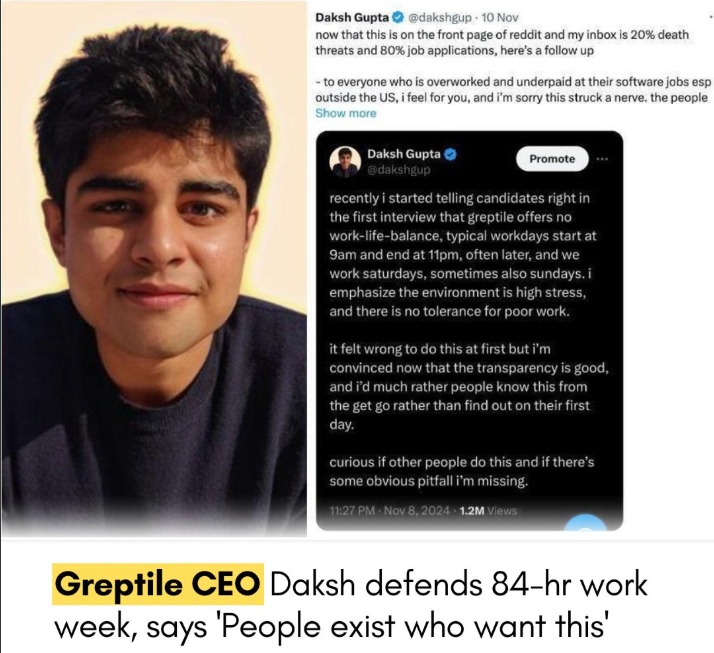
Yet the founder insisted this brutal transparency was necessary to weed out the “soft.” In startup land, exhaustion is romanticized as a badge of honor, the unspoken promise is that those who sacrifice everything will someday reap venture-capital wealth. In reality, the only things flourishing are fatigue, attrition and cynicism.
In Big Tech too, presenteeism is king. Industry stalwarts like Infosys, TCS and Genpact have turned time cards into a form of worship. Infosys, for instance, now monitors remote working hours and even e-mails people who put in too many hours. Under its official rules, employees “must work 9.15 hours a day, five days a week,” and any extra minute triggers an alert. (Humanity is flying in those emails: the HR team politely warns, “While we appreciate your commitment, we believe maintaining a healthy work-life balance is crucial”, after each overtime stint.) In other words, showing up at 9 and leaving at 6.45 is barely keeping up appearances, but working extra is suddenly a sin.
At Genpact, the calculus is flipped. Managers quietly track “daily active hours” on software, and employees report that incentives are dangled for logging longer days. In one case, workers could earn up to 500 reward points per month (about ₹3,000) by working late, plus a 5% bonus (about ₹150) for every hour over the standard day. Then management acts surprised when “quit rates” spike among senior staff, replaced by newbies eager for a handful of rupees extra. Both companies insisted no one mandates overtime, but word on the ground is that the message is clear: your compensation and job security hinge on the clock, not your contributions.
Tata Consultancy Services (TCS) went further by rewriting the rules themselves. A new policy demands each consultant chalk up 225 billable days a year (bench time capped at just 35 days). Even learning, mandated 4–6 hours a day on the company’s e-platforms, is time you’re technically “at work.” Remote work? Largely banned; 10 days a month in the office are now mandatory.
When a workers’ union cried foul, TCS management shrugged that higher utilisation was all “in line with performance goals.” Meanwhile, leaders preach that “we’re a family” and “innovation is everything,” as everyone scrambles to meet deadlines. The ultimate irony: India’s tech behemoths use productivity-tracking software to police hours, then talk up a “balanced” culture only after the public backlash.
From Finance to Factories: Everywhere is a Hustle Zone
This glorification of grind isn’t limited to tech. In finance, consulting, media and retail; any job with a chance at a bonus or a title bump, long hours are de rigueur. Investment bankers and consultants grumble that 12+ hour days are the norm worldwide, and India’s best-and-brightest know that flight risk is real: high attrition in banks is partly blamed on stress and burnout. (One December 2023 report noted private banks facing attrition rates of 30–35% as young bankers quit en masse.)
Journalists, lawyers, doctors, shopkeepers, even public sector workers, have stories of CEOs or bosses frowning on “leaving on time.” The story is the same: if you want to appear loyal, stay late; if you want to look lazy, clock out at 5 pm. Meanwhile corporate slogans tout “employee well-being” and “growth opportunities,” but never in the same breath as “mandatory overtime.”
It’s no wonder then that India ranks among the world’s most overworked countries. The International Labour Organization reports an average Indian employee logs about 46.7 hours per week, second only to a few isolated cases. Over half of us regularly work more than 49 hours weekly. This isn’t the case of a driven few; it’s baked into the system.
India already suffers second-worst statistics on global charts for long work hours. And now governments are looking to bless this grind: for example, the Karnataka state government has moved to amend labour law to raise the daily work cap (from 9 to 12 hours, with overtime up to 12). Critics warn this would simply legalize the de facto 12-hour “flexibility” already imposed in many offices. Once you formalize an all-nighter, the only “balance” left is on your coffee cup.
Government-Endorsed Overwork: Labor Law Blunder
The latest labor reforms sound more like a corporate PR campaign. In July 2025, Karnataka’s proposal to amend the Factories Act would officially allow 12-hour days and dramatically expand overtime quotas. The government claims this aligns with “industry practices” and will simplify paperwork.
Opponents see it as giving formal cover to the very abuse that’s already rampant: extended shifts will be codified as “flexibility,” leaving exhausted employees with even fewer rights. One software developer worried that “stretching the workday to 12 hours…blurs the balance further”, and cautioned that the “long hours are already romanticised in our industry”, underlining how disastrous it is to enshrine the grind into law. Meanwhile, companies can hardly contain their glee: with a nod from the state, punishing schedules and extra billing look official.
Ask a union leader or an occupational health expert, and they’ll tell you the opposite: living beings aren’t wired for 14-hour shifts, no matter how much gigabytes and glitters promise. The International Labour Organization long ago set a 40-hour week as the standard (48 as a true maximum), precisely because productivity collapses once people are pushed that far. In fact, numerous studies show that after about 40 hours, “output per hour significantly drops” and mistakes surge. Yet Indian companies keep racing in the other direction. The government’s stamp of approval on longer days only accelerates the burnout treadmill.
What’s the payoff of glorifying burnout? So far, mostly broken spirits and bodies. Employers brag that these warrior schedules breed resilience or innovation, but the evidence says otherwise. Experts warn: “Hustle culture is unsustainable,” because equating long hours with dedication “leads to anxiety, burnout, and talent loss”. As work-life boundaries collapse, motivation and creativity fade; attrition spikes.
A shocking share of employees report serious stress: one Deloitte study found 80% faced mental health issues in the past year, and many do nothing about it (half of burnout sufferers simply grin and bear it). The cruel joke is that companies celebrate those who show up late, even while those same employees suffer depressed immunity, insomnia, high blood pressure, depression, and yes, even tragic heart attacks on the job. (Last year alone saw multiple reports of young professionals collapsing under pressure, including a 26-year-old EY auditor whose death was explicitly linked to relentless overtime.) All to chase the myth that more hours = more success.
But there’s a basic truth hidden beneath the slogans: extreme effort doesn’t scale. As one work-life expert puts it, if you really value people, you reward output, not occupancy. When Indian corporates finally remember this and stop romanticizing “all nighters”, they’ll find that productivity, morale, and business success actually improve. Until then, millions of modern-day servants of the clock will keep asking: at what point does the promise of “growth” become nothing more than high interest on a never-ending debt of sleep?
At the end: Enough is Enough
India’s leaders and managers praise gaudy time-sheets, but global data and human experience tell the unvarnished truth: burnt-out employees produce burnt-out companies. It’s past time to mock the cult of 12‑hour days and demand real change. If anything, the ongoing work-life balance debate shows one thing clearly: the era of glorifying the grind must finally end. Productivity will not spring from exhaustion, and nobody’s success story should require fetal-position naps on Slack. Corporates must start holding hours worked secondary to value created, or India’s workforce will continue to be treated like an indentured generation.