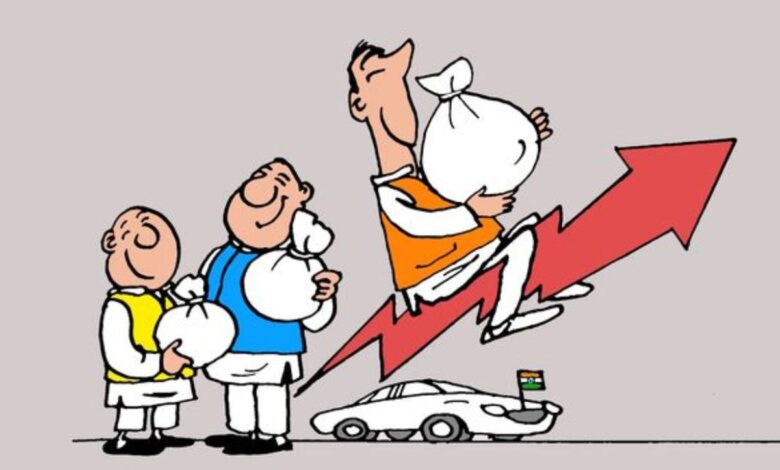
India’s newest symbol of political privilege was unveiled in August 2025 when 184 “Type-VII” luxury flats were awarded to Members of Parliament (MPs) on Baba Kharak Singh Marg in New Delhi. Each apartment spans 461.5 square metres and comes with five bedrooms, a family lounge, puja room, dining and drawing rooms, plus separate offices for the MP and personal assistant. The complexes include staff quarters, a gym/yoga centre, dispensary, community hall, canteen and even retail shops, all surrounded by landscaped lawns.
These flat towers replace the historic Lutyens’ bungalows of Delhi, but the opulence remains as double-glazed windows, wooden and vitrified flooring, central AC, WiFi, piped gas, RO water, video door phones and even garbage channels are standard in each unit. The entire project, approved in 2022 and completed by mid-2025, cost a staggering ₹646.53 crore of public money. At the inauguration, Prime Minister Modi praised the move as improving MPs’ “ease of living”; which is nothing but an eyebrow-raising claim when the common man lives any measure of ease is in question.
- Apartment Size & Layout: Each MP’s new flat is 461.5 m² – about five times a typical middle-class home. It includes an MP office, a PA’s office (each with attached lavatories), and five bedrooms with attached dressing areas and toilets.
- Luxury Amenities: Every room has balconies; kitchens are modular with chimneys. Units feature double-glazed UPVC windows, wooden flooring in the master bedroom and office, vitrified tiles elsewhere, and VRV air-conditioning. They come equipped with video door phones, centralised cable TV, EPABX telephone, piped natural gas, fridge, geyser; basically every modern convenience.
- Staff & Service Areas: There are two staff quarters per unit (kitchenette + bath), and separate entryways for staff, MP office and personal assistant.
- Building Facilities: A six-storey amenity block provides shops, a service centre, dispensary, community hall, canteen, club, gym and guest rooms. Parking space is provided for 612 vehicles. Even the campus roads have CCTV, lighting, landscaped lawns and art installations.
- Green Features: The complex boasts solar panels (400 KWp), rainwater harvesting, sewage treatment and water recycling, dual plumbing and low-flow fixtures – benefits meant to cut costs, but far beyond what ordinary citizens enjoy.
- Cost: All this cost taxpayers ₹646.53 crore, roughly US$78 million. In other words, each MP’s flat cost on average over ₹3.5 crore, even before furnishings or annual maintenance.
If you have a view of Rashtrapati Bhavan (President’s House) in Lutyens’ Delhi, symbolizing the colonial-era luxury, which is now enjoyed by India’s political elite, you will feel that millions of Indians live in squalor and hunger.
These lavish flats stand in stark contrast to the lives of ordinary Indians. Over 14% of India’s population, roughly 200 million people are officially “multidimensionally” poor, meaning they lack basic health, education or living standards. Despite steady economic growth, poverty remains endemic: in 2019–21, 14.96% of Indians were classified poor on the NITI Aayog-UNDP poverty index. More than one in five Indian children are undernourished or stunted (India’s child wasting rate of 18.7% is the highest in the world).
The Global Hunger Index ranks India 105th out of 127 countries (2019–23 data) and lists India’s hunger level as “serious”. Healthcare is similarly grim: newborn and child mortality remain high, many go without clean water or sanitation, and malnutrition contributes to hundreds of thousands of deaths each year. Unemployment is also a problem as official estimates show the unemployment rate around 4–5% in recent years, which in a country of 1.4 billion means tens of millions of unemployed or underemployed.
The disparity could not be more jarring: MPs and ministers live like billionaires while ordinary people scramble for survival. Taxpayer funds are lavished on their housing, travel and allowances, even as those very taxes come from the pocket of struggling citizens. In the year these flats opened, farmers in debt had to faint in parliament to get a parliamentary debate on agrarian distress. The Constitution may promise welfare, but in practice India feels like “two nations”: one for the fat cats of New Delhi, and one for the rest.

Unprecedented Perks: Salaries, Freebies and Allowances for MPs
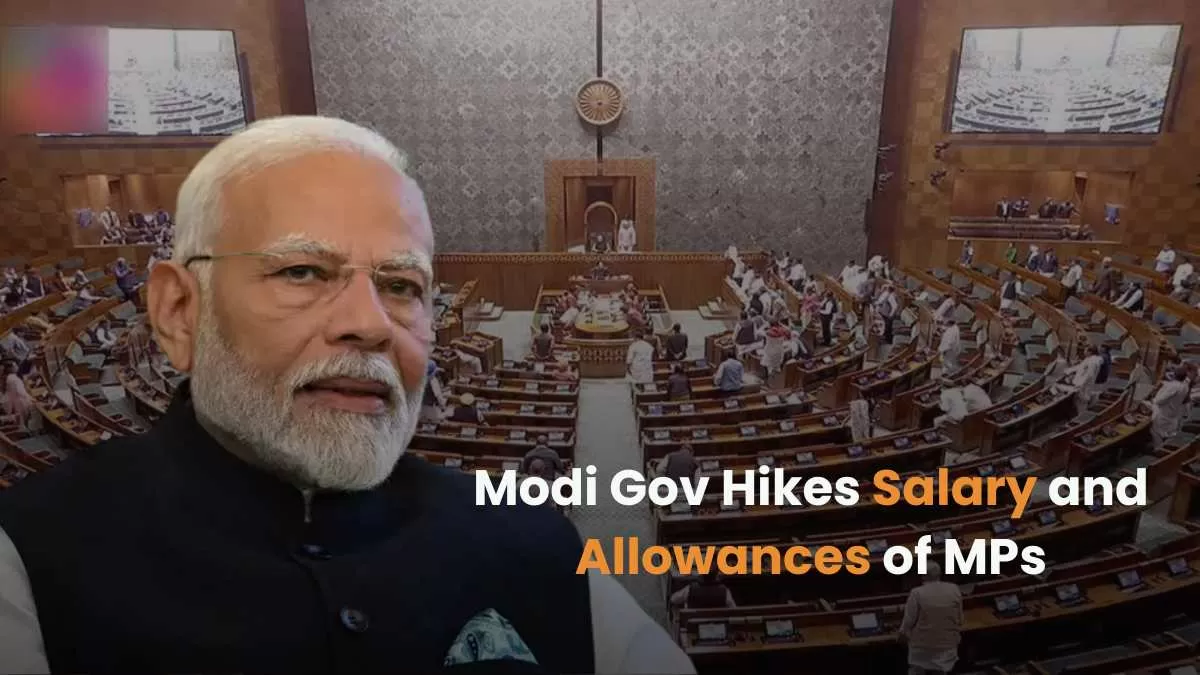
MPs themselves have the nerve to increase their perks. In March 2025, the Union Government raised MPs’ salaries by 24%, from ₹1 lakh to ₹1.24 lakh per month. Their daily allowance went up from ₹2,000 to ₹2,500, and pensions for former MPs rose to ₹31,000 per month. These hikes are justified by inflation, but ordinary government workers are not given comparable raises. In fact, since 2018, MPs have received automatic inflation-linked pay hikes every five years by law, a privilege few democracies match.
Beyond salaries, MPs collect a slew of other entitlements. According to official rules and media reports, every MP also receives:
- Massive allowances: Up to ₹70,000 per month as “constituency allowance” (for running offices) and ₹60,000 per month as “office allowance”. (For context, a government teacher or clerk might earn ₹25,000 per month).
- Travel perks: 34 free domestic air tickets per year for themselves and family, plus unlimited first-class train travel. (No family budget constraints here.) They even get free mileage by road for official travel.
- Communication and utilities: A yearly telecom allowance for phone/internet. Plus an astounding 50,000 free electricity units and 4,000 kilolitres of free water per year for their residences. These comforts would be a king’s ransom for many poor households, but MPs get them free.
- Housing: During their five-year term, every MP is entitled to rent-free housing in Delhi. Depending on seniority they get bungalows, flats or hostel rooms, all maintained by the state. If an MP declines an official house, they still get a cash housing allowance.
- Pensions: Former MPs get pensions (raised to ₹31,000/month) and additional ₹2,500 per month for each extra year of service beyond five. (In total, a long-serving MP could easily pocket over ₹60,000 a month as pension.)
In short, a Member of Parliament earns and receives benefits far beyond what ordinary Indians dream of. The “parliamentarians earn more than 13 times the per capita monthly income of ₹9,363”. A teacher, farmer or factory worker can only envy this bundle of perks. One editorialist observed that the “privileged Members of Parliament live at taxpayers’ expense in a style to which they should never have been allowed to grow accustomed”. Indeed, except for the headline, this news is seldom front-page: only our Express and a few outlets dare tally the perks.
Lutyens Legacy: Bungalows as Political Currency
Much of the criticism of VIP lifestyles centers on Delhi’s Lutyens’ Zone; the central colonial district where the Governor-General and top officials once lived. Today, prime ministers, cabinet ministers and senior MPs occupy grand colonial-era bungalows there, free of charge. There are roughly 2,000 officially owned bungalows in Lutyens’ Delhi. “White colonial bungalows featuring porticoes and arches, high ceilings, spacious rooms and forbidding perimeter walls” with servant quarters and gardens “the size of public parks”. For many incoming MPs, snagging one of these “coveted” addresses is a top priority.
Over decades, MPs have “used and abused their housing privileges”. Once an MP leaves office (or loses an election), they are supposed to vacate their official residence, but many stay on for years. Former MPs have even been threatened with cut-offs of water and electricity if they refuse to leave. Some families illegally hold on by declaring a house a “memorial” or citing security threats. In 2019 the Parliamentary Affairs Ministry bluntly warned hundreds of ex-MPs that if they didn’t move, “the gas, electricity and water will be cut off”.
The pernicious allure of these Lutyens bungalows has even been used as political bait. The Lutyens house is a golden carrot: the government can “dangle it as a carrot to political leaders to win their support.” We’ve seen whispers that big projects or plum appointments are often traded for loyalty to the ruling party. “No modern democratic country pays through its nose to accommodate its officials and elected representatives in homes that only billionaires can afford”. Yet in India, it’s routine. The man who moved Narendra Modi’s PMO to South Block also occupies a bungalow designed by Edwin Lutyens, a heritage asset inherited from the British.

In recent years there has been some attempt to minimize this privilege. Under the Modi government, new multi-storey apartments were built near Parliament to replace the sprawling bungalows. But that has only shifted luxury into tall towers. The Lutyens bungalows themselves continue to be prized. According to a Rajya Sabha committee, out of 464 existing bungalows in Delhi for ministers and officials, only about 56 have been converted to apartments; meaning most still live in standalone villas. Senior leaders still insist on Lutyens addresses.
The colonial legacy and its perks remain a blunt symbol of inequality. “Over the years, public angst against housing privileges has grown,” with commentators decrying that India sustains for its rulers “a style to which they should never have been allowed to grow accustomed.” That public anger is real; but it is galling how little it changes actual policy.
The Numbers: Hunger, Poverty, Unemployment
Children in a Mumbai slum. While MPs move into palatial apartments in New Delhi, these children face malnutrition and squalor; a shocking reminder of India’s true priorities.
Contrast the MPs’ bounty with the harsh statistics of mass deprivation. Some sobering figures:
- Poverty: As of 2019–21, about 14.96% of Indians are multidimensionally poor. That’s roughly one in seven people; on the order of 200 million souls living with severe deprivations in nutrition, health, education and living standards. Even if some may quibble over the exact methodology, no one doubts that tens of millions in India cannot afford basics. (For comparison, by the same survey 24.85% were poor in 2015–16; so progress has been made, but the absolute numbers remain huge.)
- Hunger & Health: India’s Global Hunger Index score (2024) is 27.3, categorizing the situation as “serious”. India ranks 105th out of 127 countries. Some child health figures are staggering: 18.7% of children under five are wasted (too thin for their height, the highest rate in the world); 35.5% are stunted (too short for their age). Millions of children grow up undernourished, which damages education, productivity and longevity. Meanwhile, India still has about 40 million malnourished children and nearly one in four people is undernourished (13.7% of population under global standards).
- Unemployment: Official data show India’s unemployment rate in the 4–6% range. While this percentage may seem modest, in absolute terms it means tens of millions of out-of-work Indians (given India’s huge population). Rural unemployment often hovers above 5%, youth joblessness is higher, and many who count as “employed” work in low-paying, insecure jobs (casual labor, small-scale farming, etc.). The National Sample Survey has pointed to stagnating labour force participation, especially among women.
- Public Health: India spends only about 1.7% of GDP on health (among the lowest in the world), and roughly 60% of health expenses are out-of-pocket. Rural areas often lack doctors and hospitals. These facts combine with poverty to give India a relatively low Human Development Index compared to its GDP rank.
Put simply, hardship and scarcity define daily life for a large chunk of Indians, even in normal times. Millions queue for subsidized grain, in jobs of uncertain daily wage, or endure semi-permanent electricity and water shortages. Yet our MPs just moved into the lap of luxury. The juxtaposition is jarring: while a farmer wonders how to feed his child, his MP is busy ordering double-glazed windows for a new study.
Don’t We have The Right To Ask Why This Monstrous Indifference?
The narrative of caste, religion or region aside, one red line of any just society is how its rulers treat the ruled. In India today, that line has been shattered. The Common Man’s Hell is simply ignored. MPs and ministers live in self-made bubbles of comfort, profiting from an elaborate perks system that no developing democracy should tolerate. This is not just a failure of imagination; it is a moral crisis.
It is particularly infuriating that these lavish schemes unfold under the banner of public good. The official line (rehearsed by politicians of all stripes) is that more comfortable housing or higher pay makes MPs more efficient or “motivated”. Yet no one has shown that comfortable lives in Delhi translate into better governance or fewer riots. The reality: MPs do their job for perks, not for poorer constituents. The day they were rewarded with these flats, over a dozen farmers allegedly committed suicide for want of debt relief. And that was just one tragic news story, easily forgotten by columnists.
History is not on the politicians’ side. In past decades, whenever MPs or ministers raised their pay or perks, public backlash was fierce. In 2009, attempts to give MPs a 200% pay hike (to ₹450,000/month) were rolled back after angry protests. In 2010, the Parliamentary Affairs Minister admitted that “there is no magic number” to justify higher pay, even as thousands lived without shelter or healthcare. Today, they got 461.5 sqm apartments instead. The place of irony is stark.
“Houses that only billionaires can afford” – one can only wonder at the greed and entitlement. MPs should be ashamed, but most likely they don’t feel shame at all. One wealthy politician candidly admitted, in an unrelated matter, that governments use such perks to “grease the palms” of legislators. Another said it outright: “The best way to control politicians is to give them everything.” Never has that been more literal than in India’s capital.
The common citizen must demand accountability. When leaders celebrate new MP flats, we must remind them of the roughly 200 million without toilets and 250 million still without electricity. When “ease of living” is extolled for MPs, we should retort with the ease of starvation and want endured by peasants and slum dwellers. Such opposition cannot be polite. It must be strong, fact-backed and relentless.
The Founders of India envisioned swaraj, the self-rule that put the poor first. Instead, we have a perverse inversion: self-rule for the rich and powerful, and the poor left without a voice. This grotesque reality must change.
In a vibrant democracy, such glaring inequality of privilege is unsustainable. Either our rulers recall the pledge to serve the people every day they live, or the people will come to judge that equation in other ways; at the ballot, in the courts, or on the streets. But ignoring the outrage won’t be possible forever. The luxury flats of MPs stand not as monuments of progress, but as symbols of an unraveling social contract, one that India’s citizens cannot, and should not, continue to endure.