Palmonas: New Name In India’s Demi-Fine Segment. How Will It Compete With The Already Present Titans?

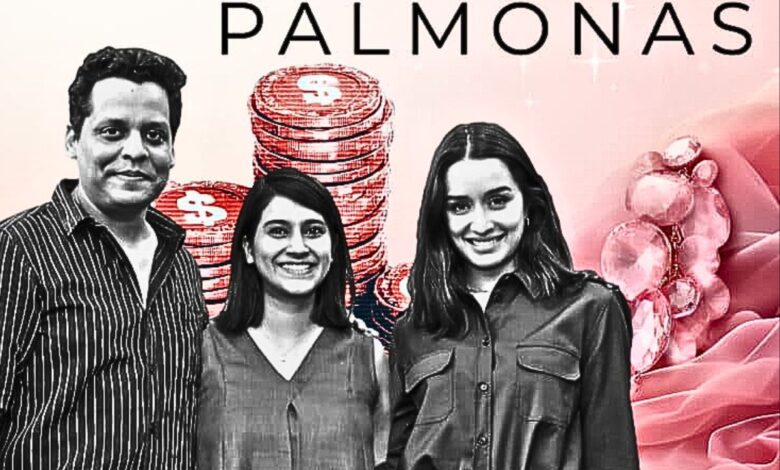
India’s ₹5.56 trillion (US$67 billion) jewellery market, which is long dominated by traditional goldsmiths is shifting toward modern, affordable luxury. A raft of digital-first “demi-fine” brands has emerged to meet a new generation of working, design-conscious consumers who want everyday wearables rather than pure-investment gold. One fast-rising player is Palmonas, a Pune-based startup co-founded in 2022 by Pallavi Mohadikar and Amol Patwari, with Bollywood actor Shraddha Kapoor later joining as co-founder.
In August 2025, Palmonas announced a ₹55 crore Series A round led by Vertex Ventures Southeast Asia & India to fund its expansion, which is a sign of strong investor faith in this niche. The capital will be used to bolster its 9kt gold demi-fine collection, open 100 stores in the next year, and branch into new categories.
Palmonas is “redefining what jewelry means for the modern Indian consumer” with a brand built on design, quality and everyday practicality.
Palmonas positions itself “between fast fashion and fine jewellery” offering high-style pieces for daily life at accessible prices. The company calls its offering “demi-fine”, meaning it blends elements of real jewellery and costume jewellery. Its products include rings, necklaces, bracelets, earrings and even mangalsutras, made from surgical-grade stainless steel or sterling silver plated with 18K gold (vermeil). These pieces are waterproof, hypoallergenic and built to last (no “green finger” tarnish), yet come at a fraction of typical fine-gold cost. In Shraddha Kapoor’s words, Palmonas’s 18K-plated jewellery provides “the same aesthetic and quality at affordable prices” as pure gold, essentially “real gold” looks with everyday durability.
Beyond plated pieces, Palmonas has even launched hallmarked 9kt gold products (9ct gold is 37.5% pure gold) to hit a middle ground of daily luxury. Its 9kt range, including lab-grown diamond rings and necklaces is promoted as “hallmarked 9 karat gold, designed to keep up with you”, offering the “sweet spot between luxury and everyday wear” at far lower prices than 18K/22K traditional gold. Palmonas emphasizes transparency as its website touts “no confusing fine print, no showroom markups, just transparent pricing, clear quality”, echoing the marketing style of its online competitors. In short, Palmonas aims to give consumers high-quality, design-driven jewellery to flaunt daily, not lock away with “beautiful, effortless and part of your everyday life,” as Kapoor puts it.
Business Model and Channels.
From launch, Palmonas has been direct-to-consumer (D2C), leveraging e-commerce as its core sales channel. It sells primarily through its own website (with free shipping and cash-on-delivery options), and also taps large online marketplaces (Amazon, Flipkart) to broaden reach. The brand has supported growth with heavy digital marketing and social media engagement, for which Kapoor, as co-founder and Chief Brand Officer, is a front-line asset. Consumers see her personally wearing Palmonas jewellery at workouts or parties, and she eschews “textbook marketing” in favor of “natural and organic” storytelling that makes the brand relatable.

Since its 2022 debut, Palmonas has rapidly built traction: 6.5 lakh orders have been delivered to date, creating a loyal repeat-customer base. It secured early funding on Shark Tank India (₹1.26 crore from Namita Thapar and Ritesh Agarwal, leading to a ₹126 crore valuation) and a ₹6 cr angel round in 2023. The Vertex round will accelerate Palmonas’s push into offline retail as it has already opened stores in key cities and plans 100 more in 12 months, as well as deeper investments in design, inventory and technology to keep up with demand.
Product Range and Pricing
Palmonas’s product strategy revolves around design-led, lightweight pieces for the modern customer. Its inventory spans everyday classics and fashion-forward styles, from sleek gold-plated chains and minimalist ear studs to embellished rings and sporty bracelets. Unlike conventional Indian brands, it rarely offers heavy bridal sets or traditional 22‑karat necklaces. Instead, it focuses on 14–18K gold plating on stainless or silver bases, often paired with lab-grown diamonds, to strike a balance between style and cost. Founder Pallavi Mohadikar emphasizes that jewellery “should feel like a second skin”, by which she means pieces must be affordable and comfortable enough to be worn daily.
Pricing underlines Palmonas’s strategy. Plated demi-fine items typically range from hundreds to a few thousand rupees, far below the price of pure-gold jewellery with similar designs. (For example, a solid-gold 9k necklace with diamonds on Palmonas’s site can be ~₹16,000, whereas a comparable 18K piece from a legacy brand would be several times higher.) The brand deliberately avoids hefty making charges or traditional weight-based valuation. As Shraddha Kapoor notes, Palmonas offers “affordable” everyday jewellery so customers “can keep coming back”. Its transparent online pricing with all costs disclosed upfront is designed to build trust in a segment that has traditionally lacked it.
By contrast, BlueStone and CaratLane (both longer-established online-founded brands) mostly sell fine jewellery. BlueStone’s portfolio includes hallmark gold, diamond and platinum pieces (rings, pendants, bridal sets, etc.). It still highlights lightweight 14–18K designs for younger buyers, but the materials are authentic (often with laser-hallmark and certificate). BlueStone prides itself on a “transparent pricing” approach as their every product page lists metal weight, diamond carat and making charges so customers see exactly what they pay for. CaratLane (owned by Titan) likewise built its name on accessible diamond jewellery, most famously offering one of India’s first 22K-certified solitaire studs priced under ₹5,000 in 2010. Over time, CaratLane expanded into gold, platinum and lab-grown collections, but still centers on everyday “office-to-evening” wear.
Tanishq (Titan’s flagship) and Kalyan Jewellers (owner of Candere) remain focused on hallmark gold and diamond jewellery, predominantly for weddings and festivals. Their pricing is weight-based and typically higher. However, Titan’s newer sub-brands like Mia by Tanishq target the same youthful market with lighter 18K pieces and non-traditional designs, bridging some of that gap. In short, Palmonas sits between pure fine jewellery and costume jewellery as it offers the look and feel of precious metal at demifine budgets. Many industry observers see this segment as under-served, especially for working women who want shiny accessories without a lifetime investment.

Sales Channels and Store Footprint
All the major players, Palmonas, BlueStone, CaratLane and the incumbents, now operate omnichannel models, though their emphasis varies. Palmonas was born online but is aggressively moving offline. Its recently announced plan to open 100 new retail outlets in one year shows that even D2C brands see a role for physical stores. These Palmonas stores aim to be immersive showrooms where customers can try, personalize and buy pieces (helping scale customer trust beyond screens).
By comparison, BlueStone pioneered the digital-first model back in 2011, but over time built a nationwide physical network. Today it operates “over 200 company-run stores and 75 franchise outlets” across India (roughly 275 total), plus a global e-commerce platform. BlueStone also has three manufacturing hubs in Mumbai, Jaipur and Surat, enabling it to control production and design speed.
In practice, most BlueStone sales now come from stores, as its IPO documents revealed, only ~6% of revenue was online in FY25 (down from 15% two years earlier) while ~93% was offline. The omnichannel approach costs money. BlueStone has never turned a profit, with losses widening to ₹221 crore in FY25, but the strategy is that digital marketing brings customers to its showrooms. BlueStone’s investors hope the high repeat-business (44% of FY25 sales came from prior customers) can eventually cover the heavy store costs.
Titan’s jewellery division (with Tanishq, CaratLane, Mia) is still predominantly offline. As of mid-2024 Titan reported 472 Tanishq stores in India, plus 274 CaratLane outlets and 192 Mia stores. (Luxury brand Zoya had 11.) Titan adds new stores rapidly as it aimed for ~170 more in FY25, using many franchise partnerships to limit capital needs. Titan also sells online (through its own sites and apps) and is gradually integrating digital tools in showrooms (e.g. Tanishq’s e-stores, AR try-ons). Overall, however, Titan’s brands still rely on in-person service and the trust built by landmark store locations.
Kalyan Jewellers (with Candere) likewise has a vast store network (over 200 stores) and complements this with Candere’s online storefront for mid-tier design jewellery. In contrast, pure-play D2C rivals like GIVA (affordable gold-plated jewellery) and Firefly Diamonds (lab-grown stones) have so far focused online, though they may open boutiques later.
In summary, Palmonas’s route to market is go direct to consumers, build a brand digitally (especially among 20–40 year-olds), but support the shift with physical stores as proof points. This hybrid model mirrors BlueStone and CaratLane’s paths, and even Titan’s recognition that younger shoppers still want a store visit before buying. In fact, it is often noted that even digital jewellery buyers tend to “fall in love with a design online, then click-and-collect or visit a store” before committing. Palmonas’s stores (new and planned) will cater to that behavior: letting customers touch pieces and get instant gratification, while maintaining the brand’s fresh design language.
Marketing and Branding
Palmonas’s brand voice is refreshingly modern and authentic. Shraddha Kapoor, beyond co-ownership, actively co-shapes its image. In interviews she emphasizes fun, spontaneity and relatability: “I’m just having fun with [marketing]! We focus on keeping things natural and organic,” she told. Palmonas’s messaging centers on empowerment (“everyday flaunting”) rather than weight or occasion: jewellery “for everyone, designed for everyday flaunting,” priced affordably, she explains. Social media posts feature real customers, user-generated content and behind-the-scenes glimpses, all aimed at young women who scroll Instagram and TikTok. In short, Palmonas markets itself like a lifestyle brand (think affordable fashion labels), not a traditional gold shop.
BlueStone similarly leans heavily on digital marketing. It has captured an outsized share of online advertising buzz. According to industry data, BlueStone accounted for 50% of all online jewellery ad volumes in FY2025, despite spending only a tenth of what Titan spent. Its campaigns (remember “Zyada Hota Toh Kya Hota”?) are irreverent and digitally focused. BlueStone’s DRHP emphasizes funnel-based digital outreach of “creating awareness, driving consideration, and conversion by communicating what the BlueStone brand stands to deliver,” it noted.
In practice this means targeted Facebook/Instagram ads, search marketing, and a slick website/app experience. Anchor investor filings also cite metrics showing BlueStone’s ad response drove a 15% lift in online conversion. Despite its origins as an online disruptor, BlueStone now spends more to advertise metro-centric, but its roots are very digital.
Titan’s marketing is far more traditional. The jewellery division (Tanishq/CaratLane/Mia) spends over ₹1,300 crore a year on advertising (FY25), dwarfing Palmonas or BlueStone. Most of Titan’s weight is on mass media. In FY25, 77% of its jewellery ad volume was on TV (versus only 8% for online/digital), reflecting an effort to reach across India. CaratLane, however, has carved out a more digital identity under Titan. It describes itself as “digital-first,” heavily using social media, user-generated content and influencers to target independent young women.
The “Wear Your Wins” campaign with influencer Nancy Tyagi, run during Cannes is one example of CaratLane blending glitzy events with social media storytelling. CaratLane’s brand positioning remains “accessibility” to diamonds as its marketing chief Jennifer Pandya put it, CaratLane was “the first brand to launch affordable diamond jewellery in the country,” aiming to give women “equal access to great, affordable diamonds”.
Other competitors use a mix. Kalyan Jewellers’ Candere, for instance, emphasizes hyper-local print and mall displays, while Firefly Diamonds advertises eco-friendly lab-grown gems online. But a common theme is clear: target consumers are young, urban (or up-and-coming urban), and digitally savvy. Whether it’s Palmonas on Instagram or BlueStone’s paid search ads, marketing budgets have shifted to match that demographic.
Market Trends and Competition
Palmonas is not alone in its segment. A slew of D2C jewellery startups like GIVA, Mia, Firefly, Amama, Kushal’s and more are vying for the same new-age buyers. All lean into modern design, affordable pricing and digital convenience. Industry reports suggest India’s demi-fine jewellery market will grow rapidly.One estimate pegs it at ~US$460 million by 2030 (12.1% CAGR). Meanwhile, the overall online jewellery market (still small relative to India’s love of gold) is projected to hit $3.7 billion by 2025 as 15% of sales migrate from traditional shops. That tailwind has drawn major funding. In 2025 GIVA raised ₹530 Cr (led by Premji Invest and others), and Firefly Diamonds (lab-grown) raised $3 million, signaling investor confidence.
Weaker players are also getting rolled up or supported. Example- Titan’s acquisition of CaratLane (rebranded CaratLane by Titan) brought an online pioneer under a retail giant’s wing, while Candere was taken over by Kalyan Jewellers. In each case, legacy jewellers have recognized that everyday, lightweight jewellery is now a battle front. BlueStone’s recent IPO prep (raise of ₹1,541 Cr) further underscores the trend. It aims to capitalize on the “casual wear” segment, which has already grown from 31% to 36% of total jewellery consumption in five years and could approach half the market by 2029. In fact, consumers are increasingly “trading down” to lower-carat, wearable pieces, which is a phenomenon noted by Titan’s CEO in mid-2025 as gold prices rose.
Against this backdrop, Palmonas’s niche is clear. Stylish everyday luxury at attainable prices. Its main competitors include other youth-focused brands: GIVA (affordable gold-plated daily jewelry), Mia by Tanishq (Titan’s own 18K fashion line), Candere (Kalyan’s online design arm), and Bluestone/Melorra (online 14–18K designers). Many articles list Palmonas alongside Bluestone and CaratLane as the new guard in India’s digital jewellery boom.
Future Outlook
The jewellery market’s evolution driven by urbanization, higher female workforce participation and digital penetration sets the stage for Palmonas’s growth. Consumers are increasingly comfortable buying even precious items online, and younger customers view jewellery as fashion rather than just heirloom. The rise of lab-grown diamonds and lower carat standards further pushes the market toward brands like Palmonas. Vertex Ventures’ Kanika Mayar sums it up as “Palmonas is taking “everyday luxury to global markets”. Indeed, the brand plans international expansion, touting “no showroom markups… Palmonas jewellery is just a click away” worldwide.
/local-samosal/media/media_files/E4LFaJ2c7SxuDCGcyGh0.jpg)
Nevertheless, challenges loom. The offline push is capital intensive; BlueStone’s experience shows that rapid store expansion can erode profitability. Palmonas will need to carefully manage inventory and locations to avoid overreach. Competition is also fiercer: as Palmonas pours funding into marketing and design, established rivals are also innovating. Titan has deep pockets and a franchise army that can undercut its reach. BlueStone and CaratLane remain formidable in the online-affordable segment, and new entrants keep emerging. Supply chain risks (gold price swings, global shipping issues) can also impact margins.
On the other hand, Palmonas has unique assets: its celebrity co-founder gives instant visibility, and its pure-D2C heritage means nimble product cycles and strong e-commerce UX. Its early track record – selling out collections in minutes – suggests real demand. If it maintains the “speed, ambition, and customer obsession” cited by CEO Mohadikar, the brand could solidify a leading position in this new category.
In summary, Palmonas reflects a broader “glittering” trend in India’s jewellery scene: brands that blend digital savvy, design innovation and retail grit to meet a changing audience. It sits at the intersection of BlueStone’s omni-channel fine jewellery, CaratLane’s everyday diamond appeal, and Tanishq’s manufacturing scale. How it navigates competition and scales profitably will determine if this “everyday luxury” startup can stand beside the giants or even reshape the market itself.