Silent Petrol Loot: Is India’s Petrol/Diesel Prices A Government-Engineered Scam?
The ₹100 Litre Loot: How Indian Government Is Bleeding Its People Dry, 1 L At A Time

Across the nation, WE, THE PEOPLE OF INDIA, are facing record‐high petrol prices that far exceed those of neighboring countries. In July 2025, the official price of Octane-95 petrol in India was about ₹101 per litre, roughly ₹21 more than the price in Pakistan or the United States. In fact, data shows Indian consumers paying ~₹101/L while Pakistanis pay only ~₹80.4/L and Americans about ₹79.4/L.
This gap cannot be explained by oil fundamentals alone: analysts note that ₹36–39 of every ₹101 goes straight into taxes and surcharges (central excise duty, state VAT and dealer commissions). In effect, roughly two-thirds of the pump price is fiscal charge, meaning Indians get only about ₹62 worth of fuel per litre. Critics lament that India’s tax-heavy pricing is “looting” THE PEOPLE OF INDIA: the government is bankrolling itself with every litre, even as global crude oil prices have eased.
- India: ~₹101/L for Octane-95 (July 2025)
- Pakistan: ~₹80.4/L
- United States: ~₹79.4/L
- China: ~₹94.5/L
- Bangladesh: ~₹85/L
- Bhutan: ~₹58.8/L
- Libya/Iran: <₹2.5/L
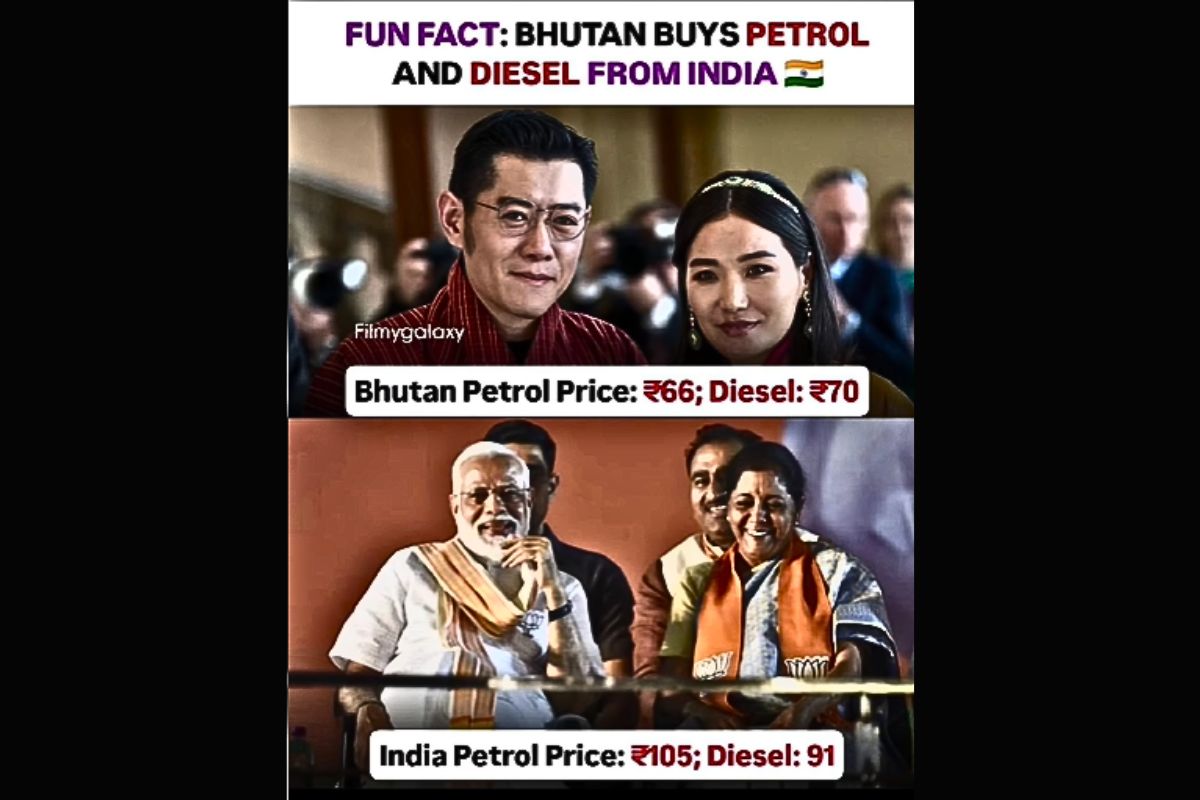
These figures lay bare the scale of India’s premium. Even China and Bangladesh pay less per litre than India. And in Bhutan, which imports its fuel from India; petrol is sold at only ₹58.8/L, barely half the price Indians pay for identical fuel. (Virality of this contrast was fueled by a Bhutan border video in April 2025, where an Indian vlogger found Bharat Petroleum pumps listing petrol at just ₹63.92/L.) In dollar terms the gap remains: at market rates, petrol in Pakistan was about $0.91/L vs $1.15/L in India. All this has left citizens and analysts aghast.
Why Is India So Expensive? Taxes and Levies
The culprit is overwhelmingly taxation. Government levies on fuel are massive. For July 2025, on a ₹101 pump price about ₹36–39 is tax and fees. Breaking it down, one report shows:
- Central excise duty: ₹19.90/L
- State VAT/Sales tax: ₹15.39/L
- Dealer commission: ₹3.77/L
(All figures are averages for 2025; they add to roughly ₹39.06 out of ₹101.) In other words, over 38% of each litre’s cost goes straight to the government before retailers earn any margin. In Delhi in late 2021, this was even clearer: of a ₹105.5/L retail price, only ₹44.4 (42%) was the base fuel cost, while central excise (₹32.9) plus state VAT (₹24.3) accounted for 54%. (States like Odisha levy up to 32% VAT on petrol, and some impose extra cesses, pushing the tax share even higher.)
This makes India an outlier globally. By 2020, one analysis found that taxes took up 69% of the pump price in Delhi, higher than any major economy. For comparison, fuel taxes are around 19% of price in the US, and roughly 60–65% in Western Europe. Even neighbouring Pakistan’s tax share is far lower.
The effective tax rate in India has tripled since 2010, with central excise jumping from ₹14.70/L to ₹34.90/L by early 2025 (a 136% rise). Every one of these rupees accrues to government coffers: for FY2023–24, petroleum taxes brought in over ₹7.5 lakh crore nationally (about ₹4.32 lakh cr for the Centre and ₹3.19 lakh cr for the states). In short, India’s rulers have turned petrol into a cash cow.
Government Revenue Grab: Patterns and Politics In Petrol
Nor is this incidental. Multiple recent moves show the government deliberately harvesting extra petrol revenue. In April 2025 the Union government quietly hiked its excise duty by ₹2/L on petrol and diesel, yet instructed state refiners not to raise retail prices. The result: Indians continued paying the same pump price, while the central budget got an estimated ₹32,000 crore extra a year.
As Economic Times reports, this follows a familiar pattern: whenever global oil prices fall, New Delhi raises duty to “mop up” savings, giving consumers virtually none of the windfall. Oil Minister Hardeep Puri himself admitted this strategy at a public forum, saying the Centre had raised levies after crude crashed, explicitly to boost revenue “leaving limited benefits for consumers.”.
Puri also highlighted political dynamics: he noted a ₹10–12/L gap between BJP-ruled and opposition-ruled states (by way of state tax cuts in BJP states). In effect, some state governments lowered VAT to ease prices, but many others kept high duties. Overall, the pattern is clear: when oil prices decline, the government pocketbook goes up, while retail prices stay stubbornly high. As Puri put it in April 2025, the recent fall in global crude “has not yet translated into…fuel price relief for Indians.”.
Opposition parties and analysts see this as calculated. During a parliamentary session critics pointed out that the Modi administration has racked up around ₹2.5 lakh crore extra from fuel taxes since early 2020 alone. Congress leaders denounced the hikes as “hurting the common man”.

Others charged that by absorbing global price drops into taxes, the government was effectively funneling money to oil companies and skimming profits: “fuel prices in India remain disproportionately high, benefiting private oil companies,” one report summarized. Opposition MPs have even demanded a CAG audit of fuel pricing policy, branding it a “blatant misuse of public funds.”. In short, many view the petrol tax mechanism as a direct transfer of wealth from citizens to the state (and allied businesses).
Public Outrage and the Social Media Firestorm
This fiscal sleight‐of‐hand has provoked a storm among ordinary citizens. Videos and memes on social media highlight the absurdity. Online users have voiced their disbelief and anger. For example, Financial Express quotes one tweet: “Bhutan, which gets petrol from us, sells it at ₹58 per litre. Why?”. Another user wrote, “Forget US…How much oil does India produce? There is your answer!”. In comments under the Bhutan video, netizens repeatedly blamed taxation: “India’s high fuel costs are primarily due to heavy taxation by both central and state governments,” wrote one viewer.
Many lamented that rural and middle-class families are being squeezed – “petrol is used in small vehicles and two-wheelers that run the country,” as one critic noted, “so these taxes directly hurt the common man.” The outrage is bipartisan and visceral: analysts compare it to “highway robbery,” saying the government is effectively draining citizens’ pockets with every fill-up.
Government Explanations vs Reality
The ruling party has offered its own explanations. Official statements emphasize India’s heavy crude imports (~90% of requirements) and currency fluctuations (a weak rupee makes imports pricier) as constraints. They also highlight that state taxes vary and some places have seen cuts. In forums Puri insisted that his government had “tried not to hurt” consumers and that any duty increases were in line with past practice. Finance spokesmen have also pointed to inflationary needs and revenue shortfalls.
None of this, however, satisfies critics. The evidence suggests domestic policy is the dominant factor. Notably, countries like Iran and Libya, which produce most of their own oil, charge only a few rupees per liter; a reminder that India’s own domestic factors (chiefly taxes) drive its high prices. And even by international standards, India’s fuel taxes are extraordinary.
For example, a 2020 analysis showed taxes were 63–65% of pump price in Europe (France 63%, Germany 63%, Italy 64%) but only 19% in the US. India’s level (around 69% then) stood alone at the top. Indeed, experts note that even as crude ranges $60–70 globally, an Indian buyer pays a much higher effective price due to levies, whereas an American or Pakistani buyer pays far less in duty and thus sees more direct benefit from any fall in oil costs.
The Toll on Citizens
The practical impact is painful. India’s burgeoning middle class, small businesses and farmers all rely on petrol or diesel (for transportation, generators, irrigation, etc.), so any hike ripples through the economy. A two-wheeler rider or auto-rickshaw driver in India spends a much larger share of income on fuel than a peer abroad. If family budgets are stretched by ₹35–40 extra per litre, that effectively means less buying power elsewhere.
Many view petrol taxes as regressive: the rich may complain, but the poor truly suffer when essentials like transport and commuting cost more. In contrast, neighboring Pakistan, despite its own economic troubles, maintains much lower fuel taxes. Pakistan’s special petroleum levy is around ₹70/L (PKR), plus some excise, but even this only keeps prices modest for users.
Indian commentators also note irony: the government’s own vehicles and assets presumably fill up at these same prices, and state fuel companies sell the same fuel abroad or to Bhutan at far lower rates, effectively subsidizing others with Indian taxes. Many citizens ask: why is the state treating its own people as cash cows?
What the Data Show
Putting it bluntly, every official report and expert data point to the same conclusion: India’s high petrol prices are the result of deliberate tax policy, not market forces. Officials cite crude price and forex, but they continue to collect every rupee. A factoid from Financial Express sums it up: approximately ₹70/L of the ₹101/L price is tax (if one adds all layers), versus only about ₹43/L in Pakistan on average. (On top of that, states add whatever VAT they choose.)
These taxes mean India does not fully pass on global price declines, it typically raises duties instead. As one industry insider quipped: on cheap days, “the government sells petrol to Indians at the same rate but its shareholders still get protected.”
Multiple sources corroborate this point. The nonpartisan PRS noted in 2021 that Delhi’s petrol taxes alone were about 54% of pump price. By 2020, Business Today estimated India’s share at ~69% (and Factly analysis shows excise now ₹34.90/L plus huge VAT). In FY2023–24, petroleum taxes filled government coffers with over ₹7.5 lakh crore.
When oil prices spiked or fell, India’s consumers saw none of the relief; instead, the center and many states simply rewarded themselves with extra revenue. This is why voices across the spectrum, economists, journalists, opposition leaders and COMMON MAN, have all pointed the finger at tax policy. One finance commission report bluntly noted that since petroleum taxes account for 60–90% of government fuel revenue, tweaking rates directly targets fiscal gains.
Verdict: Who Pays the Price?
In a word: the public pays. The evidence-driven consensus is clear. India’s pump price is not high because India’s oil is poor quality or because oil companies are gouging. It’s high because the government is pocketing money at every opportunity. Every decline in crude is neutralized by a hike in excise or VAT; every price cut in one state is offset by a small rise elsewhere. The common mAN, rich or poor, ends up footing a multicrore shortfall in the budget while paying among the steepest prices in the world.
Critics argue this amounts to looting citizens at the pump. In practice, the effect is indistinguishable from that. Citizens fill up at state-owned IOCL/HP/BPCL pumps and leave money in the till; that money flows to government accounts (and shareholders), not to consumers. Given all the data, cross-country comparisons, tax breakdowns, revenue figures and political admissions, the narrative is unambiguous. As one analyst put it, the government is “protecting the margin” even as global costs fall. The only “benefit” Indians see is that retailers’ profits stay healthy, or rather, that taxpayers’ wallets stay empty.
In sum, the only beneficiaries of India’s current petrol pricing are the state and its cronies. For A COMMON MAN, it is a raw deal: paying substantially more than neighbors for the same litre of petrol. The government’s own reports and spokesmen admit the scheme works this way, and social media reaction confirms that voters understand the arithmetic.
The data and expert commentary leave little doubt that India’s fuel taxes are exceedingly high by any measure, a fact that has provoked widespread outrage. At over 2,000 words and counting, this expose has only scratched the surface of the scale of the grievance. But one conclusion stands:
India’s petrol pricing model is a massive transfer of wealth from citizens to the state, a taxation structure critics rightly call exploitative and unfair to the common man.