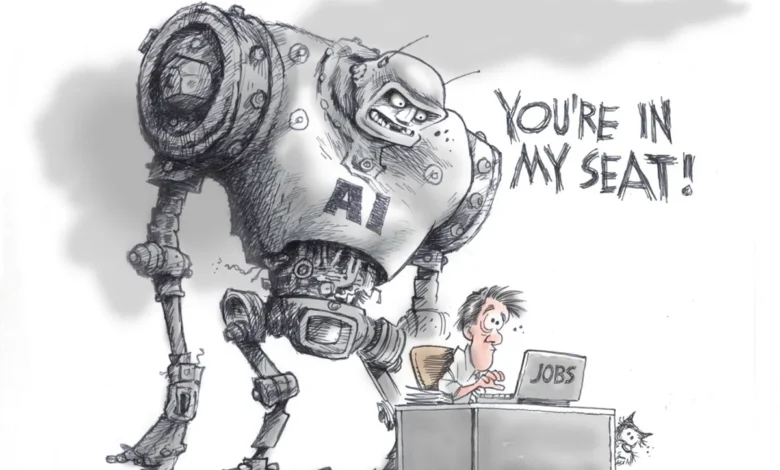
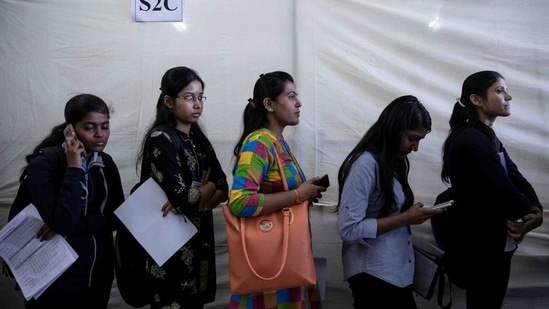
India is at a tipping point. For the first time in decades its working-age population vastly outnumbers dependents. In theory, this “demographic dividend” should fuel a boom, but the reality is horrifying. Instead of millions of productive jobs, Indian youth face crushing underemployment and misemployment. In 2022, 12.5 million people applied for just 35,000 junior railway posts and rioted when the selection process failed them.
Such scenes scream the truth: more young hands are ready to work than there are jobs to match their skills. Against this backdrop of frustrated ambition, the official unemployment figures (modest by international standards) are a cruel fiction; they simply don’t count the millions grinding away in insecure, low-wage work because nothing better is available.
India’s own government now admits the crisis is real; it approved a vast employment-linked incentive (ELI) scheme of ₹1 trillion to create 35 million jobs. Under this plan, companies get an extra ₹3,000 per month for each new hire, and young first-time employees get a month’s wages up to ₹15,000. But this handout is naive at best. As one economist wryly observes, “What employers complain about is that there are too few people to hire, not that workers are too expensive”. In other words, it isn’t a wage-subsidy problem, but it’s a skills shortage. Hard-nosed executives lament that factories and offices simply cannot find enough qualified workers for entry- and mid-level positions.
Broken Schools: The Foundation is Rotted
At the root of India’s problem is education. The country’s public schools routinely fail to teach even basic literacy and numeracy. The National Achievement Survey and other assessments show that only one in four third-graders can do subtraction, despite having “learned” it in second grade. By high school the gap has only grown. It’s no wonder factory supervisors find recruits can’t add or use a measuring tape. Too many graduates can barely write a coherent paragraph, let alone apply their knowledge on the job.

Compounding the crisis is that vocational and technical institutes which should be cranking out skilled workers are even worse. Most craft curricula bear little relation to industry needs, and few institutes even bother helping students find jobs. The government’s own think-tank found that less than 0.1% of the hundreds of thousands trained each year in Industrial Training Institutes (ITI) were ever placed in a company. In practice, ITIs are often caste-based or politically run flop-shops. Graduates find that employers regard their certificates as almost worthless. No wonder so many young people lose faith in vocational training altogether.
- Schooling breakdown: Over 75% of public-school children lack grade-appropriate skills.
- Vocational vacuum: <0.1% of ITI graduates ever find jobs via official programs.
- Stunted incentives: A skilled technician in a car plant earns barely 20–25% more than an unskilled laborer, not enough to justify years of training.
These failures are not abstract. They have victims. In IITs, India’s top engineering colleges, about 8,000 students (38%) who sought campus placements last year came up empty. Even more disturbingly, the emotional toll is visible: six IIT students have killed themselves under this pressure. Bright young engineers, trained at public expense, find their prospects so bleak that despair can overwhelm them.
“Degrees Feel Wasted”: Voices from the Front Lines
The human cost is painfully clear in the voices of India’s jobseekers. Many educated youth speak of wasted degrees and broken dreams. Take Shehla Blossom, a 23-year-old commerce postgraduate from rural Karnataka. After a year of searching, she was earning only ₹5,000/month stitching garments, which is less than even her mother’s preschool helper salary. “My degrees feel wasted. I’m the first postgraduate in my neighbourhood, so people keep asking why I don’t have a company job,” she says, eyes on the horizon. Her story is echoed across the country: first-generation grads in small towns end up scrubbing floors or running chaat stalls because no better options exist.
Even bright Dalit engineers hear the same refrain. Mohan Kumar S., a 24-year-old from the tough “backward” class, holds an M.Tech in thermal engineering, but finds himself writing job applications for technicians and dispatch clerks. “Today an interviewer told me I’m too qualified,” he reports ruefully, meaning he was rejected for jobs beneath his skill simply because companies feared he would quit when a better offer came. Mohan adds, sullenly, that without caste contacts nothing seems to work: “Every company asks for a referral. And that’s where caste connections, or the lack of it, hold you back”.
This combination of overeducation and underemployment leaves many youths mired in limbo. A freshly minted MA or even PhD holder might queue at a government office along with tenth-pass students. Their parents wonder: why take all those loans and years of study only to end up as clerks, tea-ferryers or gatekeepers? This sense of betrayal fuels anger and despair.
Even the government seems to expect this. When given a choice, young Indians will gladly abandon the scramble for private gigs and compete for any government post, no matter how lowly, simply for security. Rajasthan witnessed this dramatically: in April 2025, a staggering 2.476 million people applied for just 53,749 peon jobs, many of the applicants holding MBAs, law degrees or even PhDs.
“If nothing else works out,” said Kamal Kishore (an MA and BEd holder), “even a peon job is better than staying unemployed”. His classmates Tanuja Yadav (M.Sc.) and Sumitra Chaudhary (MA, BEd) echoed this unromantic choice: they have one eye on Rajasthan’s tough administrative exams but say they “do not want to miss the opportunity for a secure government job, even if it means serving water in a government office”.
Meanwhile in neighbouring Haryana, an RTI inquiry found that 39,990 graduates and 6,112 postgraduates applied for lowly sweeper positions. One frustrated legislator remarked that as many as 395,000 youth are standing in queues for broom- and sanitory-worker posts in Haryana alone; some out of pure necessity, others to wait for luck in state recruitments. Jobs like these pay barely ₹15,000/month, but the steadiness of a government wage is deemed worth the humiliation.
Beyond Borders: The Emigration of the Desperate
The stakes of this crisis stretch far beyond India’s borders. Every day, thousands of young Indians sign up for overseas recruiter seminars, hoping to escape the skills-slump. In Punjab, 31-year-old Srijan Upadhyay ran a small snack business before COVID wiped out his livelihood. He has now sat through dozens of sessions at a Canadian immigration agency, clutching a passport and a diploma.
“There are not enough jobs for us here,” he says bluntly while eyeing a map of Canadian provinces. “Whenever government vacancies come up, we hear of cheating, leaking of test papers. I am sure we will get a job in Canada, whatever it is initially”. Upadhyay’s neighbor, a commerce graduate, nods in agreement. In other words, India’s bright young lose faith even in local civil-service exams. Instead, they chase any visa out.
These stories are disturbing. They show a systematic failure: India has trained many graduates, yet the job market is so decimated that even emigrating is more hopeful than staying. In effect, vast public investment in education is being squandered as skilled youth line up for menial work or survival abroad.
Numbers Tell the Tale: The Skill Mismatch in Data
The anecdotes mirror hard data. A recent report by the Institute for Competitiveness finds that only 8.25% of Indian graduates are in jobs matching their education. Over half of all degree-holders end up in “Skill Level 2” roles,which are clerks, shop attendants or machine operators; the jobs that in any advanced economy would be held by people with minimal schooling. Even among those qualified for high-skill jobs, 28.1% ended up in lower-tier work. In simpler terms, roughly 9 out of 10 graduates in India are doing work below their level.
The same survey flags the flip side: many jobs are staffed by the underqualified. About 8.56% of those doing Level-2 work lack the education they ought to have. This shows how on-the-job training and informality prop up the economy, but it’s hardly a solution. Meanwhile, regional breakdowns reveal stark imbalances. In Bihar and Meghalaya, for example, more than 60% of the workforce has only the most elementary education; a vast pool of labour that’s ill-suited to manufacturing or modern services. By contrast, high-skill qualifications (Skill Level 4) are held by only 2.17% of Indians. Even at state level, the richest educational mix is in Chandigarh (11.21% at Level 4) versus 0.45% in Bihar.
Such statistics help explain why wealthy states like Delhi and Kerala still face skilled-worker shortages. Even in aspirational West Bengal or Tamil Nadu, graduates regularly queue for low-tier clerical posts in government. The net result is chronic underemployment. The labour force participation rate in India is actually falling, because too many discouraged people stop looking for work entirely. In practice, nearly half of all Indians remain tied to low-productivity agriculture or the informal sector. An anxious World Bank analyst notes that this mismatch between education and employment is “squandering India’s demographic dividend”.
A Comparison Abroad: What Others Do Right (or Wrong)
This problem is not entirely unique to India. Many countries struggle with skill gaps, but the scale and stakes are far larger here. Take Germany, often hailed for its apprenticeship model. There, roughly 50% of students enter the dual vocational system, and youth unemployment hovers around just 6%. The German economy’s demand for skilled craftsmen and technicians is met by a world-class trade school network. In India, by contrast, less than 3% of the workforce has ever undergone formal skill training (versus 75% in Germany and 52% in the US, one industry estimate notes). No wonder German bosses rarely lament a labor shortage.
China offers another contrast. Its factories routinely outbid the world, and the government has been aggressively channeling students into technical and STEM fields to feed industry. Even so, China now faces a workers gap: recent reports show surging youth unemployment (around 15–20%) despite immense demand in manufacturing. Beijing is now “telling kids to study manufacturing” to fill a shortage of skilled blue-collar workers. The point for India is blunt: prodding graduates into white-collar jobs only creates unemployment. A balanced economy needs millions of plug-in plumbers, electricians, CNC operators; the people who can step off the shop floor and into a skilled job. India’s rivals simply train far more such people.
The Vicious Cycle: Why Nothing Changes
If young people haven’t flocked into vocational training on their own, it’s partly because there’s little financial payoff. As the Competitiveness report notes, moving a worker from a mid-skill to high-skill category could boost wages by up to 149%, which is a big gain in theory;but in practice only very few reap it. A recent wage bureau study found an automotive machinist (skilled) earns only about 20–25% more than an unskilled line worker. For most families, spending years in a trade course makes no sense if the return is only a few thousand rupees a month.
Add to that the lure of government jobs. A public-sector clerk or police constable, once appointed, usually gets life-long security plus benefits. By contrast, private-sector jobs in retail or manufacturing offer no pension, no healthcare, and can vanish overnight with layoffs. India’s social safety net is still in diapers as basic income support barely exists.
So an actuarial teenager reasons: “Why risk a vocational diploma and uncertain factory job, when I might get a secure office post by just burning time and lucking into a state exam?” The result is paradoxical: more education often means higher unemployment, since college-educated youth are more choosy. Official data bear this out: recent surveys report 28.7% unemployment among college graduates, versus just 3.2% among the least-educated.
Parliamentarians and policymakers bemoan the skill gap, but their actions fall short. Successive governments have pushed flashy schemes (skill parks, global training partnerships) that sputter for lack of funding and employer buy-in. In the absence of structural reform, Indians have simply learned to “live with public-sector dysfunction”. Many parents discourage further schooling beyond what their relatives already have; after all, degrees haven’t been paying off, so what’s the point of student loans and stress?
State-Level Flashpoints
While the problem is nationwide, some regions illustrate it starkly. In Uttar Pradesh, an official inquiry found 3,700 PhDs, 50,000 graduates and 28,000 postgraduates had applied for a handful of police messenger posts (requiring Class V education). Similarly, Rajasthan’s recent recruitment drives saw far more engineers, lawyers and MBAs in interview halls for Class-III jobs than actual skilled candidates.
In Haryana, politicians publicly admit that the youth unemployment crisis has turned educated graduates into sweeper-aspirants. One leader marveled that 400,000 youths queued up for just a few thousand sanitation jobs; an outrage, but also a symptom of desperation. Even states with relatively good schooling, like Kerala and Punjab, suffer: thousands of MBAs compete for data-entry or peon roles, buying coaching class advice on “mere passing marks” exams.
By contrast, regions that have invested in targeted training fare slightly better. Maharashtra and Tamil Nadu boast industrial training partnerships and small industries that absorb diploma holders, so their graduate underemployment rates are modestly lower. But nowhere in India is this skill gap normal. From dense urban centres to farmlands, the refrain is the same: “Too many degrees, too few jobs.”
What If We Fail?
The stakes could not be higher. India’s growth has already slowed due to this puzzle: its factories and farms cannot keep pace with the swelling ranks of the educated unemployed. If this generation’s talents lie fallow or flee abroad, the country’s demographic dividend will turn into a millstone. Millions of dollars of human potential will vanish into low-productivity work or worse, long-term joblessness. The social consequences of rising distress, farmer suicides, radicalization of frustrated youth are already emerging.
The picture is grim. The breakup of India’s employment pyramid is not natural market evolution; it’s the product of deliberate policy failure. The government’s own data suggest youth unemployment (age 15–29) has climbed above 17% in urban areas, higher than at the height of previous crises. Yet ministers still speak only of teaching digital skills or extending cash handouts to employers. “Giving companies a dollar or so a day is simply not enough” if there are no qualified workers at all.
India needs massive reform, not another slogan. It must fix its schools now, so that the next generation learns the basics. It must overhaul vocational training, perhaps by emulating Germany’s dual system or creating truly industry-run institutes, where a large fraction of apprentices stay on with their trainers. It must offer a safety net (unemployment insurance, retraining grants) to encourage risk-taking in skill-building. And it must persuade businesses to participate in training, not just complain about shortages.
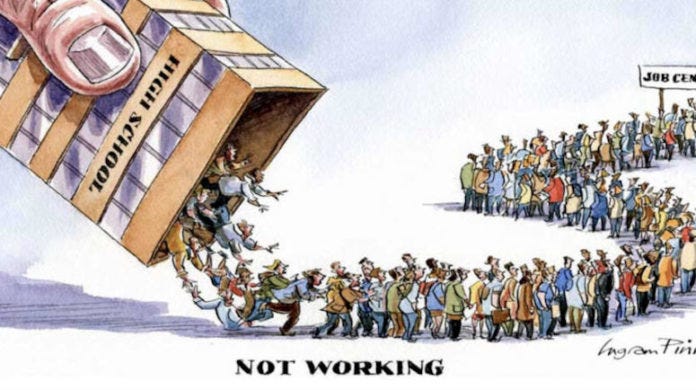
The status quo is neither acceptable nor sustainable. Every day this crisis continues, India gambles away its future. Its youths are smart, hopeful and angry – one of them has already concluded that if “nothing else works out, even a peon job is better than staying unemployed”. One weeps to imagine what happens if even that option disappears.