Why ED And SEBI Must Investigate HDFC Bank Amid Allegations Of HDFC Bank Chairman Atanu Chakraborty?


“Certain happenings and practices within the bank that I have observed over the last two years are not in congruence with my personal values and ethics.” — Atanu Chakraborty wrote on March 18, 2026
The Letter That Wiped Out ₹1 Lakh Crore in Minutes
It was a resignation letter. Certain words, written in the measured, bureaucratic English of a man who spent three decades as an Indian Administrative Service officer before ascending to the chairman’s chair of India’s largest private sector bank. It named no individual. It cited no specific incident. It used the language of personal conscience, like “values,” “ethics,” “congruence”, rather than the language of accusation. And yet, when Atanu Chakraborty submitted that letter on March 18, 2026, and walked out of HDFC Bank’s corporate offices in Mumbai after calling a board meeting on short notice, giving directors almost no information about the agenda, the effect was seismic.
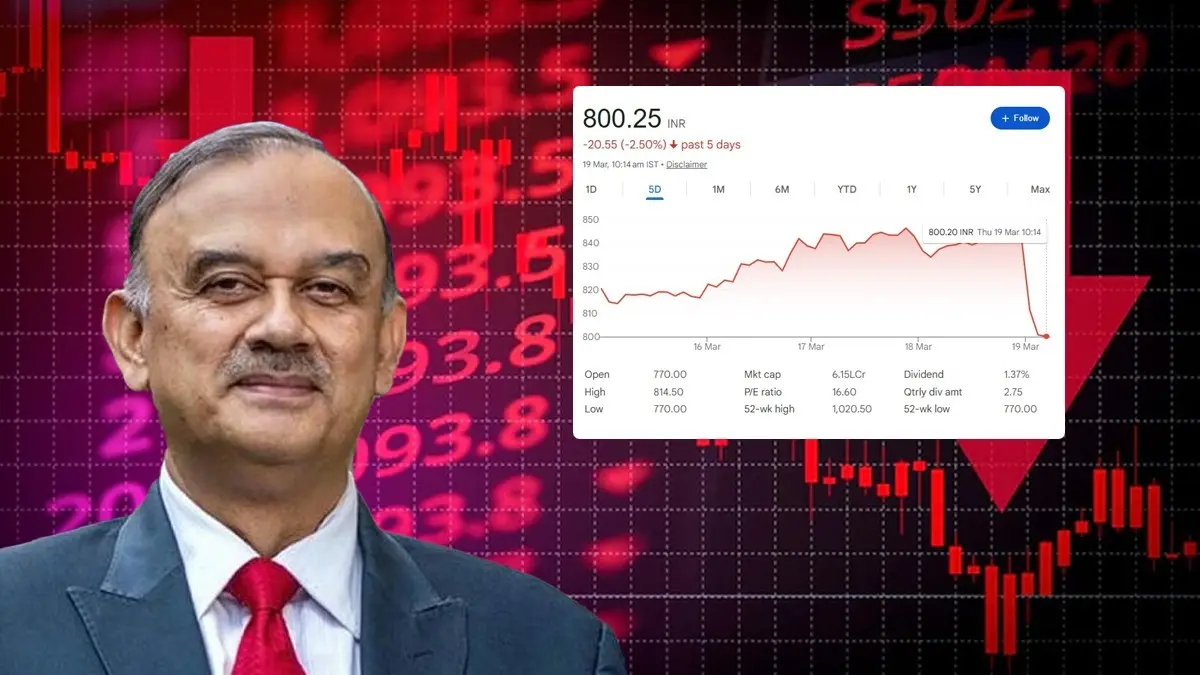
Within minutes of markets opening the next morning, HDFC Bank’s share price fell nearly 9 percent in early trade. By the end of three days, the stock had lost approximately 12 percent of its value, declining from ₹843 to around ₹735 per share. In market capitalisation terms, roughly ₹1 lakh crore, approximately $21 billion, had been erased from the books of a company that India’s retail investors treat as a near-sacred repository of financial trust.
The Reserve Bank of India issued a rare public statement reassuring markets that the bank was well-capitalised and operationally sound. The bank convened an emergency analyst call. Veteran HDFC banker Keki Mistry was rushed in as interim chairman. CEO Sashidhar Jagdishan pledged to act “ruthlessly” against any misconduct, describing the situation as “like fighting a ghost.”
A ghost! That is a remarkably revealing choice of words for the head of a ₹10 lakh crore institution. Because what Chakraborty’s exit has done is not create a ghost, but it has revealed one. It has exposed, in the most public and economically painful way possible, that India’s flagship private sector bank has been harbouring undisclosed internal tensions so serious that its non-executive chairman chose to fall on his sword rather than continue lending his credibility to practices he considered unethical.
A man who served as India’s Economic Affairs Secretary, who steered the country’s finances through the 2023 merger of HDFC Ltd with the bank, who had every incentive to manage his exit quietly, chose instead to write a letter that he knew would trigger a market storm, and refused to soften its language even when the board would have asked him to.
That act of deliberate, costly, public candour is either the expression of a man who had nothing left to say quietly, or the early warning signal of something much larger rotting beneath the surface of India’s most trusted private lender. Either way, it demands investigation. Not a performance review. Not an analyst call. Possibly, not enough is the appointment of external law firms whose report will be delivered in “a reasonable timeframe” and may never be made public. A full, independent, forensic investigation by the Enforcement Directorate and SEBI, the two bodies whose mandates are explicitly constituted to follow the trail of financial wrongdoing wherever it leads, including into the boardrooms of marquee institutions.
What We Know, What We Don’t, and Why the Gap Is Dangerous
To understand why this resignation demands regulatory investigation rather than corporate management, it is necessary to map, precisely, what is publicly known, and to be clear-eyed about why the gaps are alarming.
What is documented is, Chakraborty served as non-executive part-time chairman since April 2021 and was reappointed in May 2024. His resignation letter on March 18, 2026 cited “certain happenings and practices” not in congruence with his values and ethics, is a language he subsequently confirmed was deliberate and self-explanatory.
In interviews after the resignation, he pointed to two specific issues that had entered the public domain. First, regulatory action by the Dubai Financial Services Authority, which in September 2025 flagged lapses at HDFC Bank’s DIFC branch, restricting the bank from onboarding new clients and from conducting certain financial service activities, including investment advisory and transaction arrangements, over concerns about clients who had not completed required onboarding procedures.
The fallout from this episode triggered the departure of approximately a dozen executives, including the bank’s compliance officer and chief internal auditor. When bank management described these as “technical lapses,” Chakraborty said publicly that such framing “doesn’t really add to the standards of ethics” and that “these practices are not rooted in values.”
The second documented flashpoint involves the mis-selling of Credit Suisse’s Additional Tier-1 (AT1) bonds to clients; bonds that were written down to zero after Credit Suisse’s collapse in March 2023. Chakraborty expressed concern not merely about the mis-selling itself, but about the timing of accountability like penalties against officials involved came several years after the lapses occurred, which in his view reflected reactive correction rather than proactive ethical alignment.
Beyond these publicly confirmed issues, reported sources spoke with nine sources, including board members and current and former staff who described persistent internal rifts. A central tension was the proposed renewal of CEO Jagdishan’s tenure, for which regulatory approval is pending. Multiple sources confirmed that Chakraborty opposed the Jagdishan’s renewal while the majority of the board supported it. The two also clashed over the proposed minority stake sale in HDB Financial Services to Japan’s Mitsubishi UFJ Financial Group as Chakraborty opposed the deal, objecting both to foreign involvement and to the absence of a competitive bidding process. The proposal collapsed.
The friction extended to working style. Chakraborty, the former senior IAS officer, was hands-on and assertive, involving himself in decisions including promotions and staff interactions, which can be an unusual conduct for a non-executive chairman, but perhaps reflecting a level of concern about the institution’s internal culture that was not being addressed through formal channels.
What is not yet known, and what makes regulatory investigation not merely warranted but urgent, is the full scope of what Chakraborty observed over “the last two years.” A non-executive chairman of a systemically important bank who resigns citing ethics, refuses to soften his language, and specifically identifies the Dubai regulatory action and AT1 mis-selling as examples of a broader pattern of ethical misalignment — this is not a man complaining about personality conflicts. This is a man who has seen something, tried to address it through internal governance mechanisms, found those mechanisms inadequate, and made the most expensive signal available to him. The question ED and SEBI must answer is: what else did he see?
Part II: The Anatomy of Misgovernance — India’s Recurring Nightmare
What makes the HDFC Bank situation so alarming is not that it is unique. It is that it conforms, with startling precision, to a pattern that India’s financial sector has been unable to break for three decades. The specific institutions change. The specific frauds change. The specific individuals change. But the underlying architecture of failure, which includes unchecked CEO power, compromised boards, delayed regulatory action, and early warning signals that are systematically dismissed until the catastrophe is irreversible, replicates itself with the fidelity of a genetic code.
Let’s Start With The Yes Bank — The Textbook Catastrophe. No serious analysis of Indian banking governance can begin anywhere other than Yes Bank, because it is the most complete and documented case study of what happens when an institution loses its ethical anchor. Rana Kapoor co-founded Yes Bank in 2003 with a vision of building what he called “the best quality bank of the world in India.” By 2019, the bank was titled the world’s worst-performing lender. By March 2020, the RBI had been forced to impose a 30-day moratorium, cap withdrawals at ₹50,000 per customer, supersede the board, and orchestrate an emergency rescue in which SBI acquired a 49 percent stake to prevent a complete collapse.
What preceded this catastrophe was not a sudden external shock. It was a slow, observable deterioration that regulators saw and documented years before the crisis became uncontainable. As far back as 2015, the RBI conducted an Asset Quality Review that found Yes Bank’s non-performing loans were approximately seven times higher than the ₹750 crore the company had reported in its audited accounts, the actual figure was ₹4,930 crore.
The gap between the reported fiction and the documented reality was not a rounding error. It was a deliberate misrepresentation of the bank’s financial health, sustained across multiple reporting cycles. The RBI knew by 2015. It ordered Rana Kapoor to vacate his CEO position in September 2018, effective January 2019. That is a gap of three years between identifying the fraud and removing its architect. The consequences of that three-year gap fell entirely on depositors and retail investors who had no access to the AQR findings and were still putting money into a bank that regulators had already internally flagged as dangerously compromised.
When the ED finally arrested Rana Kapoor in March 2020, the charge sheet was devastating, that includes alleged kickbacks of ₹600 crore received from DHFL in exchange for ₹3,700 crore in loans; more than 40 shell companies linked to Kapoor’s family used for alleged money laundering; benefits worth ₹43 billion allegedly obtained by Kapoor, his family members, and associates as kickbacks for sanctioning loans to corporate groups that had turned into non-performing assets. The CBI filed charges in eight separate cases. SEBI later fined Kapoor ₹2 crore for mis-selling AT1 bonds, the same category of instrument that would reappear in the HDFC Bank narrative years later.
Then Comes The Kotak Mahindra Bank — The Succession Standoff. The regulatory complexity of succession and governance at India’s private banks is not confined to crisis institutions. Even Kotak Mahindra Bank, which is among the most respected private lenders in India, faced a prolonged, public standoff with the RBI over promoter shareholding and succession planning. The dispute centred on Uday Kotak’s stake in the bank, which the RBI wanted reduced below a specified threshold, and on the terms under which Kotak could relinquish his executive role while retaining effective influence.
The standoff stretched across years of litigation, regulatory back-and-forth, and public uncertainty about who ultimately controls governance at an institution with millions of depositors. The resolution, when it finally came, left open questions about whether India’s regulatory framework is genuinely equipped to manage the transition from founder-controlled private banks to genuine institutional governance, or whether it simply accommodates founder preferences until they become untenable.
How Could We Forget The IDFC First Bank — The Merger Identity Crisis. IDFC First Bank presents a different, but equally instructive, governance failure; the failure of institutional design at the point of a transformative merger. The bank emerged from the combination of IDFC Bank and Capital First in 2018, creating an institution whose identity, risk appetite, credit culture, and operational philosophy were unresolved from day one. The legacy IDFC Bank had a predominantly infrastructure-finance culture having a large-ticket, long-duration loans to government and quasi-government entities.
Capital First was a retail NBFC, a small-ticket, high-volume consumer lending. Combining these two cultures under a single banking license, without a clear resolution of which philosophy would dominate, created a governance vacuum at the leadership level that took years to even partially address. The bank’s performance under V. Vaidyanathan has been characterised by persistent questions about capital adequacy, the pace of transformation, and whether the retail-lending thesis that underpins the institution’s entire strategic rationale can be executed profitably enough to justify the risks being run.
Part III: Not Only The Legacy Companies, But The New Age Companies Also Have A Similar Problem
If the bank failures described above represent the collapse of governance structures that once existed, India’s new-age startup disasters represent something similarly fundamental, that revolves around the construction of billion-dollar enterprises on governance foundations that were always fictional.
Let’s Start With The Famous Controversial Shark’s Startup, BharatPe, aka The Ashneer Grover Implosion. BharatPe was, for a brief and dazzling period, one of India’s most celebrated fintech success stories. Co-founded by Ashneer Grover, it processed tens of thousands of crores in UPI transactions and was valued at over $2.9 billion at its peak. What internal investigation subsequently revealed was a company where the co-founder and his family members had allegedly misappropriated funds amounting to hundreds of crores through fictitious vendor invoices, where the board’s oversight mechanisms were either absent or bypassed, and where a whistleblower complaint ultimately triggered the governance explosion that Grover could not survive.
Grover resigned in March 2022. The company filed a case against him and his family seeking recovery of over ₹88 crore. SEBI and ED both examined the matter. What the BharatPe episode exposed was a Silicon Valley-style “founder-is-infallible” culture transplanted wholesale into an Indian fintech, where the board’s function had devolved into ratifying whatever the founder wanted, until it suddenly had to become the founder’s adversary.
The Comes The Recent Gensol Engineering And The Blusmart Sag, Which Was Once The EV Dream That Went Black on Future, And Red On Ledger, Rather Than Being Greener. Gensol Engineering, led by promoters Anmol Singh Jaggi and Puneet Singh Jaggi, represented what India’s new green economy supposedly looked like, electric vehicle leasing, solar power, and clean infrastructure.
The reality, according to SEBI’s investigation in 2025, was significantly different. SEBI’s probe found that approximately ₹977 crore of loans raised by Gensol Engineering for EV procurement from IREDA and PFC had allegedly been diverted, with funds routed away from their stated purpose and into channels that served the promoters’ personal financial interests, including the acquisition of luxury goods and real estate.
The company had also allegedly submitted falsified data to rating agencies, including fabricated bank statements, to maintain credit ratings that would have otherwise collapsed. SEBI barred Anmol and Puneet Singh Jaggi from the securities markets. The case is a textbook example of how ESG-themed companies, which are wrapped in the language of sustainability and clean energy can use that cloak to obscure governance failures that are, at their core, identical to the frauds of the pre-ESG era.
BluSmart — The EV Mobility Mirage. The collapse of BluSmart, India’s all-electric ride-hailing company, is inextricably connected to the Gensol Engineering scandal, because BluSmart was a sister concern of Gensol, both controlled by the Jaggi brothers. BluSmart had raised significant venture capital, built a fleet of electric vehicles on paper, and acquired a reputation in Delhi-NCR as a premium, reliable alternative to Ola and Uber.

When the Gensol fraud unravelled, it became apparent that the EV fleet that BluSmart was supposed to be operating had been either not fully procured or not fully paid for — the funds raised for vehicle acquisition had allegedly been diverted through the connected-entity structure. The company suspended operations in April 2025, stranding its drivers and its passengers simultaneously, and leaving investors with a company whose primary operating asset, its vehicle fleet was far smaller than represented. The BluSmart collapse is particularly instructive because it illustrates how governance failure in a connected promoter group can simultaneously destroy multiple companies, multiple investor bases, and an entire category of consumer trust.
Did You Foregt GoMechanic? GoMechanic, the venture-backed automotive servicing startup, presented perhaps the most nakedly documented case of governance failure in India’s startup ecosystem when its co-founder Amit Bhasin admitted in January 2023 that the company had inflated its financial numbers, specifically its revenue and the number of operational workshops, for approximately two years, in order to raise successive funding rounds at rising valuations. This was not accounting complexity or aggressive revenue recognition. It was a straightforward admission that the numbers shown to investors were fabricated.
The company laid off nearly 70 percent of its workforce. SoftBank, Sequoia India, and other investors collectively lost hundreds of crores. The episode prompted, but did not produce, a serious industry-wide reckoning about whether Indian venture investors were conducting adequate due diligence or whether they were simply trusting founder-reported metrics and outrunning each other to participate in the next round.
Part IV: The Institutional Pattern, What All These Failures Have in Common
Across all of these cases, from Yes Bank’s structured fraud to HDFC Bank’s current boardroom rupture to BharatPe’s vendor billing scandal to Gensol’s fund diversion, a consistent architecture of failure presents itself, and it is worth naming its components precisely, because they all appear to be present, in varying degrees, in the current HDFC Bank situation.
The first component is concentrated executive power with inadequate board counterbalance. In every case, the governance failure was enabled by a CEO, founder, or senior executive whose authority had effectively exceeded the board’s capacity or willingness to constrain it. At Yes Bank, Rana Kapoor operated for years with a board that either could not or would not question his lending decisions. At BharatPe, Ashneer Grover’s personality cult had rendered the board functionally subordinate. At Gensol, the promoter family controlled all key decisions. At HDFC Bank, Chakraborty’s resignation letter, and specifically his description of “incongruence” building over two years, suggests that an independent director attempted to exercise the constraining function and found it insufficient.
The second component is regulatory forbearance that converts early warning signals into delayed catastrophes. The RBI’s AQR findings about Yes Bank in 2015, three years before action was taken, represent the most egregious example, and we could see the pattern repeats across cases. Regulators identify, document, discuss, and then delay, all of these creating a window during which the problem compounds and the eventual rescue becomes more expensive for the public. The Dubai DFSA action against HDFC Bank in September 2025, and the subsequent departure of the compliance officer and internal auditor, (perhaps) represent exactly the kind of early warning signal that should trigger an immediate, invasive regulatory review. Whether that review has been conducted is not publicly known.
The third component is institutional capture of the disclosure mechanism. In every case, the public version of events, including the regulatory filings, the press releases, the analyst calls, substantially understated the severity of the underlying problem. Yes Bank’s NPAs were 7X higher than disclosed. GoMechanic’s revenue was fabricated. Gensol’s bank statements were falsified. HDFC Bank’s management characterised Dubai regulatory action as “technical lapses.” The credibility of financial disclosure in India is, at the systemic level, dependent on the integrity of leadership; and when that integrity fails, there is no mechanism short of forensic investigation that will produce the true picture.
The fourth and most dangerous component is the normalisation of “it’s fine” narratives at exactly the moment when it is not fine. The RBI’s public statement after Chakraborty’s resignation, affirming that HDFC Bank remains well-capitalised and operationally sound, may be entirely accurate at the technical, balance-sheet level. That is not the question. The question is whether the ethical practices and governance culture within the institution are sound. And the RBI’s statement does not address that question, because the RBI cannot address it without a full investigation of what Chakraborty actually observed. The reassurance, however well-intentioned, functions to suppress exactly the scrutiny that the situation demands.
Part V: Why ED and SEBI Must Act, Now, Before the Ghost Takes Shape!
The case for ED and SEBI investigation of HDFC Bank is not a case for presuming guilt. It is a case for proportionate regulatory action in the face of a documented, serious, public signal of governance failure at a systemically important institution.
Atanu Chakraborty is not a whistleblower from the fringes. He is a former Economic Affairs Secretary of India, a man who has spent his professional life inside the architecture of Indian financial regulation. He knows exactly what his words mean and exactly what their consequences are. He chose to use them anyway. The specific issues he has publicly identified, like the Dubai DFSA regulatory action, the AT1 bond mis-selling, and the delayed accountability for both are not internally manageable human resources matters.
The Dubai action involved restrictions on client onboarding and investment advisory services, triggered the exit of 12 executives including the compliance officer and chief internal auditor, and was characterised by management in terms that the chairman considered ethically inadequate. The AT1 bond mis-selling is precisely the category of conduct that SEBI’s mandate is designed to investigate and prosecute, and Chakraborty’s concern that accountability came “several years after the lapses occurred” raises a direct question about whether SEBI’s existing oversight of HDFC Bank’s market conduct has been adequate.
The ED’s jurisdiction is triggered by any credible indication of money laundering, proceeds of crime, or foreign exchange violations. The Dubai operation, involving client onboarding lapses, investment advisory irregularities, and the conduct of a DIFC branch regulated both by Indian and foreign authorities, is precisely the kind of cross-border financial activity that FEMA and PMLA investigations are designed to examine. If money moved through HDFC Bank’s Dubai operations in ways that violated FEMA, those violations do not become non-violations simply because management describes them as technical.
The historical argument is the most compelling of all. Every time India has waited for a banking institution to self-correct, the institution has not self-corrected. It has deteriorated. Yes Bank’s regulators waited three years after the 2015 AQR and the result was a national crisis requiring a taxpayer-backed rescue. The lesson of Yes Bank, BharatPe, Gensol, GoMechanic, and every other financial governance failure on this list is identical. The cost of early investigation is measured in weeks and regulatory effort; the cost of delayed investigation is measured in thousands of crores and destroyed lives.
HDFC Bank holds deposits from millions of ordinary Indians. Its retail investor base includes pensioners, salaried employees, and small business owners who have placed their long-term savings in an institution they trust because India’s financial press and its regulators have consistently described it as the gold standard of private sector banking. If that gold standard has been compromised, not at the balance sheet level but at the governance and values level, which is the level at which all balance-sheet catastrophes eventually originate, then these depositors and investors deserve to know, immediately, through proper investigation, rather than through a retrospective reckoning that arrives five years too late.
The ghost that Jagdishan described and the thing that is difficult to fight, that has no clear shape or location — is not the resignation letter. The ghost is perhaps, an unexamined governance failure in a systemically important institution. The way to fight a ghost is not to issue reassurances. It is to turn on every light in the building and look at every room. That is what ED and SEBI are constituted to do. The question, as always in India’s financial history, is whether they will do it before or after the catastrophe.
At the end, India’s recurring REFUSAL TO LEARN is something a matter of more concern!
There is a dismal circularity to India’s financial governance crises that ought to produce, by now, a different institutional response than the one we consistently observe. The crisis emerges. The damage is counted. The investigations begin, years late. The perpetrators are arrested or fined or merely exit with reputations intact. The regulatory post-mortems produce new guidelines. And then, in another institution, in another sector, under another set of respectable names, the same architecture of failure reassembles itself.
Yes Bank taught India that a single unchecked CEO can destroy a ₹10,000 crore institution over years of hidden NPA manipulation. BharatPe taught India that a charismatic yet controversial founder and an obsequious board are a governance catastrophe in waiting. Gensol and BluSmart taught India that ESG language is not a substitute for financial integrity. GoMechanic taught India that fabricated revenue in private companies eventually has to confront public investors and public consequences. IDFC First Bank taught India that merging incompatible banking cultures without resolving the underlying governance questions simply defers the problem until it becomes acute.
And now HDFC Bank, not a struggling NBFC or an overvalued startup, but India’s largest private sector bank, a ₹10 lakh crore institution that sits at the centre of the country’s financial architecture is showing the same early warning signs. A chairman who resigned citing values and ethics. A board that tried to manage the optics and failed. A CEO whose reappointment was contested by the institution’s own chairman. A Dubai regulatory action that cost twelve executives their jobs and drew the characterisation “not rooted in values” from the man responsible for overseeing the bank’s governance.
India has seen this film before. The only question that remains is whether its regulators will write a different ending this time, or whether, five years hence, analysts will be writing the post-mortem of a crisis that began with a resignation letter in March 2026 and ended with depositors counting their losses.

The Enforcement Directorate and SEBI have the tools. They have the precedents. They have the warning. What they do with all three will define not just the future of HDFC Bank, but the credibility of India’s financial regulation as a genuine protective force, rather than a reactive clean-up crew that arrives, reliably, after the house has already burned down.