Justice Delayed Is Justice Denied: Why Is Justice In India So Slow?
A look at the 5.4-crore-case backlog choking Indian courts, and who really pays the price!

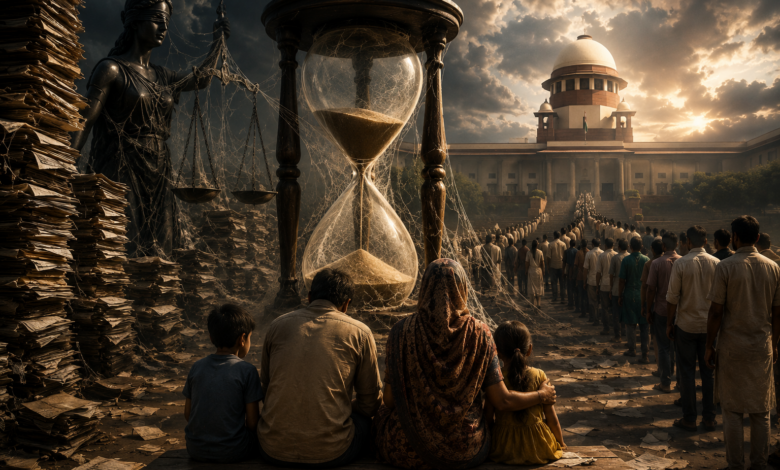
There is a courtroom in Allahabad where a land dispute has outlived the two men who filed it. There is a bench in Punjab and Haryana where a 97-year-old retired army officer waited two years for his case to be heard five times. There is a woman in Delhi named Shaheen Malik who survived an acid attack, watched her attacker’s trial crawl for over a decade, and said the quiet part out loud: “The delay wasn’t just an inconvenience, it was a punishment for being the victim.” She lived, as she put it, in “a permanent state of waiting”- her recovery tied to a verdict that never came.
This is not a fringe story. It is the median Indian experience of the justice system.
As of July 2026, more than 96,000 cases are pending before India’s Supreme Court, the court that is supposed to be the final, fastest word on constitutional rights, the epitome of justice, and over 10,000 of them have been waiting for a decade or more. 26 cases have been pending in the apex court for over 30 years. Across the country’s 25 High Courts, 80,660 cases have been pending for more than three decades, which is longer than many of the litigants involved have been alive. These are not opposition talking points. They are numbers the Union Law Minister, Arjun Ram Meghwal, read out in Parliament, sourced from the government’s own National Judicial Data Grid.
Zoom out further and the picture gets almost unbelievable: 5.64 crore (56.4 million) cases are pending across India’s courts, the Supreme Court, the High Courts, and the district and subordinate courts combined. That is roughly 1 pending case for every 25 Indians. And the backlog is not shrinking. It is growing, year after year, because India files more cases annually than its courts can dispose of.
This is the story of why. It is a story about missing judges, a decades-long standoff between the executive and the judiciary over who gets to appoint them, a constitutional right to a “speedy trial” that has become a punchline, and an economy that is quietly bleeding money, and investors, because the one thing every functioning market needs, a reliable place to enforce a contract, is broken. And, uncomfortably, it is also a story about who benefits from a system this slow; because in India, as the Supreme Court itself has observed, delay is not always a bug. For some litigants, it is the strategy.
The anatomy of the backlog: 5.4 crore cases and counting
To understand why Indian courts are so slow, one first have to understand the shape of the problem, because “pendency” is not one crisis, it’s several, stacked on top of each other.
According to Data For India’s analysis of National Judicial Data Grid figures, there were 54 million cases pending across the three tiers of the Indian judiciary at the end of 2025,aka the district and subordinate courts, High Courts, and the Supreme Court. The district and subordinate courts, the entry point for almost every Indian who goes to court, account for nearly 48 million of these cases on their own. This is where the ordinary citizen’s experience of “justice” actually happens; not in the marble corridors of the Supreme Court, but in a crowded tehsil courtroom where a bounced cheque case has been listed for the fortieth time.
The backlog has not been static. Total pendency has risen roughly 80% in the last decade, and the subordinate courts alone saw an 85% increase, jumping from 26 million to 48 million cases. A significant chunk of that spike happened between the end of 2019 and 2021,which are the pandemic years, when courts were physically shut and case filing outpaced disposal even more dramatically than usual.
How old is “pending”? In the district and subordinate courts, nearly 1/3 cases have been pending for more than 5 years, and 1/10 for more than 10 years. It gets worse as you go up: in the High Courts, almost every 2nd case is more than 5 years old, and every 4th case is more than a decade old. Even the Supreme Court, theoretically insulated from the worst of this because it hears a smaller volume of matters, has just over one in four cases older than 5 years.
Some states are in a category of their own. In Bihar, more than half of all pending cases are over 5 years old; in Tripura, by contrast, only 15% are. One of the core problem is massive judge vacancies and an inadequate number of sanctioned courtrooms/judges per capita relative to the sheer population density. Civil vs criminal, and why it matters. The nature of the backlog also shifts depending on which rung of the judiciary you’re looking at. In the subordinate courts, roughly 70-74% of pending cases are criminal — bail applications, ongoing trials, cheque-bounce cases filed under the Negotiable Instruments Act.
In the Supreme Court, it flips. 79% of pending matters are civil, largely because writ petitions — the constitutional remedy for enforcing fundamental rights — are filed far more often on civil subject matter than criminal. This asymmetry matters because it tells you something structural: the volume problem (crores of small, often petty cases) lives in the trial courts, while the complexity problem (constitutional questions, corporate disputes, appeals of national significance) lives in the higher judiciary — and both are clogged for entirely different reasons.

And here is the detail that should make every taxpayer wince. Researchers analysing Supreme Court data found that in 73% of cases the apex court admits, the government itself is the appellant — meaning the state, having lost in a lower court, chooses to appeal anyway, often with a low probability of success (in tax matters, success rates fall below 50%). The government is, by its own litigation habits, one of the largest single contributors to the very backlog it complains about in Parliament.
Add to this a further irritant. A large share of new filings in subordinate courts are not complex disputes at all, but low-value traffic and regulatory violations that could, and in some countries do get resolved through a fine, an app, or a fast-track administrative process, not a judge’s docket.
The judge shortage: 1 judge for 187 lakh people
If you had to isolate a single root cause beneath every other explanation for delay, it would be this: India simply does not have enough judges.
The number that captures it best comes from the Law Commission of India, which decades ago recommended a judge-to-population ratio of 50 judges per million people. India’s actual ratio today sits at roughly 22 judges per million, less than a third of what its own government’s expert body said was necessary, and among the lowest ratios in the democratic world. A Supreme Court-commissioned report titled “State of the Judiciary” put a stark frame on it: with a population of over 139 crore, India had roughly 20,580 working judges across all three tiers, trying to hold back a tide of 5 crore-plus pending cases.
At the ground level this translates into absurd individual workloads. Reporting from the Christian Science Monitor found that the average Indian judge is currently handling over 2,200 cases at any given time — a caseload that, in practice, forces judges to spend just a few minutes per hearing and a handful of minutes reaching a judgment. One retired High Court judge has estimated it would take 320 years to clear the existing backlog at current disposal rates if not a single new case were filed — which, of course, is not going to happen, because tens of thousands of new cases are filed every single day.
The vacancy crisis is worst where the caseload is heaviest. In 2025, the Allahabad High Court, India’s largest, has a sanctioned strength of 160 judges but was functioning with as few as 79 in position, under 50% strength, while sitting on more than 11.4 lakh pending cases. Litigation groups pointed out the brutal math: even at full sanctioned strength, Allahabad would still have only one judge for every 15 lakh people, each carrying roughly 7,220 pending cases.
The Punjab and Haryana High Court tells a similar story, where pendency is crossing 4.28 lakh cases while functioning with barely 51 of its 85 sanctioned judges, a number about to shrink further as senior judges retire with no confirmed pipeline of replacements. As of July 2026, the Allahabad High Court operates with 108 of 160 sanctioned judges, resulting in a 32.5% vacancy rate and a backlog exceeding 1.22 million cases. Simultaneously, the Punjab and Haryana High Court faces over 35% vacancy, with only 55 of 85 judges managing a backlog of over 4.3 lakh cases.
Nationally, vacancy in the High Courts has hovered between 33% and 40% in recent years, and around 20–26% in the subordinate courts — the base of the judicial pyramid, where the vast majority of Indians actually encounter the law. Retired Supreme Court Justice Madan Lokur, now chairperson of the UN’s Internal Justice Council, put the diagnosis plainly to CBC News: “Recommendations [for judge appointments] are not being made on time,” and even when they are, “the vacancies are not being filled up.”
Why does a country of 1.4 billion people, producing hundreds of thousands of law graduates every year, run its courts at 60–70% staffing? The answer sits squarely in the next section, and it is less about a shortage of qualified people than a broken machine for hiring them.
The appointments deadlock: how India’s judges actually get hired, and why it keeps breaking down
Here is a fact that surprises most people outside the legal profession: India’s judges are appointed, in the main, by other judges.
Under the “Collegium system”, created not by the Constitution’s text but by Supreme Court judgments in the 1990s (the “Three Judges Cases”) — a panel of the Chief Justice of India and senior-most Supreme Court judges recommends candidates for judgeships in the Supreme Court and High Courts. The government’s formal role is to conduct background checks and then notify the appointment — in theory a rubber stamp, in practice a chokepoint.
The mechanism for how this process is supposed to run — timelines, consultation, documentation — is laid out in a document called the Memorandum of Procedure (MoP). And this is where the system has been quietly jammed for over a decade. The MoP has not been finalised to the satisfaction of both the judiciary and the executive since the government took office in 2014, an unresolved dispute that both sides have used as cover for delay: the government sits on Collegium recommendations without either approving or formally rejecting them (there is no fixed deadline forcing its hand), while the judiciary insists the current stalemate is itself a symptom of executive overreach.
The friction has occasionally spilled into open, undiplomatic confrontation. In 2016, then–Chief Justice T.S. Thakur told the government, on the record, in open court: “You want to lock out Justice?”, pointing out that some High Courts were functioning at barely half their sanctioned strength because 75 Collegium recommendations made since January that year had simply not been acted upon.
He warned that “half of the courtrooms in Karnataka High Court are locked,” adding: “We had a situation when there were judges but no courtrooms, today we have courtrooms but no judges.” Reporting from that period counted 270 High Court judge recommendations left unanswered by the central government at one point — a backlog of appointments sitting on top of a backlog of cases.
This isn’t ancient history dredged up for effect — it is a structural feature of the system that resurfaces every few years under different governments, because the underlying design flaw (no binding timeline, no tiebreaker mechanism, mutual veto by delay) has never been fixed.
The ad-hoc judge workaround, and its risks
Faced with a permanent-appointments pipeline that keeps clogging, the judiciary has increasingly reached for a constitutional escape hatch: Article 224A, which allows a High Court’s Chief Justice, with the President’s consent, to call retired judges back to the bench temporarily to help clear arrears.
Article 224A had been almost dormant for decades — used for the first time in 1972, and only a handful of times since. But in February 2026, the Supreme Court Collegium approved the appointment of five retired judges as ad-hoc judges to the Allahabad High Court for two years, a move framed as emergency triage for a court sitting on nearly 12 lakh pending cases with barely half its sanctioned bench filled. The Supreme Court has laid down formal trigger conditions for using this route — originally, vacancies exceeding 20% of sanctioned strength, or more than 10% of the backlog being over five years old — and in January 2025, it relaxed even those conditions to make the tool easier to deploy.
But legal commentators have pushed back hard, and their argument is the crux of why this “solution” is contested rather than celebrated. As one analysis in The Leaflet put it, ad-hoc appointments risk undermining the judiciary rather than fixing it — because they treat a structural vacancy crisis with a temporary plaster. Critics raise three specific concerns:
- Moral hazard for the government. If retired judges can always be summoned to plug the gap, there is less political and institutional pressure to actually fill permanent vacancies through the ordinary, more transparent Collegium process — the government gets to relieve the visible symptom (backlog headlines) without treating the disease (unfilled sanctioned posts).
- Independence concerns. Retired judges seeking further post-retirement assignments may — even subconsciously — be more accommodating toward the executive that controls whether they get recalled, raising questions about judicial independence that permanent, tenured judges are constitutionally insulated from.
- It is a two-to-three-year fix for a permanent problem. Ad-hoc judges’ tenures are capped; when they end, the vacancy simply resurfaces, unless the underlying appointment machinery has, in the meantime, actually been repaired.
When delay becomes a constitutional crisis, not just an inconvenience
It is tempting to talk about “pendency” the way you’d talk about a supply-chain backlog — an operational inefficiency, unfortunate but morally neutral. It is not. In India, the right to a fair, prompt legal process is not a courtesy. It is, per the Supreme Court’s own repeated rulings, a fundamental right.
In the landmark 1979 case Hussainara Khatoon v. State of Bihar, the Supreme Court — responding to newspaper exposés of undertrials languishing in Bihar’s jails for periods longer than the maximum sentence for their alleged crime — held that the right to a speedy trial is implicit in Article 21 of the Constitution, the right to life and personal liberty. Justice P.N. Bhagwati’s judgment was unambiguous: denial of a speedy trial is a denial of the right to liberty itself, and any accused person denied that right can approach a High Court for a writ compelling the state to try them promptly.
Nearly 50 years later, the Court is still saying the same thing, because the underlying problem never went away. In a 2026 ruling, the Supreme Court reiterated that prolonged incarceration of an undertrial “without commencement or reasonable progress of the trial… has the effect of converting pretrial detention into a form of punishment” — and that this constitutional guarantee applies regardless of the gravity or type of the offence. In that very case, the delay was traced not to the accused, but to the investigating agency itself appealing a lower court order, generating an eight-month hold-up entirely of the state’s making.
This is where “pendency” stops being an abstraction and becomes a violation with a face. Consider the numbers:
- Undertrial prisoners now make up 76% of India’s entire prison population — up from 66% in 2012 — according to the India Justice Report 2025. In 301 prisons, every single inmate was an undertrial: nobody convicted, everybody waiting.
- According to the NCRB’s Prison Statistics India 2024 report, the undertrial count stands at 3,71,440 people, accounting for 72.6% of India’s total prison population.
- Nearly two in three undertrials are educated below grade 10 or illiterate, and disproportionately from economically weaker, often lower-caste backgrounds — meaning the people paying the steepest price for court delay are frequently those least equipped to expedite their own case through private legal muscle.
- Prisons in states like Uttar Pradesh continue to face severe overcrowding, operating at roughly 150% to 160% of their designed capacity. This ongoing crisis is driven substantially by undertrial overcrowding—with unconvicted inmates making up roughly 73% to 76% of the prison population—rather than convicted populations.
The presumption of innocence, one of the bedrock principles of any constitutional democracy, is being quietly inverted for hundreds of thousands of Indians who have been convicted of nothing, and yet serve years of imprisonment anyway — because the trial that would determine their guilt or innocence has not even meaningfully begun.

Isn’t this signalling towards a “constitutional crisis”? The phrase tends to conjure dramatic images — a coup, a suspended parliament, tanks outside a courthouse. India’s version is quieter and, arguably, more corrosive precisely because it is slow-motion and bureaucratic rather than sudden. A right that exists unambiguously on paper — speedy trial, access to justice, equality before law — is being systematically hollowed out not by any single unconstitutional act, but by an accumulation of institutional under-resourcing that no single actor is fully accountable for.
Courts blame vacancies and infrastructure; the government blames the judiciary’s “exclusive domain” over case management; both point to litigant and lawyer behaviour. Meanwhile, the person actually experiencing the “crisis” is not a constitutional scholar — it is an undertrial in an overcrowded barrack, or a rape or acid-attack survivor watching the accused walk free on bail year after year while the case gathers dust, as in Shaheen Malik’s story. When a right this fundamental becomes, in effect, unenforceable for the majority of people who need it, the distance between “operational backlog” and “rights crisis” collapses.
What judicial delay actually costs India — in money
Set aside the human cost for a moment and look purely at the ledger, because the economic case against India’s court delays is, if anything, even starker than the human-rights case — and it is a case increasingly made by economists and international rating agencies, not just activists.
The World Bank’s long-running Ease of Doing Business data found that it takes an average of nearly four years to enforce a simple commercial contract in India — placing the country among the bottom five in the world on contract enforcement speed. Think about what that single statistic implies for a small manufacturer who hasn’t been paid by a client, or a landlord fighting an illegal tenant, or a lender trying to recover a defaulted loan: the legal remedy exists on paper, but by the time a court actually delivers it, the underlying business relationship, the cash flow need, or the asset itself may no longer be worth pursuing.
The specific economic mechanisms researchers point to:
- Frozen capital. An estimated $200 billion is currently locked up in land and property disputes alone in India — capital that cannot be redeployed, developed, mortgaged, or sold cleanly while ownership remains contested in a slow-moving court.
- Elevated legal costs and management time. Long-running cases don’t just cost legal fees; they consume enormous amounts of a company’s or individual’s time and attention across years, a cost that is real but notoriously hard to quantify because it’s spread diffusely across an organisation rather than showing up as a single invoice.
- A permanent nudge toward informality. When contract enforcement is unreliable, businesses — especially small and medium enterprises — rationally choose to keep more of their economic relationships informal, relying on personal trust networks, community reputation, and relationship-based dealing rather than written, enforceable contracts. This keeps swathes of the economy in the unorganised sector, undermining the scale, transparency, and access-to-formal-credit benefits that formalisation would otherwise bring.
- Distorted business behaviour. When the threat of swift legal consequence is weak, unethical or opportunistic commercial practices — defaulting on payments, breaching agreements, slow-walking obligations — become comparatively less risky, because the counterparty’s realistic recourse is a years-long court fight rather than prompt enforcement.
- A direct drag on GDP. Several economic studies estimate that judicial delays reduce India’s GDP growth by roughly 1–2 percentage points every year — concentrated in sectors that rely most heavily on contract-dependent, relationship-specific investment: modern manufacturing supply chains, cross-border trade, and long-gestation infrastructure and investment projects.
None of this should be surprising once you sit with the arithmetic of the earlier sections: a country where it can take a decade or three for a High Court case to resolve is, by construction, a country where “the rule of law” — the single most-cited precondition for sustained economic growth in development economics — is only partially and unevenly available.
Why global business is voting with its feet: Singapore over Mumbai, Delhi over nowhere
If judicial delay were only a domestic irritation, it would still matter enormously to the 1.4 billion people who live with it. But it has also become a live, quantifiable factor in how the world chooses to do business with India, and the evidence is uncomfortable.
India set a public target to become one of the world’s top five international arbitration hubs by 2030. Arbitration exists precisely to let companies resolve disputes outside the court system — faster, more privately, with specialist arbitrators instead of generalist judges. It is meant to be India’s escape valve from its own court backlog. And yet, by the numbers: only about 2% of global companies currently choose India as their seat of arbitration. Meanwhile, in one of the more telling ironies of this whole story, Indian companies themselves are among the top users of arbitration seated in Singapore — meaning Indian businesses, given the choice, frequently opt out of their own country’s dispute-resolution system in favour of a foreign one.
Why Singapore, specifically? Legal analysts converge on a consistent list of reasons:
- A trust gap on judicial interference. Indian arbitration, historically, has been more vulnerable to Indian courts stepping in — reviewing awards, entertaining challenges, delaying enforcement — even after reforms in 2015 and 2019 explicitly aimed at curbing this. Singapore’s courts, by contrast, have built a strong, consistent reputation for supporting arbitral awards rather than second-guessing them.
- Network effects. Because so many Indian and Asia-Pacific companies already use the Singapore International Arbitration Centre (SIAC), it has become the default, low-friction choice — contracts are easier to negotiate when your counterparty is already comfortable with the forum, and specialist arbitration lawyers and infrastructure are concentrated there.
- Neutrality for foreign investors. For a foreign investor or the parent company of an Indian subsidiary, an arbitral seat in Singapore offers a genuinely neutral venue, insulated from any concern (real or perceived) about “home-court” advantage for the Indian party.
- Enforcement outside India, too. An award from an international seat like Singapore, being a signatory of the New York Convention, is more easily enforceable in the “entire developed world” — a material advantage for companies with cross-border assets.
To be fair, India’s Supreme Court has made real efforts to fix this — landmark rulings like BALCO v. Kaiser Aluminium (2012) and PASL Wind Solutions v. GE Power Conversion (2021) explicitly moved the law toward less judicial interference and greater party autonomy in choosing a foreign seat. But as one recent legal analysis dryly summarised: “the reality on the ground is still not ideal.” Even in cases where India’s post-2015 legal framework looks formally similar to Singapore’s, older, more interventionist precedents (like the “Wednesbury rationality” standard from the 2003 ONGC v. Saw Pipes-lineage cases) continue to cast a long shadow over how lower courts actually behave, regardless of what the statute book or the Supreme Court says it wants.
The upshot for international investors is blunt: fast, predictable contract enforcement is not a nice-to-have for capital allocation decisions — it is close to the whole ballgame. Global arbitration hubs like London, Singapore, and Paris succeed because they package together experienced specialist judges, dedicated commercial courts, and orders that get enforced without delay. Until Indian enforcement becomes similarly “consistent, efficient and predictable,” as one analysis puts it, India will keep losing this specific, high-value category of legal business to jurisdictions a few hours’ flight away — even when the underlying dispute, the underlying company, and the underlying money are all thoroughly Indian.
Who actually profits from endless litigation?
This is the question polite policy papers tend to avoid, because the honest answer indicts more than one powerful constituency at once. But the Supreme Court of India has, remarkably, asked it out loud — in one of the most-cited litigation sagas in the country’s modern legal history: the Sahara case.
The dispute, between market regulator SEBI and the Sahara Group over roughly ₹24,000–25,000 crore allegedly raised illegally from millions of small investors through opaque financial instruments, dragged through the courts for well over a decade, spawning appeals, contempt petitions, and repeated missed deadlines.
At one hearing, after listening to arguments stretch across more than two years on aspects of the case, the Supreme Court asked lawmakers to consider a legislative mechanism to “make anyone who indulges in endless litigation pay” — a direct judicial acknowledgment that the system, as designed, allows a well-resourced party to treat delay itself as a strategy, absorbing years of court time with minimal real consequence for doing so.
That single episode crystallises a broader, uglier truth about who benefits from a slow judiciary:
- Deep-pocketed litigants and corporations can treat protracted litigation as a form of leverage. A company that owes money, or is fighting a regulatory penalty, often has every financial incentive to appeal, re-appeal, seek adjournments, and exhaust procedural options — because a decade of delay, with the money sitting invested or simply retained, can be worth more than losing the case promptly. The asymmetry is stark: the ordinary litigant runs out of money and patience long before an institutional or corporate litigant does.
- The government itself, as the earlier statistic on 73% of admitted Supreme Court cases having the state as appellant shows, is arguably the single largest institutional beneficiary of a system where losing a case in a lower court carries little real cost — you can simply appeal, tie up the matter for years, and delay a payout, a policy reversal, or an inconvenient precedent, regardless of your odds of ultimately winning.
- Some litigants and their lawyers financially benefit from prolongation itself — a legal fee structure that bills by hearing, by appearance, by year, rather than by resolution creates a perverse (if rarely stated openly) incentive structure where a faster resolution is not obviously in every professional’s economic self-interest, even if it is unambiguously in the client’s and the public’s interest.
- Meanwhile, the ordinary citizen — the acid-attack survivor, the small trader waiting on a payment, the family fighting over an ancestral plot of land — has no comparable capacity to “outlast” the system. They are the counterparty against whom delay is weaponised, not the party wielding it.
This is the uncomfortable core of the “who profits” question: judicial delay is not a random, evenly distributed misfortune. It is a cost that falls heaviest on those with the least capacity to absorb it, while offering real, if rarely acknowledged, strategic value to those who can afford to wait — whether that’s a large company, a government department, or simply the more litigious of two private parties in an unequal fight. The Supreme Court’s own plea to Parliament, essentially asking for a legal cost to be attached to bad-faith prolongation, is a tacit admission from the country’s highest court that its current architecture does not adequately price in, let alone punish, the strategic abuse of delay.
What’s actually being tried — and why none of it is enough yet
To be fair to the system, India is not standing still. A range of fixes have been attempted, with mixed and partial results:
- Alternative Dispute Resolution (ADR): mediation, conciliation, and Lok Adalats (informal “people’s courts” that settle disputes by compromise rather than adjudication) have been scaled up specifically to divert volume away from formal courtrooms. Lok Adalats have disposed of enormous numbers of petty and compoundable cases — but they work best for disputes both sides genuinely want settled quickly, not for the contested, high-stakes matters that make up the oldest backlog.
- Specialised tribunals — for company law, tax, and other technical domains — aim to route complex matters to expert benches rather than generalist courts, in theory speeding up both accuracy and pace.
- Technology: e-filing, virtual/video hearings (which expanded dramatically and permanently during the pandemic), the digitisation of case records, and AI-assisted pilot tools like the Supreme Court’s SUPACE system (used to flag filing defects and summarise voluminous evidence) are being deployed to cut administrative friction. The government has reportedly spent over ₹9,800 crore since 2011 on court infrastructure and technology upgrades.
- Case categorisation reform: the Supreme Court has introduced 48 categories and 182 sub-categories for its pending matters, an attempt to make the true shape of the backlog — how much is routine, how much is genuinely complex — visible for the first time, so that resources and fast-track benches can be targeted rather than spread thin.
- Ad-hoc judges under Article 224A, discussed above — a real if contested short-term relief valve.
- Fast-track courts for specific categories (crimes against women and children, for instance) — disposing of hundreds of thousands of cases, though critics note these too suffer from inconsistent staffing and funding across states.
The pattern across nearly all of these initiatives is the same: each is a genuine, useful partial fix for a problem whose root cause — chronic under-staffing of the permanent judiciary, driven by an unresolved appointments deadlock between the executive and the judiciary — none of them actually touches. Technology can make an existing judge’s day marginally more efficient; it cannot conjure a judge who doesn’t exist.
Lok Adalats can clear petty disputes; they cannot resolve a contested thirty-year-old land title case. Ad-hoc judges can temporarily plug a vacancy; they retire again in two years. Until India either fixes the mechanics of how permanent judges get appointed, or substantially and durably expands sanctioned judicial strength (and actually fills those posts), the backlog will keep being managed at the margins rather than solved.
The bottom line
Justice delayed is not an abstraction in India — it is a lived condition for hundreds of millions of people: the undertrial who has served more time waiting for a verdict than the sentence for the alleged crime would carry; the small business owner whose payment is legally owed but practically unrecoverable for years; the multinational that quietly routes its India-linked disputes through Singapore rather than risk a Mumbai courtroom; the acid-attack survivor who watched her own recovery become hostage to a trial calendar.
The causes are structurally intertwined rather than separate: too few judges, because appointments are stuck in an executive-judiciary standoff that has lasted over a decade; too many cases, because government litigation habits, low-value disputes, and inadequate ADR uptake keep feeding the pipeline faster than it can be cleared; and, running underneath all of it, a system that has — however unintentionally — made delay itself a rational strategy for the powerful, at the direct expense of the powerless.

India’s Constitution promises a speedy trial as part of the right to life and liberty. Right now, for millions of Indians, that promise is being kept only on paper. Fixing it will require something India’s political and judicial establishment have both, for different reasons, avoided for over a decade: agreeing, finally, on who gets to appoint the judges the country desperately needs, and then actually appointing them.