Zoomcar, Where Is Your License?
After the fall of EV ride-hailing poster boy BluSmart, another celebrated startup in India’s mobility sector is under the lens – this time for driving straight past the rulebook. Zoomcar, once hailed as the pioneer of self-drive car rentals, now finds itself mired under lens over something as fundamental as its operating license. With regulators cancelling permits and cracking down on illegal rentals, the question echoes: Zoomcar, where is your license? The answer reveals a troubling saga of legal grey zones, lost government revenue, and consumers left in the lurch, all backed by hard data and official records.
Poster Boys on a Collision Course
In India’s startup lore, BluSmart and Zoomcar were both poster children of innovation in transportation. BluSmart, an electric cab service backed by big investors, rode a wave of hype in clean mobility, only to abruptly suspend operations in April 2025 after regulators found its co-founder had misused funds for personal luxuries. That downfall sent shockwaves through the industry. Now, Zoomcar, the poster boy of self-drive rentals, faces its own reckoning; not due to a financial scandal (though it has those too), but due to brazen regulatory violations.
The parallels are striking: both startups dazzled with visionary promises, rapid expansion, and significant hype, yet both ended up flouting rules that underpin their business. If BluSmart’s crash was about financial impropriety, Zoomcar’s is about a core legal requirement: a valid license to operate. And the data doesn’t lie; from Delhi to Bengaluru, Zoomcar’s license status has become a tale of expiration dates, show-cause notices, and official cancellation orders.
The License That Went Up in Smoke (Delhi Edition)
Zoomcar’s, ‘the poster boy of self-driven rentals in India’, troubles became front-page news in late 2023 when the Delhi Transport Department revoked the company’s operating license for violating the city’s Rent-a-Cab Scheme, 1989. This scheme mandates that any car rental firm must own at least 50 vehicles of its own, half of them air-conditioned, with proper permits, insurance, and fitness certificates.
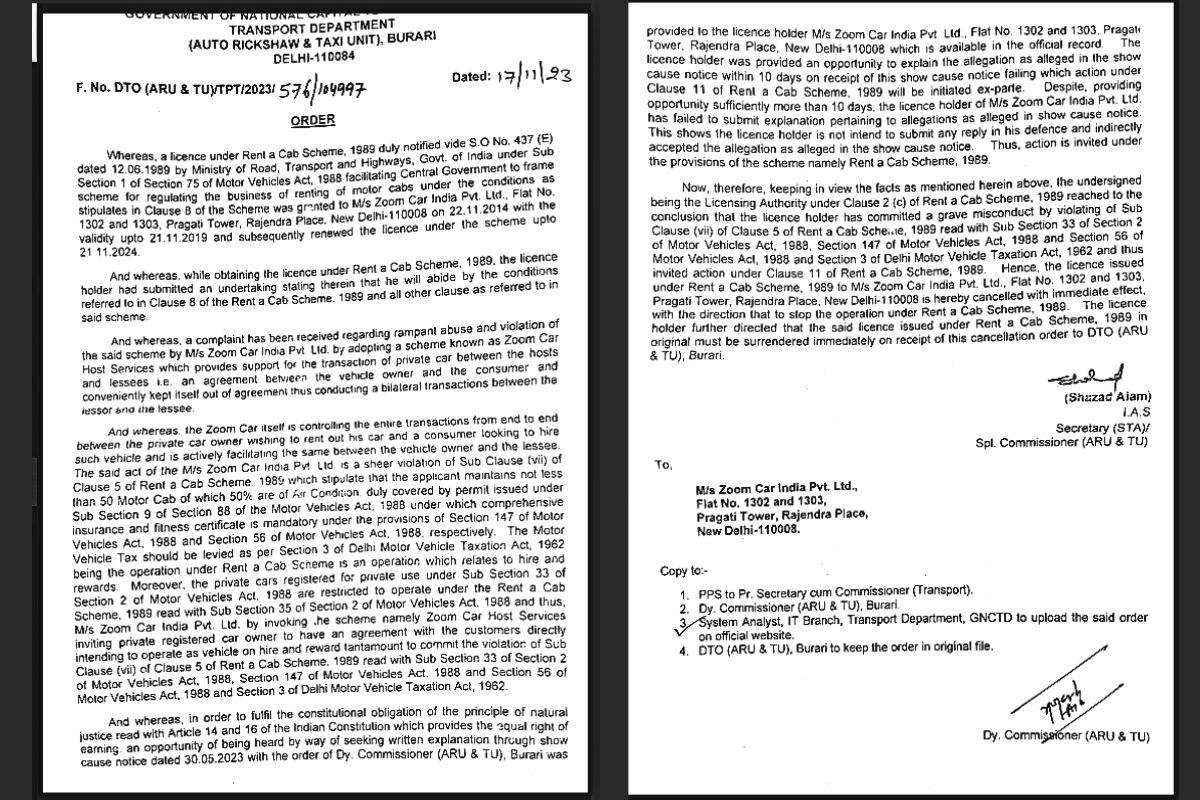
Zoomcar, however, had shifted entirely to an asset-light “marketplace” model post-Covid, where it owns no cars at all and instead lets private car owners list their vehicles for rent. In Delhi’s eyes, this was a clear subversion of the law. By aiding transactions between private car owners (“hosts”) and renters while keeping itself out of the formal agreement, Zoomcar was effectively operating private white-number-plate cars as commercial rentals.
The Delhi authorities didn’t take kindly to this workaround. They issued a show-cause notice to Zoomcar in May 2023, demanding an explanation within 10 days. Zoomcar’s response? Silence. The company failed to reply to the notice at all. As one official noted, by not responding, Zoomcar “indirectly accepted the allegation”. Thus, in November 2023, an order signed by the Special Commissioner of Transport pronounced Zoomcar guilty of “grave misconduct” and cancelled its Delhi license with immediate effect. The company was directed to surrender its original license certificate right away.
Crucially, records show this wasn’t just a technicality or an expired piece of paper. Zoomcar’s Delhi license had been active since November 2014 and was renewed up to November 2024. In other words, Zoomcar had permission to operate if it followed the Rent-a-Cab Scheme rules. But by pivoting to its peer-to-peer “Zoomcar Host” program, it ventured outside the allowed model.
Officials cited multiple provisions of the Motor Vehicles Act and the Delhi Motor Vehicle Taxation Act that Zoomcar’s scheme was violating. It was not just about the 50-car minimum; private cars are strictly barred from commercial use without proper permits and commercial registration (yellow number plates). Zoomcar’s platform had turned this law on its head, enabling thousands of privately registered cars to function as unlicensed taxis. Delhi finally had enough.
And yet, even after the very public cancellation of its operating license in Delhi, ‘the poster boy of self-driven rentals in India’ didn’t hit the brakes. By late December 2023, customers in Delhi could still open the app and book cars as if nothing had changed. The Indian Express report on the cancellation made headlines on December 26, 2023, and a Delhi government order was circulated, but Zoomcar remained mum. Republic World noted that the company “remains silent to the authorities and media queries alike”; no public statements, no apologies, and certainly no immediate halt of service. For Delhi’s car renters, nothing tangible seemed different, a regulatory action on paper met with a virtual shrug in practice.
Still Zooming without a License: The Karnataka Story
Bengaluru RTO officials seized over 20 cars in August 2025 that were being rented via Zoomcar with private (white-board) registrations, a sting operation that exposed the company’s continued operations without a valid license. The impounded vehicles, from hatchbacks to SUVs, bore no commercial permits, highlighting Zoomcar’s ongoing flouting of transport laws.
If Delhi’s crackdown was a warning shot, Karnataka’s response was a full-blown sting operation. In Bengaluru, Zoomcar’s home turf, the Regional Transport Office (RTO) spent months planning an undercover crackdown. In August 2025, a team of officers posed as customers on the Zoomcar app, booked vehicles from unwitting “host” owners, and the moment the keys exchanged hands, seized the cars on the spot. Over two dozen cars were taken straight to the Kasturinagar RTO yard that day, forming a lineup of confiscated vehicles that had been illegally operating as rentals.
The details are damning. According to the Bengaluru RTO, 21 private cars (white number plates) were impounded, including popular models like Maruti Balenos and Tata Safaris, and even high-end SUVs. Not one had the required commercial permit. The crackdown wasn’t arbitrary as officials said it came after repeated warnings to ‘the poster boy of self-driven rentals in India’ went ignored. And then comes the kicker. Zoomcar’s mandatory “rent-a-motor cab” license in Karnataka had expired in January 2024 and was never renewed.
In plain terms, since Jan 21, 2024, Zoomcar had no legal authority to operate in Karnataka. Yet here it was, still facilitating rentals well into 2026, effectively thumbing its nose at the law. The regional transport officer (East), G.P. Krishnananda, stated it plainly: “Zoomcar still hasn’t renewed its aggregator licence. Private vehicles cannot be used commercially as it’s a clear loss to the government and totally illegal”.
The consequences for those 21 car owners (many of them young techies who had treated Zoomcar as a side hustle) were severe. Each faced fines of ₹30,000 to ₹35,000 under Section 200 of the MV Act. Worse, a number of the seized cars were registered outside Karnataka (including the new BH-series “all-India” plates). These owners were hit with hefty lifetime road tax demands of ₹5–7 lakh each, because they had not paid Karnataka’s road tax while illegally running their cars commercially in the state.
Only after paying the fines and taxes, and signing an undertaking that they would never list their private car on Zoomcar again, would these folks get their vehicles back. One can imagine the rude awakening: the very platform pitched as a way to “earn from your idle car” had led them into a legal and financial trap.
Notably, this wasn’t Zoomcar’s first brush with Karnataka’s regulators. Back in December 2022, the Karnataka State Transport Authority had taken up a complaint by a drivers’ association accusing Zoomcar of the same violation of using white-board private cars as rentals. At the time, officials acknowledged Zoomcar did hold a rent-a-cab license valid until Jan 20, 2024, but the allegations were clear that Zoomcar was “hiring white-board private cars to give on rent,” violating MV Act provisions. In other words, the state knew what was happening but seemingly waited until the license lapsed to act decisively. By mid-2025, their patience wore out. The Bengaluru sting operation of 2025 was, in effect, the government saying enough is enough.
An “Asset-Light” Model Built on Legal Grey Areas
How did Zoomcar fall into this mess? The answer lies in its very business model. Zoomcar pioneered the peer-to-peer car rental concept in India, especially after 2020. Instead of the traditional model (where the company buys and maintains a fleet of cars to rent out), Zoomcar went “asset-light”, convincing ordinary car owners to list their personal vehicles for strangers to rent. By the mid-2020s, this strategy had worked astoundingly well on paper. Over 25,000 cars were listed by individual hosts on Zoomcar across India, and the company was hailed as a shining star of the sharing economy. It’s Uber or Airbnb, but for cars, what could go wrong?
Plenty, as it turns out. Indian law draws a sharp line between private and commercial vehicles. If you want to rent out a car (self-drive or with driver), that car must have a commercial registration (yellow number plate) and proper permits, taxes paid, commercial insurance, etc. Private cars (white plates) are strictly for personal use. Zoomcar’s host program essentially blurred that line beyond recognition.
Thousands of white-plate cars began carrying paying customers via Zoomcar, all without converting to commercial yellow plates or obtaining permits. This wasn’t a secret loophole, but a well-known violation of Section 66 of the Motor Vehicles Act, which bans operating any vehicle as a transport vehicle without a permit.
Zoomcar’s defense, if any, was to claim it’s just an intermediary, not the actual operator of the vehicles, akin to how Oyo (in hospitality) or Uber claim to be mere aggregators. Indeed, the company kept itself out of the rental contracts by directly letting the car owner (“host”) and renter agree, with Zoomcar controlling things from behind the scenes. In doing so, Zoomcar likely hoped to avoid legal accountability, presenting itself to regulators as a software platform, not a transport operator. But regulators weren’t buying that hair-splitting.
Delhi’s transport department explicitly pointed out that Zoomcar was “controlling the entire transaction end-to-end” between owners and renters; in effect, operating a de facto rental service without fulfilling the legal obligations of one. The “Oyo-like model” for cars, as Republic dubbed it, landed Zoomcar in hot water because India’s transport laws simply hadn’t sanctioned any such arrangement.
From a legal critique standpoint, what ‘the poster boy of self-driven rentals in India’ attempted is intriguing but fundamentally flawed. If Zoomcar had complied, say, ensured every host car got converted to a commercial rental cab with a proper permit; its whole value proposition might collapse. Few private owners would be willing to pay hefty commercial taxes and endure bureaucratic red tape just to list their car occasionally.
So Zoomcar did the opposite. It operated under the radar, hoping enforcement would be lax or that the law might eventually change to accommodate this new “sharing economy” reality. It was a high-stakes gambit, and for a while, it paid off as authorities looked the other way. But, as the mounting complaints and crackdowns show, this approach is now on a collision course with the law.
Dodging Taxes and Cheating the Government
One of the most damning aspects of Zoomcar’s license saga is the loss to the public exchequer. By running an unlicensed operation with private cars, Zoomcar and its hosts were effectively sidestepping the taxes and fees that legitimate commercial operators must pay.
The pattern of dodging legal payments didn’t stop at state borders. In Kerala, Zoomcar brazenly operated without any license at all for years. A Manorama investigation in 2024 revealed Zoomcar had been active in Kerala since 2019 without a rent-a-car license, despite a court order to cease operations. The Kerala High Court even termed Zoomcar’s unauthorized activities a “cybercrime” in an earlier case, given the app-based nature of the violations.
Think about that. A High Court felt compelled to use such strong language, and the state’s transport minister publicly vowed strict action to shut down Zoomcar’s illegal operations. Yet, until late 2024, Zoomcar continued signing up hosts and customers in Kerala, presumably pulling revenue out of the state without paying a paisa in local commercial taxes or permits. Only concerted action and potentially banning the app (as recommended by the Ernakulam RTO) might stop it.
In sum, Zoomcar’s licensing dodge is not a victimless crime. Legitimate rental companies that own fleets and pay taxes find themselves undercut by a player that offloads costs onto private individuals. The government loses out on tax revenue that could fund public infrastructure. It is not wrong if we say that the Zoomcar saga is a classic case of regulatory arbitrage. Zoomcar gained a competitive advantage by not playing by the same rules as everyone else. But that advantage may prove short-lived as the bills (and penalties) come due.
When Consumers and Car Owners Pay the Price
Beyond legality and revenue, there’s a human side to this saga. Zoomcar’s users, both those renting cars and those listing them have faced severe repercussions under this unlicensed model. The data and accounts from across the country paint a concerning picture of compromised consumer rights and broken promises.
Consider the car owners (“hosts”) first. Many were lured by Zoomcar’s slick marketing to turn their idle car into an income generator. Zoomcar dangled the carrot of monthly earnings, insurance coverage, and full support. But when things went awry, numerous hosts found themselves holding the short end of the stick. In Delhi, one host’s car was commandeered by a renter for a liquor smuggling run, ending with the vehicle impounded by police. The owner pleaded with Zoomcar for help over 15 support tickets, only to discover via a terse email that his car was stuck in a UP police station as a seizure.
In Bengaluru, the crackdown saw hosts hit with massive fines and taxes overnight, effectively wiping out any income they might have made via Zoomcar and then some. And across cities, hosts have shared Zoomcar’s horror stories on social media. Cars not returned for months after accidents, stolen vehicles with no recovery, repair bills unpaid despite insurance promises, security deposits never refunded – a “litany of horror stories,” as one report put it.
One egregious example is highlighted in a Reddit post. A Zoomcar host in Hyderabad had his car stolen by a renter and never recovered. Zoomcar’s response was to take the original vehicle documents under the guise of processing insurance, then go silent for a year, ultimately denying any payout for the loss. He learned the hard way that standard private car insurance doesn’t cover commercial rental use, and Zoomcar’s so-called insurance assistance was more mirage than reality.
In Mumbai, a renter using Zoomcar faced a ₹20,000 fine at a police checkpoint because the car had private plates. When he desperately tried to reach Zoomcar’s helpline, no one answered. He was left to either bribe his way out or pay the fine – essentially punished for Zoomcar’s breach while the company stayed unreachable.
This breakdown in support is not anecdotal, but it’s systemic. As complaints piled up, Zoomcar’s customer service often vanished when issues got serious. Hosts recount being passed from one service executive to another, emails going unanswered for months, and an utter lack of accountability when a vehicle is wrecked or seized.
One frustrated car owner in Bengaluru had his car damaged in February 2025; by mid-year, Zoomcar had done nothing; no repairs, no compensation, all while his monthly loan EMIs on that car continued. He finally prepared to sue for financial losses and mental harassment. Such stories abound, and they underline a bitter truth. Zoomcar’s model shifted risk entirely onto individuals. The company took a commission on every booking, but when laws were broken or accidents happened, it was the hosts and renters left to face police, courts, and expenses.
From a consumer rights perspective, this is alarming. People were effectively transacting in an informal, unregulated market under the veneer of a reputable tech platform. The usual protections one expects when dealing with a licensed service were absent. No regulator would come to your aid, because officially, Zoomcar wasn’t a licensed operator at all (especially post-2023/24 in many states). It’s a cautionary tale of the gloss of a fancy app can’t replace the safeguards of the law. Sadly, many learned this only after suffering losses.
Regulatory Failure or Corporate Overreach?
Zoomcar’s saga raises a pressing policy question: How did things get this far? It reflects a dual failure, on part of the company to self-regulate within legal bounds, and on part of authorities who were slow to enforce existing laws and update regulations for new business models.
On one hand, Zoomcar’s overreach is clear. Internal accounts suggest the company was well aware of the legal tightrope it was walking. Rather than course-correct, it seems to have doubled down. Whistleblower-type anecdotes indicate Zoomcar representatives even coached users on evading scrutiny; reportedly advising customers to tell police “it’s a friend’s car” if asked why they were driving a car not registered in their name.
Such behaviour hints at a conscious strategy: expand quickly, prioritize revenue over compliance, and hope that any fallout could be managed later (or that the law might relent to innovation). This is a classic move in startups, where the company act first, ask for forgiveness (or permission) later; but when public safety and law are involved, it’s a perilous gamble.
On the other hand, regulators in India arguably fell asleep at the wheel for a while. The Motor Vehicles Act and schemes like Rent-a-Cab provided the tools to clamp down on Zoomcar-like operations years ago. Yet, for a time, Zoomcar’s growth went largely unchecked. Only when incidents became too glaring, like Delhi’s notice in 2023 after presumably many complaints, or Kerala’s court order after seeing unlicensed rentals, or Bengaluru’s sting after warnings were ignored, did authorities act. Here, one question should be asked to the regulators as well- Why they awake when there is an alarm; why there is no regular check of what is going wrong, or misleading, in the economy?
One could argue that a more proactive approach (like surprise audits or earlier enforcement actions) might have reined in Zoomcar or nudged it to pivot its model legally. Instead, the crackdowns arrived only after thousands of cars were already on the platform and multiple violations had occurred. This delay is costly. It’s much harder to shut down or reform a service that millions have used and that has entrenched itself in 34+ cities.
Moving forward, this episode might prompt policy reforms. Some countries have created frameworks for peer-to-peer car sharing, ensuring private cars can be temporarily licensed or insured for commercial use in a controlled way. India will need to consider if it wants to integrate such models or unequivocally ban them. The current approach of “treat Zoomcar as just another cab operator” clearly didn’t align with what Zoomcar was doing, leading to this confrontation. Perhaps new “self-drive aggregator” guidelines could emerge, balancing innovation with accountability. But until then, the law as it stands is unambiguous, and Zoomcar will have to either comply or cease operations in these jurisdictions.
Zoomcar’s Financial Struggles and Desperation
It’s worth noting that Zoomcar’s legal woes unfolded against a backdrop of financial strain. The company went public in the U.S. via a SPAC merger in late 2023, touting itself as the “world’s largest emerging market focused car sharing platform”. Yet, behind the investor presentations, its financial statements paint a less rosy picture.
For the quarter ending September 2025, Zoomcar reported a net loss of about $794,000, which was actually an improvement of 76% from a $3.35 million loss a year prior. How did it achieve such a turnaround? Largely through accounting maneuvers, as it wrote off failed overseas ventures (in Vietnam and Egypt) which gave a one-time $1.7 million gain. Strip out those tricks, and core revenues were nearly stagnant (a mere 2% year-on-year growth up to that point), while expenses kept climbing.
By its own admission in SEC filings, Zoomcar warned investors that it “will not have sufficient funds to meet its obligations within one year” without raising fresh financing. Indeed, the company urgently needed to raise $25 million in new funding to keep the business running into 2026. An earlier funding attempt in early 2025 had already flopped. In June 2024, just months after listing on NASDAQ, Zoomcar’s board even fired CEO (and co-founder) Greg Moran amid concerns over the firm’s revenue projections. All these signals indicate a company under immense pressure to show growth and conserve cash.
This context is crucial to understanding Zoomcar’s behavior. Complying with regulations of renewing licenses, maintaining a fleet of 50+ compliant cars, paying taxes, costs money. So does providing robust customer support and insurance payouts to hosts. At a time when Zoomcar was burning cash and struggling for profitability, it had a perverse incentive to cut corners.
By not renewing its licenses or paying for permits, Zoomcar saved on costs; by not owning cars, it avoided capital expenditure; by skimping (slightly) on support and insurance claims, it preserved cash at the expense of users. It’s a textbook case of a startup trying to achieve a scalable model without bearing the full costs of that model. But those costs didn’t disappear; they were just offloaded to others, to car owners, to renters, and now we see, to the public (in lost taxes) and to its reputation.
As of this writing, Zoomcar remains operational in several cities in India, albeit under a cloud of illegitimacy in key states. The Delhi license cancellation order is in effect, the Karnataka license expired and unreplaced, and Kerala wants the app banned. Other states are likely scrutinizing Zoomcar too; transport authorities in multiple regions have started keeping an eye on private-car rentals and could follow suit with enforcement drives. The company’s promise of unfettered convenience is now colliding with the reality of Indian law and governance.
For consumers and car owners, the lesson is a hard one. The appeal of a sharing economy service can sometimes outrun the fine print of legality and accountability. When the poster boy of self-drive rentals is found running on expired papers, it’s everyday people who hit the speed bump of hefty fines and harrowing personal losses.
For the government, this is a wake-up call on two fronts, regulation and innovation. If peer-to-peer car sharing is to be part of India’s mobility future, the laws will need to adapt, perhaps offering special permits or insurance frameworks for such use. At the same time, enforcement must keep pace with innovation. Authorities cannot afford to wait years while an unregulated practice scales up to tens of thousands of vehicles. The cost of inaction isn’t just lost revenue; it’s eroding respect for the rule of law. Zoomcar’s case demonstrates that the government must be as agile in enforcement as startups are in growth.
And finally, for Zoomcar itself, the road ahead looks challenging. It can no longer fly under the radar. The choice is stark; either fundamentally alter its business model to comply (which might mean investing in its own fleet or pushing hosts to convert cars to yellow plates, a move likely to shrink its inventory dramatically), or face legal prohibition in state after state. The era of hyper-growth at any cost is over. Now comes the reckoning with reality.
In an earnings call or press release, Zoomcar might be tempted to downplay these issues, perhaps citing “engagement with authorities” or “temporary headwinds”. But the facts on record speak clearly that Zoomcar has been operating on borrowed time and borrowed cars, and the clock is winding down.
“Zoomcar, where is your license?” is a real question that regulators, investors, and customers are now asking in unison. And unless ‘the poster boy of self-driven rentals in India’ finds a credible answer grounded in compliance and transparency, its journey from poster boy to problem child might well serve as a cautionary tale for India’s next generation of startups. The truth, however uncomfortable, is laid bare in public records and court orders. No amount of narrative flair can gloss over a missing license, not for long, anyway. Zoomcar’s joyride may continue for a bit, but the law is catching up in the rearview mirror, fast.