Adani’s Good Days Finally Over? As the US Tightens The Noose, Can Gautam Adani Still Hide Behind The Indian State?
For years, power, proximity, and process ensured that Gautam Adani’s troubles never quite crossed a line they could not retreat from. Allegations emerged, headlines flared, markets wobbled and then the system absorbed the shock. This time is different. The pressure is no longer domestic, the gatekeepers are no longer Indian, and the political patience has run out, perhaps leading to the world’s most powerful financial regulator deciding to stop waiting for diplomacy and start rewriting the rulebook serving as a grim turning of events that Adani cannot ignore.


Gautam Adani can arguably be called India’s most scrutinised and controversial corporate titan of the past decade. For years, allegations have surfaced, questions have been raised, and uncomfortable facts have been met with carefully managed perceptions and forceful denials. But this time, the pressure is not coming from activists, opposition leaders, or investigative journalists. It is coming from Washington and it appears far less willing to look the other way.
In a move that signals growing impatience, the U.S. Securities and Exchange Commission (SEC) has approached a federal court in New York seeking permission to bypass diplomatic channels and serve summonses directly on Gautam Adani and his nephew, Sagar Adani, through their U.S.-based lawyers and corporate email addresses. The reason, according to the regulator, is straightforward – India has repeatedly refused to assist in serving the summonses. And that refusal (procedural on paper, political in consequence) may now have run its course.
When Process Becomes The Story
Serving a summons is ordinarily a routine legal step. In the Adani case, however, it has turned into a 14-month stalemate that has tested both patience and protocol.
Since early 2025, the SEC has been attempting to formally serve summonses on Gautam Adani, founder of the Adani Group, and Sagar Adani, an executive director at Adani Green Energy. After two failed attempts routed through India’s Ministry of Law and Justice under the Hague Convention, the regulator has concluded that further attempts are unlikely to succeed.
In its January 21 filing before the U.S. District Court for the Eastern District of New York, the SEC bluntly stated:“The SEC does not expect service to be completed through the Hague Convention.”
Instead, it has asked the court to allow service through the Adanis’ U.S. law firms – Kirkland & Ellis, Quinn Emanuel Urquhart & Sullivan, and Hecker Fink LLP – and via their business email addresses, marking it not only as an administrative convenience but an escalation.

What the Case Is Really About
The allegations themselves are grave.
On November 20, 2024, the SEC filed a civil complaint accusing Gautam Adani and Sagar Adani of orchestrating a bribery scheme involving payments or promises totalling more than $265 million to Indian government officials. The alleged objective was to secure power purchase agreements benefiting Adani Green Energy.
The case centres on a September 2021 bond offering by Adani Green that raised over $175 million from U.S. investors. According to the SEC, the offering documents projected a picture of strong anti-corruption safeguards, claims the regulator says were materially false or misleading in light of the alleged conduct of the company’s top leadership.
On the same day, the U.S. Attorney’s Office for the Eastern District of New York filed a parallel criminal indictment, charging the Adanis and others with securities fraud conspiracy and wire fraud.
The Adani Group has consistently dismissed the allegations as “baseless” and has said it will pursue “all possible legal recourse.”
India’s Role- Procedure, or Protection?
The controversy deepened when India’s Ministry of Law and Justice declined to execute the SEC’s service requests.
The first rejection, in April 2025, cited missing seals and signatures, objections the SEC maintains are not required under the Hague Convention and inconsistent with how similar requests have been handled previously.
The second rejection, communicated later in 2025, went further. It appeared to question whether the SEC had the authority to issue the summonses at all, citing an internal SEC regulation that governs enforcement procedures.
The SEC dismissed this objection as irrelevant and legally unsound, arguing that the regulation has no bearing on international service procedures under the Hague Convention.
More revealing was what followed or rather, what did not. Multiple follow-up communications from the SEC’s Office of International Affairs received no response.
For Washington, the signal was unmistakable – cooperation was not forthcoming.
Why the SEC Has Changed Course
Having reached what it describes as a dead end, the SEC is now seeking permission under Rule 4(f)(3) of the Federal Rules of Civil Procedure to serve the summonses through alternative means.
The regulator argues that serving the documents through U.S.-based counsel and corporate email addresses would provide “effective notice,” particularly since the defendants have:
- Publicly commented on the case
- Made regulatory disclosures
- Retained prominent U.S. law firms
- Actively managed their legal strategy
In other words, any claim of ignorance is implausible.
By choosing this route, the SEC is effectively dismantling the protective construct created by diplomatic delay and bringing the dispute squarely into the judicial arena.
Markets Read the Shift Instantly
Markets understood the implication faster than official statements did.
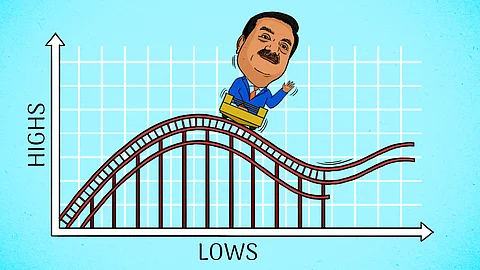
Following news of the SEC’s move, shares of listed Adani group companies fell sharply, wiping out more than ₹1 lakh crore in market capitalisation in a single trading session. Adani Enterprises, Adani Green Energy, Adani Ports, and other group companies saw steep declines.
This should not be seen as hysteria and perhaps more likely – a reassessment of risk – legal, reputational, and geopolitical.
In response to stock exchange queries, Adani Green Energy reiterated that it is not a party to the proceedings and that the SEC case is civil in nature. But investors appeared less interested in assurances and more attentive to signals.
The Last Bit, The Larger Question Power Cannot Dodge
For much of the past decade, Adani’s ability to scale controversies, from regulatory questions to corporate governance concerns, has been aided by a protective domestic environment where political alignment, institutional silence, and diplomatic caution worked in tandem. Allegations were repeatedly framed as attacks on India itself, scrutiny was dismissed as foreign interference, and the state’s reluctance to grant external regulators traction functioned as an informal but effective shield.
That strategy, however, is proving increasingly ineffective in the current geopolitical climate. Under President Donald Trump, Washington’s engagement with India has shifted from indulgent partnership to transactional enforcement, driven less by diplomatic goodwill and more by hard geopolitical and economic calculus.
Tariffs, regulatory pressure, and enforcement actions are now being deployed as tools of deterrence and discipline, not persuasion, designed to signal that strategic cooperation does not translate into regulatory immunity. India’s diplomatic posture, which may once have softened international scrutiny, has failed to bend this new framing.
The consequence is a material shift in risk for the Adani Group. Legal exposure is no longer containable within national borders. Reputational damage is no longer manageable through domestic alignment. And leadership insulation has begun to erode precisely where it matters most – in jurisdictions that control capital access, investor confidence, and enforcement power.
In the U.S. legal system, proximity is not insulation. Nor is silence a strategy. Hence, the SEC’s latest move reflects a decisive turn – from diplomatic patience to legal insistence – unfolding against a backdrop of visible strain in India–U.S. relations, sharpened further by trade disputes and tariff actions under the Trump administration. Whether coincidence or consequence, the timing is instructive.
For Gautam Adani, the question is no longer about managing perception or contesting allegations through statements and denials. It is about whether the layers of protection that once slowed scrutiny are beginning to give way and whether this time, there is nowhere left to hide.