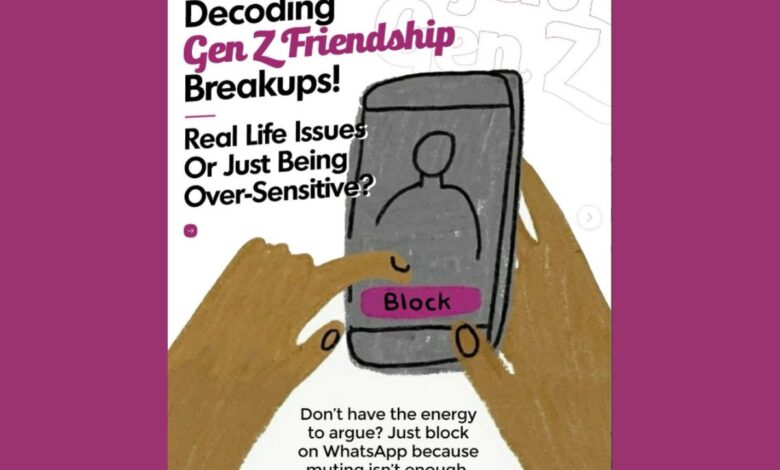
Imagine this: you text a Gen Z friend with a tiny gripe or snarky emoji, and suddenly you’re exiled, as you are banned from WhatsApp, unfollowed on Instagram, and forgotten in Snapchat history. It might feel like melodrama, but for many Zoomers (“Gen Zers,” born mid-1997 to early 2012), slamming the “block” button is second nature. Why does this happen at the drop of a hat?
In the hyper-digital world where Gen Z grew up, even small conflicts can trigger a nuclear option. From anxiety over “we need to talk” to self-care in the social media era, there’s a mix of psychology and technology behind the curtain.
Why the slightest disagreement often leads Gen Z to say “Goodbye, forever”, at least until they unblock you?
Phones have a strong voice in Gen Z’s life, sometimes literally bossing the conversation. Unlike older generations who remember landlines and meet-ups, Gen Z were born with smartphones in hand. A 2015 Pew study found that 73% of U.S. teens have smartphones, and text messaging is their number 1 way to connect with friends. In fact, when asked how they usually contact their closest friend, nearly half (49%) said texting is their first choice, and only 13% said a good old-fashioned phone call. In other words, face-to-face or voice chats are almost quaint to Gen Z.
This constant connectivity shapes everything. Teens spend hours a day on social media and messaging apps. For example, one study notes Gen Z teenagers can spend 36 hours a month on social platforms (vs. 10 hours for older adults). The digital world is where Gen Z socializes, learns and blows off steam. The problem? The same apps that let them text, emoji, and meme at will also offer a fast escape hatch when drama strikes.

Unlike meeting in person, communicating through screens is fragile and virtual. One misunderstood emoji or blunt reply can escalate immediately. And when trouble brews, Gen Z has the tech to vanish, either leave on “read”, mute, unfollow, or block, with just a few taps. It’s easier than pausing a real-life argument.
You might think, “It’s just a text fight, why not just talk it out?” Gen Z might answer as “No thanks, cue the anxiety.” Mental health experts note that many Gen Z actually fear direct confrontation. One counselor reports that teens often feel an “impending sense of doom” if someone says, “We need to talk”. The mere hint of a serious conversation can trigger so much stress and anticipatory anxiety that the temptation to avoid it altogether grows stronger.
Gen Z grew up during events like pandemic lockdowns and always had a screen between themselves and the world. They’ve become adept at hiding behind digital walls. Even preparing to make a simple phone call can cause panic (one teen had to role-play ordering pizza just to calm down). When anxiety spikes, the easiest “therapy” is to disappear, which in digital terms means blocking. Some Gen Z prefer online relationships precisely because when a problem arises, “it’s easy to block this ‘friend’ or create a new avatar and move on.” In short, avoiding an awkward conversation is often way simpler than, say, building up the courage to discuss a disagreement.
Communication Overload With Gen Z: Too Many Apps, Too Little Patience
Gen Z’s world is awash in channels. There’s WhatsApp group chats, Instagram DMs, Snapchat streaks, Discord, TikTok, you name it. All these channels amplify the noise and potential for tiny fights. Imagine being in several group chats 24/7; even a mildly salty remark can ripple through all of them. With so many lines of communication, the cognitive load is high. It’s no wonder Gen Z sometimes goes nuclear: “If it’s just one more drama, I quit!”
Studies highlight that Gen Z prefers quick, bite-sized interactions. They use fewer words and more emojis, often moving fast between apps. But fewer words means more ambiguity. A curt “k” or ignoring a message is easier than hashing out feelings. Vox reports that teens admit their phones give them “numerous passive-aggressive methods of showing disapproval” like leaving someone on read, sending deadpan replies, or silently ghosting.

This breed of “dry texting” is a common signal that someone is upset. One teen put it bluntly that he have definitely avoided talking to someone in person and just showed that he was mad by muting them for a bit. It’s kinda petty but it’s how a lot of people deal with stuff now.
So in a way, blocking is just the ultimate mute button. When words fail (or feel too much effort), Gen Z can unfriend someone across all platforms with a few taps, effectively silencing them completely. In a Pew survey, 45% of teens said they’ve blocked an ex-friend after a fall-out, which is more common among girls than boys. It’s a digital scorched-earth strategy where you cut off every channel so you never have to hear from them again. Brutal, maybe but apparently effective at ending any further hassle.
Now, before we label Gen Z as drama queens or kings, consider the other side where blocking can actually be healthy. Experts increasingly call it a form of digital self-care. One Spanish columnist notes that blocking “helps our mental health”. Psychologists say it’s a way to assert boundaries if someone consistently makes you miserable (trolling your feed, spamming, or harassing), blocking is the safest option. Even the U.S. Surgeon General has warned that social media is “associated with significant mental health harms for adolescents,” so cutting off toxic input is a smart move.
In that vein, a psychologist for an infidelity site defended blocking as “the first rule of self-respect”. Another consultant noted that a “blocking ban” (like the one Elon Musk briefly proposed on Twitter) was widely opposed because we should have a right to avoid harmful content or people. In short, if someone’s posts or messages make you feel bad, hitting block can be empowering. It’s a digital spa where you close one tab on drama, and suddenly your feed is 100% Zen.
However, experts also caution not to use block as punishment. Spanish author Lara Ferreiro warns that impulsively blocking someone after a spat “implements the punishment of silence,” and if the person is later unblocked they might harbor resentment. But Gen Z might retort that “Resentment’s an adult problem.” In their view, why waste time negotiating when you can just hit RESET on that chat?
As social media guru Sergio Magán points out, blocking can be a temporary “escape valve.” You block for a bit until things cool off, then maybe even unblock; like taking a break from someone whose content saturated your screen. In this light, blocking is not a punishment but a pause, a way to preserve one’s own sanity in an always-on world.
But There Is A Ghost In The Machine, Which Is The Rise of Digital Ghosting!
Blocking doesn’t happen just in friendships. Across the board, jobs, dating, even school, Gen Z is going ghost. A recent Times of India report notes a “strange new reality” in the U.S. job market where 66% of hiring managers say Gen Z ghosted them after accepting job offers. And Yes, blocking on LinkedIn too. Employers complain that Gen Z candidates treat the recruitment process as transactional. If a better gig appears, they vanish, no goodbyes required. In one poll, 90% of employers agreed Gen Z is much more likely to ghost than older people.
In dating too, Gen Z are big on the ghost. An Indian dating-app survey found many young GenZ consider ghosting “better than awkward conversations.” Only 23% of GenZ daters in India said ghosting is “immature,” versus 32% of millennials who insisted on at least a breakup talk. To Gen Z, it’s just more efficient to swipe left on someone’s digital presence. Why explain why you don’t like their new haircut when you can just block them?
All these studies hint at a pattern where Gen Z often sees direct confrontation as optional. Virtual silence is far more common than awkward clarity. They’ve been raised in a non-committal, instant-messaging world where you can bow out of a group chat or relationship with minimal explanation. So when small conflicts pop up like a misunderstood joke, or a canceled plan, the path of least resistance for many Gen Z is to simply vanish from each other’s notifications.
A (Semi) Serious Warning to the Unblocked
All this might make older readers sigh “Kids these days…”, but try to see it from Gen Z’s perspective. Yes, it can seem petty. Imagine one wrong word and poof, you’re cut off forever. However, Gen Z often view blocking pragmatically. It’s boundary-setting, not necessarily a personal slight (though it often is taken personally by the blocked party). If you find yourself on the receiving end of a digital wall-of-silence, it might help to remember that for Gen Z, confrontation often feels like losing the game. They’d rather say “I’m done” unilaterally than play on.
Would it help if we told them to delay hitting block for 24 hours? Possibly. But research suggests they just don’t operate that way. Therapists note Gen Z needs to learn conflict resolution skills, and counselors even train them in how to say “no” nicely and work out disputes. But meanwhile, the block button is a fact of life. As one Gen Z teen might say (sardonically) that “Either you’re cool, or you’re blocked. End of story.”

At the end…
It might sound like a trait of dramatic teenagers, but Gen Z’s habit of blocking isn’t just random cruelty; it’s the product of a lifetime surrounded by screens, stressed by comparison, and anxious about real talk. Research across the globe (from American teens to Indian students) paints the same picture that digital natives find face-to-face conflict hard, so they rely on a quick digital escape. Blocking is a way to avoid confrontation, protect mental health, and set boundaries in a cluttered communication landscape.
So next time your Gen Z niece vanishes from your group chat over a silly spat, try to remember that to her, she’s just taking care of her sanity in an overwhelming world of noise. And maybe, just maybe, reply with “I miss you, unblock me?” — assuming she hasn’t blocked that text too!