Davos 2026. When Indian CMs Need Swiss Validation – Desi Deals, Foreign Selfies!

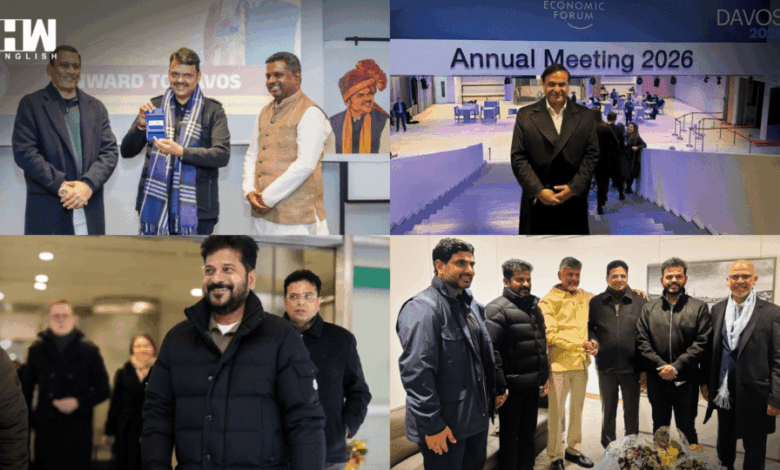
Davos is fast turning into the preferred playground of our political leadership, which starts changing colours (the official red batti included) the instant it is sworn into power. Power, it seems, comes with a complimentary makeover kit. So, should anyone be surprised when the same leaders undergo yet another transformation while travelling abroad on “official duty”? Not really.
For those who may have missed it, the World Economic Forum’s annual jamboree in Davos (January 19–23) is currently underway. And India, as always, has turned up in full force. Chief ministers, union ministers, bureaucrats, you name it. The stated mission is noble and familiar: attract foreign investment, boost development, and generate jobs for millions of unemployed Indians. On paper, it sounds like the stuff of governance dreams.
But scratch the surface and the snow starts melting.
Because what has really raised eyebrows is this: most of the MoUs being signed are not with foreign companies at all. They are with Indian firms. Which leads to the million-rupee question – if Indian companies are investing in Indian states, why fly all the way to Switzerland? Why not just pull up a chair in Mumbai, Bhopal or Guwahati and sign the dotted line over cutting chai instead of hot chocolate?
Enter BCCI vice president and Congress Rajya Sabha MP Rajeev Shukla, who didn’t mince words. Calling the whole spectacle a “status symbol” and a “show-off,” he described it as a “criminal waste of money.”
“Indians are going to Davos to meet Indians. State governments are signing agreements with Indian companies in Switzerland which they could have done in India. CMs are meeting CMs in Davos. It’s a criminal waste of money,” Shukla tweeted. “If they had signed agreements with foreign companies there, I would have understood,” he added.
He followed it up with another sharp jab:
“Is it the World Economic Forum or the India Economic Forum? Seven Indian chief ministers meeting each other in Davos. Indian companies meeting Indian companies. Actually, it has become a status symbol or show-off to go to Davos.”
And Shukla isn’t alone in asking these uncomfortable questions.
The optics became even murkier when Maharashtra CM Devendra Fadnavis announced a whopping Rs 1.3 lakh crore deal with Lodha Developers for data centres. For the uninitiated, Lodha Developers is run by Abhishek Lodha (son of Maharashtra’s skill development minister, Mangal Prabhat Lodha). On day one alone, Fadnavis claimed MoUs worth Rs 14.5 lakh crore, promising 35 lakh jobs. Big numbers, bigger headlines.
But again – why Davos?
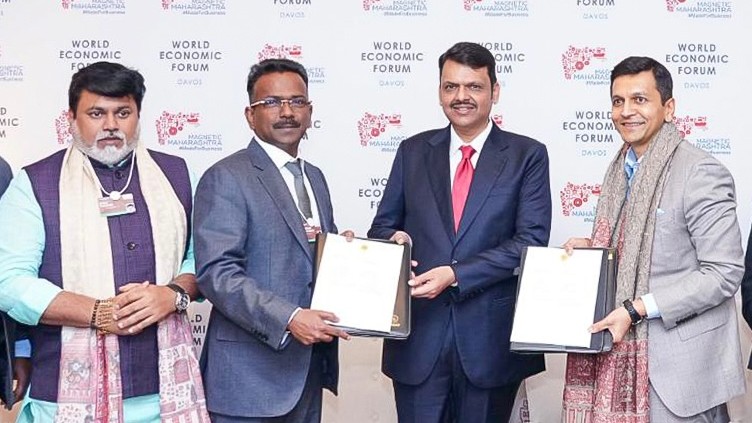
Alongside Lodha, the marquee deals featured other familiar Indian names — Raheja, Panchshil, Surjagad Ispat. All domestic. All perfectly capable of signing papers on Indian soil.
The Opposition wasted no time. Congress leader Jairam Ramesh took to X, pointing out how “the Maharashtra CM goes to Davos and signs an MoU with a company owned by a minister’s son.” His question was blunt: “Did it really have to be signed in Switzerland, or is there some hidden meaning in this odd event?”
Mumbai Congress chief Varsha Gaikwad also slammed these “Indian-with-Indian” MoUs as an unnecessary drain on public funds.
And Fadnavis is hardly skiing solo.
Madhya Pradesh CM Mohan Yadav, Assam’s Himanta Biswa Sarma, Andhra Pradesh’s Chandrababu Naidu, Telangana’s A. Revanth Reddy and Jharkhand’s Hemant Soren are all in Davos, wooing investors under the same snowy spotlight.
The political sparring followed them there too.
Jharkhand BJP mocked Hemant Soren’s visit as a “tourism trip.” The Jharkhand Mukti Morcha hit back, accusing the BJP of double standards – why ridicule Soren but stay silent when Maharashtra signs MoUs with Lodha Developers in Switzerland?
Meanwhile, India’s corporate heavyweights also made splashy announcements. The Adani Group unveiled plans to invest over Rs 6 lakh crore across aviation, clean energy, digital platforms and infrastructure — in Maharashtra, Assam and yes, Jharkhand too.
Andhra Pradesh announced a $10-billion partnership with RMZ Group. Jharkhand inked an Rs 11,000 crore deal with Tata Steel for green steel technology. Google and Gemini AI expressed interest in Madhya Pradesh. The UAE proposed partnering with Telangana on an ‘India Future City’ project expected to generate around 46,000 jobs.
So yes, deals are being signed. Jobs may come. Development may follow.
But the optics remain awkward. If most of the money is Indian and most of the players are Indian, was this really about “globalising” India’s economy? Or was it about global backdrops for local politics? Is this economic diplomacy… or just a very expensive photo-op?
Budding Influencers?
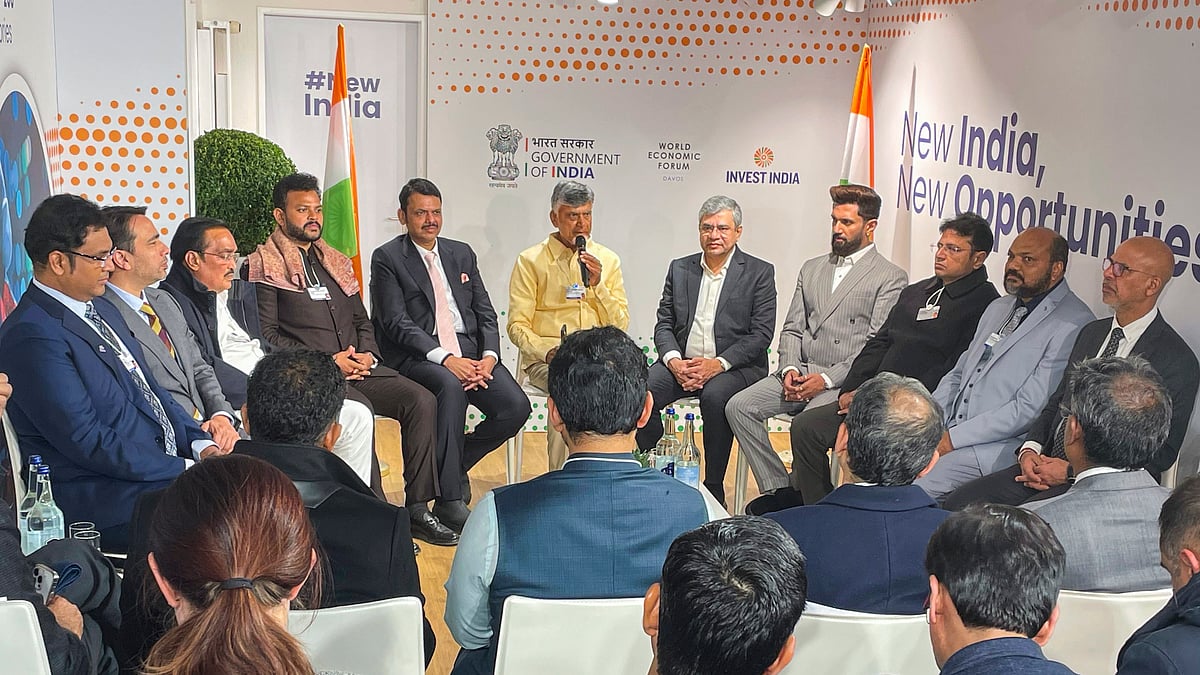
In today’s hyper-digital age, social media is no longer just about glossy pictures and curated captions. It has evolved into the fastest, loudest and most effective way to be seen, heard and politically relevant. And Davos, it seems, has now become the ultimate Instagram backdrop for India’s power class. From National Security Advisor Ajit Doval to Union ministers, chief ministers, corporate titans like Mukesh Ambani and even influencer Masoom Minawala, India has sent its largest-ever delegation to the 56th World Economic Forum Annual Meeting in Switzerland. At a summit otherwise dominated by US President Donald Trump, India is clearly eager to make its presence felt and photographed on the global stage.
The Motive
Optics, influence and a carefully choreographed projection of power. Indian leaders are expected to dominate panel discussions, including one on whether India can become the world’s third-largest economy.
Simultaneously, the country’s booming creator economy and business elite are showcasing their clout under the theme ‘A Spirit of Dialogue’. According to PTI, at least four Union ministers – Ashwini Vaishnaw, Shivraj Singh Chouhan, Pralhad Joshi and K. Rammohan Naidu – along with six chief ministers including Devendra Fadnavis, Chandrababu Naidu, Himanta Biswa Sarma, Mohan Yadav, A.
Revanth Reddy and Hemant Soren are part of the delegation. While Naidu is busy with one-on-one meetings with industrialists, Soren is presenting an energy transition model. Karnataka’s DK Shivakumar cancelled his trip citing official work, but Gujarat’s deputy CM and a UP delegation have stepped in.
Parallelly, more than 100 Indian CEOs are in Davos – a who’s who of corporate India – from Mukesh Ambani, N. Chandrasekaran, Sanjiv Bajaj and Sunil Mittal to Nandan Nilekani, Sajjan Jindal, Rishad Premji and Vijay Shekhar Sharma.
Even influencers and celebrities have entered the mix. Masoom Minawala represents India’s creator economy, while actress Bhumi Pednekar attends in her capacity as a climate activist and founder of Climate Warrior. The message – influence today is not just about boardrooms, it’s about brand presence.

Women empowerment is also being spotlighted through the Win Lounge, featuring global leaders and prominent Indian women including Smriti Irani, Sangita Reddy, Dipali Goenka and Priya Agarwal Hebbar. And adding to the hype, WEF President Borge Brende couldn’t stop praising India, calling it the fastest-growing major economy and predicting it could contribute 20% of global growth. He credited the Modi government’s rapid reforms and expressed optimism about a possible US-India trade deal.
So yes, India is shining bright in Davos – politically, economically and digitally. But beneath the speeches and selfies lies the same uncomfortable question: Is this about meaningful diplomacy… or about mastering the art of global visibility?
So why Davos? Why the Swiss Alps for meetings that could have been scheduled in Mumbai’s corporate towers or Delhi’s power corridors?
Because Davos is more than a venue – it’s a symbol. A global stamp of validation. When you sign an MoU in Switzerland, it suddenly sounds bigger, bolder and more “world-class” than if you did it in Bandra-Kurla Complex. The same deal, the same company, the same promises just wrapped in snow, suits and international media glare. Optics matter, and Davos delivers them in premium packaging.
This is where political branding comes in. Today’s leaders are more than administrators; they are personal brands. And nothing boosts a brand like being photographed with global CEOs, foreign flags in the background and “World Economic Forum” hashtags doing the rounds on social media. It signals power, access and relevance – the unspoken message being: Look, I belong to the global elite now.
Then there’s the prestige factor. Davos has quietly become a status symbol. A modern-day power pilgrimage. You haven’t truly “arrived” unless you’ve networked in Switzerland, attended closed-door sessions and posed in front of the WEF logo. It’s governance with a red carpet and every politician wants their moment in the spotlight.
But let’s be honest, are these trips really about foreign investment?
If most MoUs are being signed with Indian companies, then the “global outreach” argument starts to wobble. This looks less like economic diplomacy and more like curated spectacle. Less policy, more performance. Governance packaged as a global event, complete with press releases, reels and photo dumps.
Which brings us to the uncomfortable question: Are taxpayers indirectly funding political networking holidays?
Flights, hotels, entourages, all for meetings that could’ve happened over coffee in Delhi. At a time when public money is stretched thin, these optics don’t just look tone-deaf; they look outright indulgent with performative diplomacy at its finest. The appearance of action without the necessity of it. Elite networking dressed up as national interest. Political vanity disguised as economic outreach.
And let’s not ignore the internal politics at play. Davos also doubles up as a power-ranking exercise. Who signed bigger deals? Who got more headlines? Who shared the stage with bigger global names? Considering that in Indian politics, perception is currency.
The Last Bit,
At its core, this isn’t an argument against foreign investment or global engagement. India absolutely belongs on the world stage. Our economy, our startups, our talent – all deserve global attention.
But the question is about honesty. About intent. About whether we are chasing outcomes or applause. Because when chief ministers fly thousands of kilometres to meet fellow Indians, sign deals with Indian companies and then return home claiming “global success,” something doesn’t quite add up. Governance should not need a foreign postcode to feel credible just as development does not require Alpine air to become real.
Davos has become a mirror, reflecting not just ambition, but insecurity. The need for external validation. The urge to look global before delivering local. And while leaders pose in designer coats against snowy backdrops, the aam janta back home is still waiting for roads, jobs, healthcare and basic dignity. That contrast is jarring. It reminds us that real governance doesn’t happen in conference halls in Switzerland — it happens in dusty district offices, overcrowded hospitals and forgotten villages.
So yes, let India go to Davos. But let us also ask: Are we going there to change the world or just to be seen in it? Because if global validation matters more than local accountability, then perhaps the problem isn’t Davos.
It’s us.