DHS On The Brink, Deportations On The Rise. Funding Fight Over DHS Exposes A Deeper Shift In U.S. Security Priorities
As the Department of Homeland Security, DHS, faces a partial shutdown over political deadlock, immigration enforcement remains financially insulated. While airport security and disaster response risk disruption, deportation operations and detention expansion continue uninterrupted, exposing a deeper shift in U.S. security priorities and the growing use of budget brinkmanship as leverage.

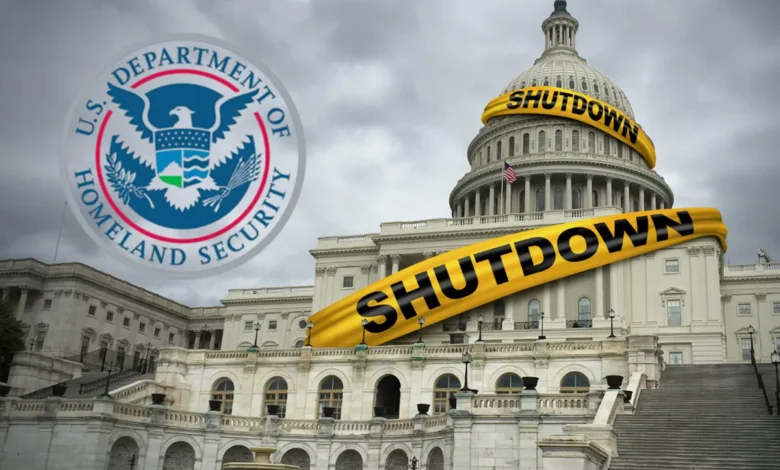
The Department of Homeland Security (DHS) is once again at the centre of a funding standoff in Washington, with lawmakers hurtling toward a partial shutdown. But beyond the immediate budget impasse lies a broader pattern. There is a certain symmetry unfolding in how the administration governs. The same White House that has wielded tariffs as pressure tools abroad now appears equally comfortable using funding deadlines as leverage at home. Disruption becomes part of the strategy. Raise the stakes, create urgency, force a response.
A Shutdown Looms in Washington. But What Is Actually Shutting Down?
At midnight in Washington, funding for the United States Department of Homeland Security (DHS) is set to expire. The Senate failed to reach the 60 votes required to advance the appropriations bill, with the chamber split 52–47. Democrats blocked the measure over demands for reforms to U.S. Immigration and Customs Enforcement (ICE), while the House had already left for recess. The result is a partial shutdown that now appears all but inevitable.
Yet even as the deadline approaches, a deeper question hangs over the impasse. If DHS is supposedly running out of money, why are deportation operations expanding? Why does the part of the department at the heart of the political dispute appear financially secure while the rest faces uncertainty?
That contradiction lies at the centre of this standoff.
ICE at the Heart of the Deadlock
The political confrontation did not emerge in isolation. It was triggered in part by a controversial immigration crackdown in Minnesota that resulted in the deaths of two US citizens. Reports of masked agents, alleged racial profiling and enforcement operations near schools and churches intensified scrutiny of ICE’s tactics.
On February 4, Democratic leaders issued a list of demands. They called for banning masks that conceal ICE agents’ identities, prohibiting racial profiling and halting immigration raids at what they termed sensitive locations. Without what they described as common-sense reforms, they vowed to withhold support for DHS funding.
Republicans rejected those conditions, arguing that enforcement agencies require operational flexibility. With the Senate’s filibuster rule in place, 60 votes were necessary to move the bill forward. Only 52 senators voted in favour. Nearly all Democrats opposed it, with Pennsylvania’s John Fetterman standing as the lone exception in his party.
The shutdown threat, then, is not a dispute about the entirety of homeland security policy. It is a battle centred squarely on ICE.

What DHS Actually Does And What Is Being Prioritised
To understand the imbalance at the heart of this standoff, it is important to step back and look at what the United States Department of Homeland Security (DHS) actually is.
Created in the aftermath of the September 11 attacks, DHS was designed as an umbrella department to centralise America’s domestic security functions. It brought together agencies responsible for airport screening, border control, disaster response, maritime security, cybersecurity coordination and immigration services under one structure. Its mandate was broad by design: protect the homeland from threats, whether they came in the form of terrorism, natural disasters, cyberattacks or transnational crime.
Within DHS sit multiple agencies with very different missions.
—The Transportation Security Administration (TSA) secures airports and transportation networks.
—The Federal Emergency Management Agency (FEMA) coordinates disaster relief during hurricanes, wildfires and floods.
—The United States Coast Guard patrols maritime borders and conducts search and rescue operations.
—The Cybersecurity and Infrastructure Security Agency (CISA) works to protect critical infrastructure and election systems from cyber threats.
—The U.S. Citizenship and Immigration Services (USCIS) processes visas, asylum claims and naturalisation applications. And then there is
—U.S. Immigration and Customs Enforcement (ICE), responsible for interior immigration enforcement and deportations.
In principle, all of these components form part of a single homeland security ecosystem. A funding lapse affects the department as a whole. TSA officers may work without pay. FEMA’s administrative machinery may slow. Cybersecurity coordination could face bureaucratic strain. These are not marginal functions; they are foundational to daily security and emergency preparedness in the United States.
Yet in the current budget architecture, immigration enforcement appears financially insulated. Through separate allocations under last year’s major spending legislation, ICE and Customs and Border Protection secured billions in funding that extend beyond the immediate appropriations battle. While the broader department remains exposed to annual budget brinkmanship, the enforcement arm at the centre of political controversy has received durable backing.
This is not merely a technical detail of congressional budgeting. It reflects prioritisation. When airport security workers face pay uncertainty and disaster agencies prepare for funding turbulence, the detention and deportation apparatus continues operating with financial certainty. The structural weighting is unmistakable.
The question, then, is not only whether DHS will shut down in part. It is what that shutdown reveals about which aspects of homeland security are being protected from political volatility and which are left to absorb it.
What a DHS Shutdown Really Means
The United States Department of Homeland Security is far broader than immigration enforcement. As mentioned before, it oversees airport security, disaster response, cybersecurity coordination and maritime protection. A funding lapse does not simply affect immigration agents; it reverberates across multiple layers of domestic security.
The Transportation Security Administration (TSA), responsible for airport screening, falls under DHS. Travel and hospitality groups have warned that requiring TSA personnel to work without pay increases the risk of absenteeism, which could translate into longer wait times and flight disruptions. Tens of thousands of federal employees may be asked to continue working without immediate compensation. Administrative functions across agencies could slow. Disaster preparedness and response operations may face bureaucratic strain if uncertainty persists.
In other words, the impact extends to everyday travellers and communities vulnerable to natural disasters, not just to immigration enforcement.

The Enforcement Machine Moves On
And yet, even as parts of DHS brace for disruption, immigration enforcement operations are largely insulated.
ICE and Customs and Border Protection secured billions in funding through President Trump’s One Big Beautiful Bill Act passed last year. That allocation provides durable financial backing for deportation and border operations independent of the current appropriations standoff.
The Minnesota operation may have been halted, but the broader deportation campaign remains intact. Border enforcement continues. Detention infrastructure expansion continues. The machinery at the centre of the political conflict does not grind to a halt.
This is the paradox defining the moment. DHS may partially shut down, but the enforcement arm driving the controversy keeps moving.
The Price of Deterrence
Complicating matters further is a recent report from Democrats on the Senate Foreign Relations Committee detailing the cost of deportations to third-party nations. According to the findings, the administration spent more than $35 million to deport roughly 300 migrants to countries with which they had no direct connection, averaging approximately $116,666 per person. In Rwanda, which received seven deportees, the cost per individual reached about $1.1 million.
The bulk of the funds, totalling $32 million, went to five countries: Equatorial Guinea, Rwanda, El Salvador, Palau and Eswatini. The report states that payments were transferred directly to foreign governments and that there is no external auditing mechanism tracking how the funds are ultimately used. A US official reportedly told Senate staff that the strategy was intended partly as a deterrent, signalling that migrants could be sent to remote destinations far from home.
Equatorial Guinea, ranked near the bottom of Transparency International’s corruption index, received $7.5 million, more than the total US foreign assistance it had received in the previous eight years combined. The numbers invite questions not only about policy intent, but also about oversight and efficiency.
When Deportations Come Full Circle
Individual cases illustrate the complexity. A Mexican national was reportedly flown more than 8,000 miles to South Sudan at an estimated cost of $91,000 per person, including temporary housing at a US military base in Djibouti. Weeks later, he was returned to Mexico. Mexican President Claudia Sheinbaum said her government had not been informed.
In another instance, a Jamaican national was sent to Eswatini at an estimated cost exceeding $181,000 despite having deportation orders to Jamaica. Weeks later, the United States again paid to return him home. Jamaican officials indicated they had not refused his return in the first place.
Such episodes raise questions about coordination, proportionality and fiscal prudence. They also underscore the scale at which enforcement policy is being pursued.

A $38.3 Billion Bet on Detention
Even as lawmakers argue over short-term funding extensions, the administration is advancing a $38.3 billion Detention Reengineering Initiative. The plan calls for acquiring and renovating eight large-scale detention centres, adding sixteen processing sites and taking control of ten existing facilities where ICE already operates.
The objective is to streamline operations and accelerate removals. The timing is notable. While Congress struggles to fund DHS for weeks at a time, long-term detention infrastructure is being built for years ahead.
The contrast is difficult to ignore.
A Pattern of Shutdowns in Trump’s Second Term
This is not the first major funding clash of President Donald Trump’s second term. In fact, the federal government has already been forced to partially or fully shut down multiple times over the past few months – evidence of the deepening budgetary impasse that now pins DHS on the brink once again.
The most consequential of these came in late 2025: from October 1 to November 12, the U.S. federal government endured a 43-day shutdown, the longest in American history. That impasse stemmed from broader budget disagreements, including disputes over healthcare subsidies and spending priorities, and resulted in hundreds of thousands of federal workers being furloughed or working without pay.
Just weeks later, in late January and early February 2026, a separate lapse in funding forced another brief shutdown affecting multiple agencies before Congress passed stopgaps for most of the government – except DHS. That standoff, like the current one, was also tied to immigration enforcement fights.
Viewed together, these shutdowns reflect a recurring cycle: Congress reaches deadlines without full funding agreements, resulting in funding gaps, brinkmanship and uncertainty not just at DHS but across the federal government.
The Electoral Backdrop
Immigration is likely to remain central as November’s midterm elections approach. A recent poll conducted by PBS News, NPR and Marist found that 65 percent of respondents believe ICE has gone too far in its crackdown. Democrats see funding leverage as a way to impose limits. Republicans frame enforcement as essential to law and order.
The shutdown standoff is therefore not just a budgetary dispute; it is an early skirmish in a broader electoral battle over immigration policy.

The Last Bit, More Than a Budget Fight For DHS
Taken together, the repeated funding standoffs since President Donald Trump’s second term began do not point to a country running out of money. The United States remains the world’s largest economy, with deep capital markets and the ability to finance its obligations. Debt payments continue even during shutdowns. Markets do not collapse. The dollar does not suddenly lose standing.
What these episodes reveal instead is institutional strain.
When funding deadlines routinely trigger brinkmanship, when departments responsible for airport security and disaster response face uncertainty while politically prioritised arms receive durable backing, the signal is not fiscal weakness but governance volatility. It reflects a system increasingly comfortable using shutdown threats as leverage.
The DHS standoff, therefore, is not just about immigration enforcement. It is a stress test of political cohesion. The question is not whether America can afford its security architecture. It is whether its political machinery can manage it without repeatedly pulling the plug on itself.
When certain enforcement mechanisms are insulated from funding volatility while airport security, disaster preparedness and federal workers face uncertainty, the message is less about financial scarcity and more about strategic emphasis. Budgets reveal what governments seek to protect from politics — and what they are willing to subject to it.