Even The Badshah Of Bollywood Can’t Dare To Interrupt Anant Ambani While Talking

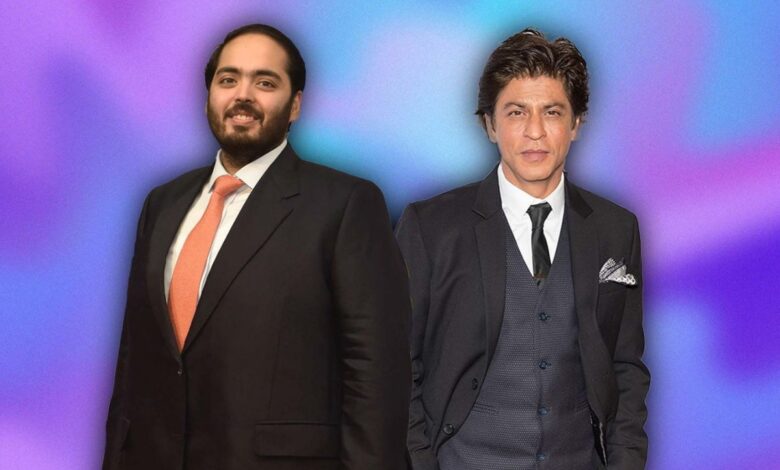
In the glittering world of Indian celebrity and industrial power, few pairings capture public fascination quite like a Bollywood superstar sharing frame space with a scion of the country’s richest family. When footage emerged of Shah Rukh Khan interacting with Anant Ambani at a high-profile event, social media did what it does best: it amplified, interpreted, and in some cases distorted the moment. What began as a short clip of two high-profile figures exchanging words quickly escalated into a legal confrontation after an Instagram creator framed the interaction as one in which the actor was instructed to “keep quiet.” The episode has reignited debates about reputation, free expression, and the limits of commentary in the age of viral reels.
The incident traces back to the Global Peace Honours 2026, held on 21 November at the Gateway of India in Mumbai. Organised under the Divyaj Foundation associated with Amruta Fadnavis, the gathering brought together spiritual leader Sadhguru, business leaders, and entertainment figures. Among the attendees were Anant Ambani and Shah Rukh Khan. Cameras captured moments of interaction, including Ambani speaking with Sadhguru and a separate exchange involving Khan.
In one widely circulated segment, Ambani appears to raise a finger in a gesture that many online viewers interpreted as a signal for silence. Khan’s expression shifts briefly before he smiles and continues engaging with others around him. Without clear audio of the conversation in many circulating versions, the visual alone became fertile ground for speculation.
Enter Suvigya Sharma, the Instagram creator behind the handle @ram.bhakt.suvi. His reel combined footage of Ambani with Sadhguru and the Khan interaction, accompanied by commentary suggesting that the actor had been told to remain silent or “keep quiet.” The framing presented the moment as evidence of a power imbalance in which even the Badshah of Bollywood deferred. The reel gained traction, prompting discussions that ranged from light-hearted observation of social hierarchy to sharper critiques of celebrity and industrial influence. For many viewers, the narrative fitted neatly into existing perceptions of wealth, status, and deference in Indian public life.
Shah Rukh Khan’s legal team saw the matter differently. On 23 November 2026, a notice issued by the firm Ind Sons Legal on the actor’s behalf was sent to Sharma. The document described the reel and its accompanying claims as “mischievous, misleading and defamatory.” It characterised the assertion that Khan had been instructed to keep quiet as “entirely baseless and false,” arguing that the presentation distorted the context of the interaction and risked damaging the actor’s reputation, public image, and dignity. The notice invoked Section 356 of the Bharatiya Nyaya Sanhita, 2023, which addresses defamation, and underscored that circulating unverified and damaging statements about public figures without substantiated evidence is not protected.
The demands were clear and time-bound. Sharma was instructed to remove the disputed reel immediately, refrain from circulating the allegation further as established fact, delete or correct any captions and statements repeating the claim, preserve the original video, source material, publication records and related communications, and provide written confirmation of compliance within 48 hours of receiving the notice. Failure to comply, the notice warned, could lead to civil and criminal proceedings under applicable Indian law, including action under the defamation provisions of the BNS, without further notice. The tone was firm, reflecting a deliberate decision to treat the content as a serious reputational harm rather than dismissible online chatter.
Sharma did not remain silent. In a subsequent video, he addressed the legal notice directly, framing his original reel as criticism protected by freedom of expression. He posed pointed questions: if the man who allegedly told Shah Rukh Khan to shut up had not insulted him, or if Khan lacked the courage to say he had been insulted, then how had the creator’s commentary itself become the insult?
The response sought to shift the conversation from the accuracy of the claim to the broader principle of commentary on public figures and public events. It also highlighted a common tension in such cases: the difference between describing what appears on camera and asserting a definitive narrative about private conversation that may not be fully audible or contextualised.
This episode sits at the intersection of several contemporary realities. Social media has democratised the ability to comment on elite interactions, allowing ordinary users to reach audiences once reserved for professional media. Reels, by design, favour brevity, emotion, and interpretive framing over exhaustive context. A raised finger, a momentary expression, and a caption can travel further and faster than a careful reconstruction of events. For public figures whose livelihoods and public standing depend on carefully managed images, such rapid reinterpretations carry real costs. Legal notices have become a standard tool in the toolkit of celebrities and corporations seeking to push back against content they view as false or damaging.
At the same time, the use of defamation law against individual content creators raises questions about proportionality and chill. India’s legal framework for defamation, now operating under the BNS, remains robust. Critics of aggressive notices argue that they can deter legitimate criticism and commentary, especially when the subject is an interaction captured in a public or semi-public setting. Supporters counter that freedom of expression does not extend to the deliberate or reckless publication of false statements that harm reputation. The distinction between fair comment on observed behaviour and the assertion of unverified facts is often contested terrain, particularly when audio is absent or incomplete.
The involvement of Anant Ambani adds another layer.
As a member of the Ambani family and a public figure in his own right, his presence at the event was always likely to attract attention. The viral framing that positioned him as someone before whom even a global star like Khan would fall silent plays into longstanding cultural narratives about industrial wealth and social hierarchy in India.
Whether the gesture was a request for quiet, a conversational cue, or something else entirely remains a matter of interpretation in the absence of fuller audio or contemporaneous accounts from those present. Khan’s legal team has chosen not to litigate the gesture itself so much as the specific claim that he was ordered into silence in a manner presented as fact.
The 48-hour window specified in the notice places the matter on a short timeline. Compliance would involve the reel’s removal and written acknowledgment; non-compliance could open the door to formal legal proceedings. Either path will be watched closely by content creators, legal observers, and the broader public interested in the boundaries of online speech. For Shah Rukh Khan, the action signals a willingness to defend his public image against what his team views as misrepresentation. For Sharma and those who share his perspective, it represents an attempt to police interpretation of a publicly visible moment.
In the end, the story is less about whether one man can interrupt another and more about how fleeting visual moments are transformed into lasting narratives. A raised finger, a smile, a few seconds of interaction between a film icon and a business heir became, through selective editing and pointed captioning, a statement about power. The legal response seeks to reclaim control over that statement.
Whether the courts, platforms, or public ultimately settle the dispute, the episode illustrates the speed with which social media can manufacture meaning and the determination of high-profile individuals to push back when that meaning is judged false. In an era when almost every public gathering is potentially content, the line between observation, speculation, and defamation remains both contested and consequential.