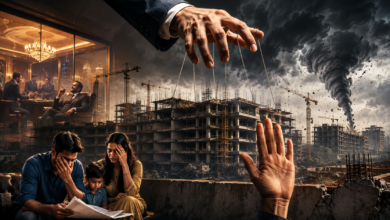
From Ansal To Vatika And Raheja: When Will Gurugram Finally Force Builders To Pay Homebuyers?
Gurugram's latest recovery drive against 71 real-estate developers has exposed an uncomfortable contradiction at the heart of India's homebuyer protection regime. HRERA orders may direct refunds, interest and penalties, yet hundreds of crores can remain unpaid for years. The administration has now moved to freeze bank accounts and attach properties, with the possibility of civil arrest if recoveries fail. Among the largest defaulters are Ansal, Raheja, Vatika, Parsvnath and Ramprastha. Behind these numbers are families who paid lakhs or crores for homes they did not receive, retirees waiting for refunds, borrowers carrying debt and buyers spending years inside litigation. The question is brutally simple: what is justice without recovery?


₹446 Crore Owed, 71 Builders, Frozen Accounts: Why Are Gurugram Homebuyers Still Waiting for Justice?
There is something deeply disturbing about the latest action against Gurugram’s real-estate developers. Not because the authorities have acted. In fact, the action is significant precisely because the administration has finally moved beyond merely issuing orders.
The disturbing part is why such coercive action became necessary in the first place.
Haryana Real Estate Regulatory Authority (HRERA) and the Gurugram district administration have initiated recovery proceedings against 71 real-estate developers over approximately ₹446 crore in unpaid dues arising from RERA orders. The dues include penalties and refund certificates, with some recovery certificates reportedly remaining pending for more than four years. Authorities have moved to freeze operational bank accounts and initiate attachment of movable and immovable properties under the Punjab Land Revenue Act. In cases where money cannot be recovered from available assets or bank accounts, officials have warned of civil arrest and detention.
This is not merely another story about builders and homebuyers.
It is a story about the failure of an order to become justice.
Because imagine the position of a homebuyer.
- You pay the builder.
- The builder does not give you the promised home or otherwise violates the contractual obligation.
- You approach the regulator.
- You win.
- The regulator directs refund, interest or compensation.
- You should, logically, be finished.
- Instead, you discover that the developer does not pay.
- So now you need another process to execute the order.
- And when even that does not work, the government has to freeze accounts.
- Then properties may have to be attached.
- And now officials are talking about civil arrest.
- At what point does the homebuyer actually receive justice?
That is the central question emerging from Gurugram’s ₹446-crore recovery drive.
The ₹446-Crore Question: Why Were RERA Orders Allowed to Remain Unexecuted?
The scale of the problem is difficult to dismiss.
It is reported that the outstanding dues involve 71 builders, with recovery certificates and other liabilities remaining pending in some cases for more than four years. This means that the problem is not simply that developers were accused of wrongdoing. In these cases, the regulatory process has already produced orders giving rise to recoverable liabilities.
The problem is the next step.
Execution.
- The very word is revealing.
- The state can pass an order.
- But an order sitting in a file does not refund a homebuyer’s money.
- An order sitting in a registry does not pay a child’s school fees.
- An order does not repay the interest accumulating on a housing loan.
- An order does not compensate the family continuing to live in rented accommodation.
- And an order certainly does not return the years that have disappeared while a homebuyer waits.
That is why the Gurugram administration’s decision to freeze accounts and pursue property attachment is potentially more consequential than another regulatory directive.
The administration is attempting to convert legal entitlement into actual recovery.
Deputy Commissioner Uttam Singh has reportedly emphasised that recovery must become time-bound so that orders passed in favour of affected allottees do not remain merely on paper. That sentence should perhaps be written above every RERA office in the country:
An order that cannot be implemented is only half-justice.
Ansal: ₹91 Crore — How Long Can a Builder Remain on the Wrong Side of a Recovery Order?
Among the largest names in the current recovery exercise are Ansal Housing Ltd and Ansal Construction Housing Ltd, together accounting for approximately ₹91 crore of outstanding dues according to the Gurugram administration’s recovery data.
The significance of Ansal’s position is that this is not an unknown or obscure developer.
Ansal has been one of the longstanding names in India’s real-estate sector.
And Haryana RERA’s own current database shows repeated execution matters involving Ansal entities.
Its September 2026 records, for example, list execution proceedings involving Ansal Properties and Infrastructure, Ansal Housing and Construction and Ansal Housing Limited.
There are cases involving individual homebuyers, including execution proceedings filed against Ansal Housing entities.
That word—execution—again becomes crucial.
A homebuyer may already have crossed the first legal hurdle.
The dispute has not necessarily remained at the stage of “Did the builder owe the buyer money?”
The next question is:
“Will the builder actually pay what the law has ordered?”
If the answer requires freezing accounts years later, the system has clearly travelled a very long distance from the original promise of a home.
- The emotional cost is easy to underestimate.
- For an established developer, ₹91 crore is a balance-sheet problem.
- For thousands of buyers collectively, it may represent life savings.
- For one individual buyer, it may represent everything.
Raheja: Around ₹90 Crore and the Tragedy of a Home That Never Came
The second giant name in the recovery list is Raheja, with approximately ₹90 crore in outstanding dues, according to the administration’s data.
It is reported provides a particularly human illustration through the case of Rohit Singh, who invested more than ₹50 lakh in Raheja Trinity in Gurugram in 2017. He reportedly never received possession. HRERA directed refund with interest within 90 days. Yet, according to the report, the payment was still not made.
Consider the chronology.
A person invests more than ₹50 lakh. The expectation is a home. Years pass. The regulator eventually orders refund. The buyer has now theoretically won. But the money still does not arrive. What is the meaning of “refund within 90 days” if the buyer then has to wait years for enforcement? This is where the human tragedy of real-estate litigation becomes difficult to express through balance sheets alone.
₹50 lakh may be an accounting figure to a developer. For a middle-class family, it may represent years of savings, a provident-fund withdrawal, money borrowed from parents, a home loan, investments liquidated, or a combination of all of them. And while the buyer waits, inflation does not wait. Rent does not wait. Bank interest does not wait. Medical expenses do not wait. Children’s education does not wait. Life does not wait. Only the refund does.
Vatika: Nearly ₹80 Crore — While the Company’s Larger Legal Troubles Continue
The current recovery data places Vatika at approximately ₹80 crore in outstanding RERA dues. The timing is especially significant because Vatika has simultaneously become the subject of much more serious enforcement scrutiny. The Enforcement Directorate recently arrested Vatika promoters Anil Bhalla and Gautam Bhalla in a PMLA investigation concerning alleged fraudulent inducement, non-delivery of residential plots and alleged diversion of purchaser funds.
The ED has alleged that seven purchaser entities paid approximately ₹260 crore for residential plots in Vatika India Next and Vatika India Next-2 between 2010 and 2012. According to the agency, approximately ₹140.73 crore worth of plots remained undelivered, while in Vatika India Next-2, approximately 1.10 lakh square yards purchased for around ₹90 crore had allegedly not been delivered even after approximately 14 years.
The ED’s January 2025 action also involved provisional attachment of properties in a Vatika-related investigation involving allegations concerning approximately 600 investors and around ₹248 crore invested across four projects. The agency said some projects had remained incomplete or deferred for eight to twelve years.
This creates an uncomfortable convergence.
On one side, ₹80 crore in RERA dues. On another, ED investigations concerning alleged diversion and non-delivery. And beneath both, homebuyers and investors waiting for outcomes. It would be legally incorrect to say that these proceedings establish criminal guilt. They do not. But it would be equally irresponsible to pretend that the accumulation of regulatory and enforcement proceedings does not deserve public scrutiny. The question is not whether Vatika has been convicted. The question is whether the existing regulatory machinery has been sufficiently effective in protecting people who entrusted money to the developer.
Parsvnath: Around ₹74 Crore and the Question of Endless Waiting
Parsvnath reportedly accounts for approximately ₹74 crore in outstanding dues in the Gurugram recovery drive. The company is hardly a new name in the Indian real-estate litigation landscape. Haryana RERA’s current records show multiple execution proceedings involving Parsvnath Hessa Developers. The continuing appearance of the developer in execution proceedings raises a larger question.
If a homebuyer obtains an enforceable order and then remains in execution litigation, what exactly has the regulator achieved? The answer is not “nothing.” A regulatory order is important. It establishes the buyer’s entitlement. But from the perspective of a person who has lost years, entitlement without recovery remains incomplete.
The distinction is painfully simple:
A legal victory is not the same thing as money in a bank account.
Ramprastha: ₹57 Crore and Another Major Name in the Recovery List
The Ramprastha group reportedly owes approximately ₹57 crore under the recovery data cited by the Gurugram administration. Haryana RERA’s records also show proceedings involving Ramprastha Promoters and Developers. In July 2026, for example, the authority listed an adjudication matter involving the company. Again, the important issue is not to label the company criminally without a judicial finding.
The important issue is institutional. Why does the enforcement chain have to become so long? Why should a homebuyer who has already gone through the regulator have to confront a second battle to receive the result? Why should recovery certificates remain pending for years?
And perhaps most importantly:
Who bears the economic cost of that delay?
- The developer may contest.
- The authority may process.
- The district administration may execute.
- But the homebuyer continues paying for the consequences.
IREO: ₹24 Crore and the Long Shadow of Real-Estate Disputes
The recovery data puts IREO at approximately ₹24 crore in outstanding dues. IREO’s appearance is important because its name has featured prominently in earlier disputes concerning Gurugram and Noida real estate.
The larger lesson is again about time. Indian real estate expanded dramatically during the boom years. Thousands of projects were launched. Thousands of buyers entered contracts. But the legal architecture struggled to keep pace with the complexity of land ownership, approvals, financing, project-level companies and developer structures.The result was a system in which a homebuyer could be legally right but practically powerless. That distinction is one of the biggest failures that RERA was supposed to address.
ILD Millennium: ₹8.59 Crore and the Hidden Meaning of “Recovery Certificate”
ILD Millennium reportedly has approximately ₹8.59 crore in outstanding dues in the current Gurugram recovery data. At first glance, ₹8.59 crore appears relatively small next to the liabilities attributed to Ansal, Raheja or Vatika.
But that comparison can be misleading. ₹8.59 crore is not a single person’s loss. It can represent hundreds of individual claims. And each claim may be someone’s savings. This is why aggregate numbers sometimes conceal rather than reveal the human tragedy.
A ₹446-crore headline is enormous. But the true story is contained in the individual claim. Amounts that may be small in the context of a large developer’s corporate structure can be financially existential for individual families.
AIPL: When the Administration First Started Freezing Builder Accounts
The present 71-builder drive did not emerge overnight.
In September 2026, the Gurugram administration had already begun using bank-account freezing against developers, with AIPL becoming one of the first prominent examples.
According to The Tribune, the administration froze AIPL’s bank accounts to recover RERA dues and approximately ₹3 crore was recovered through the action. Deputy Commissioner Uttam Singh said three recovery notices were pending against AIPL. This development is important because it demonstrates that the authorities were testing a more aggressive recovery mechanism before expanding it. The administration’s message was clear:
RERA orders have to be executed, not merely issued.
But there is another side. Freezing operational accounts can itself affect a company’s ability to function and complete projects. That is why enforcement must remain legally proportionate and case-specific. A developer facing a genuine cash-flow problem is not necessarily equivalent to a developer deliberately refusing to honour a final order. Yet the existence of such complexities cannot justify indefinite non-payment. The state has to find the balance between preserving viable projects and protecting people who have already obtained legally enforceable relief.
More Than 3,000 Recovery Certificates: The Number That Changes the Story
Perhaps the most alarming number in the current episode is not ₹446 crore.
It is the reported 3,000-plus pending recovery certificates.
According to The Tribune, more than 3,000 recovery certificates issued by HRERA over six years were still pending execution, involving approximately ₹750 crore, with only a fraction recovered despite repeated directions to district authorities. If this figure is accurate, it fundamentally changes the character of the problem.
This is not simply:
“Some builders have not paid.”
It becomes:
“There is a structural execution bottleneck between the regulator’s decision and the citizen’s recovery.”
And that bottleneck can destroy confidence in regulation.
Imagine telling a homebuyer:
- “You have won your case.”
- Then adding:
- “But now wait.”
- How long?
- One year?
- Two?
- Four?
- Six?
There is no acceptable answer if the buyer has already been legally declared entitled to payment.
The RERA Paradox: A Powerful Law Trapped by Weak Execution?
RERA was designed to transform India’s real-estate market. The basic philosophy was straightforward. Bring projects within a regulatory framework. Increase transparency. Protect allottees. Create accountability. Provide a specialised forum for disputes. Yet the current Gurugram situation reveals a serious paradox.
A regulator can issue an order faster than the state can execute it.
That means the system’s weakest link may not be adjudication. It may be enforcement. And enforcement is where citizens experience the state most directly. A judgement tells you that you are right. Execution makes that right real. Without execution, the first becomes symbolic.
The Homebuyer Is Often the Most Financially Fragile Party in the Entire Transaction
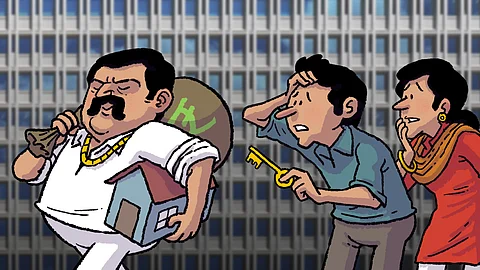
There is another dimension that deserves far more attention. The builder is a business. The bank is a financial institution. The authority is a government institution. The lawyer represents a professional service. The homebuyer is often an individual. That individual may have only one house.
One loan. One salary. One retirement corpus. One set of savings. This asymmetry matters. A builder can maintain lawyers. A buyer may have to borrow money to hire one. A builder can litigate across multiple forums. A buyer must take leave from work to attend hearings. A builder can wait. A buyer may be paying rent and EMI simultaneously. A builder can negotiate restructuring. A buyer cannot restructure the passage of his own life. This is why delayed possession and unpaid refunds should not be treated merely as commercial disputes.
They can become human-financial crises.
When the Buyer Dies Before the Case Ends
This is the darkest dimension of prolonged real-estate litigation. A home purchase is usually a multi-decade financial decision. If litigation lasts ten or fifteen years, the original buyer may age dramatically before receiving possession or refund. Some buyers may die. Their legal heirs inherit the dispute. A home that was supposed to be inherited may instead become a litigation file that heirs inherit. This is not hypothetical in the broader Indian real-estate crisis.
The Supreme Court’s long-running Unitech proceedings, for example, have repeatedly involved mechanisms for refunds and relief for different categories of affected homebuyers, including senior citizens and persons facing medical exigencies.
That should force policymakers to confront an uncomfortable reality:
A justice system that takes longer than the economic lifespan of the claimant is not functioning from the claimant’s perspective.
The 71-Builder List Is Bigger Than the Seven Names That Made Headlines
The prominence of Ansal, Raheja, Vatika, Parsvnath, Ramprastha, IREO and ILD Millennium should not obscure the larger list. Haryana RERA’s current database contains execution and adjudication proceedings involving numerous other developers, including BPTP, Emaar India, Supertech, Assotech Moonshine, Imperia Structures, KNS Infracon, Neo Developers, Pyramid Infratech, Mapsko, Signature Global, Wonder City Buildcon and others.
The presence of a company in an RERA proceeding, of course, does not by itself establish wrongdoing. A regulatory complaint can arise for many reasons, and cases can have different outcomes. But the sheer diversity of names appearing in the authority’s execution and adjudication records demonstrates the enormous administrative burden created by real-estate disputes. The system is dealing with a problem that is much bigger than a handful of bankrupt developers.
And That Raises the Most Important Question: Is the State Arriving Too Late?
The Gurugram administration deserves scrutiny not merely for what it is doing now, but for what took so long. If recovery certificates remained pending for years, why? Was there insufficient staff? Were revenue procedures too slow? Were property records difficult to trace? Were builders repeatedly given extensions? Were accounts insufficient? Were multiple corporate entities involved? Were court proceedings blocking execution? Were there competing claims by lenders?
Or was the enforcement system simply not designed for the scale of India’s real-estate disputes? These questions matter because freezing accounts today may recover money from one developer. But unless the institutional bottleneck is fixed, tomorrow’s homebuyers may face the same problem.
The Possibility of Civil Arrest Is a Dramatic Change
The administration has indicated that if liabilities cannot be recovered through bank balances or property attachment, civil arrest and detention could follow. That is a significant escalation. But it also raises a fundamental legal question:
Should imprisonment become the final enforcement mechanism for financial orders?
The answer cannot simply be “yes.”
Civil detention is an extraordinary measure and must operate strictly within the applicable legal framework. There must be due process. There must be an assessment of recoverable assets. There must be consideration of the legal status of the liability. There must be safeguards against arbitrary deprivation of liberty. But if a person or entity repeatedly refuses to honour a legally enforceable liability despite having recoverable assets, the state cannot indefinitely allow the order to remain meaningless. That is the tension at the heart of the current drive.
The Builder Cannot Be Presumed Guilty Simply Because It Owes RERA Dues
There is another distinction that a serious investigation must preserve.
Being a RERA defaulter is not synonymous with being a criminal.
A developer may owe money because a project failed. A project may fail because of financing problems. A financing problem may arise because of litigation. A project may be delayed because of regulatory restrictions. Some cases involve allegations of fraud. Some involve alleged diversion. Some involve insolvency. Some involve ordinary contractual disputes. These are legally different situations.
Therefore, the present recovery exercise should not be turned into a blanket accusation against every developer. But neither should developers be permitted to use the complexity of the industry as a shield against genuine homebuyer claims. The correct approach is case-by-case accountability backed by effective execution.
The Real Question Is Not “Can Builders Be Punished?”
It is:
Can homebuyers be protected before punishment becomes necessary?
Punishment comes after harm. Prevention comes before it. If a developer has already collected thousands of crores, spent years delaying projects and accumulated hundreds of complaints, enforcement has already arrived late. The ideal regulatory system would detect distress before the project collapses. It would identify diversion risks. It would monitor project accounts.
It would identify delays early. It would restrict new sales where necessary. It would protect buyer money. It would prevent one project from financing another irresponsibly. And where misconduct is established, it would act before the damage becomes irreversible. The ₹446-crore recovery drive therefore needs to be understood not merely as a crackdown. It is also a post-mortem of regulatory delay.
₹446 Crore Is Not the End of the Story
The administration’s recovery figure is enormous. But it is also only one slice of the Indian real-estate crisis. Across India, buyers have spent years fighting developers through RERA, consumer commissions, NCLT, High Courts and the Supreme Court.
Amrapali required extraordinary Supreme Court intervention. Jaypee became a major insolvency and homebuyer-rights battle. Unitech continues to involve court-monitored mechanisms for refunds and project resolution. Supertech’s twin-tower dispute culminated in demolition and extensive buyer-protection proceedings.
And the CBI’s nationwide builder-bank investigation has produced dozens of cases. The Gurugram action therefore fits into a much larger national story:
India has increasingly recognised the homebuyer as a vulnerable stakeholder—but recognition alone has not guaranteed recovery.
The Most Important Reform May Be Simple: Make Recovery Time-Bound
The present crisis points toward one obvious institutional requirement. If RERA awards a refund, interest or compensation, there must be a clear, enforceable and time-bound mechanism through which the money reaches the buyer. Otherwise, the buyer is effectively required to win twice.
First:
Win against the builder.
Second:
Win against the enforcement system.
That cannot be the long-term model.
A person who has already established his entitlement should not be forced into another multi-year battle merely to receive what the regulator has ordered.
Gurugram Has Now Asked the Question India Should Have Asked Years Ago
What happens when a builder refuses to pay?
The administration’s answer is now:
Freeze the accounts.
If necessary:
Attach the property.
If necessary:
Use further coercive recovery mechanisms, including civil detention within the law.
That is a significant departure from the older model in which a recovery certificate could remain trapped in bureaucratic machinery.
But the real test will come later.
- How much of the ₹446 crore is actually recovered?
- How quickly?
- How many homebuyers receive money?
- How many developers challenge the action?
- How many properties are successfully attached?
- How much money remains unrecovered?
- And does the administration maintain the momentum?
Until those questions are answered, it is too early to declare victory.
Because the Homebuyer Has Already Waited Long Enough
Behind every recovery certificate is a story.
- A person who believed the advertisement.
- A couple who signed the agreement.
- A family that paid the booking amount.
- A borrower who started paying EMI.
- A tenant who continued paying rent.
- A father who expected to retire into his own home.
- A mother who expected her children to grow up in a permanent address.
- A senior citizen waiting for a refund that was supposed to fund the final years of life.
- And sometimes, a claimant who dies before seeing either the house or the money.
That is why ₹446 crore should not merely be read as a number.
It should be read as a measure of unresolved promises.
And the 71 developers should not merely be viewed as names on a government recovery list.
They represent the unresolved question of whether India’s real-estate regulatory system can make the person who pays for a home more powerful than the company that sells it.
The Final Question: What Is the Value of RERA If the Buyer Still Has to Chase the Money?
The current Gurugram action is undoubtedly important.
- It shows that authorities can move from orders to enforcement.
- It shows that bank accounts can be frozen.
- It shows that property attachment can be initiated.
- It shows that long-pending recovery certificates can finally become active administrative cases.
- And it shows that the government is willing to contemplate stronger coercive mechanisms when ordinary recovery fails.
But the deeper story is far more disturbing.
Why did it take years?
- Why should a person who already won before the regulator still be waiting?
- Why did more than 3,000 recovery certificates reportedly remain pending?
- Why did hundreds of crores remain unpaid?
- And why does the state have to threaten account freezes and civil detention before a regulatory order begins to acquire practical force?
- These questions are not merely anti-builder questions.
- They are questions about the credibility of the Indian rule-of-law system.
Because if a citizen can spend years proving that he is entitled to money, and then spend several more years trying to actually obtain it, the problem is no longer simply the conduct of one developer.
It is the architecture of enforcement itself.
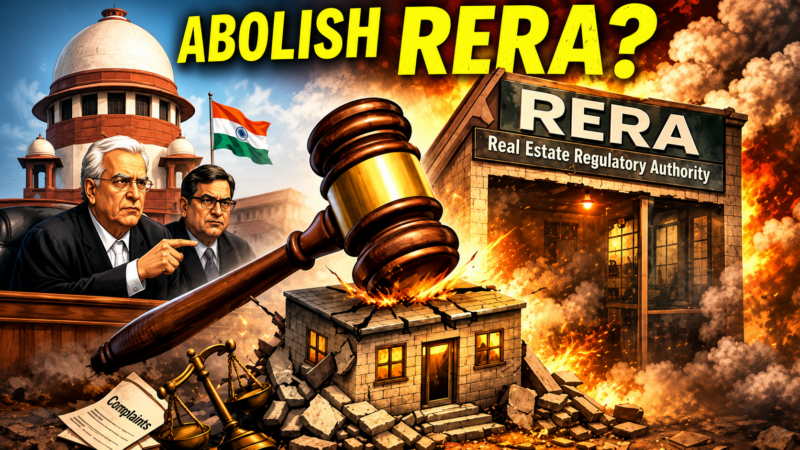
Gurugram’s 71-builder action therefore needs to be watched very closely.
Not because every developer named in the exercise is necessarily guilty of fraud.
Not because every RERA dispute represents criminal misconduct.
And not because every homebuyer claim should automatically prevail.
But because the fundamental principle is extraordinarily simple:
When a competent authority has finally decided that a homebuyer is entitled to a refund, interest, penalty or compensation, the next chapter should not be another five-year struggle.
The next chapter should be recovery.
For the homebuyer, that is what justice means.
- Not another order.
- Not another hearing.
- Not another certificate.
- Not another date.
- The money.
- The house.
- The end of the waiting.
And perhaps that is the most painful question raised by the ₹446-crore Gurugram recovery drive:
If the state has finally had to freeze 71 builders’ accounts to enforce orders that already existed, how many homebuyers spent years believing they had won—only to discover that winning the case was merely the beginning of the fight?