Goa To Ban Social Media For Children Under 16? India’s Digital Dilemma Deepens As States, Parliament And The Economic Survey Weigh In, But Can It Work?
As Goa considers restricting social media access for children under 16, a broader national debate is gathering momentum. From Parliament to the Economic Survey, concerns over digital addiction, mental health and online safety are pushing India to confront a difficult question: regulate platform design or restrict teenage access altogether?

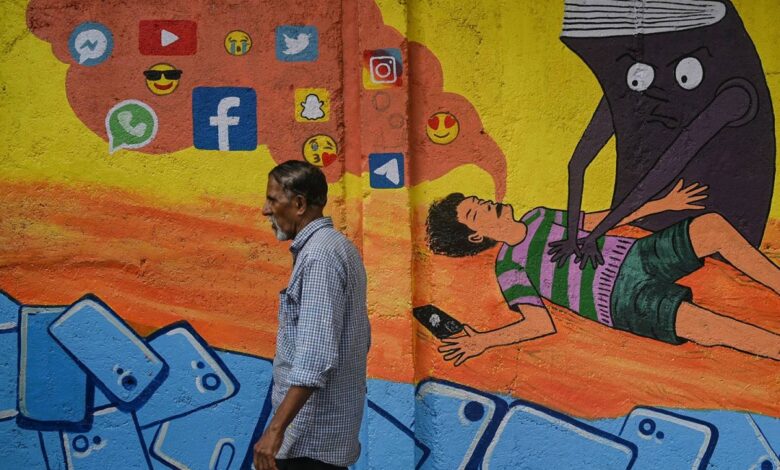
When Rohan Khaunte, Goa’s Information Technology Minister, said this week that the state is examining the possibility of restricting social media use for children below 16, it did not sound like an isolated administrative remark. It sounded like the beginning of a much larger national debate.
Khaunte made it clear that no hasty decision would be taken. A task force comprising academia, parent-teacher associations, industry representatives and government officials is expected to study the issue and recommend a policy framework. Any move, he emphasised, would need alignment with central laws, particularly the Information Technology Act.
Yet the signal was unmistakable: sixteen, he said, is a “very tender age.” At a time when children should be focusing on learning and overall development, digital addiction, exposure to age-inappropriate content, cyberbullying, anxiety, depression and misuse of personal data are raising red flags.
Goa may be small in geography. But on this question, it has stepped into a debate that stretches far beyond its coastline.
The Debate Goes National
The conversation is not confined to one state.
Parliamentarian Lavu Sri Krishna Devarayalu has indicated plans to introduce a private member’s bill that would bar children under 16 from maintaining social media accounts. His proposed Social Media Age Restrictions and Online Safety Bill would place compliance responsibility squarely on technology companies, with penalties of up to ₹2.5 billion or 5% of global revenue, whichever is lower.
While private member’s bills rarely become law, they often catalyse wider parliamentary debate. And this time, the debate is finding institutional support.
India’s latest Economic Survey has explicitly raised the issue of age-based restrictions as a point for policy consideration. Maharashtra has announced a task force to examine harms linked to digital addiction. Andhra Pradesh is studying international models. The conversation is no longer rhetorical; it is administrative.
For Big Tech, this matters enormously.

India: Big Tech’s Most Important Growth Market
Any restriction in India would not be symbolic. It would hit the world’s largest open digital market.
Meta Platforms Inc.’s Instagram and Facebook each have over 400 million users in India — more than in any other country. Snap Inc.’s Snapchat counts more than 200 million users in the country, making India its largest market. X Corp.’s X (formerly Twitter) has over 20 million users.
India has roughly 660 million smartphone users and more than 950 million internet connections. Over 85% of households own at least one smartphone. The digital economy contributes nearly 11.74% to national income and is projected to rise further.
Revenue per user may be lower than in the United States or Europe, but growth potential is unrivalled. India represents the largest pool of still-to-be-monetised digital consumers in the world.
A blanket under-16 restriction would therefore affect hundreds of millions of current and future users.
The Economic Survey’s Warning
The Economic Survey 2026 sounds unusually alarmed about digital addiction.
Indians collectively spent an estimated 1.1 lakh crore hours on smartphones in 2024 alone, according to industry estimates cited in the survey. It defines digital addiction as a behavioural pattern of excessive engagement with digital devices leading to psychological distress and functional impairment.
The risks are not abstract.
The Survey links social media addiction to anxiety, depression, low self-esteem and cyberbullying stress, particularly among the 15–24 age group. Gaming disorder is associated with sleep disruption, aggression and social withdrawal. Online gambling shows correlations with financial stress and even suicidal ideation.
Beyond mental health, the Survey frames the issue economically: reduced employability, lower lifetime earnings and increased healthcare costs. In other words, digital overuse is not just a family concern; it is a productivity concern.
Yet it also acknowledges a critical gap: India lacks comprehensive national data on the prevalence and mental health impact of digital addiction. The upcoming Second National Mental Health Survey is expected to provide empirical clarity.

The Global Wave
India is not alone in reconsidering youth access to social media.
Australia
Australia became the first democracy to enact a ban preventing children under 16 from holding accounts on certain social media platforms through its Online Safety Amendment (Social Media Minimum Age) Act. The objective: shield young users from harmful content and addictive design.
Europe
France has backed restrictions for children under 15. United Kingdom is actively consulting on an Australian-style ban under Prime Minister Keir Starmer’s government, alongside tightening its Online Safety Act to address AI chatbot risks. Spain and several other European nations are weighing similar moves.
Asia
Countries like China and South Korea have already experimented with gaming time limits and structured digital regulation.
The global direction is – governments are no longer treating youth social media use as purely a parental issue. It has become a public policy issue.
India’s Enforcement Challenge
India presents unique enforcement complications.
First, age verification. If platforms rely on self-declaration, teenagers will simply bypass restrictions. If verification becomes ID-based, it introduces privacy and surveillance concerns.
Second, VPN adoption. India reportedly has one of the highest VPN usage rates globally. Circumvention is technologically trivial.
Third, federal authority. Critics argue that such restrictions may fall under central, not state, jurisdiction – raising constitutional questions.
Digital rights advocates warn that enforcement could become either symbolic or overreaching. Apar Gupta of the Internet Freedom Foundation has argued that blunt bans risk shifting harm rather than reducing it, pushing teens toward less regulated platforms.
In other words, a ban may exist on paper but dissolve in practice.

Why the United States Struggles with the Same Idea
The United States illustrates another dimension: constitutional resistance.
Harvard Law Review has examined age-verification laws and noted serious First Amendment concerns. Courts have repeatedly found that broad social media restrictions may infringe on free speech rights, both for users and companies.
Rather than blanket bans, American legal scholarship suggests regulating specific harmful features – addictive algorithms, targeted profiling of minors, and design mechanisms that encourage compulsive engagement – while remaining content-neutral.
This approach may be legally complex, but it targets structural incentives rather than access alone.
The Take
If we are honest, the debate is not about whether children should scroll. It is about why platforms are engineered to make scrolling nearly irresistible.
Social media is not a neutral tool. It is a behavioural economy built on attention extraction. Infinite scroll, variable rewards, algorithmic amplification and targeted notifications are not accidental design features. They are revenue mechanisms.
If India moves toward an under-16 restriction without simultaneously addressing algorithmic accountability, child profiling, persuasive design features and data harvesting, the result may be cosmetic rather than transformative.
There is also a risk of creating a “cliff edge” at 16 – a sudden, unrestricted entry into a digital ecosystem without gradual literacy and resilience training.
The Economic Survey, to its credit, does not call for prohibition. It calls for balance: digital wellness education in schools, device-free hours, parental awareness, age-appropriate safeguards and expanded counselling support.
That feels closer to the real solution.
India faces a clear choice:
Option A: Adopt a high-visibility age-based ban that signals seriousness but struggles with enforcement.
Option B: Undertake the harder work of regulating platform design, strengthening child data protection, funding mental health research, embedding digital literacy in education policy and creating enforceable guardrails for persuasive technology.
The first path is politically dramatic. The second path is structurally meaningful.

The Last Bit,
Digital access is now woven into India’s economic and social fabric. Reversing it is neither realistic nor desirable. But ignoring the mental health, productivity and behavioural implications of unchecked digital immersion is equally untenable.
The question is not whether India should protect its children online. It is how.
Will the country pursue enforceable structural reform?
Will it invest in data and mental health infrastructure?
Will it regulate design rather than merely restrict age?
Digital addiction is not inevitable. It is engineered and if the architecture created the problem, architecture must be part of the solution.