India’s Smart Exit From The US-China Drama. Has India Found A Himalayan Pass Out?

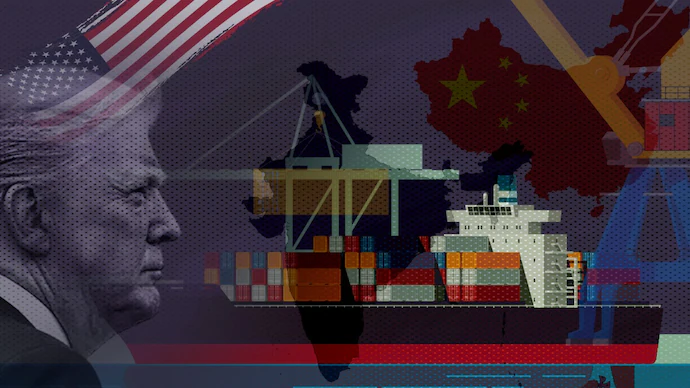
If this were a poker game, the US just went all-in with a 245% tariff hand, and China didn’t even blink and India is waiting to play its hand.
The two global giants have been locked in a tit-for-tat tariff brawl that’s starting to look less like economic policy and more like a heavyweight championship with no referee in sight. On Tuesday, the White House dramatically escalated the trade spat by threatening duties as high as 245% on Chinese imports, an eyebrow-raising figure that caught markets and observers alike slightly off-guard.
Until now, the US had slapped a 145% tariff on Chinese goods, while China returned the favour with a 125% levy on American products. But now Washington’s gloves are off, and the message is blunt – retaliate again, and we hit harder.
The trigger was perhaps a sharp response to China’s export curbs on rare earths and critical minerals like lithium, cobalt, and nickel, the backbone of EVs, semiconductors, and, well, modern civilization as we know it. Trump’s administration is now citing “national security” risks tied to America’s dependence on these foreign-sourced elements and is launching a fresh investigation into the country’s exposure.
Beijing, unsurprisingly, is not amused. In a not-so-subtle jab, China dismissed the US move as a “tariff numbers game” that’s devolved into economic theatre with little actual value, except perhaps for political mileage. In response, China has frozen new Boeing jet orders and curtailed US-made aircraft parts purchases, dealing a pointed blow to American aviation exports.
The Ministry of Commerce in China didn’t mince words either. In a sharp retort, it accused Washington of using tariffs as pressure tactics and said such actions only expose the US as “a laughingstock.”
Meanwhile, President Trump insists the US holds all the cards. White House Press Secretary Karoline Leavitt reiterated the administration’s position: China needs to come to the table. “They need our money,” she quipped, “we don’t need their deal.”
But behind the bluster and bravado, one player at the geopolitical table seems to be quietly cashing in without ever entering the fight.
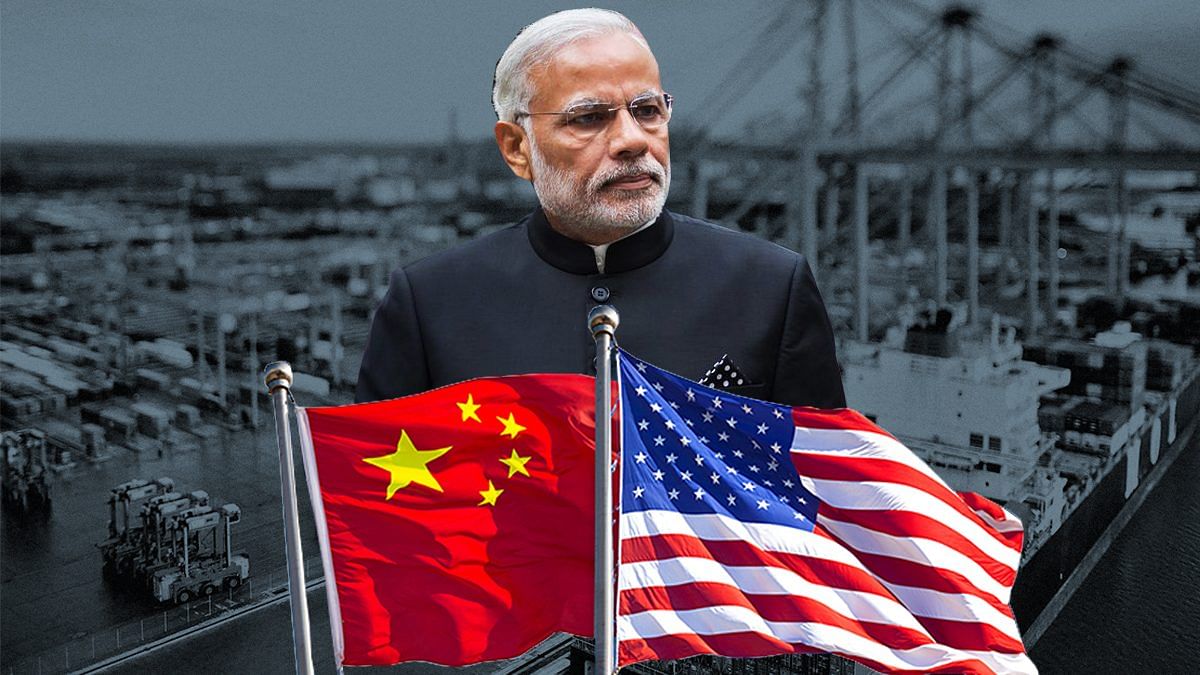
Enter India, unflustered, unprovoked, and (so far) uncaught in the crossfire.
While the US and China exchange economic jabs like prizefighters, India has quietly slid its chair a little further away from the ring, careful not to get hit, but ready to catch any opportunity that flies its way. As China and the US spiral into another round of tariff tantrums, observers, particularly in the US, are glancing toward New Delhi with renewed curiosity – could India be the alternative the world has been hoping for?
On Tuesday, Beijing fired another shot, ordering its airlines to freeze new Boeing deliveries. For context, Boeing had pinned big hopes on China, projecting around 9,000 aircraft deliveries to the country over the next two decades. That’s nearly one-fifth of its entire global order book grounded in a single bureaucratic blow.
Now compare that with India’s modest (but growing) appetite: 2,400 aircraft by 2043. Sure, it’s not the same scale but in the current climate, every plane counts. And with China grounding its ambitions, Boeing may well find Indian skies far more welcoming. Carriers like Air India Express and Akasa are eagerly awaiting the very same jets China just snubbed, Boeing 737 MAXs and 787 Dreamliners, now potentially up for grabs.
Even the aerospace spare parts market might see a quiet pivot. China’s parallel halt on buying aircraft parts is seen as a strategic push to elevate its homegrown aerospace sector, led by COMAC, a state-run entity trying to break the Airbus-Boeing duopoly. Whether it succeeds is anyone’s guess, but in the meantime, that vacuum could well become India’s opportunity.
However, amid all this geopolitical turbulence, India isn’t exactly popping the champagne. While the shifting trade winds do open doors, whether India can walk through them is still uncertain.
Manufacturing scale is still a work in progress. Logistics and infrastructure is getting there, and skilled labor pipeline is better, but still not China-level efficient.
In short, the opportunity is ripe, but the kitchen still needs work.
Trump’s hardliners, meanwhile, are a little cagey about India’s potential as a China-replacement. Particularly in sensitive sectors like pharma, where Trump has danced back and forth on whether to impose tariffs on imports, pharma included. One day he is keeping India close, the next he is eyeing import taxes. As ever, flexibility is the name of the game.
In fact, when asked if he has changed his mind on anything, Trump replied with signature flair: “I don’t change my mind. I’m just very flexible.” The statement, though meant to sound shrewd, has only fed accusations of policy inconsistency – especially as more American industries, from autos to toys, line up to request exemptions.
So, while Trump’s tariff circus plays on and China doubles down, India is executing a diplomatic masterclass in strategic silence. No loud moves. No public takedowns. Just a subtle tilt of the scales toward possibility.

From Passive Bystander to Strategic Player?
The question now is whether India can benefit from the US-China slugfest; but how long can it afford to stay quiet while opportunity knocks louder each week?
Sure, India’s exports to the US have steadily grown in recent years, and the government has rolled out the red carpet with initiatives like PLI (Production Linked Incentive) schemes across sectors from electronics to semiconductors. But the path is long and if India wants to take off as a serious alternative to China, it must do more than just cheer from the VIP lounge.
First up: supply chain confidence. Global manufacturers may be talking about “China+1,” but for most, India still isn’t that “+1”, at least not convincingly. Logistics costs remain high, last-mile connectivity remains patchy, and red tape still has more stamina than most entrepreneurs. Until those issues are addressed, India risks being the perpetual bridesmaid of global trade.
Secondly, there’s the people problem. India has no shortage of warm bodies, but what it needs is a cold-blooded skills upgrade. Precision engineering, advanced manufacturing, electronics assembly, these are areas where China has spent decades building expertise. India is playing catch-up with skilling initiatives, but time isn’t exactly on its side.
And yet, amid these hurdles lies an opportunity so big it almost dares to be missed.
The US is clearly looking to decouple from China, not just economically, but ideologically.
India, as the world’s largest democracy and a rising tech powerhouse, is perfectly positioned to be the partner Washington wants. But here’s the catch, Washington wants delivery, not just diplomacy. Nice speeches at business summits and investment-friendly slogans won’t cut it anymore.
For India to become the go-to partner, it must adopt a China-style playbook minus the authoritarianism (think aggressive infrastructure building, special economic zones tailored for global manufacturers, lightning-fast clearances, and sector-specific clusters). It also needs to speak the language of predictability – policy stability, tax consistency, and execution reliability.
The good news is some of this is already underway. States like Tamil Nadu, Gujarat, and Telangana are making serious moves to attract global investment in electronics, aerospace, and EVs. Companies like Apple and Micron have begun assembling and investing in India. But these are still green shoots, not the dense forest of manufacturing heft that China has built.
The bad news is the geopolitical clock is ticking. The US-China confrontation is no longer a flash-in-the-pan—it’s a multi-course meal. And if India wants a seat at that table, it needs to show up not just with appetite, but with cutlery and cuisine.

While Elephants Fight, the Grass Looks for Shelter
Even as the United States and China dig in their heels, global markets are holding their breath. Worldwide policymakers are watching this showdown like nervous spectators.
Europe, already juggling inflation, energy headaches, and a post-Brexit hangover, sees this trade turbulence as yet another reason to double down on “strategic autonomy.” The European Union has voiced concerns over the ripple effect on supply chains, particularly in tech and green energy. With China cutting off key minerals and the US calling dibs on every rare earth it can find, Brussels is now scrambling to build its own critical mineral reserves.
ASEAN countries, often caught in the crosswinds of big-power rivalries, are positioning themselves as neutral but opportunistic players. Vietnam, Indonesia, and Thailand are already pitching themselves to companies looking to diversify out of China. India may be playing it safe, but Southeast Asia is quietly rolling out the red carpet.
Japan and South Korea are feeling the heat too, especially with the US poking at semiconductor supply chains and demanding “friend-shoring” in the name of national security. Tokyo has pledged billions to support domestic chip production, while Seoul is playing diplomat, trying not to upset either side, especially when both are major trading partners.
And then there’s Africa and Latin America – regions historically sidelined in global trade talks but now being courted for resources, manufacturing, and influence. While they may not be front-row participants, they’re definitely in the stadium and they’re learning fast how to navigate this new, multipolar economic world.
But perhaps the biggest takeaway is this – globalisation, as we knew it, is on life support. In its place, a new doctrine is emerging, one built not on efficiency and scale, but on security, redundancy, and geopolitics.
Call it “slowbalisation,” call it “de-risking,” or call it what it is – a game of geopolitics.
The Last Bit,
In this trade war of attrition, where every tariff feels like a punch and every retaliatory move draws deeper lines in the sand, the global economy has become the collateral.
Even as the US flexes its economic muscle, China counters with quiet fury, and in between, countries like India are handed rare opportunities, if they can rise to the occasion.
More than trade war, it is a mirror reflecting the new world order, where alliances are fluid, economic decisions are deeply political, and resilience matters more than scale.
Hence, while Washington plays the bully and Beijing the wounded dragon, India – strategic, silent, and stubbornly pragmatic – may just end up holding the best card of all – the power of patience, because sometimes, not playing the game, is the smartest move on the board!