India’s $2 Trillion Export Dream, A Distant Mirage? Why China’s Might And Trump’s Tariff War Could Derail The Vision

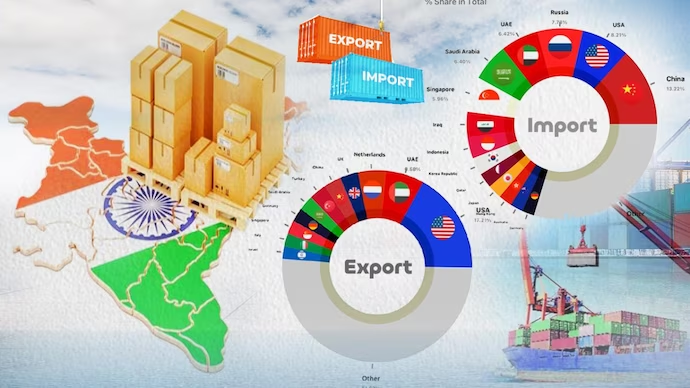
India has a dream and that is to achieve $2 Trillion in export; from a domestic perspective, China and India represent two of the most remarkable economic growth stories in modern history. Both nations, propelled by rapid industrialization and an expanding consumer base, have emerged as key players on the global stage.
Today, China is the world’s second-largest economy, trailing only the U.S., while India, after adjusting for purchasing power parity, is already the fifth-largest, just behind Japan.
But let’s call a spade a spade – China remains the undisputed champion of global manufacturing. It accounts for 26% of the world’s total with a staggering $4.61 trillion industrial output. These figures cast a long shadow over India’s $781 billion manufacturing sector and despite India’s undeniable progress, it still has a mountain to climb.
Yet, India has set its sights high – a $2 trillion export target and a $7 trillion GDP by 2030, impressive but can India realistically pull this off?
Why ‘Old’ is ‘Out’
For decades, India’s manufacturing sector has struggled with inefficiencies – fragmented supply chains, bureaucratic red tape, and high production costs. Government initiatives like Production-Linked Incentives, PLI, ‘Make in India,’ and heavy infrastructure investments have provided some momentum, but they’ve yet to catapult India into the same league as China.
On the other hand, China’s dominance is not just about cheap labor, it is about scale, efficiency, and an iron grip on global supply chains. If India wants to become an export powerhouse, it cannot rely on traditional, incremental growth strategies. A fundamental structural transformation is the only way forward.

Trump’s Tariff War, A New Roadblock for India’s Export Ambitions?
Just as India pushes to expand its global trade footprint, a fresh challenge as come in the form of Donald Trump’s tariff talk and his return to aggressive protectionism.
Starting April 2, the U.S. is set to impose reciprocal tariffs on countries that levy high duties on American imports. India, along with China and South Korea, is squarely in Trump’s crosshairs.
In a fiery address to the U.S. Congress, Trump criticized what he called “very unfair” trade practices, pointing fingers at countries like India that impose steep tariffs on American goods. A prime example he cited, the automobile sector, where India slaps duties exceeding 100% on imported vehicles. His message was clear – if a country charges high tariffs on U.S. products, the U.S. will hit back with equally high tariffs on their exports.
For India, this could spell serious trouble. The U.S. is India’s largest export destination, accounting for nearly 18% of total outbound shipments. If tariffs rise on key Indian exports—think pharmaceuticals, textiles, IT services, and engineering goods—it could erode competitiveness, hurt exporters, and dent the country’s ambitious $2 trillion trade dream.
But it’s not just about tariffs. Trump’s policies could signal a broader shift towards economic nationalism, where ‘America First’ comes at the expense of global trade partnerships. India, already facing rising competition from China and supply chain disruptions, now faces yet another hurdle, a potentially hostile trade stance from one of its biggest markets.
Ready To Take Some ‘Hit’
As India and the U.S. get down to hammering out the contours of a bilateral trade agreement, India’s domestic industries are willing to negotiate tariff reductions, but only on items of interest, while urging the government to push for reciprocal concessions from American authorities.
Commerce and Industry Minister Piyush Goyal is in the U.S. to meet with Commerce Secretary Howard Lutnick and U.S. Trade Representative officials, aiming to finalize the deal before the September-October deadline set by Prime Minister Modi and Donald Trump last month.
The Give-and-Take Strategy
Trump has repeatedly singled out India for its high tariffs, and domestic players recognize that some level of compromise is inevitable.
Hence, the Indian government’s approach could be – lower duties in select areas in exchange for U.S. concessions on key exports like textiles and leather.
Apparel Industry: India’s textile sector has identified over 50 items where reduced U.S. tariffs could boost exports. The industry is even open to cutting tariffs on certain PLI-covered products or eliminating them altogether.
Engineering Goods: The largest segment of India’s export basket has earmarked 33 high-value products, including stainless steel angle bars and round bars, where it seeks tariff relief. Since the U.S. has already raised steel levies to 25%, Indian exporters believe reciprocal tariffs won’t be a major concern.
Gems & Jewellery: Industry proposals include cutting import duties on polished and lab-grown diamonds from 5% to 2.5%, slashing tariffs on gold, silver, and platinum jewellery from 20% to 17%, and reducing gold bar duties from 5% to 4%.
The Tricky Sectors, Automobiles and Agriculture
The auto components sector faces a tough challenge. India has historically protected its automobile industry with high tariffs, but Trump and his close aide, Tesla’s Elon Musk are pushing for lower duties to boost electric vehicle exports.
Hence, it is possible that the government may trade off some auto tariffs in exchange for concessions in other sectors.
Agriculture, poultry, and dairy could be the biggest sticking points. The U.S. wants lower tariffs on farm products like chicken legs and shrimp, while India is reluctant to flood its markets with American agricultural goods.
India’s ‘Zero-for-Zero’ Strategy
As the U.S. gears up for reciprocal tariff hikes, India should consider proposing a ‘zero-for-zero’ tariff strategy, a move that could neutralize potential trade disruptions while avoiding the complexities of a full-fledged bilateral trade deal.
According to a recent report by the Global Trade Research Initiative (GTRI), this strategy would involve India eliminating import duties on select U.S. goods that don’t harm domestic industries and agriculture in exchange for similar tariff reductions by Washington.
Why ‘Zero-for-Zero’ Might Work?
GTRI suggests that India should exclude most agricultural items from the deal and instead refer to its FTA tariff offers to Japan, Korea, and ASEAN as a framework to craft its list. The aim is to negotiate this before April, ahead of the U.S. finalizing its tariff plans.
However, the proposal is not without challenges; while a ‘zero-for-zero’ tariff strategy technically violates WTO rules, GTRI argues that it is still a lesser evil compared to a full FTA, which would force India into tough compromises like –
—Opening government procurement to U.S. firms
—Reducing agriculture subsidies
—Weakening patent protections
—Removing data flow restrictions
Trump’s Tough Trade Stance & India’s Next Steps
The report states that Trump’s previous tariff war with Mexico and Canada, despite the USMCA agreement, signals his scepticism towards trade pacts. If the U.S. rejects India’s ‘zero-for-zero’ proposal, it would indicate that tariffs are being used as leverage for bigger concessions rather than a genuine concern about trade imbalances.
In such a scenario, GTRI advises India to take a firm stand and refuse to negotiate unreasonable demands and retaliate where necessary, much like China’s response to U.S. tariffs.
If India chooses to retaliate strategically, it could send a strong message without compromising its economic interests.
Implications For Indian Exports
The Trump administration’s reciprocal tariff plan could significantly impact Indian exports:
A uniform tariff hike could increase the duty on Indian goods from 2.8% to 4.9%
If sector-specific tariffs are imposed, Indian farm exports could suffer the most, with shrimp, dairy, and processed foods facing duties of up to 38.2%
Industrial goods—including pharmaceuticals, diamonds, jewellery, and electronics—are also at risk
Currently, Indian farm exports face a 5.3% tariff in the U.S., whereas U.S. farm exports to India face a much higher 37.7% duty. Similarly, for industrial goods, U.S. exports to India encounter a 5.9% tariff, while Indian industrial exports to the U.S. face only 2.6% duty.
With bilateral trade surpassing $125 billion in 2024, businesses on both sides are worried about potential losses if tariffs escalate.
The Last Bit,
But the question is, will the U.S. Play Fair?
The U.S. claims that it offers low-tariff access to global markets while other countries impose higher trade barriers, leading to a trade deficit exceeding $1 trillion.
The reciprocal tariff plan is aimed at correcting this imbalance, with Washington’s Commerce Secretary and U.S. Trade Representative (USTR) now reviewing country-specific trade policies to recommend higher tariffs.
Now whether the U.S. accepts India’s ‘zero-for-zero’ deal or use tariffs as a pressure tactic remains to be seen, if the latter, India must be prepared to hit back, protect its interests, and ensure it doesn’t buckle under unfair trade pressure.
As far as China and Indian exports go, India has a long road ahead to play ‘catch up’.