Manan Kumar Mishra Is The Perfect Example Of Thook Ke Chaatna, Why Such Bol Bachacan, When You Cant Stand By Your Words
BCI Doesn’t Hold Discretion Either To Grant Or Disallow License To Practice, Was This Entire Drama Created To Make CJI Happy & Get Elevated In Judiciary

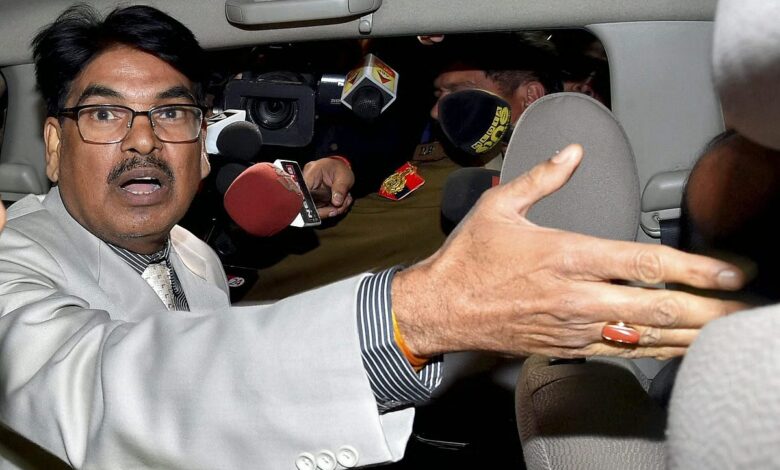
The Hasty Tyrant of the Bar: Manan Kumar Mishra’s Reckless Overreach, Institutional Panic, and the Exposed Fragility of the Bar Council of India
On the evening of 13 August 2026, Manan Kumar Mishra, Chairman of the Bar Council of India and BJP Rajya Sabha MP, did something that should never have been possible under a mature regulatory body tasked with guarding the legal profession. With a single circular, he attempted to professionally exile an entire graduating batch of one of India’s premier national law universities. Not for academic failure. Not for professional misconduct proven through due process. Not even for individual acts of contempt. He sought to freeze the enrolment of every 2026 graduate of NALSAR University of Law, Hyderabad, because a section of students had dared to object to the invitation of Chief Justice of India Surya Kant as convocation chief guest.
Within hours the same man was forced into a humiliating, multi-stage retreat. First he diluted the ban. Then he abandoned the inquiry. Finally he declared the entire episode closed, claiming the batch “had no role in any disturbance.” The episode lasted less than a day. Its stench will linger far longer. It stands as a textbook case of regulatory arrogance, political temperament dressed up as institutional concern, and the structural weakness of a body that claims vast powers over legal education and the right to practise law, yet collapses at the first serious pushback from the profession it claims to represent.
The Original Act: Collective Punishment as First Instinct
Mishra’s initial communication was not a measured request for information. It was a pre-emptive professional quarantine. State Bar Councils across the country were directed not to enrol any NALSAR 2026 graduate “until further orders.” Parallelly, the Vice-Chancellor of NALSAR was ordered to produce, within three days, an exhaustive report identifying signatories of student representations, organisers of the campaign, student body office-bearers, faculty members, alumni, and even “outsiders” who might have advised or facilitated the opposition.
The language was revealing. Mishra spoke of “groupism and dirty politics” among academic staff who were “misleading, instigating and misguiding the students.” He declared that a law student “having no regard or respect for the highest Judicial Office of the country is not expected to be a responsible or sensible Advocate, Teacher or a Judge” and would remain “a liability on the profession.” He drew a distinction between legitimate criticism and “organised intimidation, coercion, personal vilification, disruption, obstruction or an organised call for boycott.” In one stroke he converted a university petition into a potential disqualifying offence under the Advocates Act, and he did so without any individual inquiry, without any hearing, and without any finding of misconduct.
This was not regulation. This was collective punishment. It treated an entire cohort as suspect because a portion of the student body exercised a right that universities exist to protect: the right to question, to dissent, and to petition institutional authorities. The students’ stated objections concerned the CJI’s public remarks on police action against protesters and earlier comments referring to certain youth as “parasites and cockroaches.” Whether one agrees with those objections is irrelevant. What is relevant is that Mishra’s first institutional response was to hold the professional futures of hundreds of young lawyers hostage.
The Statements That Exposed the Mindset
Mishra’s subsequent public comments only deepened the damage. After the first wave of outrage, he claimed the order had been “done in haste.” He insisted the Council’s real concern was protecting students from possible difficulties in judicial internships. He told critics from the Cockroach Janta Party that “our interests are the same as theirs.” He later announced that the 2026 batch “had no role in any disturbance or movement” and that “no further inquiry” would take place.
These statements are not clarifications. They are admissions of institutional failure. An order that can be described as “hasty” by its own author hours after issuance was never a serious regulatory act. It was an emotional reaction dressed in the language of statutory authority. The sudden discovery that the entire batch was innocent sits poorly with the earlier demand for a detailed report identifying organisers and faculty instigators. The claim that the BCI was merely protecting students from future judicial hostility is particularly hollow: if the concern was genuine, the proper course was to engage the judiciary, not to brand an entire batch of students as potential professional liabilities.
The final advisory — that students should voice opinions “with respect and institutional decorum” and that “public ridicule of constitutional institutions is often counterproductive” — is the most revealing of all. It reframes the issue as one of tone and deference rather than of rights. Dissent is permitted, provided it remains polite and does not embarrass the highest judicial office. That is not the language of a regulator of a free profession. It is the language of an authority uncomfortable with challenge.
The Retaliation That Forced the Collapse
The backlash was swift, broad, and uncompromising. It came from within the profession Mishra claims to lead.
Senior advocates, including the President of the Supreme Court Bar Association, publicly described the order as arbitrary, illegal, disproportionate, and fundamentally unsustainable. Other members of the Bar Council itself called it manifestly arbitrary. Lawyers across the country pointed out the obvious: that collective professional punishment for political or ideological expression inside a university violates both the Advocates Act and constitutional guarantees under Articles 19(1)(a) and 19(1)(g). Students and young lawyers organised rapid online and offline resistance. Political voices, including Asaduddin Owaisi, framed the episode as an attempt to create a “pliant academic culture.” Even figures associated with satirical student politics threatened to protest outside the BCI office and Mishra’s residence.
The speed of the retreat is the clearest evidence of how isolated Mishra’s action had become. Within hours the blanket ban was withdrawn. Within further hours the inquiry demand itself was abandoned. By the early hours of 14 August the entire proceeding was declared closed. No report was ultimately required. No individual was named. No finding of misconduct was recorded. The mountain of institutional thunder had produced a mouse of official silence.
This was not consultation followed by reconsideration. It was panic followed by abandonment. The profession had made clear that it would not accept a regulator who treated student dissent as a professional offence and an entire graduating class as collateral damage.
The Structural Limitations the Episode Exposed
The affair did more than embarrass one individual. It illuminated the deeper institutional weaknesses of the Bar Council of India itself.
First, the BCI possesses sweeping statutory powers over legal education and enrolment, yet operates with thin internal checks when those powers are exercised by a single forceful Chairman. The capacity to issue nationwide directives affecting the professional futures of hundreds of students without prior collective deliberation or transparent process is a design flaw, not a strength.
Second, the dual role of the Chairman as both regulatory head and active political figure creates an inevitable perception problem. When a BJP Rajya Sabha MP uses the machinery of the BCI to respond to criticism of a sitting Chief Justice, the line between institutional defence of the judiciary and political defence of a particular judicial figure becomes dangerously blurred. Even if no formal political instruction existed, the optics alone damage the claim of neutral professional regulation.
Third, the BCI’s historical tendency to expand its writ into campus politics and student expression reveals a misunderstanding of its own mandate. Regulating standards of legal education is one thing. Policing the political or ideological content of student petitions is another. The latter risks turning the Council into an ideological gatekeeper rather than a professional regulator. The Advocates Act was never designed to manufacture deference.
Fourth, the absence of robust internal dissent mechanisms was on full display. Once the Chairman had spoken, the institution appeared to follow until external pressure from the wider bar forced a reversal. A healthy regulatory body should contain stronger internal brakes against impulsive collective punishment.
Fifth, the episode demonstrated how easily the threat of enrolment denial can be weaponised. For a graduating student, the right to practise is not an abstract privilege; it is the culmination of five years of education and the gateway to livelihood. Using that gateway as a disciplinary lever against expression is a form of soft coercion that sits uneasily with constitutional values.
Conclusion: A Cautionary Episode, Not an Isolated Mistake
Manan Kumar Mishra’s actions on 13 August 2026 were not a minor procedural misstep. They were a concentrated expression of regulatory overconfidence, institutional insecurity, and a troubling readiness to treat student dissent as professional unfitness. The language of the original circular, the speed of the subsequent collapse, and the final attempt to lecture students on “decorum” together paint a coherent picture: an authority more concerned with protecting the image of constitutional offices than with protecting the conditions under which independent lawyers are formed.
The nationwide retaliation by advocates was not mere noise. It was the profession’s immune response. It forced the BCI to abandon an indefensible position and, in doing so, exposed the limits of the Council’s moral and practical authority when it overreaches. The episode should serve as a permanent reminder that the power to regulate entry into the legal profession is not a licence to discipline thought, and that a body which claims to guard the independence of the bar cannot itself act with the impulsiveness of a political actor under pressure.
The chapter may have been declared closed by the Chairman. For those who care about the character of the legal profession in India, it remains wide open.