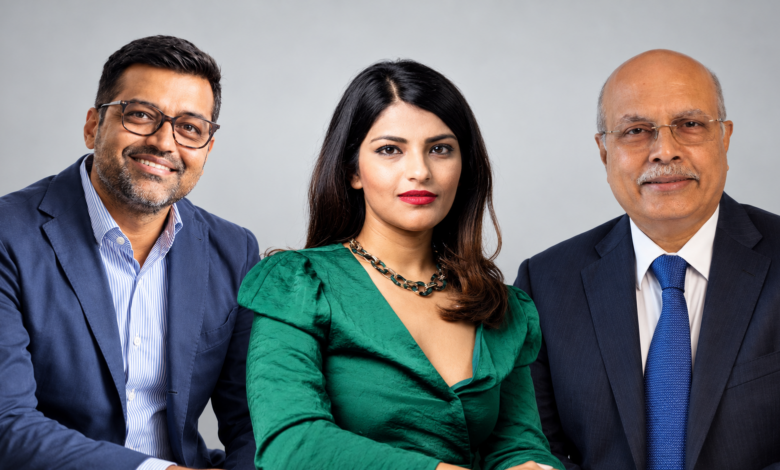
Meet Ankiti Bose, Krishan Rattan & Shailesh Haribhakti: The Three Financial Paradoxists
A Detailed Overview of Their Controversies, Financial Irregularity Allegations, Corporate Governance Questions and Legal Proceedings

When Corporate Prestige Meets the Paper Trail, the Questions Do Not Disappear
In the world of corporate finance, reputation is often presented as a substitute for scrutiny. A celebrated entrepreneur, an internationally connected investment professional and an eminent chartered accountant may occupy very different corners of the business establishment. Yet their public profiles raise a common question of considerable importance: what happens when the polished narrative of professional success encounters the less glamorous world of court dockets, insolvency proceedings, disputed financial disclosures, regulatory action and allegations of governance failure?
This investigation examines the public records associated with Ankiti Bose, Krishan Rattan and Shailesh Haribhakti.
The expression Financial Paradoxists is an editorial description, not a legal classification. It refers to the striking contrast between the professional standing associated with these individuals and the complicated financial, corporate or legal records that have emerged around particular businesses, transactions and proceedings connected with them.
The three cases are not identical. Nor do the available records establish a common conspiracy, a shared financial offence or a finding that all three individuals committed fraud. They do, however, illustrate why corporate reputation should never be allowed to replace documentary examination.
The records include a high-value English civil-fraud dispute later discontinued against Rattan without an adverse finding; a dramatic startup collapse involving allegations that Bose has disputed; and a series of proceedings, professional-disciplinary questions and historical regulatory disclosures involving Haribhakti, including a prohibition imposed on his former audit firm.
The challenge is to examine these matters without the two familiar distortions of corporate journalism: converting every allegation into a conviction, or allowing every allegation to disappear behind a prestigious résumé.
A serious investigation must do neither.
Part I — Krishan Rattan: The Voltaire Litigation, Corporate Insolvency and the Burden of Documentary Scrutiny
1. Voltaire Capital: A civil-fraud dispute involving approximately US$132 million in investments
The most significant litigation associated with Krishan Rattan in the available record concerns Voltaire Capital Holdings Limited and Others v Eric Watson and Others, Commercial Court claim CL-2022-000699 in England and Wales.
Rattan was named as the second defendant.
The claimants’ case concerned investments made between 2014 and 2019 in a group of businesses associated with Voltaire. Their allegations, as described in the English proceedings, concerned the business’s ownership and control, representations made to investors, the economic terms on which transactions were undertaken, financial forecasts, undisclosed interests and the alleged diversion or application of funds.
The figures are substantial. The case materials described approximately US$132 million invested and approximately US$101 million allegedly lost. The pleaded claims included fraudulent misrepresentation, breach of fiduciary duty, conspiracy and related accessory liability.
These figures must be understood correctly: they describe the claimants’ allegations and claimed losses, not a final judicial finding that Rattan fraudulently obtained or misappropriated US$101 million. The judgment of 24 April 2026, reported as [2026] EWHC 1103 (Comm), dealt with another defendant’s application to bring a counterclaim late in the proceedings. It did not determine that Rattan had committed fraud.
The question for investigative journalism is not whether a headline can make a large number sound incriminating. It is whether the reader is given the complete procedural story.
That story includes a material subsequent development.
2. The proceedings against Rattan were discontinued without an adverse finding
The Delhi High Court’s order of 14 September 2026 in Krishan Rattan v Nitin Naresh & Others, CS(OS) 815/2026, records Rattan’s reliance on an English consent order dated 5 August 2026.
According to the Delhi High Court order, the consent order discontinued proceedings against Rattan without an adverse finding of fraud, dishonesty or wrongdoing.
That development materially changes how the earlier English proceedings must be reported. A prior trial listing must not be presented as proof that Rattan remained a defendant facing an ongoing fraud trial after the proceedings against him had been discontinued. Equally, the discontinuance must be reported accurately without claiming that a court conducted a full trial and affirmatively exonerated him on every factual question.
The consent order itself and its complete terms were not available in the research material reviewed for this article. The appropriate conclusion is therefore narrow but important: the Delhi High Court recorded the discontinuance and the absence of an adverse finding against Rattan in those proceedings.
A fair investigation cannot omit this development simply because the earlier allegations make for a more sensational headline.
Nor does an accurate account of the discontinuance erase the historical fact that the civil-fraud claims were made. The legal outcome and the original allegations are separate parts of the record.
3. The £63,267 costs order: A real judicial order, but not a fraud penalty
There is another independently significant development in the same litigation.
On 28 July 2025, in [2025] EWHC 1948 (Comm), the English Commercial Court ordered Rattan to pay £63,267 towards the claimants’ costs associated with a contested disclosure-guidance application.
The court assessed costs at £70,297 before applying a 10% reduction to reflect Rattan’s limited success.
This was a personal civil-litigation costs order. It was not a criminal fine, a regulatory penalty or damages awarded after a finding that Rattan had committed fraud. The material reviewed for this article does not establish whether the amount was subsequently paid or how it was treated under the later settlement.
The distinction matters. A costs order is legally meaningful, but it cannot responsibly be repackaged as a fraud conviction.
4. Voltaire Capital (United Kingdom) Ltd: Liquidation and eventual dissolution
Companies House records establish that Voltaire Capital (United Kingdom) Ltd, company number 08099043, entered creditors’ voluntary liquidation on 17 May 2019 and was dissolved on 23 April 2025. Its records also identify Rattan as a director.
These are corporate facts, not allegations.
But their meaning must not be exaggerated. A company entering liquidation does not, by itself, establish that its directors committed misconduct, that a director became personally bankrupt, or that the director was personally liable for every corporate obligation.
The legitimate investigative question is what the company’s filings, accounts, creditor information and insolvency records reveal about its financial history and the responsibilities of those who managed it. Those questions are different from a presumption of personal guilt.
5. Distribution Logistics Infrastructure: A ₹993.26-crore creditor-claims figure
The next major financial record concerns Distribution Logistics Infrastructure Private Limited, referred to here as DLI.
The company entered the corporate insolvency resolution process in May 2026. The creditor information dated 6 June 2026 in the research dossier records secured financial claims submitted of approximately ₹994.24 crore, of which approximately ₹993.26 crore had been provisionally admitted.
The creditors included major financial institutions such as the State Bank of India, Bank of Baroda, Bank of India, Punjab National Bank, Union Bank of India and ARCIL.
The scale of the admitted claims raises obvious questions about the company’s financial position, its asset base, its business decisions and the recovery prospects for creditors. These are precisely the matters that insolvency proceedings are intended to examine.
However, these are claims against DLI, not an adjudicated personal debt or fraud liability of Rattan.
Terra-Invest has publicly stated that Rattan’s resignation from DLI took effect on 20 June 2025, before the commencement of the insolvency proceedings. The underlying cessation filing was not obtained during this review, so the resignation date is attributed to the firm’s statement rather than independently treated as an MCA-verified fact.
The appropriate investigation is into the company’s accounts, assets, creditor recoveries, management decisions and insolvency resolution—not the automatic assignment of the company’s debts to a former director. The IBBI’s public-announcement records independently confirm the commencement of DLI’s insolvency process.
6. Mount Row and the US$124-million Fujairah terminal transaction
A separate controversy concerns the sale of GP Global’s Fujairah terminal to Mount Row Partners for US$124 million in May 2022.
Trade publication Ship & Bunker reported that Gulf Petrochem FZC filed a lawsuit in Dubai in July 2024 against Mount Row and restructuring professional Rod Sutton. The claimant sought annulment of the asset-purchase agreement and AED100 million in damages.
The reported allegations included the claim that a higher offer of US$135 million could have been accepted and that the terminal’s land lease had been transferred alongside the terminal without proper authority or additional value.
A Dubai appellate decision on 30 April 2025 reportedly reversed an earlier dismissal based on an arbitration clause and returned the dispute to the first-instance court for determination on the merits.
That is a serious commercial dispute surrounding a transaction involving a nine-figure dollar sum. It deserves scrutiny of the sale process, valuation, lease arrangements and treatment of creditors.
But two safeguards are essential: AED100 million was the amount of damages sought, not an established award, and the material reviewed does not establish that Rattan was personally a defendant in the Dubai proceeding or that a final merits judgment found wrongdoing by him.
7. The defamation case in Delhi: Fact-finding is not the same as unrestricted publication
Rattan has also initiated legal proceedings in India over publications concerning his record.
On 14 September 2026, the Delhi High Court granted an ad-interim restraint against further articles containing defamatory imputations against him. The order expressly clarified that it did not preclude continuing fact-finding concerning allegations against him.
On 28 September 2026, Rattan sought action alleging that 12 articles published after the injunction breached the order. The defendants disputed that allegation and sought time to respond. The court directed a reply and listed the application for 15 October 2026.
As of 11 October 2026, the material reviewed does not establish a final determination of that alleged breach. The application remained a live procedural matter at the research cutoff.
The public-interest principle is straightforward: a court file can be investigated, but a publication must accurately represent what the court has and has not decided. Neither a plaintiff’s accusation nor a defendant’s denial should be presented as a final judicial conclusion.
Part II — Ankiti Bose: Zilingo’s Collapse and the Unanswered Questions of Startup Governance
If Rattan’s record is dominated by complex commercial disputes and corporate insolvency, Ankiti Bose’s public controversy is closely associated with the dramatic collapse of Zilingo.
Zilingo began as a fashion-commerce startup and became one of Southeast Asia’s most prominent venture-backed businesses. Bose was its co-founder and chief executive. Yet the company that had attracted major institutional investors ultimately entered liquidation after a series of financial and governance controversies.
The important question is not simply how a startup collapses. Businesses fail for many legitimate reasons. The more consequential question is whether a company’s financial reporting, spending, management structures and internal controls give investors a reliable picture of its true condition.
8. Suspension and dismissal in 2022
Bose was suspended in March 2022 following complaints concerning alleged financial irregularities and was dismissed on 20 May 2022 after a company-commissioned investigation.
Bloomberg’s investigation, republished by The Indian Express in August 2022, described concerns over Zilingo’s financial performance, management practices, spending and changing expansion strategy. The reporting drew on interviews with more than 60 people, including current and former staff, merchants, investors and others familiar with the business. Bose denied wrongdoing.
An important qualification emerges from Mint’s reporting on her termination letter: the listed grounds reportedly included insubordination, neglect, failure to provide documents or attend questioning, and a breakdown of trust, but the letter did not expressly accuse her of fraudulent transactions.
Bose disputed the circumstances of her dismissal and said she had not received a sufficient opportunity to respond.
An internal investigation and a board’s employment decision are not equivalent to a criminal conviction. Nor does the absence of a criminal finding erase the governance questions that prompted the board to act.
The company, its board and its investors had to confront the difference between the public image of a celebrated startup and the financial and operational concerns reported inside it.
9. The disputed vendor payments exceeding US$10 million
A prominent part of the controversy concerns vendor payments reported by Inc42 in its investigation published on 21 April 2023.
The report questioned payments totalling more than US$10 million, including approximately:
| Reported recipient | Amount reported |
|---|---|
| Algo Legal | US$7 million |
| OneDelta Technology Solutions | US$2.3 million |
| EbixCash | US$944,000 |
| Total of the listed figures | US$10.244 million |
The report questioned the approval process, commercial justification and timing of these transactions and attributed approval of payments to Bose.
Bose denied knowledge of financial discrepancies or unexplained payments and challenged the account presented by anonymous sources. Inc42 said it had not obtained the Kroll or Deloitte investigation reports that might have helped independently resolve the claims.
Consequently, these are disputed reported payments—not judicially established misappropriation, proven proceeds of crime or a financial penalty imposed on Bose.
Nevertheless, the underlying issue is legitimate and important. In a venture-backed enterprise, payments running into millions of dollars should be supported by identifiable contracts, invoices, services, approvals and accounting entries. The existence of such documentation, and what it says, is more important than any individual’s public reputation.
If the payments were commercially justified, the records should establish that. If there were discrepancies, the appropriate investigators should determine their nature, responsibility and financial consequences.
Public debate should demand that evidence—not substitute speculation for it.
10. The salary controversy: A dispute requiring documentary resolution
Reporting also raised questions about Bose’s remuneration.
Bloomberg reported questions from company stakeholders about an alleged increase from a monthly salary of S$8,500 under an earlier employment contract to S$50,000 from 2019.
Bose disputed the characterisation of the increase. Her subsequent explanation, recorded in an NDTV stock-exchange disclosure dated 13 August 2023, referred to a 30% salary reduction and supporting company documentation.
The allegation of an unauthorised increase was not established by a judicial finding in the material reviewed for this article.
The obvious question is whether remuneration was authorised by the board, supported by contemporaneous employment records, properly disclosed and accurately represented to stakeholders.
That is a corporate-governance issue. It should be resolved by examining contracts, board minutes, payroll records and relevant disclosures—not by declaring either side guilty on the basis of a headline.
11. Three different revenue figures: US$190 million, US$164 million and US$140 million
Perhaps the most consequential reporting questions concern Zilingo’s financial figures.
Bloomberg reported that investigators examined three different FY2021 revenue figures shared with external parties:
- US$190 million;
- US$164 million; and
- US$140 million.
A separate document shared with a potential investor reportedly showed net revenue of approximately US$40 million.
These figures should not be collapsed into a simple accusation of fabricated revenue. Gross merchandise value, gross revenue, net revenue, booked revenue and uninvoiced revenue are not interchangeable accounting concepts. Different dates and treatments of cancellations can also produce different totals.
Bose’s explanation referred to reporting dates, cancelled orders, uninvoiced revenue and the basis used during fundraising. She also maintained that investors knew the company’s revenue-recognition practices. Bloomberg reported that investigators were concerned about the differing numbers.
But this is precisely why transparent accounting matters.
When a company reports figures of US$190 million, US$164 million and US$140 million to different audiences, investors should be able to reconcile those amounts through clear definitions, adjustments, cut-off dates and supporting ledgers.
And when a separate document reports US$40 million in net revenue, the differences should be explained in a way that a competent independent reviewer can reproduce.
There is no substitute for a reliable reconciliation. Explanations become persuasive when the documents support them.
12. Zilingo’s fundraising success and financial collapse
Zilingo reportedly raised US$226 million during its 2019 funding round, reaching a valuation of approximately US$970 million. Bloomberg’s broader reporting stated that the startup had raised more than US$300 million from prominent investors, including Temasek and Sequoia India.
The same reporting described how concerns about spending and financial performance escalated, creditors sought repayment, employees departed and the company entered a prolonged crisis. Bloomberg reported that the US$226 million raised in early 2019 had been spent in less than two years.
The financial lesson is uncomfortable but indispensable: a near-unicorn valuation is not proof of financial health, just as an impressive investor list is not a substitute for independent scrutiny.
A large funding round can buy time, expansion and public attention. It cannot permanently compensate for weak internal controls, unclear reporting or an unsustainable business model.
At the same time, the fact that a startup consumed its funding does not, by itself, prove that its management committed fraud. Capital can be exhausted by poor strategy, market shocks, operational losses and many other causes. Establishing misconduct requires evidence of particular acts, intentions and legal breaches.
13. The GST proceeding in Mumbai: A significant lead, not a finding of guilt
The case register reviewed for this article identifies a Mumbai proceeding titled Lavakesh Additional Assistant Director v Ankiti Bose, registration number 155/2025, with CNR MHMM110153622025. The nongovernment court index classifies the matter under provisions of Sections 132 and 137 of the Central Goods and Services Tax Act.
The indexed record identifies Bose, Zilingo Global and other parties and displays the case as pending, with 18 January 2027 shown as the next date.
However, the underlying complaint, prosecution sanction, cognizance or summoning order, alleged tax amount and any substantive judicial determination were not obtained in this review.
That limitation is material. Without those documents, it would be irresponsible to invent a tax-evasion mechanism, quantify an alleged loss to the exchequer or report a conviction that has not been established.
The existence of an indexed case is a legitimate reason to obtain the original prosecution papers and track the proceedings. It is not proof of the allegation’s truth.
14. Two Section 379 BNSS applications: The procedural distinction matters
The research register also identifies two applications brought by Nikhil Subramaniam and Inc42:
| Case | CNR | Indexed status in the available record |
|---|---|---|
| MC 1583/2025 | DLSE020191842025 | Pending |
| MC 1584/2025 | DLSE020191822025 | Pending |
The matters were filed on 16 April 2025 and registered on 22 April 2025. The index displayed 24 October 2026 as the next listing.
The underlying applications and substantive orders were not obtained.
Their existence therefore does not establish proven perjury, a deliberate false statement or a direction by the court to prosecute Bose. These are precisely the kinds of proceedings where an investigative report should obtain the application, response and relevant judicial orders before drawing a conclusion.
15. The KN95 mask controversy and the US$6.75-million bank guarantee
Another controversy arose during the COVID-19 pandemic.
Mint reported allegations by health-ministry officials that Zilingo attempted to supply substandard Chinese KN95 masks using allegedly forged inspection certificates. Zilingo disputed unethical conduct and referred to changing certification standards and procurement difficulties. The available reporting does not establish a personal finding of wrongdoing against Bose.
The associated Delhi High Court matter was M/s Zilingo Pte. Ltd. v Union of India, W.P.(C) 8001/2020. On 15 October 2020, the court permitted encashment of a US$6.75-million bank guarantee, with the funds to be held separately subject to further orders.
This amount was contractual security. It was not a personal fine on Bose and was not, on the record reviewed, a final award of fraud damages.
A responsible investigation must distinguish the allegations about product quality, the contractual and administrative disputes, and the court’s actual order. The amount involved makes the matter worthy of examination, but it cannot be used as shorthand for personal criminal liability.
16. Regulatory filing failures and Zilingo’s liquidation
Singapore’s Accounting and Corporate Regulatory Authority confirmed in February 2023 that enforcement action had been taken against Zilingo for failing to file annual returns for 2020 and 2021.
ACRA did not identify the specific action taken or disclose a monetary penalty in its public statement. It therefore does not support assigning a particular fine to Bose.
Zilingo subsequently entered creditors’ voluntary winding-up, with a resolution dated 17 February 2023. Liquidation administration continued in the records reviewed through March 2026.
Corporate liquidation is not proof of personal fraud. But for investors, creditors, employees and business partners, a major startup’s collapse creates an unavoidable need to examine asset realisation, creditors’ recoveries, the handling of books and records, and the explanations for the company’s financial condition.
The public should not be expected to choose between a founder’s version and the board’s version without access to the documents that can test both.
17. Bose’s own litigation and complaints: The other half of the record
A complete account must also describe proceedings initiated by Bose herself.
The Mahesh Murthy/Outlook defamation litigation. Bose filed Suit 242/2023 in the Bombay High Court and sought ₹820 crore in damages over publications she alleged were defamatory. An interim application concerning a column implying illicit withdrawals received relief on 24 August 2023. Subsequent Bombay High Court procedural orders continued the earlier relief. The amount claimed was not a damages award, and the interim order was not a finding that Bose had committed financial misconduct.
The Inc42, Nikhil Subramaniam and NDTV litigation. Bose also sought ₹820 crore in litigation involving publications concerning Zilingo and financial allegations. The jurisdictional dispute proceeded to the Supreme Court, which dismissed the defendants’ special leave petition in February 2024. That procedural outcome must not be misdescribed as a judicial endorsement of the underlying financial allegations or as a final award of the amount sought.
The NDTV settlement. Adani Enterprises’ prospectus dated 30 June 2025 disclosed an amicable settlement involving NDTV Convergence and an application to remove NDTV as a party. The disclosure did not state a settlement payment.
The complaint against Dhruv Kapoor and Aadi Vaidya. In April 2024, Bose made criminal allegations including cheating, intimidation, conspiracy and harassment against her former co-founder Kapoor and former COO Vaidya. She alleged that they had misled her and investors and sought to pressure her into relinquishing shares and her business interests. Both men denied the allegations and disputed her account. The public reporting does not establish a final judicial determination of those competing claims.
The civil suit against Kapoor. Bombay High Court proceedings numbered S/244/2024 were still producing procedural orders in September 2025 concerning service and the filing of written statements. The retrieved order did not decide the substantive allegations.
The Saket proceedings against Nikhil Subramaniam and Inc42. The index reviewed lists CS 601/2024, criminal defamation complaint 3709/2024 and criminal revision 324/2026, initiated by Bose. The underlying substantive outcomes were not independently verified.
These proceedings matter because the story is not merely one of allegations directed at Bose. She has also made allegations against others and litigated over publications about her. A serious investigation must apply the same evidentiary standards to both sides.
18. The injunctions concerning publications about Bose
In litigation brought by Bose, the Delhi High Court issued an order on 24 August 2026 concerning particular publications and the exercise of her legal rights.
The court restrained the dissemination of identified articles through social media and restricted further articles that would have the effect of restraining her from exercising her legal rights. The order records her challenge to allegations of fraud and misappropriation, her position that no judicial finding of guilt had been made against her, and the history of earlier interim relief.
These are interim orders, not final adjudications of every underlying factual dispute. But they are part of the legal position that any publication concerning Bose must take seriously.
An investigative publication can examine documents and report verified events. It cannot responsibly turn an unresolved allegation into a declaration of guilt or disregard an operative court order because the subject is controversial.
Part III — Shailesh Haribhakti: Professional Scrutiny, Historical Proceedings and the Difference Between an Auditor and an Audit Firm
Shailesh Haribhakti’s record requires a different approach.
He has held prominent roles in professional services, corporate boards and governance discussions. The public record includes personally named proceedings, historical disclosures and regulatory action against an audit firm with which he was associated.
But a crucial distinction runs through these matters: an action against an audit firm or another partner is not automatically a personal sanction against Haribhakti.
A credible report must preserve that distinction even when it complicates the headline.
19. The ICAI disciplinary proceeding: A hearing listed for 13 October 2026
The Institute of Chartered Accountants of India’s official disciplinary materials identify case PPR/HPC/DD/58/INF/2018/DC/1860/2024 concerning Haribhakti & Co. LLP, with CA Shailesh V. Haribhakti named as the member answerable.
The relevant cause list schedules a hearing for 13 October 2026, two days after the present research cutoff.
This is a personally named professional-disciplinary proceeding and is materially different from a proceeding concerning only his former firm or other professionals.
However, the cause list does not set out the full charges or establish misconduct, a monetary penalty or removal from membership. At 11 October 2026, the listed hearing was still in the future. Its eventual outcome cannot be reported in advance.
This is precisely where professional accountability matters. An official process should proceed promptly, transparently and according to the applicable disciplinary rules. If misconduct is established, the result should be recorded in a reasoned order. If the charges are not established, that outcome should be just as clear.
20. Five legal-metrology prosecutions in Mangaluru
A second cluster concerns five prosecutions arising from an inspection involving mandatory package declarations and additional maximum-retail-price stickers.
The associated Karnataka High Court petitions and underlying trial cases were:
| Karnataka High Court petition | Underlying trial case |
|---|---|
| 2605/2013 | CC 527/2012 |
| 2606/2013 | CC 525/2012 |
| 2607/2013 | CC 529/2012 |
| 2608/2013 | CC 526/2012 |
| 2609/2013 | CC 528/2012 |
On 29 May 2019, the High Court quashed proceedings against several petitioners but allowed the corresponding prosecutions to continue against petitioner/accused No. 4, Haribhakti, in four matters. A subsequent order on 11 December 2019 allowed the fifth prosecution to continue against him and the relevant company.
These orders establish that the High Court declined to quash the proceedings against him at that stage. They do not establish a conviction.
The later trial outcomes were not verified for this report. The responsible next step is to obtain the latest trial-court orders and determine whether the cases remain pending, have been disposed of or have resulted in a judicial finding.
21. The Blue Star/Ramsons Traders dispute and the alleged ₹41-lakh claim
Blue Star’s placement document dated 22 September 2023 disclosed a complaint filed by Raghunath Prasad, proprietor of Ramsons Traders, on 19 August 2017.
The complaint named Haribhakti and alleged that termination of a distributor/service agreement without the required 30-day notice had resulted in the avoidance of approximately ₹41 lakh in service payments. It included allegations of cheating and criminal conspiracy.
Blue Star disclosed that the Calcutta High Court had stayed further proceedings on 14 September 2023.
The ₹41 lakh was the disputed payment amount alleged in the complaint, not a fine imposed on Haribhakti. The latest final outcome was not located in the records reviewed here.
This is a case where the original complaint, the stay order and subsequent proceedings need to be brought together. Reporting the allegation without the stay would be incomplete; treating the stay as proof that the allegation was false would be equally inaccurate.
22. The Blue Star signboard case: A favourable subsequent order
An older municipal complaint concerned a dealer’s “Blue Star Metro Airconditioner” signboard allegedly installed without permission.
The Bombay High Court addressed the matter in Ashok M. Advani & Others v State of Maharashtra, Writ Petition 1390/2011. On 21 August 2026, the court quashed the process issued in Criminal Case 4200450/SS/2011, finding insufficient basis to connect the company and directors with installation of the signboard.
This is a significant and favourable procedural outcome for the persons affected by that prosecution. It supersedes older disclosures that described the case as pending.
The episode illustrates why historical case lists should be updated whenever courts issue new orders. An old complaint cannot be presented as an unresolved accusation after the relevant process has been quashed. Nor should a matter involving a signboard be inflated into proof of financial fraud.
23. The Patna High Court criminal matter
The record also identifies Criminal Miscellaneous 48139/2025, Shailesh Vishnubhai Haribhakti v State of Bihar, arising from Government Official Complaint 7/2022 in Muzaffarpur.
The Patna High Court’s order dated 5 January 2026 dealt with the listing and adjournment of connected matters. It did not disclose sufficient underlying allegations to characterise the case as financial fraud, and it did not establish guilt or a penalty.
The case therefore belongs in a complete litigation register, but not in a headline implying established financial wrongdoing.
24. Historical food-adulteration proceedings
A 2013 information memorandum for Future Lifestyle Fashions listed historical food-adulteration cases associated with relevant corporate litigation disclosures:
| Location | Case numbers |
|---|---|
| Kamrup/Guwahati | 4556/2008 and 4557/2008 |
| Navi Mumbai | 1184/2010 |
| Indore | 20668/2008 and 28669/2008 |
The Indore portion expressly named Haribhakti and recorded a Madhya Pradesh High Court stay. The other entries appeared under the relevant litigation heading, but their narratives referred to other individuals, including members of the Biyani family.
These are historical disclosures. The available research did not establish current pendency, conviction or fines in the listed cases.
They should be included in a comprehensive review only with these qualifications. A litigation disclosure is not a substitute for the underlying prosecution records, and names that appear in a broad corporate disclosure should not be treated as accused persons in every case listed below it.
25. The Delhi Food Bazar municipal-licence proceedings
In Pantaloon Retail (India) Ltd v State, Criminal Revision 90/2007, Haribhakti was among the petitioners in litigation concerning a Food Bazar health-trade licence prosecution.
The revisional court’s order of 3 October 2007 set aside the challenged magistrate’s order and rejected unsupported additional allegations under the Indian Penal Code. It also addressed the insistence on personal attendance.
The judgment referred to possible statutory fines of ₹50 and ₹1,000, but the material reviewed does not show that those fines were actually imposed. No final conviction or sentencing order was located.
The proper account is therefore that the challenged order was set aside, not that a fine was imposed on Haribhakti.
26. Inalsa Appliances: Liquidation-related summons and the former-director explanation
Another historical matter concerned Inalsa Appliances, for which SEBI-hosted disclosure material recorded Official Liquidator notices in 2008, Company Petition 128/2004 and a summons dated 20 September 2010 relating to failure to file a statement of affairs.
Haribhakti’s response was that his independent directorship had ended on 3 October 2000, after which he lacked access to the company’s information.
The retrieved disclosure does not establish a resulting conviction or fine.
The relevant question is whether the underlying documents support the notice, the period of directorship and the explanation offered. A summons connected with a company’s liquidation is not, without more, proof of personal financial misconduct.
27. Future Lifestyle Fashions: Board responsibilities and restructuring disputes
Haribhakti was involved in Future Lifestyle Fashions’ restructuring-related corporate proceedings as meeting chairman.
In one proceeding, Catalyst Trusteeship challenged its exclusion from creditor participation. IA 8/2022 was dismissed on 20 April 2022. The order does not establish personal fraud by Haribhakti.
He resigned as chairman and independent director of Future Lifestyle Fashions with effect from 22 April 2022, citing difficult legal and financial circumstances and the inadequate implementation of board recommendations. He maintained that he had discharged his responsibilities diligently.
These facts raise legitimate questions about board oversight, restructuring, creditor treatment and the effectiveness of governance recommendations. They do not, by themselves, establish personal liability for the company’s financial condition.
28. Aakash Educational Services: NCLAT proceedings
Haribhakti was also named as a director/respondent in proceedings concerning Aakash Educational Services, including Company Appeals (AT)(CH) 81 and 82/2024 before the National Company Law Appellate Tribunal.
The retrieved order, dated 6 December 2024, was procedural. It did not establish personal fraud or impose a personal financial penalty on him.
As with the other entries in this section, subsequent developments should be verified against the complete case file before any stronger conclusion is published.
29. The RBI’s two-year restriction on Haribhakti & Co. LLP
The clearest regulatory action involving Haribhakti & Co. LLP was announced by the Reserve Bank of India on 12 October 2021.
The RBI stated that an order dated 23 September 2021 barred the audit firm from undertaking audit assignments in RBI-regulated entities for two years, effective 1 April 2022, because the firm had failed to comply with a specific RBI direction concerning its statutory audit of a systemically important non-banking financial company.
The regulator’s release did not specify a monetary fine. The action was against Haribhakti & Co. LLP, not a personal prohibition imposed on Shailesh Haribhakti.
Haribhakti publicly stated that he had ceased being a partner of the firm on 31 March 2018. That statement is relevant when examining personal responsibility for the later firm-level action.
The governance questions remain important: what failed in the audit process, what direction did the RBI issue, what corrective steps were required, and how did the firm respond?
But personal accountability has to be established through the applicable professional and legal processes. A firm-level sanction cannot simply be transferred to a former partner.
30. The reported 2006 RBI action and the Karvy controversy
Two additional historical matters require careful treatment.
First, Moneylife reported a 2006 RBI restriction concerning Haribhakti & Co.’s work on a special audit of Bank of Punjab. The original order was not obtained in this review. It must therefore be described as a reported historical firm-level action, not as a verified personal sanction against Haribhakti.
Second, a 2006 SEBI order concerning the Karvy IPO/demat-account controversy recorded adverse observations about internal-audit work by Haribhakti & Co., including failures to check or report irregularities involving accounts opened at common addresses.
These observations are relevant to the history of the audit firm and to questions about its control and verification processes. The material reviewed does not establish a personal fraud finding or a personal fine against Haribhakti arising from that record.
The distinction is not an attempt to minimise audit failures. It is the minimum standard required to identify accurately which person or entity a regulator actually acted against.
31. The penalties imposed on other audit professionals must not be attributed to Haribhakti
Two further regulatory matters often require explicit separation from Haribhakti’s own record.
In June 2024, ICAI imposed a ₹5-lakh penalty and three-year removal from membership in a proceeding against CA Anand Kumar Jhunjhunwala.
In December 2024, an NFRA order concerning the DB Realty audit imposed a ₹5-lakh penalty and five-year debarment on Chetan Desai, and a ₹3-lakh penalty and three-year debarment on Rakesh Rathi, as described in the order.
Those sanctions named the respective professionals. They were not penalties imposed on Shailesh Haribhakti.
A comprehensive investigative article should not inflate its case against any individual by quietly aggregating penalties imposed on other professionals. Such an approach may produce a more dramatic headline, but it does not produce accurate journalism.
The appropriate focus is the disciplinary matter that personally names Haribhakti, the historic court proceedings whose outcomes require verification, and the separate regulatory action concerning the audit firm.
Part IV — What the Three Records Actually Have in Common
It would be tempting to compress all three histories into a single narrative of financial wrongdoing. That would be rhetorically convenient and evidentially unsound.
The records do not establish that Bose, Rattan and Haribhakti participated in a common financial offence, operated one common scheme or share the same kind of liability.
Their cases are different in nature:
Rattan’s record includes substantial civil-fraud allegations in England, a personal costs order, corporate insolvency records, a disputed commercial transaction and an Indian defamation suit. The discontinuance of the English proceedings against him without an adverse finding is a central part of that record.
Bose’s record includes the collapse of Zilingo, an internal investigation, disputed vendor-payment and revenue allegations, a regulatory filing failure by the company, liquidation, indexed legal proceedings and defamation litigation she brought herself. The detailed financial allegations remain subject to the distinctions set out above.
Haribhakti’s record includes a personally named ICAI disciplinary proceeding, older criminal and quasi-criminal cases, corporate-governance disputes and a documented RBI restriction imposed on his former audit firm. The available material does not establish a personal financial-fraud conviction against him.
The shared theme is therefore not proven criminality. It is the need to look beyond professional standing and inspect the underlying records.
The real paradox: Reputation cannot replace records
Modern corporate life places enormous value on presentation. A founder may be celebrated as a visionary, an investment professional may be judged by the transactions he facilitates, and an auditor may be trusted because of credentials and years of professional experience.
But the tests of accountability are more prosaic.
Were financial statements complete and accurate? Were payments commercially justified? Were contractual obligations disclosed? Did boards exercise independent oversight? Were audit findings acted on? Were creditor claims properly recorded? Were regulatory directions followed? Did investigations reach reasoned conclusions? Were court orders obeyed?
These questions cannot be answered by a glossy website, a prominent investor, a professional designation or a carefully curated public profile.
Nor should they be answered by internet outrage.
The documents must speak, and investigators must be prepared to follow the evidence even when it complicates their initial theory.
Part V — Why Investigations and Trials Must Be Faster, More Transparent and More Rigorous
The appropriate public demand is not that a particular agency should assume guilt or that a court should deliver a predetermined verdict. It is that legally actionable allegations should be examined promptly, supported by verifiable evidence, and brought to a reasoned conclusion.
Delay serves nobody well.
For investors, prolonged uncertainty makes it difficult to understand their potential losses or assess the reliability of financial disclosures. For employees and creditors, delay can reduce the value of recoverable assets. For the individuals facing allegations, unresolved proceedings can impose a long-lasting reputational burden. For the public, opaque processes create fertile ground for misinformation and selective outrage.
There are several concrete steps that would improve accountability.
1. Complete and disclose the material records lawfully available
Where a company-commissioned investigation, insolvency process or regulatory proceeding has generated substantive findings, the competent authority should make the relevant records available to the extent permitted by law.
For the Zilingo controversy, the central documentary questions concern the underlying financial statements, the treatment of revenue, the vendor-payment approvals and the findings of the investigations commissioned by the company. The existence of conflicting accounts should lead to documentary reconciliation—not to an assumption that one side must be correct.
For DLI, the public interest lies in a transparent insolvency process, accurate creditor records, disclosure of recoveries and a clear account of the company’s financial position.
For the Voltaire dispute, the pleadings, judicial decisions and subsequent consent order must be read together. The later discontinuance cannot be ignored, and the earlier claims cannot be reported as a final finding of fraud against Rattan.
2. Expedite the outstanding professional-disciplinary process
The ICAI proceeding naming Haribhakti was scheduled for 13 October 2026. A prompt and procedurally fair hearing should be followed by an appropriately reasoned determination and any permitted appeal process.
The aim must be a definitive and accurate public record, not a pre-written verdict. Where allegations are proved, the outcome should be made clear. Where they are not proved, that outcome should be equally clear.
3. Track company-level regulatory action and personal responsibility separately
Regulators and professional bodies should identify precisely which legal entity or individual is the subject of each action. This is particularly important for auditing, where a firm-level prohibition, a partner’s individual disciplinary case and a finding concerning another audit professional may arise from different records.
A public register that clearly identifies the subject, basis, date, status and outcome of each action would improve accountability and reduce the risk of false attribution.
4. Obtain final outcomes in historic proceedings
The unresolved or unverified trial outcomes identified in the case register should be checked against the latest court records.
This includes the Mangaluru legal-metrology cases, the Ramsons Traders dispute, the older food-adulteration disclosures and the other proceedings for which only historical or procedural orders were located.
Investigative journalism should not treat old cases as perpetually pending without checking them. Equally, an allegation should not be declared false merely because the latest order has not been found.
5. Strengthen insolvency transparency and creditor recovery
The insolvency process involving DLI provides an opportunity to examine the company’s assets, claims, transactions, liabilities and prospects for resolution. Creditors and the public should receive timely information about the process and its outcomes in accordance with the Insolvency and Bankruptcy Code.
The scale of provisional creditor claims makes accurate disclosure particularly important. But the objective must be recovery, transparency and accountability—not the attribution of the company’s entire liability to a former director without a legal basis.
6. Enforce judicial orders while protecting legitimate fact-finding
The proceedings brought by Rattan and Bose concerning publications underline the need for responsible reporting.
Courts must be able to protect parties against publications that violate operative orders or unlawfully interfere with the exercise of legal rights. At the same time, legitimate public-interest fact-finding must be distinguished from unsupported allegations, particularly where the court’s own order expressly preserves the right to investigate.
The appropriate standard is neither blanket immunity for publishers nor blanket immunity for prominent businesspeople. It is evidence, fairness, due process and compliance with the law.
Conclusion — Three Records, Different Questions, One Non-Negotiable Standard
The title The Three Financial Paradoxists is intended to provoke a question, not deliver a verdict.
How should society assess people whose professional standing exists alongside complicated records of litigation, financial controversy or regulatory scrutiny?
The answer cannot be that a celebrated founder is automatically trustworthy, that an investment professional is guilty because a company failed, or that an eminent auditor is personally responsible for every action taken by an associated firm.
But neither should status create an exemption from scrutiny.
The Voltaire record contains enormous civil-fraud claims, a personal costs order and a later discontinuance against Rattan without an adverse finding. The DLI insolvency presents a substantial creditor-recovery question, not an adjudicated personal debt against him. The Mount Row transaction remains a reported commercial dispute whose ultimate merits cannot be inferred from the appellate decision alone.
The Zilingo record contains serious questions concerning differing revenue figures, reported vendor payments, governance, spending and regulatory filings. It also contains Bose’s denials, her explanations and litigation she initiated against people who made allegations about her. The available material does not turn the disputed claims into a proven fraud case.
The Haribhakti record includes a personally named professional-disciplinary proceeding and a collection of historical legal and governance matters. It also contains favourable procedural outcomes, cases with no verified final determination and sanctions imposed on entities or professionals other than him. Any report that ignores those distinctions would misrepresent the evidence.
These are not reasons to abandon investigation. They are reasons to conduct it more rigorously.
The public deserves prompt regulatory responses, transparent insolvency proceedings, accessible judicial outcomes and a clear accounting of what has been established, what remains disputed and what still needs investigation.
The relevant authorities should proceed wherever the evidence and law warrant further action. Courts should resolve pending matters as efficiently as fairness permits. Professional bodies should publish reasoned outcomes. Companies in distress should not be allowed to leave creditors and employees in avoidable uncertainty. And publishers should be prepared to correct the record when new evidence changes the picture.
A prestigious reputation should not shield anyone from legitimate scrutiny. A controversial past should not strip anyone of the presumption that allegations must be proved.
The ultimate test is not the ferocity of the headline. It is whether the evidence survives examination.
Editorial and legal note
This article distinguishes reported allegations, court orders, corporate records, regulatory action and unresolved proceedings. It does not assert that any of the three individuals has been convicted of financial fraud on the basis of the material reviewed.
The author should seek and incorporate fresh responses from all three individuals and the relevant companies before publication. The underlying records—particularly the English consent order, the Mumbai GST complaint and cognizance papers, the outstanding trial records and the eventual outcome of the ICAI proceeding—should be obtained wherever available.
The operative Delhi High Court orders concerning publications about Rattan and Bose must be reviewed by counsel before the article is published or disseminated.