Cockroach Janta Party: When an Insult Became a Movement, a Joke Became a Revolution, and the Establishment Accidentally Created Its Own Opposition
A satirical political commentary and chronological account of the Cockroach Janta Party (CJP), from its reported birth on 15–16 May 2026 to the Delhi confrontation of 10 October 2026.

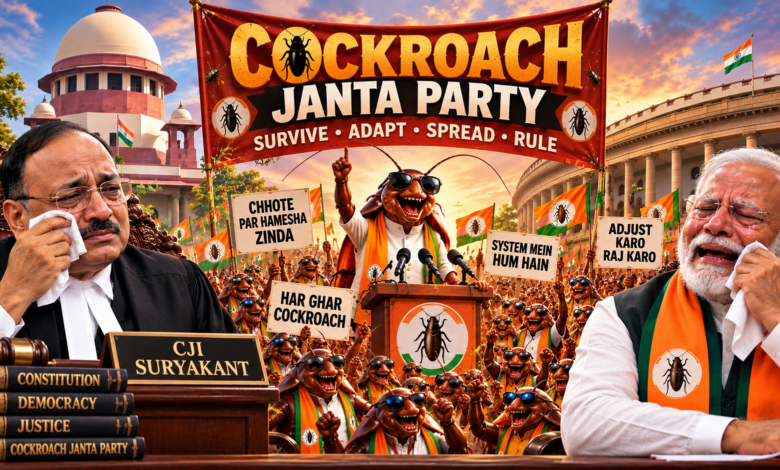
Disclaimer: The phrase “started by CJI Surya Kant and promoted by the BJP” is used here as political satire, not as a claim that the Chief Justice founded the party or that the BJP officially promoted it. The reported origin of the movement was a controversial courtroom remark, followed by a satirical online response. The Election Commission, BJP and other public institutions’ positions must be distinguished from the protesters’ allegations.
There are political movements that begin with ideology. There are movements that begin with manifestos, mass meetings, carefully planned campaigns and years of organisational work.
And then there is the extraordinary Indian political phenomenon of 2026: a movement whose name reportedly emerged from a courtroom insult, whose popularity grew through internet satire, whose supporters turned ridicule into resistance, and whose protest on 10 October transformed the streets of the national capital into a battleground over electoral transparency, public order and the right to dissent.
Welcome to the Cockroach Janta Party.
A party whose name sounds like a municipal pest-control campaign, whose origin story reads like political stand-up comedy, and whose trajectory offers a serious question beneath the humour: what happens when people who believe they have been dismissed by the powerful decide to organise themselves around the very label used to dismiss them?
If this sounds like a script written by a satirist who has spent too much time watching Indian politics, the reported chronology suggests that reality has been doing a considerable amount of the writing itself.
The central irony is difficult to miss. A remark intended to criticise a category of online critics became the raw material for a satirical identity. That identity developed into a youth-led campaign, moved into street protests, took up examination-related grievances and later joined the fight over electoral rolls and the Chief Election Commissioner.
The most effective political satire does not always need to invent a contradiction. Sometimes it simply puts an existing contradiction under a spotlight.
1. The grand political irony: Did the system accidentally write the opposition’s slogan?


The title “Cockroach Janta Party” is itself an exercise in political mockery. It borrows the language of an insult and converts it into a badge of collective identity.
That is a familiar technique in protest movements: take the word meant to humiliate, repeat it publicly, and deprive it of its original power.
The irony becomes particularly sharp when the remark is attributed to a sitting Chief Justice of India. The judiciary occupies a position of constitutional authority, and judicial language carries a weight far beyond ordinary political commentary. A phrase spoken during a hearing can travel beyond the courtroom, acquire a life of its own, and become the centre of a public controversy.
The reported remark attributed to Chief Justice Surya Kant on 15 May 2026 concerned young people who criticised judges online and who, in the reported account, were described as “cockroaches.” The wording and context matter: this was a courtroom observation, not evidence that the Chief Justice established a political organisation.
But the internet had a different idea about what to do with the metaphor.
Instead of arguing endlessly over whether the label was fair, the emerging campaign asked a more mischievous question: if the supposedly insignificant people gathered together, what would happen?
The answer was the Cockroach Janta Party.
The satire practically wrote itself:
-
If cockroaches are dismissed as insignificant, why are people suddenly paying attention when they organise?
-
If online critics are supposedly irrelevant, why can a phrase about them become a national political talking point?
-
If young people without secure employment, stable opportunities or confidence in public institutions are easy to dismiss, what happens when they stop protesting individually and begin acting collectively?
The joke is the packaging. The underlying grievance is much more serious.
And that is where the story stops being merely funny.
2. The complete timeline: From a courtroom remark to the streets of Delhi
15 May – 10 October 2026
The following chronology brings together reported milestones from the CJP’s formation, the examination controversy, the July protests, subsequent legal developments, and the October mobilisation. Where a date marks an allegation or a political claim rather than an established finding, that distinction is preserved.
15 May
2026
Chapter 1 — The alleged birth of the metaphor
During a Supreme Court hearing, Chief Justice Surya Kant reportedly made a remark comparing certain unemployed young critics of judges to cockroaches. The observation triggered controversy online.
Political satire had found its raw material. Nobody needed to hire a branding agency; the name was practically supplied by the news cycle.
16 May
2026
Chapter 2 — The Cockroach Janta Party is born
Activist and political communications strategist Abhijeet Dipke launched the CJP as a satirical online platform. Its identity was built around turning the controversial label into a collective voice for young people.
The punchline: a movement named after an insect began attracting the attention normally reserved for much larger political creatures.
The CJP was a satirical movement, not a recognised political party registered with the Election Commission.
20–23 May
2026
Chapter 3 — The meme starts growing legs
The campaign gained attention on social media. What began as a sarcastic response acquired a wider identity around unemployment, criticism of public institutions and frustration among young people.
In internet politics, an insult can have a surprisingly long shelf life. Especially when people decide to turn it into their own slogan.
3 May
2026
Chapter 4 — The examination crisis adds fuel
NEET-UG was held amid the pressures surrounding India’s highly competitive medical admissions system. Subsequent allegations of paper leaks and examination irregularities intensified public anxiety.
This grievance was separate from the controversy that inspired the CJP’s name, but it gave the movement a concrete public issue around which to mobilise.
Source: Reuters’ examination-protest chronology.
12 May
2026
Chapter 5 — The NEET controversy escalates
The National Testing Agency scrapped the examination following allegations concerning leaked questions. A re-test was subsequently held on 21 June.
For students, this was no longer an internet argument about language. It concerned preparation, time, money, admissions and the credibility of an examination system on which careers depend.
6 June
2026
Chapter 6 — The online movement arrives in Delhi
Dipke returned from the United States and led the campaign into street-level protest. Supporters gathered in Delhi and demanded accountability from Union Education Minister Dharmendra Pradhan over the examination controversy.
The movement was beginning to discover the difference between a post that goes viral and a protest that requires people to travel, assemble and face the consequences of public dissent.
7–19 June
2026
Chapter 7 — Digital campaigns turn into a sustained protest
CJP supporters continued sit-ins and online campaigning, keeping the demand for ministerial accountability alive.
A satirical identity was acquiring the practical machinery of a protest movement: mobilisation, demands, public communication and a physical presence.
20 June
2026
Chapter 8 — Jantar Mantar becomes the movement’s address
The CJP began an extended sit-in at Jantar Mantar, Delhi’s established protest site. The central demand remained the resignation of the Union Education Minister.
The movement had moved from the smartphone screen to the public square. The metaphor had acquired a venue, a timetable and a political target.
21–27 June
2026
Chapter 9 — The campaign seeks a wider constituency
Dipke appealed to NEET aspirants to join the protest after the re-test. Hundreds reportedly visited the protest site during the day as the sit-in continued.
The question shifted from whether the name was funny to whether the campaign could represent grievances beyond its original online audience.
28 June
2026
Chapter 10 — Sonam Wangchuk joins the agitation
Engineer-educator and activist Sonam Wangchuk joined the Jantar Mantar protest and began a hunger strike in support of the demand for Pradhan’s resignation. Students associated with the All India Students’ Association also participated in the hunger strike.
His involvement gave the agitation a prominent public face beyond its social-media origins.
30 June – 17 July
2026
Chapter 11 — The sit-in refuses to disappear
The campaign continued, with support building over the following weeks. The issue now involved more than the CJP’s founding controversy: it was about whether public examination failures would carry political consequences.
The movement’s challenge was to turn public anger into a sustained demand for institutional accountability rather than a temporary viral moment.
18–20 July
2026
Chapter 12 — The protest reaches a breaking point
Wangchuk was taken to hospital on 18 July after his condition worsened. Crowds swelled the following day. On 20 July, a large march towards Parliament encountered police action, including tear gas and baton charges, amid clashes.
The scenes pushed the protest well beyond its original scale and brought the handling of the demonstration into the centre of the national debate.
21–23 July
2026
Chapter 13 — The controversy reaches Parliament and the government
Prime Minister Narendra Modi appealed for strict action against those responsible for examination leaks and a more reliable examination system. On 23 July, he announced special courts to prosecute those involved in paper leaks.
Opposition lawmakers raised the issue in Parliament, while protests also spread to other cities. The government proposed action on examination integrity, but the CJP continued pressing for ministerial accountability.
24 July
2026
Chapter 14 — The hunger strike ends; the pressure remains
Wangchuk ended his 26-day hunger strike, while movement representatives held another round of talks with the government.
A protest can end a hunger strike without ending the political dispute. The central demand remained unresolved at that point.
25 July
2026
Chapter 15 — Dharmendra Pradhan resigns
Pradhan resigned as Union Education Minister amid the continuing controversy and protests. Reuters reported that he cited the situation around the protest and across the country, while also referring to concerns about “anti-national forces” exploiting the situation.
The sequence was politically significant: a movement that began online had become part of a sustained national pressure campaign, and the minister at its centre stepped down. That does not, by itself, establish that every demand of the protesters was justified or that the movement alone caused the resignation.
26–27 July
2026
Chapter 16 — Reform enters the legislative conversation
Modi announced a task force headed by technology entrepreneur Nandan Nilekani to examine reforms to the examination system. On 27 July, the government introduced a bill proposing changes to the law governing public examinations, including tougher penalties for offenders.
The irony was now unmistakable: a movement whose name invited ridicule had helped keep examination accountability on the national agenda.
1 September
2026
Chapter 17 — The Supreme Court intervenes on protest-related FIRs
The Supreme Court used its powers under Article 142 to quash FIRs registered against students who participated in the NEET protests, following requests from the Centre and some states. The CJP described this as meeting a key demand and called off a planned 5 September march.
The ruling concerned the identified protest-related FIRs; it should not be read as a blanket declaration that all conduct during protests is immune from criminal law.
4–9 September
2026
Chapter 18 — The movement expands into other accountability disputes
Reporting documented a CJP-linked march concerning an alleged assault on the father of a student protester, followed by the detention and judicial custody of influencer Swatantra Bhardwaj in connection with the Jantar Mantar assault case. Separate reporting also described Dipke’s support for tribal students protesting in Nashik, who ended their hunger strike after talks.
These were distinct developments, not proof that every allegation made by the movement had been judicially established.
Late September
2026
Chapter 19 — The political agenda widens
The movement’s public focus increasingly encompassed electoral-roll revisions and accountability surrounding Chief Election Commissioner Gyanesh Kumar. The controversy concerned the Special Intensive Revision (SIR) of electoral rolls and allegations by critics that the changes unfairly affected voters and benefited the BJP.
The Election Commission and BJP rejected allegations of deliberate manipulation. Claims about voter deletions, their causes and their impact on election outcomes must therefore be examined against the underlying data and official explanations rather than treated as proven merely because protesters repeated them.
6 October
2026
Chapter 20 — The second major Jantar Mantar confrontation is announced
CJP leaders said they would proceed with a march even if permission was denied. Co-convener Ashutosh Ranka said the protest would continue wherever police stopped the march.
The announced demand was now the resignation of Chief Election Commissioner Gyanesh Kumar, not the education minister whose resignation had dominated July.
7 October
2026
Chapter 21 — The protest is formally notified
CJP and student organisations submitted an intimation to Delhi Police for a joint protest at Jantar Mantar on 10 October.
The proposed gathering now involved a coalition of student organisations as well as the CJP. Its organisers also indicated that the campaign would not necessarily end with the resignation of the election chief.
8–9 October
2026
Chapter 22 — The mobilisation becomes a national logistical contest
Four CJP volunteers travelling from Telangana were reportedly detained at Bhopal railway station on 8 October and released the following day. Delhi Police prepared an extensive security plan, including 37 blocking points and detention facilities across 15 police districts, according to contemporary reporting.
On 9 October, the Supreme Court heard concerns over the proposed restrictions, including the planned closure of 57 Metro stations. The Court stressed the need to balance peaceful assembly with public convenience and essential transport.
10 October
2026
Chapter 23 — Delhi wakes up to the Cockroach confrontation
Authorities imposed extensive restrictions, deployed large numbers of police and paramilitary personnel, and detained protesters and political figures before many could reach Jantar Mantar. Reuters reported more than 2,000 detentions in Delhi; other reports documented detentions in Mumbai and elsewhere.
CJP founder Abhijeet Dipke and associates Saurav Das and Ashutosh Ranka were detained after arriving by flight, according to the movement and contemporary coverage. Opposition leaders criticised the restrictions; BJP representatives defended the security response and attacked the protest’s legitimacy.
The planned mass gathering was substantially disrupted. The CJP nevertheless vowed to continue its campaign.
The timeline reveals the most important transformation: the CJP did not remain a single-issue joke. It moved from the controversy over judicial language to examination-related grievances, then to protest-related legal issues, and ultimately to a campaign over electoral-roll revisions and the accountability of the election chief.
That is a significant evolution for a movement that reportedly began as an online satirical response.
3. The CJI Surya Kant connection: A remark, a reaction, and a remarkable political boomerang


Let us examine the first great irony of this story.
The Chief Justice of India is not an ordinary commentator on social media. The office represents the leadership of the country’s highest court, an institution whose constitutional responsibilities include protecting fundamental rights, adjudicating disputes and ensuring that power remains subject to law.
That makes judicial language consequential.
The reported May 15 remark became controversial because critics considered the comparison demeaning to young people who criticise judges and public institutions. The subsequent formation of the CJP was a political response to that controversy, not a formal political initiative by the judiciary.
Imagine a political strategist spending months trying to invent a catchy slogan. Imagine consultants conducting focus groups, testing hashtags, hiring branding agencies and presenting three hundred PowerPoint slides.
Then imagine the entire exercise being overtaken by a courtroom metaphor.
The opposition did not have to invent its mascot. The controversy supplied one.
Of course, the CJI did not create the party in any formal sense. It would be inaccurate to suggest that he deliberately launched a movement, intended to encourage political mobilisation or endorsed its subsequent demands.
But the satirical interpretation is irresistible: a phrase associated with dismissing certain young critics became the name under which those critics could organise.
That is a communications lesson worth studying.
When an institution responds to criticism with language perceived as contemptuous, it risks making the criticism larger than it was before. Instead of ending the conversation, it may provide the conversation with a memorable headline.
And in the internet age, memorable headlines can have a political afterlife.
The Cockroach Janta Party’s name became a reminder that the person who supplies the insult does not necessarily control the meaning it acquires.
4. The BJP and the Cockroach Janta Party: A promotion campaign nobody needs to prove to enjoy the irony
Now we arrive at the deliberately provocative second half of the title: promoted on a pan-India basis by the BJP.
To be clear, there is no substantiated basis in the reporting cited here to claim that the BJP formally founded, financed or deliberately promoted the CJP. The movement’s reported founder was Abhijeet Dipke, and its origin was a satirical online campaign.
But satire has a useful way of exposing the difference between an intended message and its unintended consequences.
Consider the following hypothetical marketing campaign:
-
A controversial remark gives a movement its name.
-
The name becomes memorable precisely because it is outrageous.
-
News coverage repeats the name.
-
Political opponents attack the movement.
-
The movement’s supporters use the criticism to reinforce their identity.
-
A major protest turns the movement into a national news story.
In a conventional marketing presentation, that might be described as brand awareness, audience acquisition, earned media and organic distribution.
In politics, it is considerably less comfortable.
The joke about the BJP is not that it has been proven to run the CJP’s publicity operation. It is that political confrontation can give an opponent precisely the visibility that the opponent needs.
If an adversary wants to be noticed, there are few things more helpful than a powerful adversary repeatedly insisting that nobody should take it seriously.
The October 10 confrontation made this irony particularly sharp. BJP president Nitin Nabin accused the CJP and Rahul Gandhi of trying to destabilise the country, while BJP MP Sambit Patra described the protest as a defeat for what he called “mobocracy.” The protesters and opposition parties, meanwhile, argued that the restrictions infringed democratic rights.
This produced two radically different narratives.
The BJP’s narrative emphasised public order, security and the legitimacy of the electoral process.
The protesters’ narrative emphasised electoral transparency, accountability and the right to peaceful assembly.
The resulting political spectacle gave the CJP extensive national visibility, regardless of whether the government’s actions were intended to suppress it or whether the movement’s organisers had anticipated the scale of the response.
That is the real satirical point.
A movement may receive more publicity from its opponents than from its own advertising budget. It may acquire more recognition through confrontation than through persuasion. And it may find that the authorities’ efforts to contain a protest become part of the protest’s public story.
The hypothetical slogan practically writes itself:
Cockroach Janta Party — now receiving national attention through the most expensive publicity campaign nobody has established that anyone commissioned.
The punchline is about political consequences, not a proven conspiracy.
5. From examination failures to electoral rolls: The movement’s change of target
The CJP’s evolution is worth examining separately from its comic name.
Its initial street mobilisation focused on the NEET examination controversy and the demand for Education Minister Dharmendra Pradhan’s resignation. By October, the movement had turned towards the Special Intensive Revision of electoral rolls and a demand for Chief Election Commissioner Gyanesh Kumar’s resignation.
These are distinct issues. They should not be collapsed into one allegation of wrongdoing.
The examination controversy concerned allegations of leaks and irregularities, the reliability of the examination process and the consequences for students.
The electoral-roll controversy concerns the revision of voter lists, the treatment of potentially eligible voters, the accuracy of the lists and allegations that the exercise disproportionately benefited the ruling party.
The CJP and its allies contend that the SIR process raises serious questions about electoral fairness. The BJP and Election Commission reject allegations of deliberate manipulation. Those competing claims require examination of actual voter-roll records, deletion and restoration data, eligibility rules and the evidence surrounding individual cases.
Here is where the satire becomes a serious democratic question.
A government cannot settle a factual dispute merely by criticising the people raising it. Nor can protesters establish wrongdoing merely by repeating an accusation loudly enough.
The appropriate test is evidence.
If voter deletions are legitimate, transparent records and effective appeal mechanisms should help demonstrate that. If eligible voters have been wrongly removed, they should have accessible remedies. If there is evidence of systematic manipulation, it should be independently examined.
The public should not have to choose between blind faith in institutions and blind faith in their critics.
The real test is whether institutions can demonstrate that they deserve public confidence.
And that is a much more substantial issue than whether the name of the organisation demanding answers sounds like a joke.
6. October 10: When the capital’s security apparatus met the Cockroach movement


By the morning of October 10, the CJP’s campaign had become a major confrontation over the right to assemble in the national capital.
The scale of the preparations was substantial. Delhi Police established blocking points and detention facilities, while Metro closures and other restrictions affected large parts of the city. The Supreme Court had already intervened on October 9, directing the Centre to ensure that transport restrictions did not amount to a complete shutdown.
On October 10, Reuters reported that more than 2,000 people were detained in Delhi. The CJP’s founder and senior associates were detained after arriving in the city, while protesters were picked up at locations away from the planned demonstration. Opposition politicians and other public figures were also detained.
The proposed gathering at Jantar Mantar was substantially disrupted.
That sequence raises legitimate questions about proportionality, public order and the practical ability to exercise the constitutional right to peaceful assembly.
The state has a responsibility to protect public safety. A demonstration is not a licence to commit violence, obstruct essential services indefinitely or disregard lawful restrictions. Equally, the existence of a security concern does not automatically justify every restriction that authorities might choose to impose.
The difficult question is whether the restrictions were necessary, proportionate and appropriately limited.
And here is the satirical contrast.
The movement was named after an insect supposedly associated with insignificance. Yet its proposed gathering prompted a substantial security operation, transport restrictions, detentions and intervention by the country’s highest court.
The scale of the response does not prove that every allegation made by the CJP is correct. Nor does it prove that the authorities’ actions were unlawful.
But it does make one question unavoidable:
If this was merely an irrelevant gathering of people whose concerns deserved no serious attention, why did its planned arrival become such a major test of Delhi’s public-order machinery?
That is a question about proportionality and political judgment, not proof of any hidden arrangement.
And it is precisely the sort of question a democratic society ought to be able to ask without treating the question itself as a threat.
7. The Supreme Court: The courtroom that inspired the joke also had to confront the protest
There is another irony in this chronology.
The CJP’s reported origin is associated with a courtroom remark by the Chief Justice of India. Months later, the Supreme Court was hearing concerns about the restrictions imposed before the movement’s October 10 protest.
It would be inaccurate to claim that the Supreme Court remained completely silent. On October 9, the Court addressed the proposed transport restrictions and emphasised the need to balance the right to protest with the interests of the public.
That intervention matters.
The judiciary is not required to endorse a protest’s demands merely because it considers a restriction excessive. Nor does the right to peaceful assembly mean that every proposed march must proceed in exactly the form its organisers prefer.
But courts have an important constitutional role when executive restrictions threaten to become disproportionate.
The broader satirical question is whether public institutions recognise the difference between criticism of an institution and a threat to the institution.
Judges can be criticised. Governments can be challenged. Election officials can be questioned. Protesters can be held accountable for unlawful conduct. These propositions are not mutually exclusive.
A constitutional democracy should be capable of accommodating all of them.
The Cockroach Janta Party’s unusual origin story therefore presents a challenge that extends beyond one judge, one party or one protest.
Can the state tolerate ridicule without treating it as rebellion, and can protesters demand accountability without treating every institutional decision as proof of bad faith?
Both questions deserve serious answers.
8. A satirical scorecard: What the Cockroach Janta Party achieved by 10 October
1. An unforgettable name
The movement converted a controversial metaphor into a recognisable political identity. It did not need a conventional party name to attract attention.
2. A move from online satire to physical mobilisation
The June and July protests demonstrated that its activity was not confined to social media. It organised a sustained sit-in and helped keep examination-related grievances in the public debate.
3. A place in a national political dispute
The July campaign coincided with Pradhan’s resignation and subsequent examination-reform announcements. In October, the movement was involved in a different dispute over electoral-roll revisions and the accountability of the election chief.
4. A continuing constitutional debate
The October protest brought questions about preventive detention, public-order restrictions, transport access and peaceful assembly into national focus. The legality of each individual action must be judged on its own facts.
5. An unresolved question about electoral fairness
The CJP’s October campaign raised allegations concerning SIR and voter deletions. The allegations are politically significant, but their truth must be assessed through verifiable records and independent scrutiny, not assumed from the intensity of the protest.
There are limits to this scorecard. The CJP’s political visibility does not establish its long-term electoral prospects, its membership numbers, its organisational durability or the truth of every allegation it makes. It was a satirical movement rather than a registered political party in the reporting cited here.
But it has already demonstrated something worth noting: a movement can use humour to open a door to a much more serious conversation.
9. The real joke: India’s democratic institutions are not supposed to be afraid of questions
Let us return to the name.
The Cockroach Janta Party is funny because it sounds absurd. It is politically effective because the absurdity carries a grievance. And it is revealing because the story behind it concerns the relationship between authority, criticism and public accountability.
A democracy cannot function on the assumption that its citizens must always speak respectfully enough to avoid offending the powerful. Respectful language is desirable, but criticism does not lose its constitutional protection simply because it is sharp, sarcastic or uncomfortable.
At the same time, a movement’s popularity does not exempt it from the ordinary obligations of peaceful conduct, factual accuracy and legal accountability.
The principle must apply in both directions.
A judge’s authority does not make every remark immune from public criticism.
A government’s electoral mandate does not make every administrative decision immune from scrutiny.
An election commission’s constitutional importance does not mean that its decisions should never be questioned.
And a protester’s grievance does not automatically establish the truth of every allegation made in its name.
The democratic answer is not to declare one side infallible. It is to insist that every side remain answerable to evidence, law and reason.
That is why the CJP story is more interesting than its name.
A political movement born from a metaphor eventually found itself confronting questions about examination accountability, voter registration and the boundaries of state power. The controversies are different, and the evidence relevant to each is different. But the underlying democratic question is similar: who gets to question authority, and what happens when they do?
The most useful satire is not the kind that merely insults a politician, a judge or a party. It is the kind that exposes a contradiction and then demands an answer.
And the contradiction here is worth examining.
If institutions are confident in their decisions, they should be able to defend them with evidence. If an election process is fair, its integrity should be demonstrable. If restrictions are necessary, their necessity should be explained. If allegations are false, they should be rebutted with facts.
A constitutional democracy should not need to fear a cockroach-shaped meme.
It should be able to answer the questions underneath it.
10. The final punchline: Who really promoted the Cockroach Janta Party?
The title’s claim that the movement was “started by CJI Surya Kant and promoted pan-India by BJP” works as biting political satire only if its meaning is understood correctly.
The reported chronology is that the CJP was launched by Abhijeet Dipke after the controversy over the judicial remark. It then grew through online mobilisation, street protests, the examination controversy, wider public support and later political disputes. By 10 October, its campaign had become part of a major confrontation over the SIR process and the right to protest.
There is no verified evidence in the sources cited here that the CJI formally founded the movement or that the BJP organised a deliberate pan-India publicity campaign for it.
But the satire can still land.
If a controversial remark supplied the movement’s name, if public grievances supplied its political substance, and if confrontation supplied much of its visibility, then the story demonstrates how political actors can lose control of the narratives they help set in motion.
The CJP’s most memorable achievement may be that it turned an insult into a question.
Its most important test will be whether it can turn that question into a sustained, evidence-based demand for accountability.
And the test for the institutions confronting it is equally clear: respond to allegations with evidence, regulate protests proportionately, protect lawful dissent and distinguish criticism from criminal conduct.
The Cockroach Janta Party may be a ridiculous name for a serious political movement. But a ridiculous name does not make every grievance ridiculous, just as a serious grievance does not make every allegation true.
The final verdict, as of 10 October 2026: the Cockroach Janta Party’s story is an extraordinary illustration of how a controversial phrase can escape its original context, become a satirical identity and evolve into a national political flashpoint. The claim that its founders or promoters included the CJI or BJP remains unsubstantiated; the documented political irony is that the controversy, subsequent mobilisation and official response helped make the movement impossible to ignore.
Perhaps that is the most fitting ending to this very Indian political comedy.
A movement that began with a cockroach metaphor ended up asking questions that no democratic institution should be afraid to answer.
And if the entire episode teaches one lesson, it is this:
In politics, the person who makes the joke does not always get the last laugh.
Editorial note: This is a satirical political commentary based on reported events through 10 October 2026. Allegations regarding voter-roll manipulation, the motives of public officials and the proportionality or legality of particular police actions should not be treated as established findings without supporting evidence. The CJP is described as a movement rather than a registered political party.