RBI Holds Repo Rate At 5.25% As Global Risks Rise – Growth Holds, But Uncertainty Deepens
RBI has kept the repo rate unchanged at 5.25 per cent in its first Monetary Policy Committee (MPC) meeting for FY27, maintaining a ‘neutral’ stance amid rising global uncertainty. The decision comes as geopolitical tensions, particularly in West Asia, continue to influence inflation and growth expectations.

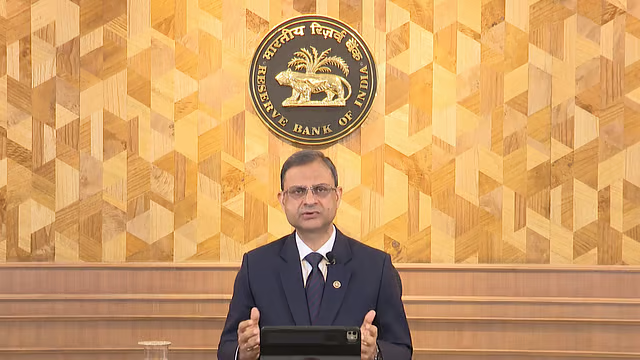
The RBI’s six-member Monetary Policy Committee (MPC), chaired by Governor Sanjay Malhotra, unanimously decided to keep the benchmark repo rate unchanged at 5.25 per cent. This marks the second consecutive policy pause following cumulative rate cuts of 125 basis points in 2025.
Alongside the repo rate, the standing deposit facility (SDF) rate was retained at 5 per cent, while the marginal standing facility (MSF) rate and the bank rate were kept unchanged at 5.5 per cent. The central bank also continued with its ‘neutral’ policy stance, indicating flexibility to respond to evolving macroeconomic conditions.
The MPC noted that while domestic economic fundamentals remain stable, the uncertain global environment necessitates a cautious approach to monetary policy.
Growth and Inflation Outlook
The RBI has projected India’s real GDP growth at 6.9 per cent for FY27, reflecting continued resilience in domestic economic activity. The quarterly growth projections stand at 6.8 per cent for Q1, 6.7 per cent for Q2, 7 per cent for Q3, and 7.2 per cent for Q4.
On the inflation front, the central bank has estimated Consumer Price Index (CPI) inflation at 4.6 per cent for the financial year. The quarterly projections are 4 per cent in Q1, 4.4 per cent in Q2, 5.2 per cent in Q3, and 4.7 per cent in Q4.
The RBI stated that while food price conditions remain comfortable due to robust agricultural output, rising global energy prices and supply-side disruptions continue to pose risks to the inflation outlook.

Global Risks and RBI’s Warning
The RBI flagged rising global uncertainties as a key risk to both growth and inflation, with particular emphasis on the ongoing conflict in West Asia. Governor Sanjay Malhotra noted that disruptions in energy markets, fertilisers, and other critical commodities could have a cascading impact on multiple sectors of the economy, including industry, agriculture, and services.
He warned that elevated crude oil prices could widen India’s current account deficit and add to inflationary pressures. Higher freight and insurance costs, along with disruptions in major shipping routes, may also weigh on external trade and increase input costs for businesses.
The central bank further spotlighted that prolonged supply disruptions could lead to broader economic consequences. According to the RBI, an initial supply shock -triggered by geopolitical tensions and commodity price volatility – could potentially evolve into a demand shock over time if supply chains are not restored.
In addition, heightened global uncertainty could tighten financial conditions, dampen investment activity, and weaken external demand, including remittance flows. Despite these risks, the RBI maintained that India’s macroeconomic fundamentals remain stronger than in previous periods of global stress, providing a degree of resilience against external shocks.
Policy Signals and Forward Guidance
The RBI reiterated that its ‘neutral’ stance provides flexibility to respond to evolving economic conditions, with the repo rate capable of moving in either direction depending on incoming data. Governor Sanjay Malhotra stated that while growth remains steady, uncertainties in the global environment have prompted the central bank to adopt a wait-and-watch approach.
The Governor also clarified that the introduction of a core inflation forecast should not be interpreted as a shift in the RBI’s monetary policy framework. The move, he said, was in response to market participants seeking more granular insights into underlying inflation trends.
Core inflation, which excludes volatile components such as food and fuel, will be used as an additional analytical tool. However, the RBI emphasized that headline Consumer Price Index (CPI) inflation will continue to remain the primary anchor for policy decisions, in line with its inflation-targeting mandate of 4 per cent.
The central bank also noted that it does not rely on any single measure of inflation, and will continue to assess all components of CPI while determining the future course of monetary policy.
Banking and Regulatory Changes
In addition to its monetary policy decisions, the RBI announced a set of regulatory changes aimed at providing greater flexibility to banks and improving operational efficiency.
The central bank proposed to remove the existing condition that restricts the inclusion of quarterly profits in the calculation of the capital-to-risk weighted assets ratio (CRAR) based on fluctuations in provisioning for non-performing assets (NPAs). With this change, banks will be able to include quarterly profits in their capital calculations without being constrained by variations in provisioning levels, potentially improving their reported capital adequacy.
The RBI also proposed to dispense with the requirement for maintaining an Investment Fluctuation Reserve (IFR) for commercial banks, excluding small finance banks, payment banks, and regional rural banks. The IFR was earlier maintained as an additional buffer against potential losses arising from fluctuations in the value of investments.
The central bank noted that existing prudential norms related to market risk, along with updated frameworks for classification, valuation, and investment management, already provide sufficient safeguards. As a result, the IFR requirement is now considered an additional and largely redundant buffer for most commercial banks.
The RBI added that revised guidelines for other categories of banks will be issued separately to address operational challenges and ensure greater regulatory consistency across the banking system.

Market Reaction
Financial markets reacted sharply to global developments alongside the RBI’s policy announcement, with the rupee strengthening against the US dollar in early trade. The currency appreciated by 50 paise to 92.56, recovering from its previous close of 93.06, following the announcement of a temporary ceasefire between the United States and Iran.
The easing of geopolitical tensions triggered broad-based movements across asset classes. Brent crude prices declined, falling below the USD 100 per barrel mark to around USD 95 in futures trade, while the dollar index weakened, reflecting reduced demand for safe-haven assets.
Domestic equity markets also saw a strong rally in early trade. The benchmark Sensex rose over 2,500 points, while the Nifty gained more than 750 points, supported by improved global sentiment and easing oil prices.
Market participants indicated that the rupee is likely to remain range-bound in the near term, with expectations of volatility between 92.50 and 93.50, as investors continue to monitor global developments and the evolving macroeconomic outlook.
Sectoral Reaction
The real estate sector welcomed the RBI’s decision to keep the repo rate unchanged, stating that policy continuity would help sustain demand across both residential and commercial segments.
Industry stakeholders noted that stable interest rates provide predictability in borrowing costs, which in turn supports homebuyer sentiment. With equated monthly instalments (EMIs) remaining unchanged, prospective buyers are better positioned to make long-term investment decisions, particularly in a period marked by global uncertainty.
Developers also indicated that a steady rate environment allows for greater confidence in planning project pipelines and managing financing costs. The absence of rate volatility is expected to support both ongoing and upcoming projects across key markets.
Recent data points suggest a mixed trend within the sector. Residential sales declined by 4 per cent year-on-year to 84,827 units in the first quarter of 2026, while office leasing activity rose by 6 per cent year-on-year to 29.9 million square feet, marking a quarterly high.
Industry participants added that while current conditions remain stable, any future rate cuts could further improve affordability and drive stronger momentum in both housing demand and commercial real estate expansion.
What Can Be Expected
The RBI’s next Monetary Policy Committee (MPC) meeting is scheduled to take place between June 3 and June 5, where the central bank will reassess its policy stance based on evolving domestic and global conditions.
Market participants are expected to closely track key indicators, including inflation trends, crude oil prices, and developments in the global geopolitical environment, particularly in West Asia. The trajectory of external demand, currency movements, and financial market stability will also remain in focus.
With the central bank maintaining a neutral stance, future policy actions will depend on how growth and inflation dynamics unfold in the coming months, alongside the resolution or escalation of global uncertainties.
The Last Bit,
The RBI’s decision to hold rates reflects a balancing act between steady domestic growth and an increasingly uncertain global environment, with the path ahead likely to be shaped by factors beyond its immediate control.