Incredible India, Invisible Rupee: How The Rupee Became Asia’s Weakest Currency?
The rupee has lost over 95% of its value relative to the dollar since independence, which is a slow-motion erosion of purchasing power over generations.

The Depreciating Value of the Rupee…
If the Indian rupee could talk, it might well beg for a holiday. The once-proud currency that fetched roughly ₹4 per US dollar at independence now needs nearly ₹90 for the same dollar. In 2025, the rupee has sunk to historic depths, flirting with the dreaded 90-per-dollar mark despite India’s “stellar” 8% GDP growth and record stock market highs. It’s a paradox that has left economists and Indians alike asking: How can the economy roar while the currency crumbles?
The answer may lie in a web of global machinations and domestic missteps, all grounded in cold, hard facts. This is the epic tale of the rupee’s decline – a story of data and drama, where trade wars and trade deficits entwine, where central bankers walk a tightrope, and where history’s echoes warn of the challenges ahead.
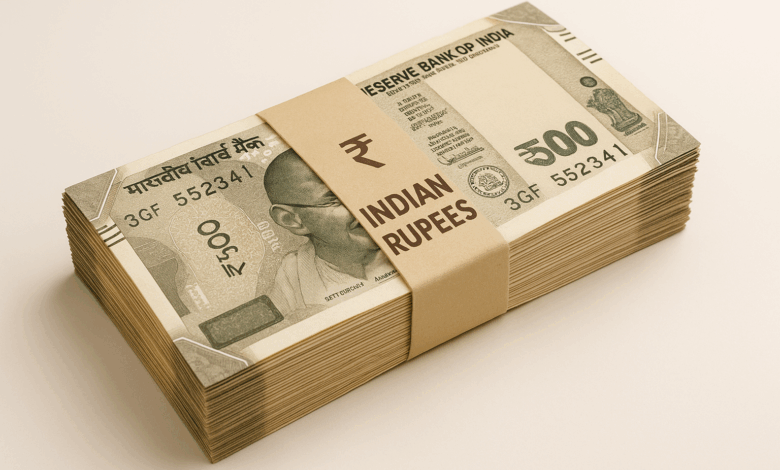
A bundle of Indian rupee notes.
The rupee’s value has steadily eroded over decades due to inflation and repeated economic shocks, making each note buy less in dollar terms.
The rupee’s journey is not just an economic chart; it’s a saga of resilience and erosion. This currency has weathered wars, oil shocks, booms and busts, each leaving its scar. Today, it stands as Asia’s weakest currency of 2025, an unenviable title underscored by a year-to-date slide of around 4.3%. While neighbours’ currencies are sailing with the wind, many Asian peers from the Thai baht to the Taiwan dollar have actually strengthened this year, making the rupee is the outlier, stubbornly sinking.
In fact, by late 2025 the rupee was not only Asia’s worst performer, but on track for its steepest annual loss since 2022, when the Russia–Ukraine war’s oil-price shock last dealt it a heavy blow. The data doesn’t lie. Moody’s notes the rupee fell over 20% against the dollar from January 2020 to January 2025. And despite a relatively modest ~5% drop in the last two years, that cumulative decline cements the rupee’s place among the weakest currencies in South and Southeast Asia.
Yet behind those percentages are real stories of companies bleeding cash, of households paying more for essentials, of policymakers making tense choices. A master storyteller of finance must weave all these threads. So, let’s dissect the global currents and local undercurrents dragging the rupee down. We’ll compare how the rupee stacks up against its Asian peers and dive deep into India’s domestic economic cauldron.
We’ll revisit historical turning points, from the desperation of 1991 to the taper tantrum of 2013, to see how those ghosts still haunt or guide us. And we’ll do it with an unsparing eye, no convenient political spin, just economic truth grounded in verifiable facts and data.
A Long Slide: From Independence to the Brink of 90
To understand the rupee’s current predicament, we must first appreciate the long arc of its decline. History paints a sobering picture. In 1947, as India took its first breaths of freedom, the rupee was pegged to the British pound and indirectly to the US dollar. One US dollar was worth roughly ₹4.16 back then. Today, that same dollar fetches nearly ₹90. Put another way,
The rupee has lost over 95% of its value relative to the dollar since independence, which is a slow-motion erosion of purchasing power over generations.
Some of that decline is the natural consequence of inflation. India’s prices have risen faster than America’s for decades, and currencies adjust accordingly. The theory of purchasing power parity (PPP) tells us that if one country has persistently higher inflation, its currency will tend to weaken against lower-inflation peers. India is a textbook case. With inflation often outpacing that of developed economies, a gentle rupee depreciation of a few percent each year has almost been “baked in.”
If US inflation is 2% and India’s is 6%, PPP suggests the rupee should fall ~4% annually to keep the real exchange rate stable. Over time, that adds up. “When India’s inflation is consistently higher than the US’s, the rupee’s purchasing power erodes faster, leading to depreciation”. In plain terms, a rupee in your pocket buys a little less each year, both at the Delhi market and on the world stage.
But inflation alone doesn’t explain the dramatic spurts of rupee weakness that have punctuated this long slide. For that, we look to history’s economic shockwaves. One early jolt came in 1966, when India faced drought and war-related stresses. Under IMF pressure, the government devalued the rupee by a whopping 57%, from ₹4.76 to ₹7.50 per dollar, overnight. It was a blunt-force attempt to boost exports and earn precious foreign exchange, though it came at the cost of domestic price pain.
Fast forward to 1991, arguably the rupee’s most harrowing chapter. India was on the brink of default, its foreign exchange reserves barely enough for three weeks of imports. A spiralling fiscal deficit, political instability, and a spike in oil prices (thanks to the Gulf War) had pushed the economy into a balance of payments crisis. In a scene that reads like financial dystopia, New Delhi secretly airlifted 67 tons of gold to European vaults, pawning the family jewels to raise emergency loans.
The rupee was swiftly devalued by about 18–19% in two jolts in July 1991. What cost ₹17 in rupees for a dollar shot up past ₹20, and then ₹25. This painful measure, taken under IMF guidance, helped stabilize the external account and ushered in sweeping economic reforms, liberalizing India’s economy for the decades ahead. But the shock of 1991 left an indelible lesson. A currency is only as strong as your macroeconomic fundamentals (and sometimes, as your pile of gold and foreign reserves).
The rupee’s troubles didn’t end with liberalization as new demons arose in the age of globalized capital. In 1997–98, the Asian Financial Crisis saw currencies of Thailand, Indonesia, Korea and others collapse. India escaped the worst (thanks in part to capital controls and a still-small external sector), but the rupee still felt heat, dipping from ~₹35 to ₹42 per dollar in that period. Then came the “Taper Tantrum” of 2013. When the U.S. Federal Reserve merely hinted at tightening its easy-money policies, investors fled emerging markets en masse.
India, with its sizeable current account deficit at the time, landed in the crosshairs. The rupee plunged about 20% in mere months, from around ₹55 in early 2013 to almost ₹69 by that August. It was branded among the “Fragile Five” economies most vulnerable to Fed shocks. Memories of 1991’s near-death experience resurfaced; the RBI had to hurriedly raise interest rates and curb imports (even banning gold coin imports, ironically) to stem the rout. By early 2014, calm returned and the rupee recovered to the low 60s per dollar, but the message was heard loud and clear saying that the global capital can be as ruthless as any crisis of the past.
In more recent times, 2020–22 delivered a one-two punch. First, the pandemic pummeled India’s growth and brought foreign outflows in 2020. The rupee wobbled but was propped up by ample global liquidity. Then in 2022, Russia’s invasion of Ukraine sent oil prices skyrocketing above $100 a barrel. As a country importing ~85–90% of its crude, India was hit hard.
)
The import bill ballooned, the trade deficit widened, inflation flared, all putting downward pressure on the rupee. Indeed, 2022 saw one of the rupee’s sharpest falls in recent memory, and it ended that year around ₹83 to the dollar, an all-time low back then. The war’s shock had effectively knocked the rupee down by about 10% in a year, despite RBI’s interventions.
That brings us to 2023–2025, when a new saga of equal parts economic and geopolitical has unfolded. If 1991 was a domestic crisis and 2013 a financial markets tantrum, the current chapter is a trade war tragedy (with a dash of farce). Through 2024 and 2025, India’s rupee slid steadily, hitting fresh lifetime lows as 2025 progressed.
In November 2025 it breached the once-unthinkable ₹89 mark, and by December 1, 2025, it kissed 89.76 before the RBI’s defenses kicked in. What on earth is driving this slump, especially when India’s own economy is seemingly doing well? To answer that, we must step back and survey the battlefield beyond India’s borders; because the rupee is being squeezed by forces far larger than itself.
The Global Battlefield: How the Rupee Stacks Up in Asia
In the ruthless arena of international currencies, not all Asian currencies are created equal. The rupee’s recent performance can only be called dismal, but context is key. 2025 has been a mixed bag for Asia. Several currencies actually strengthened against the U.S. dollar this year as the mighty dollar softened a touch from its 2022 highs. Take the Thai baht, Taiwanese dollar, or Malaysian ringgit. They all have gained ground, buoyed by improved trade balances or capital inflows. Even the Chinese yuan and Indonesian rupiah, though facing their own pressures have outperformed the Indian rupee. In short, India is the odd one out where a major Asian economy whose currency is making fresh lows even as others regain strength.
It wasn’t always this way. During the chaotic early months of COVID-19 in 2020, for instance, the rupee’s moves were middle-of-the-pack. And in 2022’s Fed-driven dollar surge, the rupee’s losses were unremarkable compared to, say, the Japanese yen’s plunge. In fact, Bloomberg noted that the rupee’s decline back then was “a far cry from the 2013 tantrum experience,” implying India’s external metrics had improved somewhat. But 2025 flipped the script.
Analysts now regard the rupee as Asia’s weakest link, at least among major emerging currencies. By November 2025, the Indian currency was down ~4.3–4.5% for the year, while many regional peers were flat or stronger. The Philippine peso and Singapore dollar were relatively steady; the Thai baht surged on revived tourism; the yuan was managed tightly by Beijing; and the Indonesian rupiah leveraged high commodity exports to stay firm. India, despite robust GDP growth, lagged them all.
There are a couple of awkward exceptions. Japan’s yen and South Korea’s won. These two have their own troubles, ultra-loose monetary policy in Japan and export woes in Korea have made yen and won quite weak in recent times. The rupee was “faring better than structurally weak currencies like the yen and won”. But beating the yen (which hit 30-year lows due to Bank of Japan’s negative rates) or the won is a pretty low bar. For India to be lumped with them is hardly a compliment as it underscores that something is fundamentally askew.
So why is the rupee an underperformer in a region where others are doing okay? Part of the answer lies in the global dollar cycle. The U.S. Federal Reserve’s aggressive interest rate hikes from 2022 into 2023 had pushed the dollar to two-decade highs. In 2024–25, the expectation was for the Fed to pause or even cut rates as inflation cooled. That caused a mild dollar retreat and gave relief to many currencies. But by late 2025, as fresh U.S. economic data came in surprisingly strong, traders began doubting any imminent Fed rate cuts.
This “higher for longer” U.S. rate outlook sparked risk aversion towards emerging markets generally, which is a risk-off sentiment that invariably hits currencies like the rupee. Falling hopes of a Fed rate cut after strong U.S. jobs reports kept EM currencies under pressure and fed a strong dollar demand that hurt the rupee. In other words, the global dollar tide turned against the rupee at the worst possible time.
Yet, global Fed policy is only one piece. The rupee’s slide has been magnified by a unique external shock that India alone in Asia is facing: a trade skirmish with the world’s largest economy. We’re talking about the United States and its tariff onslaught. In mid-2025, the U.S. surprised India with steep tariffs, a hefty 50% on most Indian exports, the highest in Asia, plus a special 25% penalty tariff aimed at India’s trade with Russia. Suddenly, India’s exporters were on the back foot, and a long-hoped U.S.-India trade deal was delayed indefinitely.
These tariffs acted like a one-two punch as they curbed India’s export earnings (reducing demand for rupees) and scared off foreign investors who saw worsening prospects for Indian firms. By late November 2025, foreign investors had yanked out nearly $16–16.5 billion from Indian equities through the year, which is an exodus approaching the record outflows seen in 2022. That capital flight created a surge in dollar demand (as investors sell rupees to take money out), directly weakening the rupee. It’s no coincidence that the rupee’s worst monthly declines in 2025 came after Washington’s tariff bombs in July/August.
Other Asian countries did not face this kind of shock in 2025. Malaysia, Thailand, Taiwan, none were slapped with punitive tariffs by the U.S. Thus, their exporters actually benefited from a somewhat softer dollar; many rushed to convert their dollar earnings to local currency, which strengthened those currencies. India, by contrast, missed out. Its exporters, confronted with tariffs and uncertainty, couldn’t enjoy a weaker dollar’s usual upside. “India has not benefited from this trend because its exporters remain under tariff pressure”. In effect, India got the worst of both worlds: the global dollar didn’t weaken enough to lift the rupee, and U.S. trade policy actively undercut confidence in the currency.
Beyond the U.S.-India spat, other global factors also played villain. Oil prices remained relatively elevated for much of 2025, partly due to supply cuts from OPEC and geopolitical tensions. Every extra dollar on a barrel of crude adds millions to India’s import bill (India imports ~4.5 million barrels a day).
By October 2025, India’s merchandise trade deficit had swollen to an all-time high, hitting $41.7 billion in a single month. Think about that. $41.7 billion more going out than coming in, in just October. A big driver was expensive oil and gas imports, alongside a surge in gold imports. Indeed, with global uncertainties afoot, Indians’ perennial love for gold only grew, and higher gold prices meant India spent more foreign exchange to slake that demand. A larger trade deficit directly translates to more rupees being sold for dollars to pay import bills, exerting downward pressure on the rupee.
In summary, globally the rupee got hit by:
- a resurgent U.S. dollar thanks to sticky U.S. rates,
- a U.S. trade policy sucker punch in the form of tariffs,
- high commodity prices (oil, gold) bloating the import bill, and
- investors reallocating to “safer” markets (the U.S. in particular, where stocks were hitting new highs driven by an AI-fueled rally).
While some of these factors also grazed other currencies, none combined the way they did for India. The result is that the rupee found itself at the bottom of Asia’s currency scoreboard in 2025, a “perfect storm” punching far above the currency’s weight class.
The Domestic Dilemma: India’s Economic Cross-Currents
If global forces lit the fire under the rupee, domestic factors piled on fuel. The irony of 2025 is that by many traditional metrics, India’s economy is in rude health. Growth is high, stock markets are booming, and foreign exchange reserves are sizable. Yet the rupee keeps sinking. It’s a vivid reminder that a currency’s strength isn’t a simple proxy for economic success; it’s about balances and flows, expectations and trust.
First, let’s talk economic growth. India posted an 8.2% GDP expansion in the July–September quarter of 2025, a “blowout” number that exceeded all forecasts. Normally, such growth should attract investment, create optimism, and support the currency. Indeed, India’s stock indices scaled record peaks in late 2025. But here’s the uncomfortable truth: red-hot growth didn’t help the rupee one bit. “Robust growth has offered little respite to the currency,” admitted one Reuters piece.
The rupee still fell to record lows even in the afterglow of that GDP report. The disconnect hints at deeper issues where growth is driven by internal factors (like government spending) that doesn’t automatically fix external imbalances. India’s stellar GDP was overshadowed by “a balance of payments position that has turned less supportive”. In other words, no matter how fast the economy runs, if more money is gushing out of the country than coming in, the rupee will feel the pain.
The balance of payments is indeed where the shoe pinches. A country that imports more than it exports (running a trade deficit) must either attract enough capital from abroad or see its currency weaken to restore balance. India has long run sizable trade deficits, not always a bad thing when capital inflows are strong. But in 2025, those inflows dried up (recall the $16+ billion equity outflow) just as the trade gap ballooned (record monthly deficits around $40B). That’s a classic recipe for currency depreciation.
Consider India’s current account, which includes trade plus services and remittances. For a while, it was benign. Earlier in 2023, lower oil prices and strong services exports (IT sector) had trimmed the current account deficit to manageable levels. But by late 2025, the current account was worsening again. The Vision IAS analysis noted that despite a “benign current account” earlier, capital outflows were pushing the rupee down. By Q4 2025, the current account likely turned more adverse due to import surges and export hiccups from tariffs. So the twin deficits of fiscal and current account, loomed again, spooking investors.
Now add India’s interest rate dynamics. In an effort to support growth amid global turmoil, the Reserve Bank of India (RBI) earlier in 2025 had actually started cutting rates, a cumulative 100 bps (1%) of easing in the first half, according to economists. Another 25 bps cut was expected in December 2025, though after the GDP surprise some thought the RBI might hold off. Either way, India’s monetary policy turned more dovish just as the U.S. Fed stayed hawkish. That interest rate differential, which is a key driver of currency flows, shrank in favour of the U.S. Higher U.S. yields make American assets more attractive to investors, pulling money out of emerging markets.
For the rupee, this meant fewer foreign buyers of rupee bonds or equities at the margin, and perhaps even some outflow from Indian debt markets. It’s a quiet factor, but an important one, saying, money flows to where it gets the best risk-adjusted return. In late 2025, the U.S. offered high yields with a stable currency; India offered high growth but the prospect of rate cuts and a falling currency. The choice for many global investors? Sadly, not the rupee.
Then there’s the question of confidence. Currencies are as much about psychology as economics. By late 2025, sentiment toward the rupee had soured. A cocktail of factors fed this: uncertainty over trade negotiations, doubts about how far the RBI would go to defend the rupee, and concerns that India’s underlying economic strength might not be as solid as the headline GDP suggests.
On that last point, economists pointed out some worrying signs: high unemployment rates, weak private investment, and tepid consumer demand dogging the economy beneath the surface. Strong GDP growth driven by a few sectors (or statistical base effects) doesn’t necessarily reflect the broader health. If investors believe India’s growth isn’t sustainable or broad-based, they won’t bet on the rupee long-term.
Economist Arun Kumar noted that despite flashy GDP numbers, “concerns about unemployment, weak private investment and low demand have created anxiety about the broader economic outlook”. In other words, domestic uncertainty was amplifying the rupee’s troubles. Moreover, India’s structural issues, like a heavy import dependence and insufficient export competitiveness outside of IT services, remained unresolved. It also reflects declining investor confidence as global capital shifts toward stronger economies.
The depreciation exposes vulnerabilities in India’s external sector, raises living costs, and signals the need for deeper economic and policy reforms.” None of those flaws can be fixed overnight, and in the meantime, the rupee bears the brunt.
Finally, there is the domestic political-economic choice: do you prioritize growth or a strong currency? In an emerging economy, you can’t always have both. The RBI and government have seemed content to let the rupee gradually depreciate to support exports and growth; as long as the slide is not disorderly. A weaker rupee can be a double-edged sword: it boosts export competitiveness and can discourage imports, which may help reduce trade deficits and spur local production.
In fact, some experts speculate that the RBI might even prefer a slightly weaker rupee in the current environment to aid exporters hit by tariffs. Arun Kumar suggested that with high U.S. tariffs squeezing Indian exporters, the central bank might allow the rupee to slide further to make Indian goods cheaper abroad. This would, in theory, help offset the tariff impact. The trade-off, of course, is higher imported inflation at home, as oil and other imports cost more in rupee terms.
So far, the evidence of this approach is mixed. Non-oil exports haven’t boomed (world demand is soft), but imports have indeed slowed a bit due to costlier dollars, and the trade deficit would be even worse if the rupee were stronger. Still, it’s a dangerous game: too rapid a slide can panic markets, spike inflation, and hurt domestic confidence. Thus, the RBI’s stance has been a balancing act, which we’ll explore next. But suffice it to say, domestic policy is implicitly tolerating a weaker rupee in favor of growth – a gamble that the benefits (export boost) will outweigh the costs (inflation, capital outflow risk). It’s a sensitive choice, and one the central bank must calibrate carefully.
2025: The Perfect Storm – Trade Wars, Tariffs and a Tethered Rupee
All these global and domestic elements came to a head in 2025, making it a year the rupee would rather forget. Let’s recount how this perfect storm unfolded month by month, almost like chapters in a thriller:
- Early 2025 – False Calm: The year began on a hopeful note. The rupee wobbled in January, touching the mid-80s, but then strengthened modestly in March–April. By early May, it even hit its strongest level of the year: around ₹83.75 per dollar. Optimism abounded, fuelled by expectations that India would clinch a trade deal with the US imminently. Traders believed lower U.S. tariffs were coming, foreign investors were tentatively upbeat, and the RBI had kept things stable. It was a mirage of stability, or can be seen as the lull before the storm.
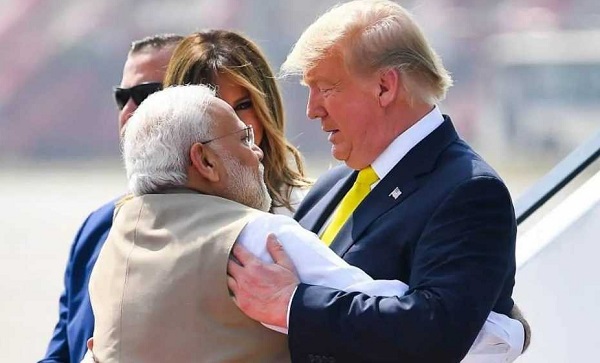
- July 2025 – Trade War Twists the Knife: Come July, hopes for an easy deal with Washington were dashed. In a shock move, U.S. President Donald Trump (back in office with a protectionist zeal) unveiled tariff plans “far harsher than expected,” including threats to penalize India for buying Russian oil. New Delhi’s dreams of preferential trade treatment evaporated overnight. All the hoo-hah of ‘Howdy Modi’ evaporated overnight when ‘my friend doland trump’ (pun intended) betrayed me!!! The rupee, sensing the danger, had its worst monthly fall since 2022. By end of July, the currency was clearly on a downward trajectory, having cracked through previous record lows.
- August 2025 – Rupee in Free Fall: In August, Washington made good on the threats. A sweeping 50% tariff on Indian exports went live, alongside that special 25% Russia-related tariff. This made Indian goods among the most tariff-hobbled in the world’s biggest market. Global investors took fright. The rupee, already weakened, collapsed to a series of fresh lows, sliding past ₹88 to the dollar. Each week seemed to bring a new record low. What compounded matters was an information vacuum, neither government could assure markets of a resolution, and rumours flew. The once rock-solid faith that “RBI will never let it past 88” was shattered when the central bank’s interventions could not fully stem the tide.
- September 2025 – Contagion of Fear: No relief arrived in September. Reports emerged that the U.S. was lobbying its allies in Europe to also slap India with Russia-linked penalties. Meanwhile, the U.S. mooted an outrageous hike in H-1B visa fees (used mostly by Indian tech workers) to $100,000. It was as if every avenue of India’s external engagement of trade, labor, geopolitics, as everything was under assault. The psychological impact on markets was severe. Foreign investors accelerated their exit, concerned that India’s export sectors (textiles, auto parts, etc.) would suffer and corporate earnings would falter. Indeed, by late November foreign outflows neared $16.3 billion, as mentioned. The rupee sank further in September, inching ever closer to ₹89.
- October 2025 – RBI’s Last Stand: Through all this, the RBI had been intervening – selling dollars from its reserves to slow the rupee’s fall. Traders noticed RBI’s hand especially in February and again in October. By one estimate, since July the RBI might have offloaded $30+ billion to defend the rupee. India’s forex reserves, while large at around $693 billion, started shrinking. (They still covered 11 months of imports, a healthy buffer, but the trend was down.) In October, the RBI seemed determined to hold the line at ₹88.80 per dollar, a level it had informally signalled as a pain threshold. Each time the rupee neared 88.8, state-run banks (often RBI’s proxies) would dump dollars to prop it up. This “line in the sand” briefly anchored expectations; traders kept testing it, but for a while RBI pushed back. Consequently, October saw the rupee relatively range-bound, albeit at the weaker end of its range.
- November 2025 – Breaking Point: The fragile equilibrium broke on November 21, 2025. On that day, a sudden wave of dollar demand, likely a mix of importers panic-buying and speculators sensing blood, pummelled the rupee past the 88.80 support. The RBI, notably, did not intervene aggressively at that moment (perhaps to teach speculators a lesson, or maybe to conserve reserves). With the safety net gone, the rupee crashed through 89 in a matter of hours. Stop-loss orders triggered in a cascade, and the currency hit a new record low near ₹89.49 that day. This was a watershed: after defending 88-89 for so long, the central bank seemed to relent. Traders now believed the RBI would accept a weaker new normal. The rupee ended November dangling just shy of 89.50, logging a 0.8% decline for the month and a 4.5% loss year-to-date. Crucially, the IMF took note – reclassifying India’s exchange rate regime in November as a “crawl-like arrangement,” implying the rupee was being guided down gradually, after years of calling it “stable”. The IMF diplomatically said there was “room for additional exchange rate flexibility,” essentially green-lighting further depreciation.
- December 2025 – Record Low and a Cautious Pause: As December began, the rupee finally hit a record intraday low of 89.76 to the dollar. This happened on December 1, 2025 (despite news of India’s 8.2% GDP growth), showing how little that positive news mattered compared to trade and flow concerns. Reuters noted the rupee was now firmly “among Asia’s worst-performing currencies this year”. However, once it neared the 90 mark, two things occurred. First, comments from US-India trade negotiators hinted at revived talks and possible tariff relief on the horizon. That raised hopes and checked some of the bearish speculation. Second, the RBI stepped in more visibly to prevent a break of 90 – perhaps for the psychological optics of not letting the rupee cross that Rubicon in the calendar year. Bankers described the RBI’s actions as “regular intervention” that had saved the rupee from even larger losses. By mid-December, with global markets quieting for the holidays and oil prices easing a bit, the rupee stabilized around the high-88 to mid-89 range. It was still down ~4.5% for 2025 – the worst in Asia – but the free-fall had been arrested.
To sum up 2025, it was a stress test for the rupee, a trial by fire that combined external shocks (tariffs, global risk aversion) with internal fragilities (deficits, policy trade-offs). Each month taught a lesson.
January’s lesson: don’t be lulled by calm seas.
July’s: geopolitics can trump economics.
November’s: a currency defense has limits, and when those snap, the fall is swift.
Through it all, India’s policymakers were improvising on the fly, trying to contain market panic without strangling growth. The result was neither triumph nor disaster – more of a rough landing with bruises all over.
The RBI’s Tightrope: Defending the Rupee (or Not)
A critical player in this drama is the Reserve Bank of India, the steward of the rupee. The RBI’s job is unenviable. It must ensure an orderly currency market, fight inflation, and support growth, often goals at odds with each other. In 2025, the RBI found itself walking a tightrope over a canyon – lean too much one way (propping up the rupee) or the other (letting it slide), and the consequences could be dire.
For much of 2025, the RBI’s mantra was “curb excessive volatility, but don’t fight fundamentals.” Officially, the central bank does not target a specific exchange rate; it only intervenes to smooth out wild swings. In practice, of course, there are levels it cares about (like that ₹88.80). The central bank’s dilemma was evident. If it spent too many reserves defending the rupee, it could burn through war-chest dollars and undermine confidence, yet if it stood back entirely, the rupee could enter a free-fall, fuelling inflation and panic. As the rupee slid every other day, RBI Governor (a new one appointed in Dec 2024) faced tough calls.
Analysts noted that under the new governor, the RBI was “more restrained”, intervening only when absolutely necessary. This was a shift from previous years, where the RBI more aggressively bought or sold dollars to manage the rupee. In fact, some economists argued that staunchly defending ₹88.8 was unsustainable amid weak inflows and a widening trade gap. JP Morgan’s economists even opined that a “calibrated rupee depreciation” was inevitable and desirable given the macro environment. They suggested that as long as the US-India trade deal remained elusive, the rupee had to weaken to compensate Indian exporters for lost competitiveness. In plain English: if exports can’t rise via volume (due to tariffs), they must adjust via price (a cheaper rupee).
This view likely resonated with the RBI. Indeed, after that dramatic November 21 breach, the RBI let the rupee find a new low before stepping back in. By doing so, it signalled to the market a grudging acceptance of a weaker rupee, drawing a new line perhaps closer to 90. Arun Kumar observed that the RBI’s approach is often to prevent sudden plunges – “if the currency is to decline it should not be sudden, it should be gradual”. Sharp volatility can feed a panic (like stop-loss cascading). So the RBI’s interventions aim to ensure a steady, not spiralling, depreciation. 2025 exemplified that: lots of small down days, few extreme moves until that late November blip.
Interestingly, RBI’s Forex tactics also extended to the forwards market. We saw commentary that the central bank was already “significantly short on USD/INR in the non-deliverable forwards (NDF) market”, meaning it had sold dollars forward to temper speculative pressure. This is a less visible way to support the rupee without immediately depleting reserves, but it carries risk if overdone, as the RBI might have to deliver those dollars later. By late 2025, some traders worried the RBI’s capacity to intervene was constrained by these forward positions.
The foreign exchange reserves, at ~$693 billion, gave RBI a decent arsenal. But using reserves is like using ammo – you want to conserve it for when it truly counts. As the rupee kept plumbing new depths, RBI had to gauge- is this that moment? Or is worse to come? One misstep, and speculators could smell blood, shorting the rupee en masse.
Through the fall of 2025, Governor and his deputies thus performed a high-wire act: selling just enough dollars to prevent chaos, but not so much as to signal panic or deplete too fast. Insiders say RBI intervened in September and October whenever the rupee seemed on the verge of runaway decline. But in November’s breach, RBI’s non-action for a critical window was telling.
It might have been a deliberate tactic: let the rupee overshoot a bit, scare out the speculators, then come in strong to stabilize. This can punish speculators who bet on a one-way move. Indeed, after the rupee blew past 89 and hit 89.49 on Nov 21, it retreated and hovered around 89.2-89.3 in subsequent days, suggesting RBI quietly sold dollars to cap it. A Business Standard report from end-November noted the rupee closed at 89.4575, “a whisker away” from its record low, thanks largely to central bank intervention blunting the pressure.
The central bank also used other tools. It tightened some regulations to curb speculative trades and encouraged state-run oil companies (big dollar buyers) to do forex deals in a calibrated manner. Unconfirmed reports hinted at currency swap lines being prepared (like with the UAE or other friendly nations) should dollar liquidity get very tight. Fortunately, those backstops weren’t needed openly.
Perhaps the biggest ace in RBI’s hand is market confidence in its stewardship. By and large, despite criticism, the RBI has a reputation of being a sturdy pilot through currency turbulence. Even when rupee hit record lows, there wasn’t a full-blown crisis of confidence in India – no rampant capital control rumours, no mass corporate defaults (helped by the fact that most Indian corporate foreign debt is hedged or manageable). Moody’s report helpfully pointed out that of 23 rated Indian companies, only six had notable exposure to dollar strength, and all had mitigating hedges. That meant no Tatas or Reliance were blowing up due to the rupee, reducing systemic risk fears.
One stark corporate example showed both the danger and manageability of rupee swings: IndiGo Airlines. In Q2 FY26 (Jul–Sep 2025), IndiGo reported a massive net loss of ₹2,582 crore, a 161% wider loss than a year ago, entirely due to forex losses from the rupee’s slide. The CFO revealed that with $9 billion in lease liabilities, every ₹1 fall in the rupee hits IndiGo with ₹900 crore ($108M) in forex losses. In that quarter alone, the rupee fell ₹3.18 (from June to Sep), costing IndiGo about ₹2,900 crore. That wiped out operational profits.
The CFO candidly blamed the “sharp rupee depreciation” driven by “tariff imposition on India and continued FDI outflow” as the culprit. IndiGo’s story is dramatic, but importantly, it could absorb that loss with hedges and a prior profit cushion. It even maintained a large hedge book ($850M) to guard against future falls. This suggests corporate India, while hurt by the weak rupee, isn’t panicking; they adapt by hedging or passing on costs. The RBI can thus focus on macro stability without constantly firefighting company crises.
As 2025 ended, the RBI faced an inflection that should it tighten policy to defend the rupee or keep easing to bolster growth? The consensus seemed to be a pause till December 5, 2025. On the policy front, most economists expect the Reserve Bank of India to deliver a 25 bps cut on December 5 and then pause through 2026, following a cumulative 100 bps of easing earlier this year.
Looking ahead, the RBI’s tightrope act will continue. With the IMF effectively endorsing more flexibility (i.e., don’t be afraid of some depreciation), the RBI has cover to let the rupee weaken further if needed, but in a controlled way. At the same time, if a positive shock comes (say a trade deal or global dollar retreat), the RBI might gladly mop up inflows to rebuild reserves and prevent an overly rapid rupee appreciation (as they have in the past to keep exports competitive).
Remember, the RBI has historically been more assertive in resisting rupee appreciation than depreciation. They tend to buy dollars to keep the rupee from getting too strong (helping exporters), while they allow depreciation unless it’s disorderly. This asymmetry has been policy for years. 2025 simply underscored it: rupee down? Okay, but slowly. Rupee up? Step in and buy dollars to cap it.
In essence, the RBI is managing a “crawl-like” depreciation path – a term the IMF now uses formally. The rupee will likely be allowed to crawl weaker in line with inflation differentials and external pressures, with RBI smoothing the path. For all the noise, this is a pragmatic stance for an emerging market central bank. But it’s a thin line: misjudge the pace, and it could either trigger capital flight (if too fast) or loss of competitiveness (if too slow relative to others). So far, the RBI has managed to avoid the worst-case outcomes, even if the rupee’s level today is nothing to celebrate.
Collateral Damage: How a Weak Rupee Impacts Everyday India
Numbers on a forex screen can feel abstract. But currency fluctuations hit home in very concrete ways for businesses and households. The rupee’s depreciation isn’t just an elite worry for policymakers; it ripples through the real economy, for better and worse.
On one hand, a weaker rupee is a boon for exporters and for Indians earning in foreign currency. Export-oriented industries like IT services, pharmaceuticals, textiles, gemstones get more rupees for each dollar of sales. This can boost their profit margins (unless they import a lot of inputs). For example, Indian IT companies often cheer a sliding rupee, as it means a 1% rupee drop can translate to a 0.5% revenue uptick and even higher profit growth, all else equal.
In fact, analysts in late 2025 predicted that many Indian software exporters would see a nice earnings bump thanks to the rupee’s fall. Similarly, Indian families receiving remittances from relatives abroad found that each dollar or dirham sent home converted into more rupees. India is the world’s top recipient of remittances (over $100 billion a year), so a weak rupee actually means a raise for those households – an expatriate worker in Dubai sending 2000 dirhams a month would see their family get more rupees when the rupee is ₹22 per dirham instead of ₹20.
A cheaper rupee can also, in theory, help reduce the trade deficit by curbing non-essential imports and making domestic products more competitive versus imports. Expensive foreign goods might nudge consumers to “buy Indian.” Over time, this substitution can stimulate domestic industry. The government often tacitly likes some rupee weakness for this reason: it’s like a pressure valve that can improve the current account deficit by throttling luxury imports (say, foreign cars, high-end electronics) and encouraging export-focused growth. In a period when India is negotiating trade deals (UK, EU on the horizon) and facing export hurdles, any edge helps.
However, and it’s a big however, the downsides of a weak rupee are significant and more immediately felt by the common man. Import costs shoot up. India relies on imports for critical needs. ~85% of its oil, a significant share of its natural gas, fertilizers for agriculture, certain food items like cooking oils, and electronics (from iPhones to industrial machinery).
When the rupee falls, these become costlier in rupee terms. Oil is the glaring example: oil is priced in dollars globally, so if rupee drops 5%, oil imports cost 5% more in rupees, directly feeding into fuel prices unless the government cuts taxes (which it rarely does, because it needs the revenue). Higher fuel costs then cascade into everything – higher transportation costs make food and goods pricier, hurting consumers through imported inflation.
By late 2025, India’s inflation was inching up again, partly due to these currency effects. A weak rupee pushes up inflation by making imports pricier, and inflation erodes everyone’s purchasing power. This especially hurts the poor, for whom essentials like fuel and cooking oil are a big part of expenses.
Economist Arun Kumar explained that while a sliding rupee can boost growth via exports, it simultaneously causes inflation to rise, “which will be negative for the economy”. He noted that the benefit to growth comes from exports and maybe import substitution adding demand, but “the inflation would rise, which will be negative… so the sliding rupee helps somewhat in growth rate but hurts via higher inflation”. This sums up the conundrum: the rupee’s fall is a double-edged sword.
Beyond macro numbers, think of specific scenarios: middle-class families find holidays abroad or overseas education getting more expensive (since they need to shell out more rupees per dollar of expense). An Indian student in the US whose tuition is $50,000 would have paid ₹40 lakh at a 80/$ rate; at 90/$, it’s ₹45 lakh – potentially life-altering for the family financing it.
Small businesses that rely on imported raw materials or machinery face rising costs, squeezing their profitability or forcing them to hike prices (if they can). Take a toy manufacturer in Delhi importing components from China; a weaker rupee means each shipment costs more, and either the business eats the cost or passes it to consumers. Often, a bit of both happens, thinning margins and stoking inflation.
There’s also the matter of foreign debt. The Indian government prudently has very low external debt in foreign currency, but some Indian companies have dollar-denominated loans. When the rupee falls, those loans become costlier to service in rupees. So balance sheets of such firms deteriorate unless they hedged the currency risk. Thankfully, many large firms do hedge. And India’s external debt is largely stable – one reason we didn’t see a 1997 Asian crisis type meltdown is that India’s short-term foreign currency debt is modest relative to reserves. But still, for certain companies and banks, a rupee plunge can mean provisioning for forex losses (like IndiGo had to).
Then there is the psychological effect on consumers. A continually falling rupee can dent national pride and consumer confidence. People read headlines “Rupee at record low” and may feel a sense of economic insecurity, even if indirectly. It can influence their spending decisions, some might postpone buying that imported appliance, anticipating it could get even pricier, or conversely, they might advance purchases fearing further depreciation. Such shifts can have small ripple effects on demand patterns.
Government finances, too, get hit in some ways. Oil subsidies (if any) grow, and a weaker rupee makes it expensive for the government to procure imported defense equipment or other projects. However, one silver lining is that, a weaker rupee increases the rupee value of tax revenues from customs duties (levied in % on costlier imports) and from petroleum taxes, somewhat offsetting the fiscal impact.
All said, for the average Indian, the immediate impact of the rupee’s slide is higher prices – at the petrol pump, the grocery store (edible oils, pulses that might be imported), the electronics shop, etc. In a country where inflation hurts the poor the most, this is a serious concern.
The government and RBI know this, which is why they won’t gleefully let the rupee spiral down unchecked. The public can tolerate a gradual decline (it’s almost expected by now that rupee falls a few percent a year), but a sudden crash that makes headline inflation jump would be politically and socially destabilizing (even if we’re not talking politics explicitly, it’s a reality that no government wants angry voters facing costlier essentials).
Thus, the calculus of allowing depreciation vs defending the rupee includes managing these impacts. It’s a delicate balance of pain versus gain. Letting the rupee weaken might help narrow the trade deficit and boost select sectors, but it can aggravate inflation and hurt consumers. Policymakers tend to lean toward short-term stability, which is why, for instance, when the rupee’s drop threatened to push fuel prices too high, you often see some tax tweaks or pressure on oil companies to absorb costs.
In 2025’s case, since the depreciation was relatively controlled (about 4-5% over the year), the inflation pass-through was also gradual. Core inflation (non-food, non-fuel) did creep up, but not dramatically. If the rupee had gone into a free-fall (say 10-15% drop), we might have seen emergency measures like interest rate hikes or import restrictions on some goods to curb the damage.
It’s worth noting that in economic surveys or earnings calls, many businesses cite the rupee’s value as a planning factor. Importers will hedge more or raise prices. Exporters will opportunistically convert earnings when the rate is favourable. The volatility in 2025 forced companies to be nimble. Some large importers like Indian Oil or Hindustan Petroleum reportedly started buying dollars in advance (forward contracts) to lock in rates as the rupee fell, which ironically can create more near-term pressure on the rupee. This behaviour is rational for each firm but collectively can exacerbate the currency’s slide – a classic prisoner’s dilemma in currency markets.
In summary, the rupee’s depreciation in 2025 was not just a tale of charts and policymakers – it’s one that touched lives across India. Exporters and overseas Indians smiled at their bigger rupee gains; importers and consumers winced at higher costs. The economy likely got a minor growth boost from net exports (as imports slowed), but it paid for it via higher inflation.
The net effect is hard to precisely quantify, but as Arun Kumar emphasized, a gradual decline is manageable whereas a sudden drop is not. Fortunately for India, 2025’s decline, while steep in historical terms, was stretched over many months. This gave people time to adjust – however grudgingly – to the new reality that the rupee in their wallet simply doesn’t go as far as it used to.
Epilogue: Lessons, Parallels, and the Road Ahead
As the dust settles on this tumultuous chapter, what have we learned about the depreciating rupee? Several lessons and historical parallels emerge:
- Structural Deficits Demand Structural Solutions: Time and again, India’s rupee has been dragged down by its current account deficit – the gap created when a country imports more than it exports. In the 1960s and 1991, deficits and overvaluation led to devaluations. In 2013, a high current account deficit made India vulnerable to capital flight. In 2025, a record trade deficit sealed the rupee’s fate. The pattern is clear: unless India can structurally narrow its trade gap – through export growth, import substitution in critical areas (like electronics or oil alternatives), and higher domestic productivity – the rupee will remain on the back foot. Service exports (IT, consulting) and remittances have been India’s saving grace, often covering part of the goods deficit. But manufacturing exports lag behind. Without a stronger export base, any global shock (oil prices up, foreign capital out) quickly stresses the rupee. The government’s “Make in India” and production-linked incentives may help over time, but 2025 showed those gains are not yet enough. The prophecy here is that the rupee’s long-term trajectory will continue downward unless the trade deficit finds a sustainable fix – either via policy reforms, diversification of export baskets, or reduced oil dependence (e.g. renewable energy push).
- The Dollar’s Throne Remains Unchallenged (For Now): The rupee’s weakness also underscores the enduring dominance of the US dollar. Despite talk of de-dollarization globally, when stress hits, the dollar is still king. Investors flock to U.S. assets, and emerging currencies feel the heat. In Asia, only the Chinese yuan has the heft to partially buck this trend (and even it weakens when the dollar index surges). 2025 reaffirmed that the Fed’s actions in Washington can dictate the fate of currencies in Delhi or Jakarta. The lesson for India is to keep prudent buffers (reserves, manageable external debt) to ride out these dollar waves. As global aspires to trade more in local currencies (India and UAE talked of rupee-dirham trade, for instance), these are still small steps. The rupee’s fortunes will for the foreseeable future be tied to the Federal Reserve’s policy and the dollar’s strength. Betting against that, without strong domestic footing, is perilous.
- Confidence and Communication Matter: A striking aspect of 2025 was how quickly sentiment can sour and how policy communication (or miscommunication) can exacerbate market moves. The delay and opacity around the India-US trade talks created uncertainty that fed the rupee’s decline. When authorities finally hinted at progress in late 2025, the rupee stabilized. Similarly, the RBI’s signals – defending certain levels then suddenly stepping back – if not clearly communicated can either anchor expectations or amplify fear. Future crisis management would do well to remember transparency is key. If the market understands the central bank’s tolerance range and game plan, speculation can be mitigated. If not, rumors fill the void.
- History Rhymes if Not Repeats: There’s an uncanny parallel between 2013 and 2025, albeit with roles reversed. In 2013, the Fed’s prospective taper caused panic; in 2025, the Fed’s prolonged tightening (and U.S. tariffs) did. In 2013, India was part of the “Fragile Five”; in 2025, India ironically is relatively isolated in fragility (peers are doing better). One reason is India entered 2025 with much stronger reserves and lower external debt than in 2013, giving it more cushion. That’s a clear improvement from past crises – a deliberate policy choice post-2013 was to build reserves and reduce vulnerability. It paid off: the rupee fell in 2025, but there was no sense of an imminent currency crisis per se, just a depreciation. This contrasts with truly perilous moments like 1991 or even 2013’s frantic weeks. So while history’s factors (deficits, Fed hikes, oil shocks) keep rhyming, India’s ability to cope has improved. That’s an encouraging sign: reforms and prudent policies can raise the resilience of the rupee, even if they can’t reverse its downtrend entirely.
- Not All Depreciations Are Equal: It’s worth noting that the rupee’s fall in 2025, making it “Asia’s worst currency,” was still a single-digit percentage decline. In truly chaotic episodes (1997 Asian crisis, 2018 Argentine crisis, etc.), currencies can halve in value. India’s situation is nowhere near that – a testament to relatively sound macro management. Moody’s highlighted that the rupee’s 20% drop over five years made it “one of the weakest in South/Southeast Asia”, but in those five years many peers also fell 10-15%. The rupee’s extra weakness is notable but not catastrophic. The takeaway: a gentle slide, while not flattering, is far preferable to a crash. So long as India can ensure its depreciations stay gradual and aligned with fundamentals, it can avoid the extreme crises that plague more reckless economies. The real fear would be a loss of control – which 2025 thankfully avoided.
Looking ahead, what might the future hold for the rupee? Here the economic prophecy must be delivered with humility (currency forecasting has humbled many a prophet!). But based on current trajectories and expert analyses:
- If the India-US trade deal gets signed in 2026 and those nasty tariffs are lifted, one can expect a relief rally for the rupee. Analysts suggest the rupee could regain some lost ground – possibly stabilizing around ₹88 to the dollar – because export prospects would improve and foreign investors might return seeing reduced trade uncertainty.
- Conversely, if trade tensions remain unresolved and the U.S. continues to press India (or if new global risks emerge), the rupee could breach the 90 mark decisively. Some forecasts by banks (e.g., Union Bank of India) see the rupee “gradually drifting toward 90 by March 2026” in a status-quo scenario. Breaking 90 might carry symbolic weight and potentially trigger another bout of imported inflation, which the RBI would monitor closely.
- Over the medium term, much depends on whether India can attract consistent capital inflows to offset its trade deficit. The government is pushing reforms, courting foreign investment (e.g., in manufacturing, infrastructure). If those bets pay off, FDI inflows could strengthen the capital account, providing support to the rupee. If not, and if portfolio flows remain fickle, the rupee will keep feeling downward pressure each time the global environment turns risk-averse.
- Global trends: The U.S. dollar cycle is also key. Should the Fed begin cutting rates in late 2026 or 2027, the dollar might ease broadly, giving emerging currencies a breather. The rupee could then even appreciate slightly or at least depreciate less. However, if global interest rate differentials remain high and other central banks (like in Europe or Japan) also tighten belatedly, capital may shuffle in unexpected ways. One wildcard is oil prices – a spike to $120+ would hit the rupee hard, whereas a collapse to $60 would be a windfall. Climate action and the global shift in energy could slowly reduce oil’s chokehold on the rupee, but that’s a long road.
- Psychological levels: 90 is near, beyond that 100 looms in the imagination. It’s not unthinkable that within some years, ₹100 per $1 could become reality if inflation differentials and trends continue. That would be another ~12% depreciation from current levels – which, spread over say 3-4 years, is plausible. It would certainly make headlines (a three-figure exchange rate has a way of grabbing attention, as South Africa or Indonesia experienced when their currencies crossed those thresholds). But it’s crucial to note that a rupee at 100 is not an apocalypse if it happens gradually and alongside growth and rising incomes. It’s the pace, not just the number, that matters.
In closing, the saga of the rupee’s slide is a reminder that economics is a continual balancing act. India’s story – a rising economic powerhouse with a wobbling currency – might seem paradoxical, but it encapsulates the challenges of emerging markets integrating into a volatile global system. The rupee will likely keep depreciating modestly each year – a reflection of that higher domestic inflation and developmental gap – but whether those moves are smooth or spiky will depend on deft management and a bit of luck.
There’s a certain resilience in the rupee’s tale too. It’s been knocked down repeatedly over the decades, yet it’s never completely collapsed. Through crises, reforms, wars, and now trade wars, the rupee endures – weaker but alive, a barometer of India’s economic journey. As an investigative financial journalist might quip with a touch of sarcasm: the rupee may be the weakest boxer in Asia’s currency ring this round, but it’s still standing – bruised, yes, but standing. And perhaps, hidden in that weak currency is a seed of future strength – an undervalued rupee making India more competitive, setting the stage for the next export surge or investment cycle.
After all, as Bloomberg noted, the rupee’s rough patch has pushed its real effective exchange rate (REER) into undervalued territory (below 100), meaning by trade-weighted measures it’s cheaper than many peers. If history is any guide, an undervalued currency can sow the seeds of a rebound – as exports pick up or smart money snaps up underpriced assets.
Until then, the common Indian will continue to live with a currency that slowly loses weight each year – grumbling about costlier imports but soldiering on. The elites will debate the rupee’s fate in op-eds and earnings calls, while the RBI and Finance Ministry perform their high-wire act behind the scenes. It’s an ongoing drama, unscripted and unending.
The depreciating value of the rupee is not just an economic statistic; it is India’s economic story writ small – a story of ambition and constraint, of potential and pitfalls, of navigating a complicated global dance while trying to keep home in order. It is humbling, it is challenging, and yes, it is often frustrating. But in that story lies the roadmap of what India must do to truly strengthen not just its currency, but its economy’s foundation.
Until those deeper issues are addressed, the rupee will continue to keep us all a bit on edge – a sentinel quietly signaling that all is not completely well, and that much work remains to fulfill the promise of a truly robust, globally competitive India.
In the meantime, keep an eye on those exchange rates – they often tell a story more candid than any official press release. And as we’ve done here, keep questioning, keep analyzing, and ground every claim in hard facts and history. The rupee’s fall might make for uncomfortable truths, but facing them is the first step to plotting a climb back up.