SpiceJet Cuts Staff, Delays Pay, Reports Losses. SpiceJet’s Recovery Has Been “In Progress” For A Decade. How Many Turnarounds Can One Airline Have?
India’s low-cost carrier SpiceJet is once again under financial strain, with reports of staff cuts, delayed salaries, and shrinking operations surfacing at a time when the airline was expected to stabilise. The developments raise a familiar question, whether this is a temporary setback or part of a deeper, recurring pattern.

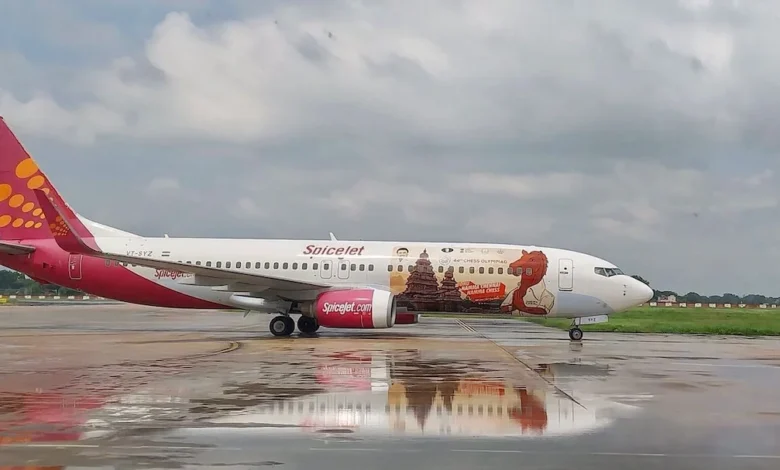
The latest developments indicate that SpiceJet is facing a fresh round of operational and financial stress. Employees have reportedly been furloughed, while salary payments have been delayed, in some cases stretching over weeks. For many within the organisation, this has translated into growing uncertainty about both income stability and the airline’s near-term direction.
At the operational level, the airline is functioning with a reduced fleet, limiting its ability to maintain schedules and compete effectively in a market that has become increasingly competitive. Fewer aircraft in service not only restrict route expansion but also directly impact revenue generation, creating a cycle that is difficult to break.
The financial strain extends beyond employee costs. The airline is also dealing with mounting statutory and operational dues, including obligations related to taxes and employee benefits. At the same time, external pressures such as elevated aviation turbine fuel prices continue to weigh on margins, making recovery even more challenging.
In response, the airline is understood to be exploring multiple options to stabilise its position, including seeking fresh funding and other forms of financial support. However, the gap between these efforts and the realities on the ground appears to be widening.
But the current stress is only one part of the story.
The Numbers Don’t Match
If the operational stress paints one side of the picture, the numbers tell a more complex and, in many ways, more revealing story.
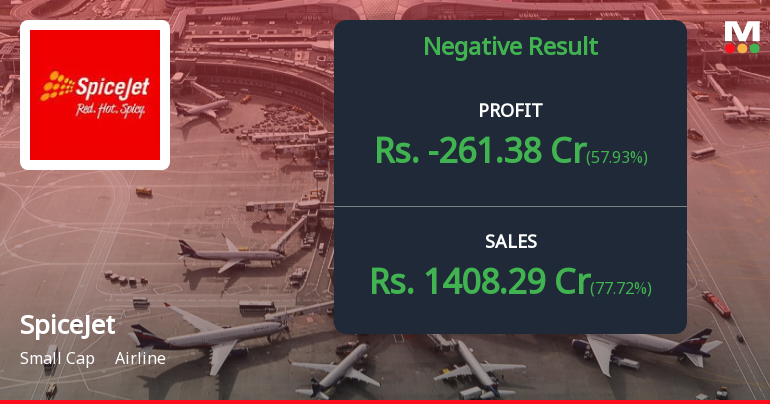
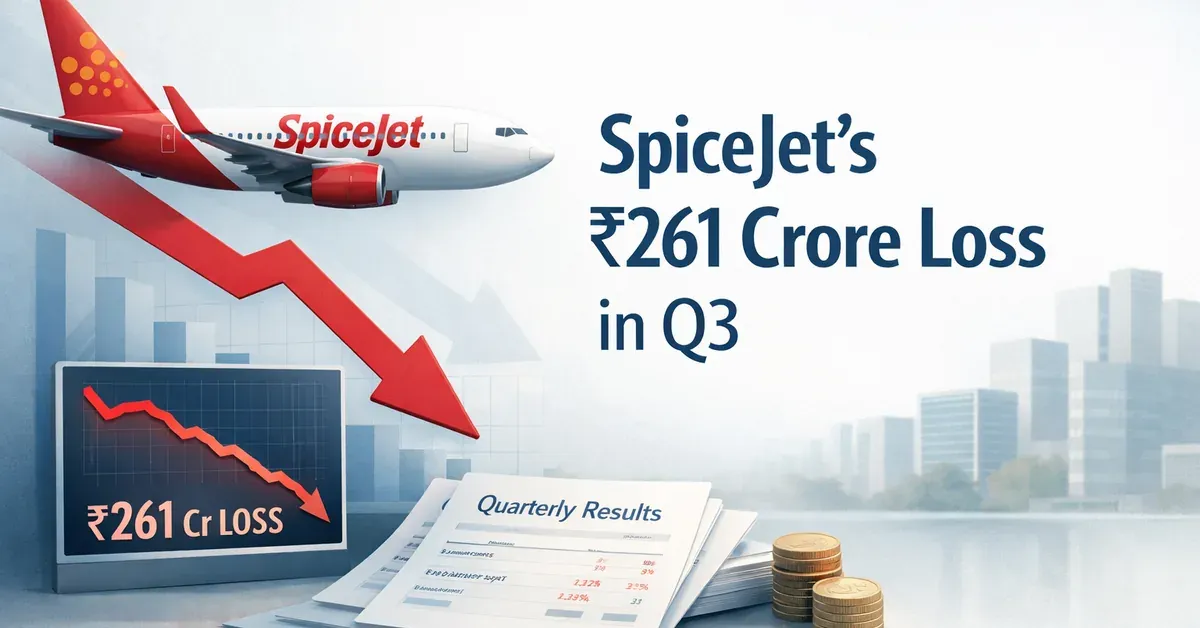
In the third quarter of FY26, SpiceJet reported a net loss of over ₹260 crore. What makes this figure particularly significant is not just the size of the loss, but the direction of movement. In the same quarter a year ago, the airline had reported a modest profit. The shift from profit to loss, within a year that was expected to consolidate recovery, raises immediate concerns about the sustainability of the airline’s financial trajectory.
At the same time, the topline tells a very different story.
Revenue for the quarter rose to the range of ₹1,300–1,380 crore, reflecting a noticeable year-on-year increase. On a sequential basis, the jump is even sharper, indicating that demand has returned and capacity utilisation has improved. Passenger numbers have grown significantly, and the airline is operating with a load factor close to 90 percent – levels that, in most cases, would indicate a healthy and efficient operation.
This is where the contradiction begins to emerge.
An airline flying fuller planes, carrying more passengers, and generating higher revenue would typically be expected to move towards profitability. Instead, SpiceJet finds itself slipping back into losses. The gap between operational performance and financial outcome suggests that the issue is not demand, but cost and more importantly, the structure of those costs.
Aviation turbine fuel continues to remain one of the largest pressure points, with elevated prices eating into margins. At the same time, a weaker rupee has made dollar-denominated expenses (such as aircraft leases and maintenance) more expensive. Add to this the impact of regulatory changes, one-time provisions, and operational disruptions such as grounded aircraft and longer flight routes due to airspace constraints, and the financial strain begins to take clearer shape.
Even when adjusted for exceptional items, the airline remains in the red, indicating that the problem is not merely temporary or accounting-driven. It is embedded in the way the business is currently functioning.
What makes this more telling is the market’s reaction. Despite visible growth in revenue and passenger traffic, the stock responded negatively to the results. This suggests that investors are looking beyond the headline growth and focusing instead on the airline’s inability to convert that growth into sustainable earnings.
In effect, SpiceJet is expanding its activity without strengthening its financial position. The airline is flying more, earning more, and yet losing money. And that is where the story begins to shift – from recovery to a more difficult question of viability.
This Isn’t New
What makes the current situation more significant is not just the numbers or the immediate stress; it is the familiarity of it all.
For SpiceJet, this is not the first time that operational strain, delayed payments, and financial pressure have appeared together. In fact, the airline’s recent history has been marked by a recurring sequence of events: a period of distress, followed by an infusion of capital or strategic adjustment, a phase of apparent stabilisation, and then a gradual return to stress.
This cycle has repeated itself often enough to raise a more structural question – whether the airline is facing isolated disruptions, or whether it is operating within a model that struggles to sustain itself over time.
Each phase of recovery has typically been accompanied by visible improvements. Aircraft return to service, routes are reintroduced, passenger numbers increase, and revenue begins to recover. On the surface, these shifts suggest that the airline has regained its footing.
But the underlying financial position has repeatedly failed to strengthen at the same pace.
Liabilities continue to accumulate, cash flow remains tight, and operational disruptions resurface, often in different forms but with similar consequences. Salary delays, vendor dues, and fleet constraints are not new developments – they are recurring signals that tend to reappear when financial buffers weaken.
What is particularly telling is that these episodes are not triggered by a single external shock. While factors such as fuel prices, currency movements, or regulatory changes do play a role, the frequency with which the airline returns to stress suggests that the vulnerability runs deeper.
It points to a structure where even periods of growth and recovery do not create enough resilience to absorb future pressures.
This is where the distinction between recovery and continuity becomes important. SpiceJet has demonstrated an ability to continue operating through difficult conditions, often finding ways to stay afloat when the odds appear stacked against it.
But continuity is not the same as stability.
And when the same signs of stress begin to surface again – delayed salaries, reduced operations, rising dues – it becomes harder to view them as isolated setbacks. Instead, they begin to look like part of a pattern that has yet to be broken.
Which brings the focus to the central question – if the cycle keeps repeating, what exactly has each phase of recovery achieved?
The Turnaround Question
At the centre of SpiceJet’s story lies a turnaround that has, for years, defined how the airline is perceived.
When Ajay Singh returned to take control in 2015, the airline was on the verge of collapse. Flights were being cancelled, dues were mounting, and confidence (both within the company and among passengers) had eroded sharply. What followed was widely regarded as one of the most remarkable recoveries in Indian aviation.
Costs were tightened, operations were rationalised, and within a relatively short period, the airline returned to profitability. The turnaround became a reference point – not just for SpiceJet, but for how distressed businesses could be revived through decisive management and operational discipline.
But more than a decade later, that same outline is beginning to face a more difficult test. Because the question is no longer whether SpiceJet was turned around once. The question is whether that turnaround ever translated into lasting financial stability.
The repeated reappearance of stress, whether in the form of delayed salaries, mounting dues, or shrinking operations, suggests that the recovery may not have fully addressed the underlying fragility of the business. Instead, it appears to have restored functionality without fundamentally strengthening resilience.
This distinction is critical.
A turnaround, in its truest sense, is expected to change the trajectory of a business. It should not only pull a company out of immediate crisis but also reduce the likelihood of returning to similar conditions. In SpiceJet’s case, however, the pattern suggests that while the airline has been repeatedly brought back from the brink, it has not moved far enough away from it.
That raises a more uncomfortable possibility – that what has been described as a turnaround may, in effect, have been a series of recoveries that stabilised the airline temporarily, without fully resolving the pressures that continue to build beneath the surface.
The longer this pattern continues, the harder it becomes to separate perception from reality. Because an airline that is consistently in the process of turning around begins to invite a different question altogether – whether it is truly recovering, or simply finding new ways to keep going.

A History That Keeps Echoing
To understand the present, it helps to look at how often SpiceJet has found itself in similar situations before.
The crisis of 2014 remains the most defining moment. The airline was on the brink of shutting down, with flights cancelled due to unpaid fuel bills and operations reduced to a fraction of their scale. It was at this point that Ajay Singh stepped back in, initiating the turnaround that would later become central to the airline’s identity.
The recovery that followed was real. Costs were cut, operations were stabilised, and within a year, the airline returned to profitability. For a time, it appeared that the worst was behind it.
But the years that followed did not build on that stability in a linear way.
Instead, the airline entered another familiar cycle. Expansion returned, new opportunities were pursued, and capacity was added. The collapse of Jet Airways in 2019, for instance, created a sudden gap in the market, and SpiceJet moved quickly to capture it, adding aircraft, routes, and market share.
Yet, the expansion came with its own pressures.
Financial stress began to surface again, even before the next major shock arrived. And when the pandemic hit in 2020, the fragile balance gave way once more. Passenger demand collapsed, revenues fell sharply, and the airline was forced to rely heavily on its cargo business to stay operational.
The shift to cargo, particularly through its freight operations, helped the airline survive a period that proved fatal for many others. It demonstrated adaptability and the ability to respond under pressure.
But survival once again came without a complete reset.
In the years that followed, the airline focused on financial restructuring – raising capital, settling dues with lessors, and gradually bringing grounded aircraft back into service. By 2025, it reported a return to profitability, marking yet another milestone in what appeared to be a continuing recovery story.
And yet, within a relatively short span, signs of stress have re-emerged.
This sequence – crisis, correction, recovery, and renewed pressure – has now played out multiple times over the airline’s journey. Each phase has been different in its triggers, but similar in its outcome.
What this history suggests is not a failure to recover, but a difficulty in holding that recovery. While SpiceJet has repeatedly demonstrated that it can come back from the edge, it has also shown that staying away from it is a far more difficult challenge.

The Industry Isn’t Helping Either
While much of the focus remains on SpiceJet, the pressures it is facing do not exist in isolation. They are deeply tied to the economics of the aviation business in India – an industry where growth is strong, but profitability remains consistently fragile.
At the centre of this imbalance is cost.
Aviation turbine fuel continues to be one of the single largest expenses for airlines, and in India, it is further burdened by high taxation. Even small fluctuations in global crude prices can have a disproportionate impact on operating margins. For a low-cost carrier, where ticket pricing is already tightly constrained, the ability to absorb such increases is limited.
Then there is currency exposure.
A significant portion of an airline’s expenses – aircraft leases, maintenance contracts, and insurance – are denominated in dollars. When the rupee weakens, these costs rise automatically, regardless of how the airline is performing operationally. This creates a structural mismatch, where revenues are largely earned in rupees, but key expenses move with global currency trends.
Competition adds another layer of pressure.
India’s aviation market is among the fastest-growing in the world, but it is also intensely competitive. Airlines are often forced to keep fares low to maintain market share, especially on high-traffic routes. This keeps load factors high, but compresses yields, making it harder to translate demand into profit.
Operational constraints further complicate the picture.
Airspace restrictions can lengthen flight routes, increasing fuel consumption. Delays in aircraft deliveries or maintenance can reduce available capacity. Regulatory requirements and compliance costs continue to evolve, adding to the overall burden of running an airline.
Taken together, these factors create an environment where even well-performing airlines operate with limited financial buffers.
In such a system, growth does not automatically lead to profitability, and efficiency alone is often not enough to offset structural cost pressures. But this is also where the distinction becomes important.
These challenges affect the entire industry. Yet, not all airlines find themselves repeatedly returning to financial stress at the same frequency or intensity. Which raises a more pointed question – if the environment is difficult for everyone, why does it appear to be harder for some to break out of the cycle than others?

The Last Bit, The Question That Remains
Taken together, the latest developments, the financial data, and the airline’s own history begin to point in the same direction.
SpiceJet is not an airline that has failed to recover. On the contrary, it has recovered multiple times, often under far more difficult conditions than it faces today. It has adapted, restructured, expanded, and found ways to continue operating when the odds suggested otherwise.
But that is precisely where the question begins. Recovery, if it is to mean something more than survival, is expected to create distance from crisis. It is expected to make each subsequent disruption easier to absorb, not harder to manage. In SpiceJet’s case, that distance has remained uncertain.
The airline is flying fuller planes, reporting higher revenues, and attempting to rebuild capacity. And yet, the same signals – delayed salaries, operational constraints, financial strain – continue to reappear, often within a relatively short span of stability.
This creates a gap between activity and outcome.
On the surface, the airline appears active, expanding, and present in the market. Beneath that, the financial position continues to show signs of stress that have not fully eased over time.
Which brings us back to where it began. If staff are being cut, salaries are being delayed, and losses are returning even as demand remains strong, then the question is no longer about whether the airline can recover once again.
It is about whether this cycle of recovery is, in itself, becoming the story. And if a turnaround continues to remain “in progress” for over a decade, it leaves behind a quieter, more difficult question – At what point does a recovery stop being one, and start looking like a pattern that cannot be broken?