The Shock That Broke The Clock. Is The SaaSpocalypse Here? Why Software Stocks Are Cracking Under AI Pressure
Is the SaaSpocalypse here? On February 4, nearly $285 billion was wiped off global software and IT stocks - not by war or rate hikes, but by a plugin. An AI tool that did in seconds what professionals bill for in weeks forced markets to confront an uncomfortable reality: time may no longer be money.

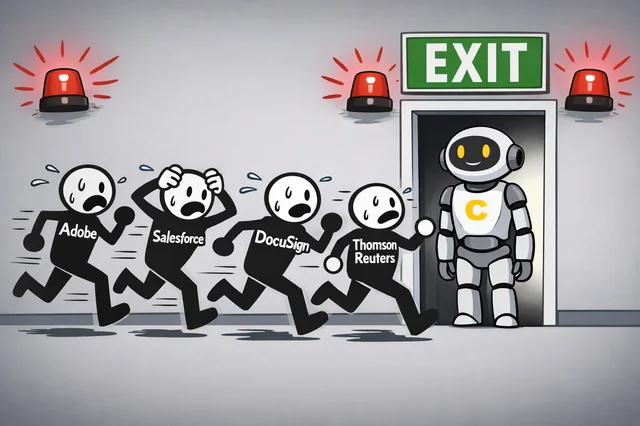
On February 4, 2026, global markets were rattled by what many analysts are now calling the SaaSpocalypse or “professional services reckoning.” Roughly $285 billion was wiped out across software, financial services, and IT services stocks in a matter of hours. The trigger was not a war. Not an interest rate surprise. Not a corporate scandal. It was a software plugin.
A new automation tool released by AI firm Anthropic demonstrated something markets had intellectually understood for months but had not fully priced in: AI is no longer just assisting professionals. It is beginning to replace billable human hours at scale. And when time is the product, that realization hits valuations hard.
What Actually Happened: The Plugin That Spooked Wall Street
Anthropic’s latest release was deceptively simple in concept. Users feed it their organisation’s internal legal guidelines. The system then reads contracts line by line, flags clauses as green (acceptable), yellow (review), or red (problematic), and suggests specific amendments. It also classifies and processes routine agreements – in seconds.
Tasks that once required teams of junior lawyers or compliance officers working for weeks can now be executed in under two minutes. Legal technology firms were hit first. Thomson Reuters Corporation fell sharply, down 28% year-to-date as of February 11. But the contagion did not stop there.
Software majors such as Microsoft and Adobe saw steep monthly declines. Consulting-linked technology firms like Cognizant and Gartner were dragged lower as well. In the US, Goldman Sachs’ basket of software stocks recorded its steepest one-day fall since April’s tariff-driven selloff.
The message from markets was blunt: the economics of professional services are under threat.
The Death of the Billable Hour
For generations, modern economies have operated on a simple principle: time equals value.
Law firms bill by the hour. Consultants invoice hours. IT companies charge for effort. Auditors charge for review time. Even freelancers, tutors, and medical professionals monetize time blocks.
The slower the clock ticked, the larger the invoice.
If a merger required 500 hours of document review, 500 hours were billed. If an audit took 200 hours, 200 hours appeared on the invoice. If a consulting project consumed 1,000 hours, those hours were monetised.
When 40 hours of document review compress into 90 seconds of machine output, the very foundation of time-based billing begins to crack. Clients will not pay premium hourly rates for work that software can execute almost instantly for a fraction of the cost.
Clearly, this is not just automation; it is economic compression. The “charge by the metre” model – where every minute is monetised – is being repriced in real time.
The Indian IT Vulnerability
The tremors were felt sharply in India.
The Nifty IT index plunged over 5% in a single session, hitting levels not seen since October 2023. Within three trading days, the index shed nearly 12%.
IT bellwethers including Infosys, Tata Consultancy Services, HCL Technologies and Wipro fell between 4% and 7.5%.
According to brokerage estimates, up to 30–40% of IT services revenue could face AI-driven productivity deflation. Motilal Oswal suggested that 9–12% of sector revenue may ultimately be eliminated over a three-to-four-year horizon.
The vulnerability is structural.
Indian IT’s outsourcing model has historically depended on scale – large teams billing predictable hours for development, maintenance, testing, ERP implementation, and support. The model thrives on headcount expansion.
But if AI agents can complete 40% of research work and 70% of manual data entry tasks, clients will not require a 10-member team when two engineers plus an AI system can deliver the same output.
Meaning, margins compress. Hiring slows. Revenue growth softens.
And markets price that in early.
This Is Not Just About Coding
While early AI disruption fears centred on software development, the threat is broader.
Enterprise resource planning implementation – once assumed to be less exposed – is now under scrutiny. Routine application maintenance, testing cycles, documentation review, financial modelling, compliance research, consulting presentations – all involve structured knowledge work.
AI does not get tired. It does not bill overtime. It does not increase costs with experience. Hence, what is unfolding is not merely job automation. It is knowledge compression.
When the time required to produce expertise shrinks dramatically, industries that monetise time must rethink how they price value.

Bubble or Structural Reset? Lessons From 2000
The comparisons with the dot-com era are inevitable.
In the late 1990s, capital flooded internet startups with little regard for sustainable profit models. When valuations detached from earnings, the bubble burst. Thousands of firms collapsed. Survivors like Amazon endured brutal drawdowns but eventually rebuilt on stronger foundations.
Today, the AI race has triggered capital expenditure plans of unprecedented magnitude. Major technology players are expected to collectively spend hundreds of billions of dollars on AI infrastructure and data centres.
The critical question is familiar: will revenue justify the investment?
Unlike the dot-com period, however, AI is already demonstrating measurable productivity gains. The risk is not that AI lacks utility. The risk is that its productivity deflates the revenue pools of companies that depend on human time.
This is not a speculative bubble alone. It may be a pricing reset.
Short-Term Chaos, Long-Term Recalibration
In the near term, disruption is inevitable.
Junior roles focused on repetitive knowledge tasks face the greatest risk. Hiring freezes in consulting and IT services could follow. Revenue growth may soften as clients renegotiate contracts in light of AI productivity gains.
Yet long-term projections suggest global productivity could rise significantly over the next decade due to AI adoption. Economic output may expand as costs fall and efficiency improves.
The transition, however, will be uneven.
Legacy firms face a paradox: AI boosts efficiency but erodes traditional billing models. They must transition from selling hours to selling outcomes, from labour leverage to intelligence leverage and this shift will not be painless.
The Last Bit, SaaSpocalypse – If Time Loses Value, What Replaces It?
The deepest disruption here is philosophical as much as financial. For decades, the most universal complaint in professional life has been: “I don’t have time.”
Entire business models were built on that scarcity.
But if AI makes time abundant – if what once took 40 hours now takes 90 seconds – scarcity shifts elsewhere. The premium may move from time spent to insight delivered, from effort logged to results achieved.
The market selloff reflects fear. But it also reflects recognition and when the unit of economic value changes, valuations must adjust.
The clock has not stopped, but for industries built on billing it, the ticking no longer sounds the same.