Trump’s Tariff Tsunami – Warning Bells For US Economy, Wipes Clean $5 Trillion Off Wall Street And Billionaire’s Wealth

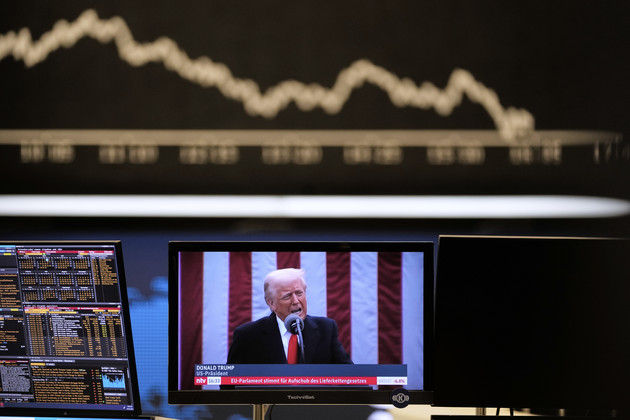
US economy is headed for choppy waters in 2025 as Trump’s tariffs take a toll, J.P. Morgan has become the first major Wall Street firm to forecast a full-year economic contraction in 2025, a signal that the impact of sweeping trade policies under President Trump may be more severe than previously anticipated.
In a note to clients, Michael Feroli, J.P. Morgan’s chief U.S. economist, revised the bank’s outlook sharply downward.
“We now expect real GDP to contract under the weight of the tariffs,” Feroli said, projecting a -0.3% growth rate for 2025, down from the earlier estimate of 1.3%.
According to Feroli, the U.S. could slip into a two-quarter recession in the latter half of 2025, with GDP falling by 1% in Q3 and another 0.5% in Q4. The key driver behind this downturn is a sharp escalation in trade tensions and tariff hikes under Trump’s proposed policies.
The economic slowdown could hit American workers hard. Feroli expects the unemployment rate to climb to 5.3%, up from 4.2% as of March. While job growth appeared resilient last month, that momentum could falter as tariffs squeeze business profits and dampen consumer spending.
Inflation is also likely to rear its head again. J.P. Morgan now sees the Fed’s preferred inflation gauge, the core PCE index, spiking to 4.4% by year-end, up from 2.8% in February. The result is a gloomy “stagflationary” scenario of higher prices and weaker growth.
In response, Feroli expects the Federal Reserve to start trimming interest rates by June, with rate cuts at every meeting until early 2026, eventually bringing the benchmark rate down to between 2.75% and 3%, from the current 4.25%-4.5%.
Still, Fed Chair Jerome Powell doesn’t appear to be in any rush. “It feels like we don’t need to be in a hurry,” Powell said Friday, following the release of the latest jobs report.
Despite the Fed’s cautious tone, markets are already pricing in at least four rate cuts this year, as recession fears gain traction.
And J.P. Morgan isn’t alone. A growing number of institutions are sounding the alarm. Barclays has also forecast a contraction in 2025. Citi sees growth flatlining at 0.1%, while UBS pegs it at a modest 0.4%.
UBS Chief U.S. Economist Jonathan Pingle pointed to the broader implications of Trump’s trade moves:
“We expect U.S. imports from the rest of the world to fall more than 20% over the forecast horizon… bringing imports as a share of GDP back to pre-1986 levels.”
For a $30 trillion economy, that’s a major adjustment.
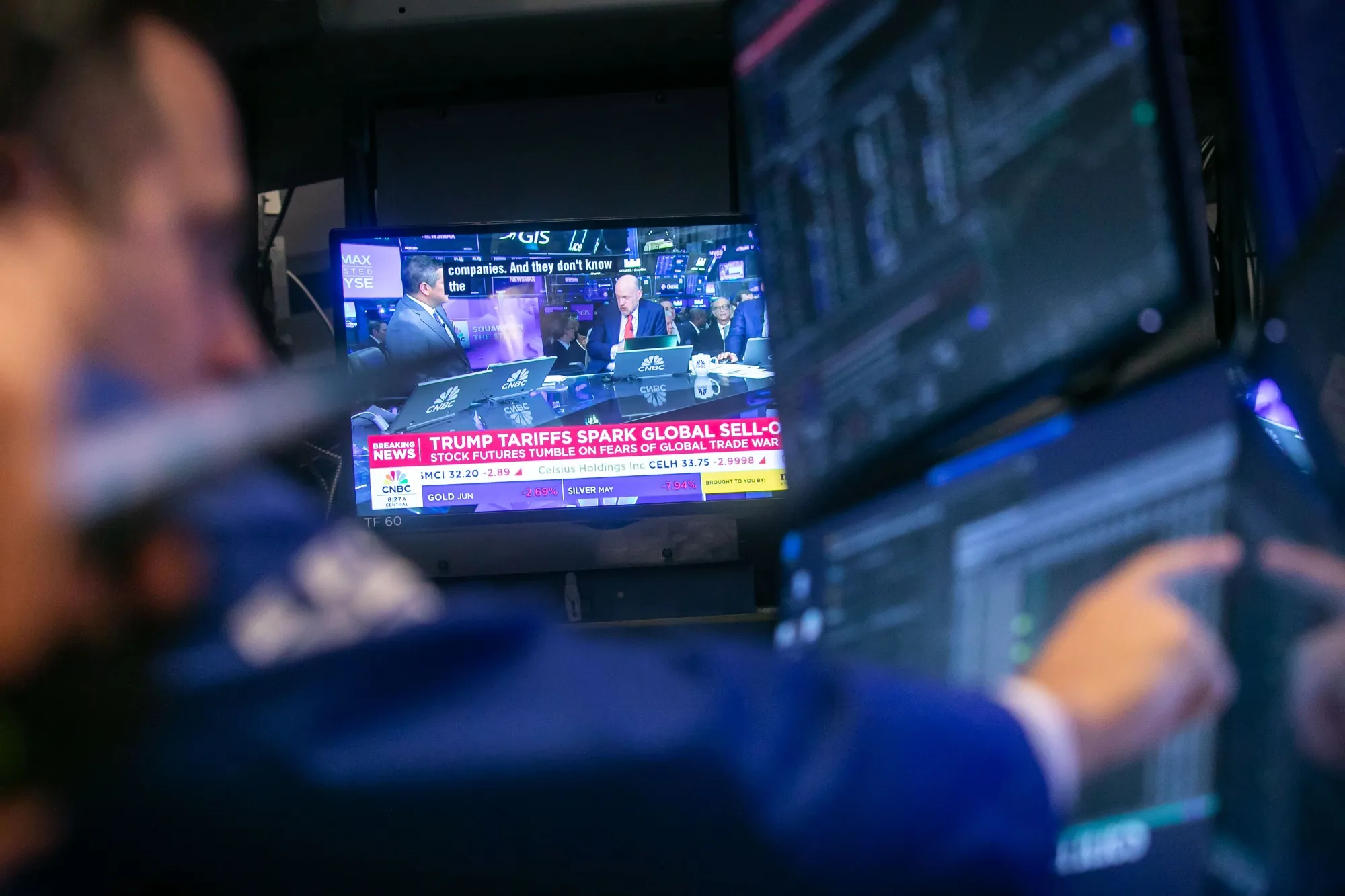
Trump’s ‘Liberation Day’ Tariffs Send Wall Street Into Tailspin, $5 Trillion Vanishes in Two Days
It’s been one of the most turbulent weeks for the global economy in recent memory and Wall Street just got hammered. The Nasdaq officially slipped into bear market territory on Friday, capping off a bruising stretch that saw U.S. stocks lose a staggering $5 trillion in market value in just two days.
The trigger is President Trump’s latest round of sky-high tariffs, and the fierce global retaliation they sparked.
China wasted no time hitting back, announcing 34% additional duties on all U.S. imports, just two days after Trump raised tariffs to their highest levels in over a century. That move escalated an already tense trade standoff into full-blown economic warfare.
Any hope that Fed Chair Jerome Powell would step in with a lifeline was quickly dashed. Despite increasing pressure, including some not-so-subtle social media nudges from Trump himself, Powell stuck to a cautious tone, highlighting “elevated risks” to growth and inflation, and signaling no immediate rate cut.
That didn’t sit well with investors already rattled by the worsening outlook. The S&P 500 plunged 6% by Friday’s close, with panic spreading fast. The Fed is now staring down a tough choice: cut rates to support growth, or hold firm in the face of mounting inflation.
This week’s market meltdown is the worst since the COVID-19 shock in 2020. But this time, there’s a major difference, the chaos is self-inflicted, driven by deliberate policy moves rather than an unforeseen crisis. The White House likely knew these risks and they pulled the trigger anyway.
And now, the numbers are hitting hard:
–The steepest U.S. tariff hike in more than 100 years
–A de facto tax hike on Americans, bigger than anything since 1968, per JPMorgan
–$5 trillion in equity value wiped out in just 48 hours
–Nearly $8 trillion in market cap lost since Trump took office
Barclays economists now expect U.S. inflation to top 4% this year, with a contraction in Q4 GDP, a combination “consistent with recession.” And the shockwaves aren’t stopping at U.S. borders.
Citi estimates the eurozone could lose up to one percentage point of growth this year, pushing it dangerously close to recession. China isn’t spared either — its GDP growth, already under pressure, could slide below 5%.
Oil markets, a barometer of global demand, are also tanking. Brent crude dropped more than 6% for a second straight day, now trading at a four-year low near $62 per barrel – down 26% from last year.
And in a telling sign of investor anxiety, the yield on the benchmark two-year Swiss government bond briefly fell below zero on Friday. Yes, it’s Switzerland, but even there, the flight to safety is on.
Japan’s Nikkei and European markets didn’t fare any better.
The Nasdaq, now officially in a bear market, is down over 20% from its December highs. The Roundhill ‘Magnificent Seven’ ETF – Down 10% this week alone – its worst showing ever and clocking in seven straight weeks of losses, now 30% below its December peak.
Bond markets aren’t looking any calmer. High-yield U.S. credit spreads blew past 400 basis points. The next stops – 450 and 500 bps – the kinds of numbers we last saw during serious credit squeezes in 2023.

Billionaire Wealth Decimated, $208 Billion Gone in a Flash
The market carnage not just numbers on a screen, it torched some of the world’s biggest fortunes. President Trump’s “Liberation Day” tariffs sent investors scrambling and took a sledgehammer to billionaire wealth.
Meta’s Mark Zuckerberg led the losers, watching $17.9 billion evaporate in a single day. His year-to-date losses now sit at $18.6 billion.
Jeff Bezos lost $15.9 billion, and Elon Musk shed $11 billion more, bringing his 2025 losses north of $110 billion.
In total, the Bloomberg Billionaire Index clocked $208 billion in wiped-out wealth this week.
But the president remains unfazed. “The markets are going to boom, the stock is going to boom, the country is going to boom,” Trump said, adding, “I think it’s going very well.”
Investors, however, begged to differ.
The top 500 public companies lost $2.4 trillion in value overnight. Tech giants alone shed $760 billion, according to Reuters.
Here’s a snapshot of the billionaire bloodbath –
Rank Name Current Net Worth One-Day Loss
1 Mark Zuckerberg $189B $17.9B
2 Jeff Bezos $201B $15.9B
3 Elon Musk $322B $11B
4 Michael Dell $92.1B $9.53B
5 Larry Ellison $160B $8.10B
6 Jensen Huang $89.6B $7.36B
Even relative stalwarts didn’t escape, Bill Gates lost $774 million, Sundar Pichai dropped $18 million, and Tim Cook’s net worth slipped by $68 million.
Tech Gets Slammed
Meta plunged 9%, Amazon sank 6%, and Tesla dropped 5.5%. Nvidia, exposed to Taiwan and Mexico for chips and AI hardware, fell 4%. Apple and Alphabet followed the downward spiral in after-hours trading. Microsoft was spared the worst, but still lost nearly 2%.
Even safe havens weren’t safe. Gold dipped. The Russell 2000, which tracks small-cap U.S. stocks, sank over 6.6%.
The fear now is this isn’t just a sharp pullback; it could be the beginning of a deeper crisis. Trump’s tariff war could ignite a global recession by hammering supply chains, sending inflation higher while killing off demand and that’s a stagflation cocktail nobody ordered.
Adding to the unease – Trump’s use of the International Emergency Economic Powers Act (IEEPA) to enforce sweeping tariff changes is already drawing legal fire. And if this power play turns into a constitutional crisis, markets won’t be the only casualty.
Global Impact Looms, India at Risk
Markets across Asia and Europe mirrored the U.S. meltdown. Investors are already bracing for more pain next week – futures are flashing red.
The U.S. accounts for 26% of global GDP and nearly half of the world’s total market cap. That makes this America’s mess but everyone else’s problem too.
For India, the exposure is serious. Over 43% of foreign portfolio investor (FPI) equity assets under custody are U.S.-linked. If the slide continues, Indian markets could be the next domino.
What began as a nationalist economic move now risks spiraling into a full-blown financial crisis for the US economy; and with billionaire backers bleeding and the world on edge, Trump’s inner circle may soon find that patriotic slogans can not paper over portfolio losses.