Your Tax Money Built This and It Still Doesn’t Work. From Gurgaon to Delhi, Multiple Cities, Multiple Projects, One Repeating Breakdown Story Where the Ending Is Always Bitter.
Here’s a question: what comes to mind when you think of India’s infrastructure - the billions allocated on paper, the tax money it comes from, or the quality of what actually gets built?

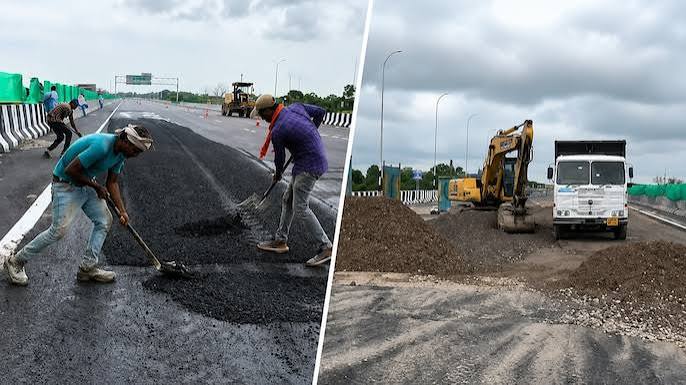
Here’s a question: what comes to mind when you think of India’s infrastructure – the extravagant sums allocated on paper, the tax money that funds it, and the reality of what is ultimately delivered?
To make that easier to answer, consider a few recent examples that offer a near-accurate picture of reality.
On the ₹4,200-crore Lucknow–Kanpur Expressway, sections of the road began to crack and sink within weeks of opening after rainfall. As repairs were carried out, videos showed workers using pedestal fans to dry freshly laid bitumen – a stopgap measure that quickly went viral and raised serious questions about construction quality and oversight.
In Delhi, heavy rain turned open drains into a hazard. In one incident, three children narrowly escaped after falling into an uncovered drain, while a man was reported missing in a separate case linked to similar conditions – pointing to gaps not in design, but in basic maintenance and safety enforcement.
In Rajasthan’s Churu district, part of the roof at a government hospital in Sujangarh collapsed, injuring a woman and once again drawing attention to the condition of public buildings that are expected to remain functional during adverse weather.
The thing to understand here is this – these incidents are not connected by geography or by agency. They involve different states, different authorities, and different types of infrastructure – highways, drainage systems, and public buildings.
What connects them is the outcome. Infrastructure that is expected to hold under routine conditions is failing – early, visibly, and repeatedly. Is it really surprising anymore? Different locations. Different systems. The same result.

This Was Always Going to Happen
What unfolded this week across Delhi-NCR was not unusual. It was familiar.
A few hours of rainfall were enough to trigger widespread waterlogging across the region, slowing traffic, stranding commuters, and disrupting daily movement. Key stretches across Delhi, Noida, Ghaziabad, and Gurugram reported flooding, forcing authorities to issue advisories and, in some cases, recommend work-from-home measures.
This is not new.
Despite annual desilting drives and pre-monsoon preparation plans, large parts of Delhi continue to face the same problem every year – drains overflow, roads submerge, and traffic collapses under conditions that are neither extreme nor unexpected.
Gurgaon offers an even clearer example. The city has long struggled with urban flooding, with key areas repeatedly going under water during monsoon due to inadequate drainage capacity and disruption of natural water channels caused by rapid construction.
In other words, the failure points are already known. The locations are known. The causes are known. Even the timing is known. And yet, the outcome remains unchanged.
Thus. logically the question is no longer why cities flood during the monsoon. The question is why they are still built in a way that guarantees it.
The Taxpayer Question
The scale of spending makes the failures harder to dismiss.
Across cities, infrastructure projects are routinely backed by allocations running into thousands of crores. The Lucknow–Kanpur Expressway, for instance, alone carries a cost of over ₹4,200 crore – a project meant to improve connectivity and reduce travel time, now facing structural issues within weeks of opening.
In Nagpur, projects worth over ₹1,900 crore have coincided with deteriorating road conditions. In Thane, infrastructure plans exceeding ₹2,800 crore are being rolled out even as concerns persist about whether the city can sustain what is being built.
Now, are these abstract investments?
No, this is taxpayer money – collected with the promise of better roads, reliable drainage, and infrastructure that works when it is needed.
But the outcomes raise a different question.
If thousands of crores are being spent, why does failure still look this basic?
Why do roads break under routine rainfall? Why do drainage systems fail under predictable load? Why do public assets require temporary fixes so soon after completion?
At this point, the issue is no longer about how much is being allocated but what survives after the money is spent. And right now, the answer appears increasingly clear – very little.
When Even Big-Ticket Infrastructure Starts Failing
The pattern does not stop at city limits.
In Assam’s Dhubri district, an approach road to a bridge was washed away after heavy rain, cutting off access and disrupting movement. In Uttarakhand, the approach to a bridge over the Tons River collapsed, once again raising concerns about construction quality and long-term resilience.
Even high-visibility projects are not immune. Sections of the Delhi–Dehradun Expressway (a flagship connectivity corridor) have reported damage following rainfall, despite being designed to handle precisely these conditions.
These are not small civic works. They are large-scale projects built to improve connectivity, reduce travel time, and support economic movement. They are also projects that involve significant public expenditure and long-term planning.
When such infrastructure begins to show signs of failure so early, the implications are far larger than inconvenience. Routes become unreliable. Supply chains slow down. Safety risks increase.
At that point, the issue is no longer about isolated lapses or local mismanagement.It raises a more fundamental question – if even high-value, high-priority infrastructure cannot hold under routine stress, what exactly is being built, and how long is it expected to last?
Where It Actually Breaks
By the time a road floods or a structure collapses, the failure has already passed through multiple stages.
Projects are rarely executed by a single authority. Roads, drainage systems, utilities, and surface work are handled by different departments and contractors, often working in sequence rather than in coordination. A road may be newly laid, only to be cut open weeks later for pipeline or cable work. Restoration that follows is rarely to the original standard.
Over time, this layering weakens the base itself.
Construction timelines tend to prioritise completion over durability. Deadlines are met, projects are inaugurated, but performance under real conditions is not always tested. What appears complete on paper often behaves differently under stress.
Maintenance, meanwhile, remains inconsistent. Drains are cleared before the monsoon, but not always maintained through it. Temporary repairs are used to manage immediate failures, but underlying issues remain unaddressed.
Responsibility is distributed across agencies, but accountability is not. When failures occur, they are treated as isolated incidents (patched, managed, and moved past) rather than traced back to their source.
The result is infrastructure that functions until it is tested. And when it is tested, it fails quickly.
The Pattern That Doesn’t Change
Across cities, across projects, and across agencies, the outcome remains the same.
Infrastructure is built, announced, and funded at scale. Yet, when tested (by rain, by usage, by time) it breaks in ways that are now familiar. Roads flood, structures weaken, systems fail, and temporary fixes take over.
None of this happens in isolation. It follows a pattern that repeats across locations and across years.
What makes it harder to ignore is that the failures are no longer unpredictable. The weak points are known. The conditions are known. Even the consequences are known.
And yet, nothing fundamentally changes.
For the taxpayer, this is no longer about one bad road or one failed project. It is about paying into a system where breakdown is expected, and durability is uncertain. At some point, the question is no longer whether infrastructure will fail. It is whether there is any consequence when it does.