
The Pannun Case Turns A Corner As Nikhil Gupta Admits To Murder-For-Hire Charges In The US. What It Means For India–US Ties
Nikhil Gupta’s guilty plea in a US federal court over an alleged plot to assassinate Khalistani leader Gurpatwant Singh Pannun marks a pivotal moment in a case that has stirred diplomatic tensions. Beyond the courtroom, it raises complex questions about sovereignty, security, and international accountability.

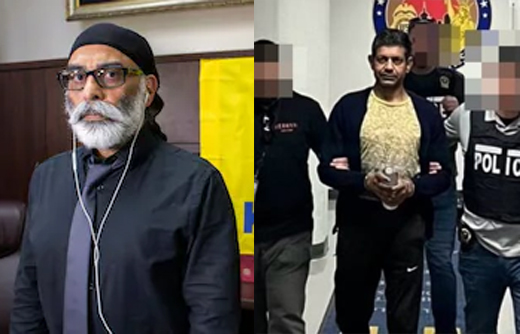
Nikhil Gupta, an Indian national accused in a foiled assassination plot targeting Khalistani leader Gurpatwant Singh Pannun, has pleaded guilty in a federal court in New York. The 54-year-old admitted to charges of murder-for-hire, conspiracy to commit murder-for-hire, and conspiracy to commit money laundering.
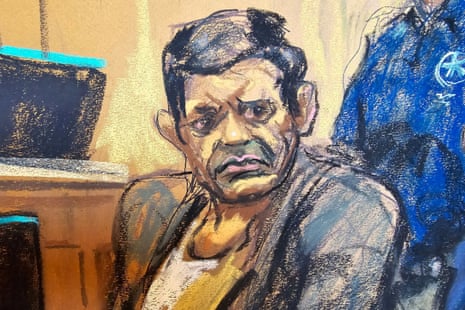
Gupta is scheduled to be sentenced on May 29, 2026, by US District Judge Victor Marrero. While the statutory maximum sentence could amount to 40 years in prison, federal sentencing guidelines suggest he may face approximately 20 to 24 years, according to media reports.
The case, which has triggered diplomatic sensitivities between Washington and New Delhi, is being viewed as one of the most serious allegations of a transnational assassination attempt on US soil involving an Indian national.
The Charges and the Guilty Plea
According to the US Department of Justice, Gupta pleaded guilty to:
- Murder-for-hire (maximum 10 years)
- Conspiracy to commit murder-for-hire (maximum 10 years)
- Conspiracy to commit money laundering (maximum 20 years)
In a statement dated February 13, the Department of Justice quoted FBI Assistant Director Roman Rozhavsky as saying:
“Nikhil Gupta was a key participant in a murder-for-hire plot against a US citizen, a murder that was prevented thanks to the actions of US law enforcement.”
Rozhavsky further stated that the intended victim became a target “solely for exercising their freedom of speech” and added that US authorities would pursue anyone attempting to harm American citizens.
The sentencing decision, however, will ultimately rest with the judge.
How the Alleged Plot Unfolded
According to US prosecutors, Gupta agreed to arrange the killing of Gurpatwant Singh Pannun for $100,000. Authorities allege he attempted to hire what he believed to be a contract killer in New York. The individual, however, was an undercover federal agent.
Prosecutors claim Gupta paid $15,000 as an advance in June 2023. The alleged plan was intercepted before any attack could be carried out.
The indictment further alleges that a former Indian intelligence officer, identified as Vikash Yadav, recruited Gupta to execute the plan. In October 2024, US authorities unsealed a superseding indictment naming Yadav as “CC-1,” the previously unnamed Indian official.
The indictment recounts communications following the June 2023 killing of Hardeep Singh Nijjar in Canada. Prosecutors allege that Gupta told the undercover agent that Nijjar “was also the target” and that there were “so many targets.” They further claim that the killing of Nijjar increased urgency around the alleged plan targeting Pannun.
Gupta’s defence team previously argued that there was “nothing on record to link the Petitioner to the massive alleged plot,” asserting that he was being unfairly prosecuted.
Who Is Nikhil Gupta?
Nikhil Gupta, an Indian citizen, was arrested in the Czech Republic in 2023 and extradited to the United States in June 2024. Since then, he has been lodged in a federal detention facility in Brooklyn.
US authorities have alleged that Gupta had links to international narcotics and weapons trafficking networks. Those allegations form part of the broader background presented by prosecutors regarding his background.
His guilty plea marks a significant development in a case that has unfolded across three countries – the United States, India, and the Czech Republic – and intersects with diplomatic tensions involving Canada.
Who Is Gurpatwant Singh Pannun?
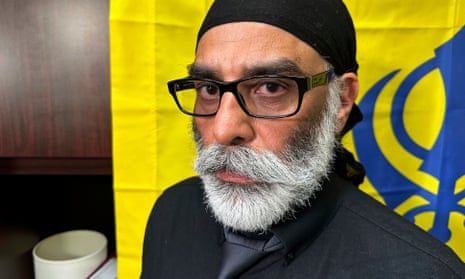
Gurpatwant Singh Pannun is an American-Canadian lawyer and the leader of the US-based group Sikhs for Justice (SFJ). The Government of India has designated him a terrorist under the Unlawful Activities (Prevention) Act (UAPA) and has banned SFJ in India, citing activities prejudicial to national security and public order.
Pannun is a vocal proponent of the Khalistan movement, which seeks a separate Sikh homeland.
Over the years, he has issued statements and video messages critical of the Indian government and has announced monetary rewards related to pro-Khalistan activities. In 2023, he warned Indo-Canadian Hindus to leave Canada – a statement that drew condemnation from Canadian political leaders.
He has also issued warnings related to Air India flights and publicly announced rewards targeting former Indian military officers associated with Operation Blue Star.
India considers him a wanted individual in multiple cases.
India’s Official Position
The Government of India has strongly denied any involvement in the alleged assassination plot.
Foreign Secretary Vikram Misri described the allegations as “completely unwarranted and unsubstantiated imputations.” The Ministry of External Affairs (MEA) reiterated that India remains committed to the principles of sovereignty and non-interference.
Following concerns raised by the United States, India constituted a high-level committee in November 2023 to examine the matter. In January 2025, the Ministry of Home Affairs stated that the committee had recommended legal action against an individual whose “earlier criminal links and antecedents” had come to light during the inquiry.
In October 2024, the MEA confirmed that the official named in the US indictment was no longer employed by the Government of India.
India has also rejected allegations made by Canada linking New Delhi to the killing of Hardeep Singh Nijjar in British Columbia, calling them “absurd” and stating that no evidence had been shared.
Diplomatic Ripples Across Three Countries
The case has unfolded against the backdrop of already strained India–Canada relations and delicate India–US diplomatic engagement.
While Washington has publicly acknowledged India’s cooperation in examining the allegations, the episode underscores the complexity of managing diaspora politics, national security concerns, and international law enforcement coordination.
The Nijjar killing in Canada and the alleged plot against Pannun have added a new dimension to global discussions around what US officials describe as “transnational repression.”
The Take
This case is not just about one man pleading guilty in a New York courtroom. It is about the uncomfortable space where geopolitics, diaspora activism, and national security collide.
India views Khalistani extremism as a direct threat to its territorial integrity. The United States frames the case as an attempt to silence a citizen exercising free speech. Canada, meanwhile, has already accused India of involvement in Nijjar’s killing – something New Delhi has categorically denied.
What makes this episode significant is not merely the alleged plot itself, but the precedent it sets. If states begin to pursue political adversaries beyond borders or are even perceived to be doing so – it introduces a level of mistrust that can erode strategic partnerships.
India and the United States are partners in the Indo-Pacific, collaborators in defense, technology, and trade. Yet cases like this test the maturity of that partnership. They require transparency, credible investigation, and institutional accountability.
At the same time, diaspora extremism and separatist rhetoric cannot be dismissed as abstract political expression. Governments often argue that unchecked rhetoric can translate into violence. The line between free speech and incitement is thin — and frequently contested.
Ultimately, the durability of India–US ties will depend on how both democracies face these legal and diplomatic fault lines without allowing them to spiral into structural mistrust.
The Last Bit
Nikhil Gupta now awaits sentencing on May 29, 2026. His case may be legally nearing closure, but its geopolitical implications remain very much alive.
Further developments – particularly regarding the role of the alleged Indian official and any additional disclosures – could shape diplomatic conversations in the months ahead. For now, the courtroom phase has reached a turning point. The international ramifications, however, are still unfolding.


