₹7,429 Crore Allegedly Diverted To Reliance Group, ADAG Entities: What Does CBI’s Fresh Chargesheet Mean For Anil Ambani’s Scams?
On 1 October 2026 the CBI filed a second chargesheet naming eleven accused, three senior Reliance ADA Group executives, seven group companies and RHFL’s statutory auditor over the alleged diversion of ₹7,429.16 crore borrowed by Reliance Home Finance Ltd. This follows a July first chargesheet alleging ₹3,526.35 crore loss to ten public-sector banks. Layered atop SEBI’s 2024 findings of evergreening and circular transactions, ED’s quantification of ₹15,548 crore as proceeds of crime, and multiple forensic reports, the expanding record raises a single unsettling question: how did a housing-finance company become the centre of multi-agency probes into the movement of public and bank funds through weak or connected entities, and why did every supposed safeguard fail to stop it in real time?

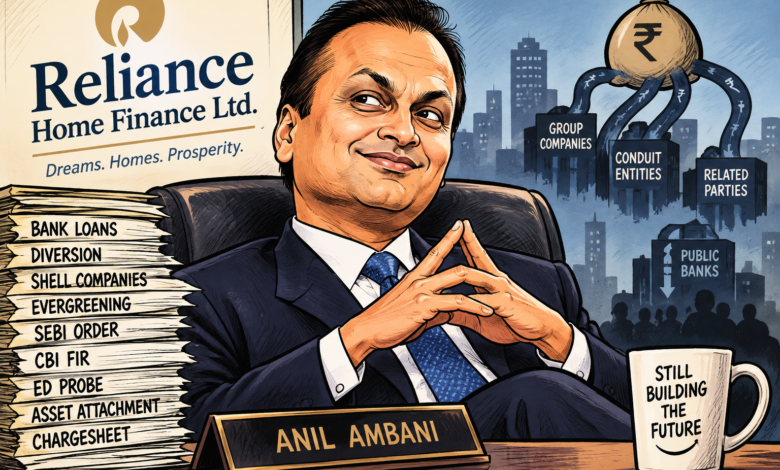
From SEBI Ban to CBI’s Expanding Chargesheets: Why Is Anil Ambani’s Group Still at the Centre of the Growing RHFL Fraud Allegations?
The Central Bureau of Investigation, CBI filed its second chargesheet on 1 October 2026 before the Special Judge for CBI Cases in Mumbai. 11 accused stand named:
- Amit Bapna, then Director and Chief Financial Officer of Reliance Home Finance Ltd;
- Amitabh Jhunjhunwala, Group Managing Director and Vice Chairman of Reliance Capital Ltd;
- Suresh Nagarajan, Chief Financial Officer of Reliance Power Ltd;
- Vijay Napawaliya, chartered accountant,
- RHFL’s statutory auditor; and
7 companies,
- Reliance Infrastructure Ltd,
- Reliance Power Ltd,
- Reliance Big Entertainment Pvt Ltd,
- Reliance Broadcast Network Ltd,
- Reliance Business Broadcast News Holdings Ltd,
- Reliance MediaWorks Financial Services Pvt Ltd and
- Kunjbihari Developers Pvt Ltd.
The agency alleges that funds amounting to ₹7,429.16 crore borrowed by RHFL were diverted through intermediary and conduit entities to various Reliance ADA Group companies in violation of the terms and conditions stipulated by lenders, causing wrongful loss to the banks and corresponding wrongful gain to the accused and related entities. The offences cited are criminal conspiracy and cheating under the Indian Penal Code.
This 2nd chargesheet against RHFL comes barely 3 months after the first chargesheet of 9 July 2026, which had named only four accused, RHFL itself, former Executive Director and CEO Ravindra Sudhalkar, former Chief Risk Officer Krishanan Gopalakrishnan Iyer, and former Reliance Capital Chief Credit & Risk Officer Dhananjay Bhagwanprasad Tiwari, and quantified an alleged loss of ₹3,526.35 crore to a consortium of 10 public-sector banks. With the latest chargesheet, the total number of chargesheeted accused in the principal RHFL case has risen to 15. The CBI has explicitly stated that further investigation continues to ascertain the roles of other persons and entities.
Why does a second chargesheet, expanding both the list of accused and the quantum of alleged diversion, still leave the public with more questions than answers? If ₹7,429.16 crore moved through intermediaries into group companies, who designed the architecture of those intermediaries, who signed the credit approvals, and who ultimately controlled the destination accounts?
The CBI’s own language, “allegedly diverted,” “investigation conducted so far has revealed”, underscores that these remain prosecutorial claims awaiting trial. Yet the very need for a second, broader chargesheet invites a deeper interrogation: was the first filing merely the visible tip of a larger structure that forensic examiners and regulators had already flagged years earlier?
The roots of the controversy stretch back to the period 2017–2019, when RHFL, then a housing-finance subsidiary of Reliance Capital within the Anil Dhirubhai Ambani Group, raised substantial funds from banks and financial institutions. SEBI’s investigation examined the company’s General Purpose Corporate Loan portfolio and recorded potential evergreening of fifteen loans amounting to ₹785.80 crore and potential circular transactions in three instances amounting to ₹412.89 crore.
The amount potentially returning to RHFL as repayment of existing loans was recorded at ₹1,198.69 crore. From 100 loan cases examined in the forensic material, ₹8,842.87 crore out of ₹8,884.46 crore was classified according to utilisation; the scrutiny indicated that some funds returned to RHFL through circular routes while substantial sums were used to repay earlier RHFL loans- the classic signature of evergreening.
What does evergreening actually mean in this context? It means new lending was allegedly used to keep older stressed exposures appearing current rather than recognising the underlying financial weakness. SEBI’s final order of 22 August 2024 concluded that the pattern constituted a fraudulent scheme involving diversion of RHFL funds through loans to entities connected with the promoter group.
More than ₹9,000 crore in loans, according to contemporaneous reporting of the order, went to borrowers SEBI considered financially incapable of repayment, and more than ₹5,000 crore went to entities linked to Reliance-group promoters. SEBI imposed a five-year securities-market ban on Anil Ambani and twenty-four other entities or persons and a ₹25-crore penalty on Ambani; aggregate monetary penalties across noticees were reported at approximately ₹624 crore.
The regulatory findings did not stand alone. SEBI explicitly compared its own investigation with the PwC report prepared under Section 143(12) of the Companies Act and the Grant Thornton forensic audit commissioned by Bank of Baroda as lead bank of the RHFL lender consortium. Common findings included loans to financially weak entities, deviations from credit-appraisal procedures, inadequate documentation and due diligence, connections between borrowers and Reliance ADA Group entities, diversion toward promoter or group entities, onward lending on the same day, and loans disbursed before formal sanction.
One concrete chain cited involved RHFL advancing ₹25 crore to Mohanbir Hi-Tech Build Pvt Ltd, which transferred the money to Gamesa Investment Management Pvt Ltd, after which ultimate recipients transferred amounts back to RHFL.
If three independent examinations, SEBI, PwC and Grant Thornton, converged on the same structural weaknesses, why did the lending continue? Why were loans allegedly disbursed before sanction? Why did newly incorporated companies with little operating history receive large corporate loans? Why did documentation remain incomplete?
These are not peripheral procedural lapses; they go to the heart of whether the credit process itself had been subordinated to a different purpose. RHFL and its executives disputed aspects of the allegations, arguing that onward lending and use of funds toward group obligations had been disclosed in annual reports and undertaken in the ordinary course of business. SEBI considered those explanations and still reached its conclusions. The distinction remains critical: SEBI’s order is a securities-law regulatory determination, not a criminal conviction. Yet the convergence of forensic material makes the regulatory findings difficult to dismiss as isolated opinion.
Parallel to the securities investigation, the debt-resolution process unfolded. In June 2021 lenders selected Authum Investment & Infrastructure Ltd as the successful bidder under the RBI’s Prudential Framework. The Supreme Court, on 3 March 2023, approved implementation of Authum’s resolution plan under Article 142 while allowing dissenting debenture holders to pursue remedies.
RHFL’s business undertaking was subsequently acquired by an Authum subsidiary on a slump-sale basis. A later Corporate Insolvency Resolution Process was admitted by the NCLT on 16 September 2025 and continued into 2026. Resolution of the company’s balance-sheet distress, however, did not extinguish the investigative trail concerning earlier conduct.
The criminal dimension began in earnest with CBI FIR RC2242022A0003 registered on 19 September 2022. Yes Bank’s reported investments of approximately ₹2,965 crore in RHFL instruments and ₹2,045 crore in RCFL instruments during 2017–2019 had turned non-performing; outstanding amounts stood at roughly ₹1,353.50 crore and ₹1,984 crore respectively by December 2019.
Separate CBI chargesheets in 2025 addressed transactions involving Yes Bank, RHFL, RCFL and entities linked to the family of former Yes Bank CEO Rana Kapoor. A distinct FIR registered on 6 December 2025 on a Union Bank of India complaint alleged a wrongful loss of ₹228.06 crore; that case named RHFL, Jai Anmol Anil Ambani (then a director), Ravindra Sudhalkar and unidentified persons and public servants. CBI searched premises associated with Jai Anmol Ambani in December 2025 and questioned him for approximately six and a half hours in March 2026. Union Bank had classified the relevant account as NPA in 2019 and as fraud on 10 October 2024.
ED entered the picture on 22 July 2025, registering a PMLA investigation on the basis of multiple CBI FIRs. Searches of more than thirty-five premises followed on 24 July 2025. Anil Ambani appeared for questioning on 5 August 2025. Provisional attachment of more than forty-two properties worth over ₹3,083 crore was announced in November 2025.
On 15 April 2026 ED arrested Amitabh Jhunjhunwala and Amit Bapna under Section 19 of the PMLA. A prosecution complaint naming fifty-five accused was filed on 12 June 2026. By 8 July 2026 ED quantified ₹15,548 crore as proceeds of crime, attached assets worth ₹4,510 crore, and obtained confirmation of ₹3,926 crore by the Adjudicating Authority. An additional provisional attachment of thirty-one immovable properties worth ₹581.65 crore was recorded in March 2026.
These figures must never be aggregated casually. The CBI’s first RHFL chargesheet alleges ₹3,526.35 crore loss to ten public-sector banks. The second chargesheet speaks of ₹7,429.16 crore allegedly diverted. ED’s ₹15,548 crore is a quantified proceeds-of-crime figure covering the broader RHFL/RCFL investigation. The ₹27,337 crore figure cited by CBI in mid-2026 represents the aggregate alleged loss across seven FIRs involving Reliance Communications, RHFL, RCFL and Reliance Telecom. Adding them produces a misleading total that collapses distinct legal concepts and scopes.
CBI arrested Ravindra Sudhalkar on 22 June 2026 and formally arrested Amit Bapna on 4 July 2026 while he was already in ED custody. Searches at fifteen premises covering twenty-three interlinked entities occurred on 18 July 2026. The first chargesheet followed on 9 July; the second on 1 October. The Supreme Court has monitored the wider set of CBI cases, but monitoring an investigation is not the same as adjudicating criminal guilt.
What remains judicially unproven is precisely the core of public concern. Has any court yet determined that the specific individuals named committed the offences alleged? Has the full chain of ultimate beneficiaries been established beyond the intermediary layer? Why were loans allegedly sanctioned to entities later characterised as financially weak or newly incorporated? Why did end-use monitoring appear so porous that forensic examiners could later map circular flows returning to RHFL or moving into group companies? Why did the credit-appraisal process, the risk function, the statutory audit and the lenders’ own monitoring fail to interrupt the pattern in real time?
The second chargesheet expands the cast of accused and the quantum of alleged diversion, yet it simultaneously underscores how much remains open. Further investigation continues. ED’s prosecution complaint is still at the pre-trial stage. SEBI’s regulatory sanctions, while final in the securities domain, do not substitute for criminal adjudication.
The public is therefore left with a growing dossier of regulatory findings, forensic observations, provisional attachments and successive chargesheets, and with the same fundamental questions that first surfaced years ago. How did a housing-finance company become the vehicle for the alleged movement of thousands of crores of borrowed money through entities of questionable capacity? Who designed the intermediary structures? Who approved the critical sanctions?
And most critically, when every institutional checkpoint of internal risk, external audit, regulatory oversight, lender monitoring appears, on the investigative record, to have been circumvented or ignored, what does that say about the resilience of the safeguards that are supposed to protect public and bank funds?

Until the criminal courts test the evidence on its merits, the honest description remains one of serious, multi-layered allegations still awaiting final determination. The second chargesheet of 1 October 2026 does not close the matter; it widens it. The public is entitled to ask whether the architecture that allowed such alleged diversion will ever be fully mapped, or whether successive chargesheets will continue to name more participants while the ultimate design and the ultimate beneficiaries remain partially obscured.