From CIC To Courtroom: How A Simple RTI Question About Modi’s Degree And Education Became A Decade-Long Legal Battlefield
For nearly a decade, a simple question, what are Prime Minister Narendra Modi's actual educational qualifications?, has traveled from a 2016 RTI letter to the Central Information Commission, through Delhi and Gujarat High Courts, and into a criminal defamation complaint against Arvind Kejriwal. On September 30, 2026, the Gujarat High Court upheld a ₹25,000 fine on Kejriwal for persisting with the question. The degree itself remains published, disputed, and unresolved in public memory. This piece asks what it means when curiosity about a head of government's credentials becomes costlier than the credentials themselves.

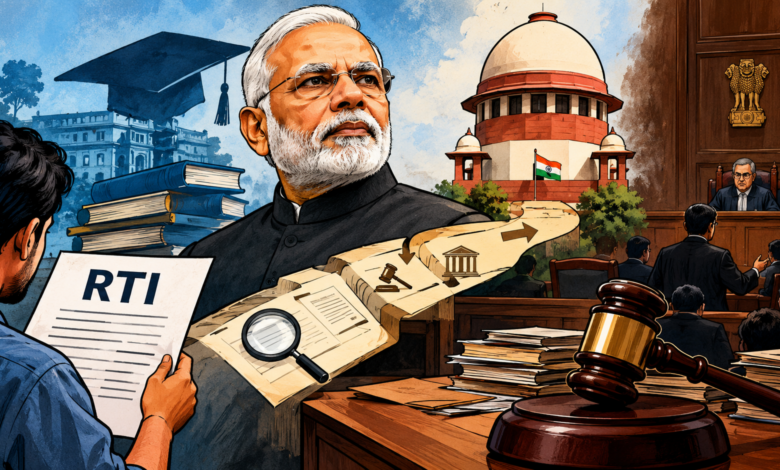
Fined for Asking: What the Gujarat High Court’s Verdict on Modi’s Degree Really Settles, and What It Doesn’t
PM Modi’s Degree- A Question That Refuses to Die
On September 30, 2026, a Division Bench of the Gujarat High Court, led by Chief Justice Sunita Agarwal, dismissed Arvind Kejriwal’s appeal against a ₹25,000 fine imposed on him for pursuing information about Prime Minister Narendra Modi’s post-graduate degree. The court held that statutory proceedings like the RTI Act cannot be used to serve political interests, and found no ground to interfere with a 2023 single-judge ruling that had already quashed a Central Information Commission (CIC) order directing Gujarat University to disclose the degree details.
On the surface, this looks like a clean legal conclusion: a court applied settled RTI exemptions, found no demonstrable larger public interest, and penalized what it viewed as a politically motivated pursuit. But step back from the legal procedure for a moment and ask a more uncomfortable question; why does a sitting head of government’s basic educational record, something millions of Indian graduates have displayed, verified, and moved on from within weeks of asking, require nine years, two high courts, a Central Information Commissioner’s removal from his CIC portfolio, a criminal defamation complaint, and a ₹25,000 fine to even partially settle?
The Timeline Nobody Can Quite Agree On
The degree row did not begin as a political ambush. It began in 2013, when Roshan Shah, a Canadian citizen of Indian origin, filed a routine RTI application with Gujarat University asking for details of Modi’s educational qualifications. He never received a response. In 2014, a similar query to the Prime Minister’s Office drew a reply stating the PMO simply did not possess the documents. That alone should raise an eyebrow: if the PMO itself does not hold a copy of the Prime Minister’s own degree, where, precisely, is the paper trail supposed to live?
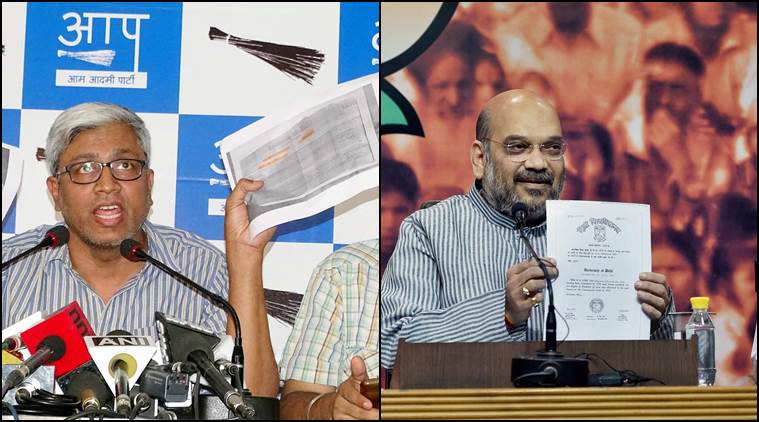
The controversy escalated in May 2016, when BJP president Amit Shah and then-Finance Minister Arun Jaitley held a press conference and flashed what they said was Modi’s 1978 Delhi University degree. The very next day, DU’s Registrar Tarun Das told media the records had been verified and the degree was authentic. India Today later clarified a specific wrinkle in the paperwork: Modi had cleared his BA exam in 1978 but was formally awarded the degree only in 1979, a detail that the Aam Aadmi Party seized upon, pointing out that the degree certificate circulated by BJP leaders referenced 1978, not 1979.
Whether this is a clerical footnote or a substantive discrepancy depends entirely on who is interpreting it, and that is precisely the problem: nearly a decade later, citizens still cannot independently verify which account is correct, because the underlying examination records have never been placed in the public domain through an uncontested, transparent process.
The same month, Gujarat University’s then Vice-Chancellor M.N. Patel announced that Modi completed his MA in Political Science in 1983 as an external student, with 62.3 percent marks, and the university posted the degree on its website. Yet journalists at the time noted the degree listed the subject as “Entire Political Science”, a designation that, as reporting at the time pointed out, does not appear to correspond to any subject actually taught at the university.
Is this an archaic administrative phrasing quirk from 1983, or a red flag that deserved the same scrutiny any other credential claim would receive from a journalist or a university verifying a hiring candidate’s resume? Nine years on, nobody outside Gujarat University’s own internal records can say for certain.
When a CIC Order Costs an Official His Portfolio
Perhaps the single most telling data point in this entire saga is what happened to the information commissioner who first ruled in favour of disclosure. In December 2016, Central Information Commissioner Sridhar Acharyulu passed an order directing Delhi University to allow inspection of its 1978 examination records — a routine RTI compliance order by any technical reading of the Act. Within weeks, in January 2017, Acharyulu was divested of his oversight of the HRD (education) ministry portfolio at the CIC.
The official explanation offered no direct admission of retaliation, and causation cannot be proven from timing alone. But any citizen watching that sequence unfold is entitled to ask: is it a coincidence that the one commissioner who ordered transparency on this specific, politically sensitive question lost jurisdiction over education-related RTI matters almost immediately afterward? If institutions want the public to trust that RTI adjudication operates independently of political pressure, episodes like this are exactly the kind that corrode that trust, regardless of what actually caused the reassignment.
The Legal Question Courts Have Actually Answered — And the One They Haven’t
It’s important, in the interest of fairness, to be precise about what Indian courts have actually decided and what they have pointedly left open. Both the Gujarat High Court’s 2023 single-judge ruling and its 2026 division-bench affirmation rested on a specific, narrow legal finding: that the CIC had acted outside its jurisdiction by converting what began as an informal letter from Kejriwal — not a properly filed RTI application — into a suo motu disclosure direction at the second-appeal stage. The court also found that, absent demonstrable “larger public interest,” the RTI Act’s privacy and fiduciary exemptions under Sections 8(1)(j) and 8(1)(e) shielded the records.
This is a defensible, narrowly-reasoned procedural ruling, and it deserves to be represented honestly rather than flattened into “the courts covered up Modi’s degree.” The court did not rule that a Prime Minister’s educational qualifications can never be disclosed under any circumstance; it ruled that Kejriwal’s specific process for seeking it, and the CIC’s handling of that specific request, did not meet the Act’s procedural and public-interest thresholds. That is a real and legitimate distinction, and critics of the degree controversy are right to point out that genuine curiosity does not automatically establish the “larger public interest” standard the RTI Act requires for exempted categories of information.
But here is where the interrogative must sharpen rather than soften: if courts have repeatedly disposed of this matter on procedural grounds — wrong applicant status, improperly converted suo motu proceedings, insufficiently demonstrated public interest — does that actually resolve the public’s underlying question, or does it simply mean the question has never yet been tested on its substantive merits by anyone with standing the courts find unimpeachable?
A procedural dismissal is not a finding of authenticity. It is a finding that this particular petitioner, through this particular route, did not satisfy this particular legal threshold. Those are very different things, and conflating them — as supporters of the government routinely do, and as the government’s own political messaging has encouraged — misrepresents what the judiciary has actually settled.
The Price of Persistence
What should trouble anyone who values institutional transparency, regardless of their political affiliation, is the escalating cost structure attached to simply asking the question. A ₹25,000 fine. A criminal defamation complaint filed by Gujarat University against Kejriwal and AAP’s Sanjay Singh over statements as basic as “if there is a degree and it is genuine, then why is it not being given.” Delhi University calling RTI transparency activists Anjali Bhardwaj, Nikhil Dey, and Amrita Johri — three of India’s most respected founding figures in the right-to-information movement, whose work predates and transcends any single political controversy — “meddlesome interlopers” and “busybodies” in open court, represented by no less than the Additional Solicitor General of India.
Ask yourself: is this the posture of an institution confident in the authenticity of a routine academic record, or the posture of an institution that has decided the safest path is to make the asking itself as expensive and reputation-damaging as possible? When a university that publishes the examination results of hundreds of other students online suddenly discovers, specifically for the records of 1978, an urgent and previously unasserted privacy interest, what inference is a reasonable, apolitical citizen entitled to draw?
The Case for the Other Side
Fairness requires acknowledging the strongest version of the opposing position. Modi has never claimed, in any official capacity, to lack a formal education; both degrees have been separately displayed, and multiple institutional officials — DU’s registrar, Gujarat University’s then Vice-Chancellor — have affirmed their authenticity on the record.
The RTI Act genuinely does carry privacy exemptions, and not every citizen’s academic transcript should be subject to mass public disclosure merely because a political figure requests it; universities routinely resist blanket disclosure of decades-old individual student records as a matter of general policy, not merely in this one case.

Kejriwal’s own legal standing in the 2016 proceeding was genuinely irregular — he had sent a letter rather than filed a formal RTI application, and the CIC’s suo motu conversion of that letter into a second-appeal direction was, on a technical reading, a real procedural overreach that any neutral court might have struck down regardless of whose degree was at stake. None of this is manufactured; these are legitimate legal and factual counterpoints, and this piece would be dishonest if it pretended otherwise.
What Remains Unanswered
Even granting every one of those counterpoints its full weight, the deeper, structural question this saga raises survives them: in a democracy that prides itself on the Right to Information Act as a landmark transparency reform, why has the most basic category of information about the country’s most powerful elected official — his formal educational credentials — never once been resolved through a clean, uncontested, publicly verifiable disclosure process, but instead has traveled through nine years of jurisdictional technicalities, portfolio reassignments, defamation complaints, and escalating fines?
Courts have repeatedly told the public what this case is not about — standing, procedure, suo motu jurisdiction. Nobody in nine years has yet given the public a forum where the question of what it is actually about — the content of the records themselves — gets tested on the merits, in the open, without a fine attached to the asking.