From Narrowing Losses to Confidential Filings: Can Spinny Scale Without Profitability?
Spinny’s path to a potential ₹2,500–3,000 crore IPO in 2027 is being sold as the story of a used-car retailer evolving into a high-margin automotive ownership platform. Revenue has climbed to roughly ₹4,657 crore in FY25 and reportedly touched ₹6,000 crore in FY26, while losses narrowed for a second consecutive year. Yet procurement still consumes the overwhelming majority of that revenue, insurance contributes a mere ₹9 crore scale, and the ₹450-crore GoMechanic acquisition inherits a troubled governance history. The central question remains unanswered: can Spinny extract meaningful lifetime value after the car is sold, or is the ecosystem thesis still more aspiration than evidence? Investors must interrogate every number before the DRHP arrives.

Spinny’s ₹6,000-Crore Mirage: Can an Inventory-Led Used-Car Retailer Still Bleeding Hundreds of Crores Really Transform Into a Profitable Ecosystem Before Public Investors Demand Proof?
Spinny’s IPO story is not a simple tale of a loss-making startup seeking public capital. It is a more unsettling narrative of a company that has achieved genuine scale while remaining trapped inside the economics of an inventory-heavy retail business. Revenue has grown sharply. Losses have narrowed for two consecutive years. Procurement and employee costs have become more efficient relative to revenue. Marketing spend has fallen. Physical and digital infrastructure has expanded. Yet the fundamental problem has not disappeared.
Spinny is still primarily an inventory-led used-car retailer that buys cars, refurbishes them and sells them. That model produces large headline revenue because the entire vehicle selling price is recognised as revenue, but it simultaneously consumes the vast majority of that revenue in procurement costs. In FY25, Spinny reported approximately ₹4,656.8 crore of operating revenue and a net loss of ₹423.8 crore. Procurement alone stood at roughly ₹4,309 crore. Total expenditure reached about ₹5,170 crore.
That single relationship, revenue of ₹4,657 crore against procurement of ₹4,309 crore, defines the economic challenge. The company’s strategic response is increasingly clear: treat the used-car sale not as the end of the customer relationship but as the beginning. This explains the aggressive push into financing, insurance, warranties, exchanges, B2B dealer auctions, new-car exchange partnerships, EV resale, and, most consequentially, the ₹450-crore acquisition of GoMechanic. The thesis is attractive on paper. The financial evidence available today does not yet establish that Spinny has successfully transformed itself into a high-margin automotive ecosystem. That distinction is the one investors must keep firmly in view before any IPO.
What exactly is Spinny? Founded in 2015 by Niraj Singh, Mohit Gupta and Ramanshu Mahaur and operating through parent Valuedrive Technologies, the company sources used cars, evaluates them, purchases selected vehicles, refurbishes them, lists them, sells them to consumers, offers financing and insurance options, provides warranties, handles documentation and delivery, and increasingly seeks to remain involved throughout the vehicle’s ownership lifecycle. Its consumer proposition rests on trust and standardisation rather than traditional bargaining.
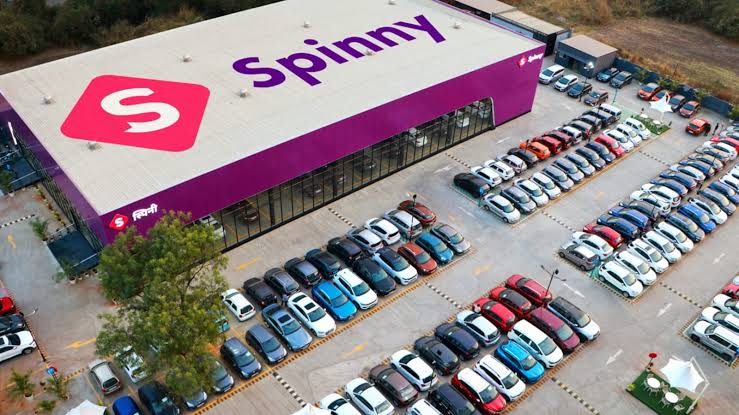
The company advertises more than 10,000 inspected second-hand vehicles, a five-day money-back guarantee and a one-year comprehensive service warranty. Its exchange operation claims more than 5.26 lakh sellers and coverage across 75-plus cities, with broader operating footprints reported at 80-plus cities.
The most important accounting point is often overlooked. Spinny’s revenue is not marketplace GMV. In FY23 the company changed its revenue recognition for the cash-and-carry business, beginning to recognise the full selling price of vehicles rather than only commissions.
Reported operating revenue consequently jumped from approximately ₹109 crore in FY22 to ₹3,260 crore in FY23. Comparing that figure with an asset-light classified marketplace is therefore misleading. For Spinny, revenue largely equals the selling price of cars, while the purchase price of those same cars is an enormous corresponding expense. ₹4,657 crore of revenue does not describe a high-margin technology business; it describes a retail business with technology layered around it.
The reported financial trajectory is nonetheless significant. Operating revenue moved from roughly ₹25 crore in FY21 and ₹109 crore in FY22 to ₹3,260 crore in FY23, ₹3,730 crore in FY24 and ₹4,657 crore in FY25. Net losses stood at approximately ₹288 crore, ₹283 crore, ₹820 crore, ₹590 crore and ₹424 crore across those years. The FY26 figure of around ₹6,000 crore is reported by sources familiar with the company and by multiple publications, but it is not an audited FY25-equivalent number. The cleaner formulation is that Spinny generated about ₹4,657 crore of operating revenue in FY25 and reportedly reached approximately ₹6,000 crore in FY26.
FY25 is where the improvement becomes interesting and where the questions multiply. Revenue grew roughly 25 percent. The net loss fell about 28 percent to ₹423.8 crore. Operating loss narrowed to approximately ₹381 crore from ₹532 crore. This was the second consecutive year of loss reduction. Yet the company remained substantially loss-making. Operating break-even and net profitability are not the same thing. Where does the money go?
Total expenditure of approximately ₹5,170 crore against revenue of ₹4,657 crore leaves little room for comfort. Procurement of goods alone consumed roughly ₹4,309 crore, around 92 percent of reported operating revenue. The company is essentially buying expensive physical assets and attempting to extract a relatively small spread after refurbishment, logistics, warranties and operating costs.
Gross-margin improvement is the real FY25 story. Procurement costs rose about 23 percent, employee costs fell approximately 14 percent to ₹338 crore, advertising and sales promotion declined about 13 percent to ₹123 crore, and total expenses grew only 17 percent while revenue grew 25 percent. That is operating leverage. Revenue grew considerably faster than the overall cost base.
Public-market investors generally want to see precisely this trajectory before an IPO. Advertising costs are particularly noteworthy. Marketing expenditure has fallen from higher levels in earlier years to around ₹123–125 crore in FY25. Used-car startups traditionally spend heavily to acquire both sellers and buyers. If Spinny can grow while reducing customer-acquisition spend, that suggests improving brand recognition and operational efficiency. But it remains only one component of unit economics.
Approximately 98 percent of revenue from contracts with customers still comes from car sales themselves. Ancillary and other income remains relatively small. This is strategically critical. If a customer purchases one used car and disappears, Spinny has only one major economic event from that relationship.
If the same customer can subsequently be sold insurance, financing, servicing, warranty extensions, roadside assistance, accessories, exchange services and eventually the next vehicle, the economics become far more attractive. That is the logic behind the ecosystem strategy. Yet the numbers today still show overwhelming dependence on the vehicle transaction.
The used-car business itself is inherently difficult. Every additional transaction requires physical inventory, capital, inspection, refurbishment, storage, transportation, staff, warranty provisioning, customer support, documentation and resale-risk management. Depreciation risk is real.
A vehicle that sits too long can erase the spread even if it eventually sells. Spinny must simultaneously optimise purchase price, refurbishment cost, inventory holding period, selling price, warranty cost and financing or insurance income. Margin per vehicle therefore matters far more than headline revenue.
The market opportunity is genuinely large. Redseer estimates India’s used-car market at approximately $35 billion currently, with a projected value of $68–78 billion by FY31. Annual transactions could reach 9–10 million by FY31 from around 6 million in FY26, growing at 14–18 percent CAGR by value and 8–11 percent by volume. Roughly 79 percent of transactions still occur through unorganised channels. Organised players such as Spinny therefore have substantial room to take share.
The trust deficit is Spinny’s real competitive opportunity. Traditional used-car buying in India involves uncertainty around accident history, mileage, mechanical condition, ownership, paperwork, financing, resale, warranty and price negotiation. Spinny’s model attempts to monetise the opposite proposition: standardisation, inspection, fixed pricing, warranty and return guarantee. That is why its brand can potentially command a premium.
Yet the same full-stack model that creates consumer trust also creates higher costs. A classifieds company can connect seller and buyer. Spinny buys the car, inspects it, refurbishes it, stocks it, sells it, finances it, warranties it and potentially services it. That control comes with capital requirements and operational risk. This is the fundamental difference between Spinny and an asset-light marketplace.
GoMechanic is the most consequential acquisition. Spinny agreed to acquire the company in a transaction valued at approximately ₹450 crore through a combination of cash and stock. The deal was intended to deepen presence in after-sales. Before the acquisition, Spinny relied on third-party providers for much post-sale servicing. GoMechanic provides network and operating infrastructure.
The customer relationship theoretically changes from “buy car, goodbye” to “buy car, service, repair, insure, maintain, exchange, buy another car.” That is exactly what Spinny needs if it wants to justify high customer-acquisition costs.
But GoMechanic is not an ordinary acquisition. In 2023 the company experienced a major governance crisis. Founders admitted to serious financial-reporting errors. Approximately 70 percent of employees were laid off. Revenue had been inflated. Concerns emerged regarding fictitious garages. Investors appointed third parties to investigate.
A consortium led by Lifelong Group subsequently acquired the distressed company. Therefore Spinny’s ₹450-crore acquisition should not be viewed merely as buying a fast-growing servicing company. It bought a previously distressed automotive-services business that had undergone major governance and restructuring. The crucial question is whether the post-2023 GoMechanic business has genuinely been stabilised.
There is evidence of recovery. In 2023 GoMechanic reported servicing more than 68,500 cars in one quarter with service revenue and GMV growing around 30 percent. By the time of the Spinny deal it operated workshops across 150-plus cities and had restructured its cost base.
One analysis puts GoMechanic’s FY25 revenue at approximately ₹144.5 crore. Spinny paid roughly ₹450 crore for a business whose reported revenue was only around ₹145 crore. Servicing businesses can have recurring revenue and higher margins than vehicle retail, but the strategic thesis becomes absolutely dependent on future growth and synergies.
GoMechanic is supposed to solve Spinny’s biggest weakness: the customer relationship ending after the vehicle sale. A buyer of a ₹6-lakh used car requires periodic servicing, repairs, tyres, batteries, insurance, roadside assistance, warranty support, accessories and eventually another car.
GoMechanic creates a potential recurring-revenue relationship and a two-way funnel: Spinny customers to GoMechanic, and GoMechanic customers potentially to Spinny. That is strategically more important than simply adding service-centre revenue. Yet the conversion metrics remain unproven in the public domain.
Insurance is already a separate business through Spinny Insurance Broker Pvt. Ltd., a wholly owned subsidiary operating under an IRDAI direct-general-broker licence. FY25 revenue for the insurance broker was approximately ₹8.92 crore, growing about 41 percent year-on-year. That growth is positive.
The absolute scale is tiny against ₹4,657 crore of consolidated operating revenue. Insurance cannot yet be described as the financial engine of Spinny; it is a promising ancillary product.
Financing is strategically more important because used-car purchases are highly finance-dependent. Financing can increase conversion and potentially generate additional revenue through referral fees, commissions or distribution income. Investors should be careful about assuming that every rupee of vehicle financing becomes Spinny’s revenue. The IPO prospectus will be critical in revealing how much Spinny actually earns per financed vehicle.
Warranties are another potential high-margin product. Spinny already offers a one-year comprehensive service warranty, with newer Assured+ categories adding roadside assistance and longer powertrain coverage. A warranty attached to an existing vehicle sale can have better economics than buying another car. The key IPO question will be the gross-profit contribution from warranty and protection products after claims. Revenue alone does not answer that question.
The B2B strategy through Spinny Partners allows verified dealers to access auctions, inspect reports, bid, purchase and manage transactions. Not every car is optimal for consumer retail. B2B channels can improve inventory velocity—an extremely important metric in an inventory-led business.
New-car partnerships are strategically significant. In March 2026 Nissan and Spinny launched a 55-minute vehicle-exchange programme across 30 cities. Later expansions involved Nissan, JSW MG Motor India and Tesla, covering new-car exchanges, pre-owned EVs and vehicle upgrading. Tesla appointed Spinny as a preferred exchange partner. These arrangements can lower customer-acquisition costs by receiving sellers directly from new-car dealers.
This changes the definition of Spinny’s business from used-car retailer toward automotive transaction and ownership platform. The theoretical customer journey becomes new-car purchase, exchange of old vehicle, Spinny acquisition and refurbishment, sale, financing, insurance, warranty, GoMechanic servicing, eventual exchange and another sale. That is the ecosystem thesis. But the ecosystem thesis has not yet been financially proven.
FY25 numbers still show overwhelming dependence on vehicle sales. Insurance at roughly ₹9 crore and GoMechanic at around ₹145 crore remain small against ₹4,657 crore of operating revenue. The statement that “the real bet is not about selling more cars” is an interpretation, not an established financial fact. Spinny is still very much dependent on selling more cars. The more accurate formulation is that Spinny is trying to make its car-selling business more profitable by monetising more parts of the ownership lifecycle.
Spinny’s funding history reveals another layer of concern. It became a unicorn in 2021 after raising approximately $283 million at a valuation around $1.8 billion. Subsequent rounds in 2025 totalled roughly $131 million to $170 million, with later transactions around $160–170 million. Reported valuations have ranged from $1.4–1.5 billion to $1.8 billion depending on the transaction and methodology. The discrepancy matters. Investors should not casually quote a single current valuation as uncontested fact.
The valuation issue becomes crucial before the IPO. Spinny has already experienced a valuation reset or uncertainty relative to its earlier private-market peak. Private investors can price future potential. Public investors eventually confront quarterly financial statements. That changes the standard. What valuation will public investors assign to a business still losing more than ₹400 crore annually?
Valuedrive Technologies converted from private to public limited company in August 2026. In September 2026 it confidentially filed draft IPO papers with SEBI. Reports indicate a proposed issue of approximately ₹2,500–3,000 crore, expected to contain both a fresh issue and an offer for sale. Listing could occur in 2027 subject to regulatory approval. Book-running lead managers include Kotak Mahindra Capital, Citigroup, Morgan Stanley and 360 ONE WAM.
Why the fresh issue matters is straightforward. An OFS primarily provides liquidity to existing shareholders. A fresh issue brings new capital into the company for expansion, working capital, technology, GoMechanic integration, inventory, new cities or other purposes. The eventual DRHP will reveal the precise split and use of proceeds. If most of the IPO is OFS, investors should ask whether existing shareholders are primarily monetising their investment rather than funding Spinny’s future.
Spinny’s balance sheet shows why capital matters. Reported FY25 figures include substantial short-term borrowings, cash and cash equivalents, inventory and trade receivables. The business is not capital-light. Additional revenue cannot necessarily be generated without additional capital and inventory management.
The core unit-economics question remains unanswered in the public narrative: how much contribution profit does Spinny make per vehicle after every direct cost? Investors need average selling price minus purchase price, refurbishment, logistics, warranty claims, inventory holding costs, payment costs and customer acquisition. That contribution multiplied by the number of cars sold must cover employees, technology, corporate overhead, hubs, depreciation, financing costs and other expenses. Without that number, headline revenue growth can be deceptive.
The customer-acquisition question is classic LTV/CAC economics. If Spinny spends X to acquire a customer who purchases one car and never returns, the acquisition cost must be recovered from the first transaction. If that customer generates vehicle margin, insurance commission, financing income, warranty income, service revenue, accessories, exchange revenue and eventually another vehicle sale, lifetime value can be much higher.
Investors need actual data on CAC, first-transaction contribution margin, repeat purchase rate, service retention rate, insurance attach rate, finance penetration, warranty attach rate, average revenue per customer and customer lifetime value. The IPO prospectus will hopefully provide more of these metrics.
CarTrade offers an important but imperfect comparison. Its model is more diversified and more asset-light, operating through brands including CarWale, CarTrade, Shriram Automall and others. FY25 consolidated revenue from operations was approximately ₹641 crore with net profit of ₹144.9 crore. That is a dramatically different financial profile from Spinny’s ₹4,657 crore revenue and ₹424 crore loss. The two businesses cannot be compared merely on topline.
CarTrade’s stock has roughly doubled since its IPO, demonstrating that public markets can reward organised automotive platforms. It does not prove that Spinny deserves the same valuation. CarTrade’s success also provides a warning: an automotive platform can become highly profitable when it avoids carrying too much inventory risk and builds diversified transaction businesses. Spinny is taking the opposite, more vertically integrated route.
Cars24 is the more relevant competitor. In FY26 it reported adjusted net revenue growth of 27 percent to approximately ₹1,411 crore, reduced adjusted EBITDA loss to approximately ₹200 crore, achieved its first adjusted-EBITDA-positive quarter, and generated approximately ₹7,766 crore in vehicle transaction GMV. The sector is moving from growth at any cost toward margin, operating leverage and ancillary revenue. Spinny’s differentiation is control of more of the transaction and ownership experience. The question is whether consumers and investors will pay for that control.
Spinny’s GoMechanic acquisition could therefore be both its biggest opportunity and biggest risk. Opportunity lies in recurring servicing revenue, customer retention, cross-selling of insurance and warranties, vehicle sourcing, customer acquisition and higher lifetime value. Risk lies in integration, legacy governance history, capital expenditure, service quality, warranty claims, workshop economics and most critically, whether customers actually migrate from GoMechanic into Spinny’s vehicle ecosystem.
A GoMechanic customer is not automatically a Spinny customer. The biggest unanswered question is ecosystem conversion: what percentage of GoMechanic customers subsequently sell, exchange or purchase through Spinny, and what percentage of Spinny buyers service through GoMechanic?
The EV opportunity through partnerships with JSW MG Motor and Tesla is real because used-EV resale currently suffers from uncertainty around battery health, residual values, warranty, charging and technology obsolescence. A trusted organised platform could create greater confidence. Yet EVs also create different risk: battery-related defects can produce substantially different warranty and valuation problems than conventional vehicles.
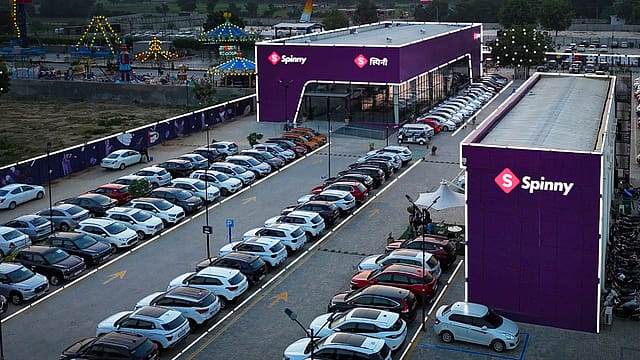
Physical infrastructure creates both moat and fixed-cost burden. Reports put Spinny at 57-plus Car Hubs, 17 Spinny Parks and 15-plus integrated restoration centres across more than 80 cities. An empty hub is not a technology asset; it is a cost centre. Inventory risk is underappreciated. A car bought for ₹5 lakh and expected to sell for ₹5.7 lakh can see its ₹70,000 spread disappear through depreciation, interest, storage, maintenance, refurbishment, insurance, logistics and warranty exposure if it sits too long. Inventory days and inventory turnover may ultimately matter more than revenue growth.
When the DRHP becomes available, the most important data points will include average revenue per car, gross profit per car, contribution margin per car, CAC, LTV/CAC, inventory days, inventory write-offs, return rate, warranty claims, financing penetration, insurance attach rate, warranty attach rate, GoMechanic customer overlap, GoMechanic revenue and EBITDA, cross-selling metrics, B2B contribution, repeat customers, city-level profitability, cash flow and working-capital intensity.
The ₹6,000-crore revenue number therefore needs context. Growth from ₹3,260 crore in FY23 to ₹3,730 crore in FY24, ₹4,657 crore in FY25 and roughly ₹6,000 crore in FY26 is impressive. But revenue growth alone cannot resolve the investment question because the cost base grows with every car purchased. The loss trajectory is encouraging: from roughly ₹820 crore in FY23 to ₹590 crore in FY24 to ₹424 crore in FY25. The loss has fallen by almost half from FY23 levels. The company has not yet crossed the most important threshold—profitability—and the IPO arrives precisely when public investors must be convinced that the remaining loss can disappear.
Is the business fundamentally broken? The data does not support that conclusion. Revenue is growing, losses are declining, operating losses are narrowing, marketing and employee costs are falling, the used-car market is expanding, the organised segment has room for growth, the brand is recognisable, physical infrastructure is substantial, financing and insurance capabilities exist, a B2B channel is in place, exchanges and new-car partnerships have expanded, and GoMechanic has been acquired. Those are genuine strengths.
Is Spinny already a proven profitable ecosystem? No.
That claim would go beyond the available evidence. The financial evidence still shows a business whose economics are overwhelmingly driven by vehicle transactions. Ancillary revenue remains relatively small. GoMechanic is recent. Insurance remains tiny. Financing economics have not been demonstrated at sufficient public scale. B2B is interesting but not yet a major earnings engine. The ecosystem is a strategy, not yet a proven economic reality.
The bull case is straightforward: a large and growing market with high unorganised share, consumer demand for trust and convenience, improving operating leverage, declining marketing spend, potential for repeated monetisation of the same customer, GoMechanic’s recurring revenue opportunity, insurance and financing attach, B2B inventory liquidation, OEM partnerships that reduce acquisition costs, and the emerging EV category. If these pieces work together, Spinny could move from low-margin used-car retailer to higher-frequency automotive transaction ecosystem.

The bear case is equally clear: continued losses, inventory-heavy core business, procurement consuming the overwhelming majority of revenue, vulnerability to used-car prices and inventory ageing, fixed costs from physical expansion, GoMechanic’s historical governance baggage, the need for the ₹450-crore acquisition to generate meaningful incremental economics, tiny insurance revenue, insufficient public transparency on financing economics, unproven cross-selling, inconsistent private-market valuation history, and public markets that ultimately value cash generation and profitability more than private-market growth narratives.
The three comparable businesses illustrate three different approaches. Spinny: high revenue, low margin, inventory ownership, full-stack experience. Cars24: technology-led retail, financing, improving adjusted EBITDA. CarTrade: lower revenue, much higher profitability, more asset-light ecosystem. The question for Spinny’s IPO is not whether it can become as big as CarTrade on revenue—it already has greater revenue. The question is whether it can eventually generate CarTrade-like profitability while retaining the consumer advantages of an inventory-led full-stack model. That is much harder.
Is Spinny’s loss-making status automatically a problem? No. The loss is declining and operating leverage is emerging. Is the business model economically proven? Not yet. Is the ₹6,000-crore topline meaningful? Yes, as a reported FY26 figure, but it is not FY25 audited revenue. Is the used-car market attractive? Yes. Is Spinny well positioned? Potentially, given brand, network, inventory, data, exchange infrastructure and customer proposition.
Is GoMechanic strategically logical? Absolutely, because it addresses the historical ending of the customer relationship after the vehicle sale. Does GoMechanic automatically make the model profitable? No. It must demonstrate recurring revenue, healthy margins and meaningful cross-selling. Is the ecosystem thesis already proven? No. It remains the company’s most important future bet.
The best way to understand Spinny before its IPO is therefore not to ask whether ₹6,000 crore of revenue is enough or whether a ₹424-crore loss is too large. The real question is whether Spinny can make substantially more money from a customer after selling that customer a car. A thin-resale-margin used-car transaction is one business.
A customer who generates car sale plus financing plus insurance plus warranty plus servicing plus repairs plus accessories plus exchange plus the next car is an entirely different business. That is why the ₹450-crore GoMechanic acquisition may ultimately be more important to Spinny’s IPO story than the headline revenue figure. As of October 2026, the evidence supports saying that Spinny is building that ecosystem—not that it has already proved the ecosystem works at public-market scale. That is the distinction investors should carry into the IPO.