From Zoom To Doom: The Dark Side Of Zoomcar!
Let’s Explore The Zoomcar’s Road To Win: When The Sharing Economy Runs Over Its Owners

When a “Verified” Renter Turns a Car Owner into a Criminal
In late 2025, a person named Deepankar Tiwari did what thousands of Indians have been enticed to do. He listed his personal car on Zoomcar’s platform, hoping to earn some passive income. Within 48 hours, that decision derailed his life. Tiwari’s car, driven by a Zoomcar customer supposedly “verified” by the platform, was seized by Gujarat police after being caught smuggling liquor (a serious offense in dry Gujarat). The innocent owner suddenly found himself entangled in a criminal case with his vehicle held in custody for months. He slogged through the legal labyrinth from FIR to High Court, posting a ₹5,00,000 surety bond and spending over ₹25,000 in lawyer fees to prove he had no part in the crime.
All the while, his car, meant to be an income-generating asset, languished in a police lot for four months, gathering dust and new dents. Zoomcar initially promised to “support” him, then ghosted him entirely, leaving Tiwari to fend for himself. This is not ‘sharing economy’. This is platform profit + owner punishment, he cried, tallying up ₹3,00,000 in lost income and a wrecked vehicle as the price of trusting Zoomcar. He’s not alone.
On Zoomcar’s own social media pages, one distraught host pleaded: “its been more than 4 months now and my car is still not returned… release my car from the police station as soon as possible,” after his vehicle, wrecked in a Zoomcar booking, had been impounded with no help in sight. The signals the desperation that echoes across India’s new so-called car “sharing” economy: if a “verified” renter commits a crime or crashes the car, the owner pays the price, alone.
The ‘Sharing Economy’ Dream that Became a Nightmare
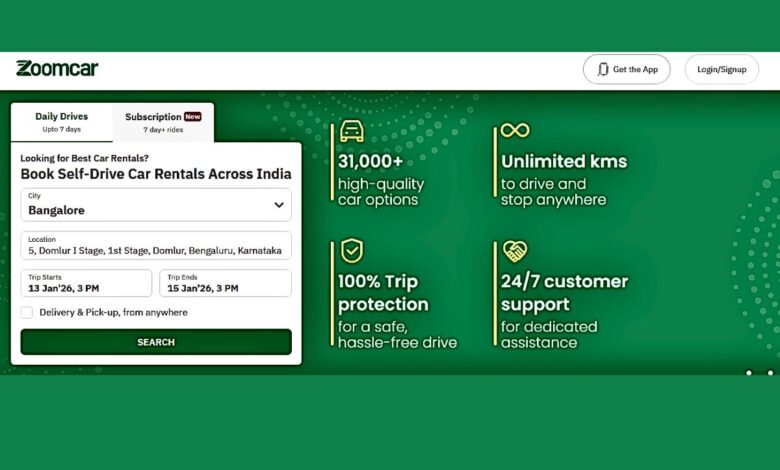
Zoomcar markets itself as the harbinger of a new peer-to-peer mobility revolution: an asset-light platform where ordinary people can “earn money from your idle vehicle” by renting it out, while Zoomcar handles the heavy lifting. The sales pitch glitters with promises, monthly passive income, full damage protection, insurance coverage, 24/7 support, hassle-free maintenance, which is all a classic win-win. It’s a pitch that worked: by mid-2020s, over 25,000 cars were listed by individual “hosts” on Zoomcar across India, turning the company into a poster child of India’s sharing economy. But for many of those car owners, the dream has curdled into a nightmare.
Consider the story shared by Mohammed Nabeel Uddin, whose close friend, lured by Zoomcar’s slick advertising, put his humble family car on the platform. One booking was all it took to upend that family’s life. Mere hours after a customer drove off in the car, a phone call brought devastating news of a major accident. Zoomcar assured the owner it would take care of everything. Instead, it took custody of the totaled vehicle and then seemingly forgot about it.
Days turned into weeks, weeks into months; no repairs were done, no insurance claim was processed. The car has now spent over 1.5 years rotting in Zoomcar’s “repair” yard, effectively junked, worth only its weight in scrap metal. Every attempt by the owner to get updates or action met a wall of silence as the customer care stopped responding, emails went unanswered, and no executive took responsibility. The friend’s once-valuable car (worth several lakh rupees) is now a paperweight on wheels.
The deeply flawed model of Zoomcar!
Zoomcar’s vaunted safeguards turned out to be hollow. As Nabeel Uddin summarizes: Zoomcar’s model is deeply flawed as the company rents your car to unknown individuals, takes no responsibility when things go wrong, hides behind layers of non-responsive communication, and leaves the car owner with all the financial and legal burden. In this “platform profit + owner punishment” model, Zoomcar enjoys the revenue from each booking while the owner is left holding the bag when a renter crashes the car or uses it for nefarious purposes.
Many car owners across India have had similar experiences. Cars damaged. Cars lost. Cars abandoned. And Zoomcar simply vanishes, Uddin wrote bluntly. Scan through consumer forums and social media, and you’ll find a litany of horror stories: cars kept unreturned for months after accidents, stolen vehicles, safety lapses, unpaid repair reimbursements, security deposits vaporized, and a customer support apparatus that ranges from apathetic to outright evasive.
In one public post, a Zoomcar host recounted how a guest wrecked his car in February 2025, and six months later, Zoomcar had provided zero accountability, with no repair, no compensation, no updates, while his bank EMIs piled up for a car he no longer had. He is now preparing legal action for financial losses, breach of trust, and mental harassment.
Another host from Hyderabad reported that his car was stolen by a Zoomcar renter and never recovered; a year passed with the company making empty promises to “settle” his case, even taking his original RC and keys under the pretense of processing an insurance claim, only to stop responding and deny any payment. “Zoomcar will not provide any assistance… you will be on your own. Even the insurance company will deny your claim,” the host warned, after learning the hard way that the platform’s assurances mean nothing. These are not isolated anecdotes, but symptoms of what looks like an emerging pattern of neglect and corner-cutting.
Lawlessness on Four Wheels: Isn’t This An Illegal Business Model?
Why are Zoomcar’s customers, the car owners or “hosts” left so vulnerable? A major reason is that Zoomcar’s very business model in India, as mentioned in a reddit post, operates in a legal grey zone, one that arguably veers into outright illegality. Indian law mandates that any vehicle being rented out for self-drive must have a commercial permit and bear a yellow-on-black number plate.
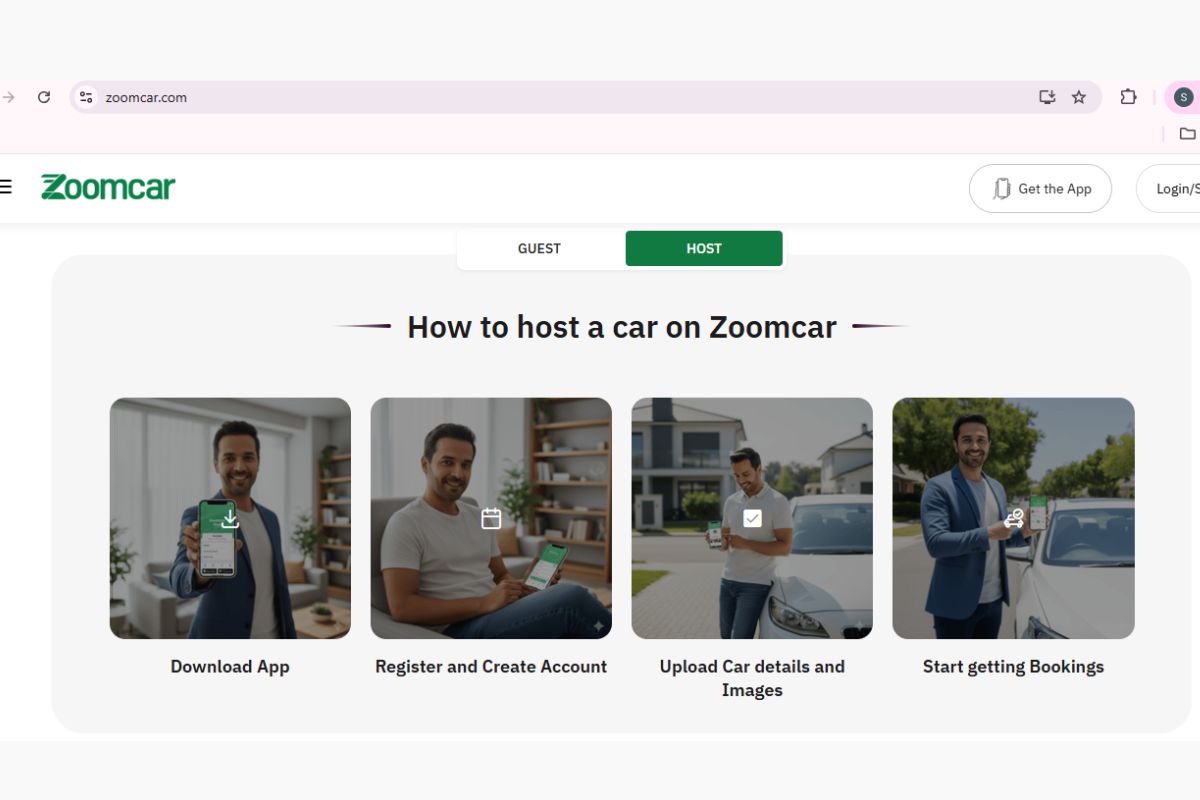
Private cars (with standard white number plates) cannot legally be used as self-drive rentals. This isn’t a trivial technicality; it’s the law of the land under the Motor Vehicles Act, intended to ensure proper insurance and regulatory oversight for vehicles carrying fare-paying users. Yet, Zoomcar’s peer-to-peer “host program” has, by design, enlisted privately-registered cars, thousands of them, for commercial rental service without converting them to commercial registration. Their own website mentions just 4 steps for a host to register a private owned vehicle and get it used as a commercial vehicle for getting bookings.
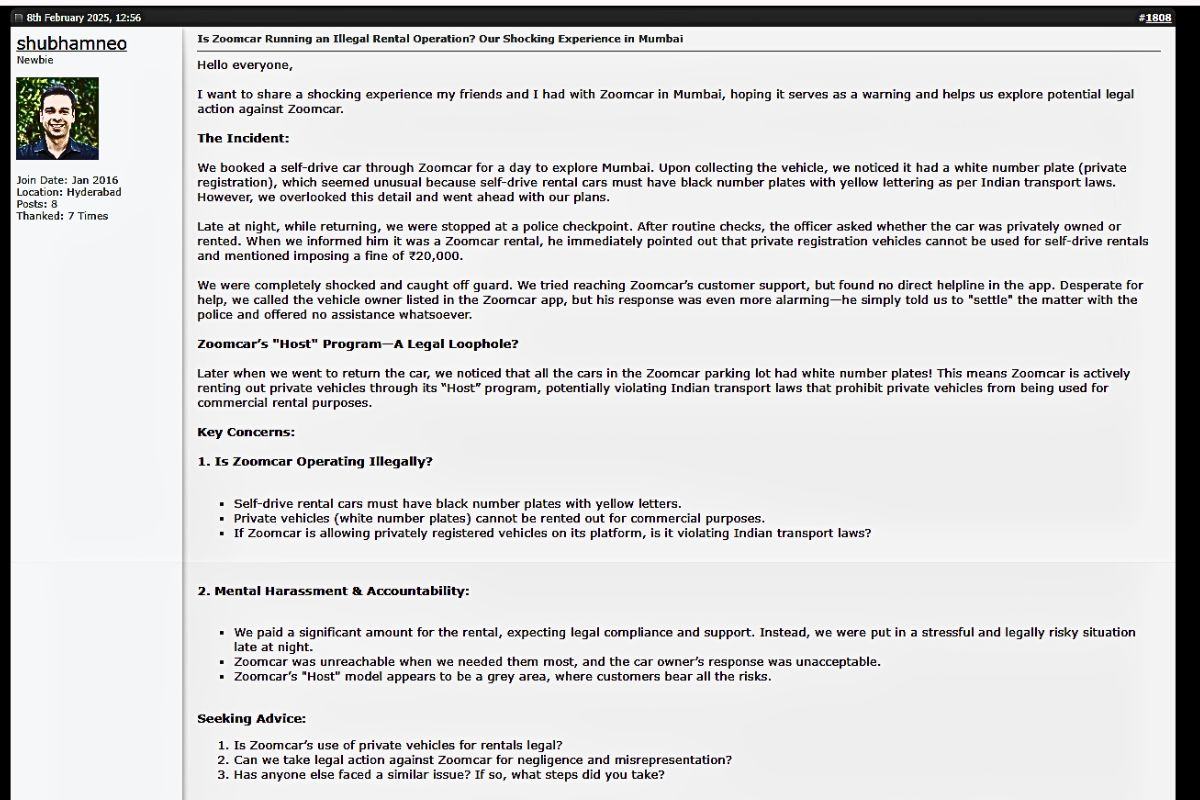
For years, this practice flew under the radar, even as every Zoomcar parking lot was filling with white-plate cars in plain violation of transport laws. Renters, hosts, and the company all shrugged through the legal ambiguity, until incidents forced the issue into the open. In one case in Mumbai, a Zoomcar customer was pulled over at a police checkpoint and slapped with a ₹20,000 fine when officers realized the rental car had private plates, which is an illegal setup. The hapless renter discovered there was no emergency helpline to call: Zoomcar was unreachable in the moment of crisis.
The “host” (the car’s owner) whom the renter contacted offered no help either; he simply advised to quietly “settle” the matter with police. Both customer and owner had been unwittingly complicit in Zoomcar’s rule-bending, and it was they, not Zoomcar, who faced the consequences on the ground. Online forums are now peppered with such accounts, and legal experts note that any fine for using a private car as a rental would be imposed on the car’s owner, not on Zoomcar. In other words, the platform reaps the profits while hosts (and sometimes renters) take on the legal risk.
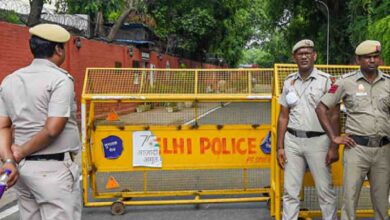
Regulators have begun to wake up. Transport authorities in multiple states are cracking down on these illegal rentals. In Bengaluru, officials carried out a sting operation in August 2025. RTO officers posed as customers on Zoomcar, booked cars from unsuspecting hosts, then immediately impounded 21 private vehicles attached to Zoomcar that were being run without permits. The Bangalore RTO revealed that Zoomcar’s mandatory “rent-a-cab” licence had expired in January 2024 and was never renewed, meaning the company has effectively been operating without a valid license.
The seized cars, many belonging to young techies who thought they’d found a nifty side hustle, then faced steep fines (₹30,000+ each) and hefty lifetime taxes for those registered out-of-state, and mentioned, only be released after owners give a written undertaking not to list them again. “Private vehicles cannot be used commercially – it’s a clear loss to the government and totally illegal,” said the regional transport officer, underscoring that Zoomcar “still hasn’t renewed its aggregator licence” even after warnings.
Down south in Kerala, the alarms are even louder. In late 2024, Kerala’s Transport Minister publicly vowed to take strict action against unauthorised app-based ‘rent-a-car’ services like Zoomcar, acknowledging that full inspections are challenging but promising enforcement on reported violations. Zoomcar has been operating without any license in the state since 2019, despite a court order to cease operations.
In fact, the Kerala High Court had earlier ruled that Zoomcar’s unauthorized activities constituted a cybercrime, calling for decisive action. The Regional Transport Office in Ernakulam even recommended an outright ban on the Zoomcar app. When a high court labels your business a cybercrime, you know something is terribly amiss. The core of the illegality is the same: Zoomcar’s platform has thousands of private car owners running afoul of Section 66 of the Motor Vehicles Act by renting out vehicles without commercial permits.
This not only cheats state revenues (no permit fees, no commercial taxes), but it also leaves fundamental safety gaps. However, there is one advantage that if one of these cars crashes, Zoomcar will bear the costs of insurance. However, the guest pays a deductible based on their choosen Damage Protection Package (Standard or Peace of Mind) and is responsible for minor damages, towing, and specific policy violations, with the host’s private car registration potentially adding complexity if not commercialized. But, using a private car (white number plate) for commercial rentals (like Zoomcar) can be a grey area, and some users report insurance issues or difficulties with claims, as standard private insurance might not cover commercial use.
Zoomcar knows all this. Hosts have reported that company reps privately advise them on how to dodge scrutiny. One user recounted how a Zoomcar representative suggested that if cops ask, “just say it’s your friend’s car,” essentially coaching customers to lie to officials. Such advice is a telltale sign. Zoomcar appears aware that its model doesn’t hold water legally, yet continues to scale it, betting on lax enforcement or legal loopholes.
It seems like a cynical calculus of “profits now, and apologize (or pay fines) later” This is similarly as complex as ‘Buy Now Pay Later’. Meanwhile, it’s the hosts, who are ordinary vehicle owners, who literally pay in the form of fines, seized cars, legal trouble, or denied insurance. This is as much a failure of regulatory oversight as it is a corporate transgression where, Zoomcar’s continued operation using private white-plate cars highlights the failure of authorities to enforce the law, leaving innocent car owners vulnerable.
Vanishing Accountability: When Support is Just a Buzzword
One of the most jarring aspects of these stories is the near-total lack of accountability or support from Zoomcar when things go wrong. The company’s upbeat marketing of “24/7 support” has become a cruel joke to those on the receiving end of its apathy. Car owners describe being passed around an endless loop of customer care executives via emails and app chats, with no real person ever taking ownership of a problem. In many cases, Zoomcar representatives simply stop responding once an issue becomes complex or costly – a wrecked car, a police seizure, a reimbursement due.
Mohammed Nabeel’s friend saw the same vanishing act after Zoomcar towed his crashed car to their yard, nothing happened for months, and no one could even tell him where his car physically was or why repairs hadn’t started. Another host quipped bitterly on LinkedIn that ignoring car owners and leaving them high and dry seems to be Zoomcar’s new business model. When enough aggrieved hosts started talking of uniting to file a PIL (Public Interest Litigation) against the company, Zoomcar’s social media handlers occasionally popped up with templated apologies and requests for “ticket IDs”, which is too little, too late.
Even on Zoomcar’s official posts celebrating a customer’s road-trip, the comments are hijacked by angry hosts asking about their stuck vehicles and pending refunds. The optics are terrible as a company trying to projecting growth and adventure while its earliest adopters accuse it of negligence and fraud in the same breath. These exasperations are palpable. It should not take shaming on social media or tagging government ministers to get a response from a company that touts customer obsession.
At the heart of this breakdown is Zoomcar’s frantic pursuit of a scalable, asset-light expansion, one that, by design, minimizes its responsibility. By positioning itself as a “marketplace” or intermediary, Zoomcar has attempted to have it both ways: to hosts, it promises hands-on management of rentals (insurance, verification, support); to regulators, it likely portrays itself as just a tech platform connecting car owners and renters, distancing itself from liabilities. This shell game has left car owners in a lurch whenever real trouble strikes. As one furious host wrote, “They market themselves as partners, but in reality, owners are left helpless when things go wrong.”
Profits Over Safety: The Financial Angle
Why would a company allow such risk and resentment to fester among its user base? The answer may lie in Zoomcar’s financial troubles and strategic choices. Zoomcar Holdings, which went public on Nasdaq in 2022 via a SPAC merger, has struggled to turn a profit. For the quarter ending September 2025, the company did report a dramatic 76% reduction in net losses (down to $794,000 from $3.35 million a year prior). But dig deeper, and that improvement sounds largely cosmetic, which is the result of a one-time $1.7 million accounting gain from writing off failed overseas subsidiaries in Vietnam and Egypt.
Its core Indian operations are still far from truly profitable; in fact, revenues grew a meager 2% year-on-year even as expenses climbed, and Zoomcar only shrank its losses by selling off pieces of itself. The company all but admitted in its SEC filings that it “will not have sufficient funds to meet its obligations within one year” without fresh financing.
By its own account, Zoomcar needed to raise $25 million in new funding (a combination of $5M bridge debt and $20M equity uptick) just to keep the engines running into 2026. An earlier attempt to raise $15 million in early 2025 flopped spectacularly. These are not signs of a healthy enterprise; they are flashing red warnings of a cash-starved startup on the brink.
Amid this cash crunch, Zoomcar’s leadership has been touting bright spots like “eight consecutive quarters of positive contribution profit” and “sustained progress toward full profitability”. That sounds reassuring, but such metrics can be cold comfort to a car owner whose vehicle is wrecked or impounded today. In pursuit of profitability, the company appears to have aggressively cut costs and one can’t help but suspect that customer support, insurance payouts, and regulatory compliance budgets were among the first on the chopping block.
Every rupee not spent on repairing a host’s car, every claim denied or delayed, and every “generic message” instead of real assistance might be helping Zoomcar inch toward a positive EBITDA on paper. It’s a cynical calculus where the company (perhaps) tries to externalize costs and risks to your users (both car owners and renters) in order to shore up your own balance sheet. After all, paying out on an insurance claim or compensating a host for a totaled car would hit the quarterly results; far easier to let the host’s insurer (if any) or fate handle it.
Indeed, numerous hosts report Zoomcar flatly refused reimbursement by citing obscure policy clauses or by simply not responding, effectively forcing the car owners to claim on their personal insurance or absorb the loss. The catch? If the car was being used commercially without the proper registration (which, as noted, it almost always is on Zoomcar), the owner’s personal insurance can rightfully refuse the claim. It’s a perfect storm of irresponsibility, and it’s the little guy who gets blown away.
The Buck Stops Where?
Zoomcar’s saga is more than just a story of one company’s failings; it may be considered a cautionary tale about the broader “move fast and break things” ethos that has swept India’s startup ecosystem. Here is a venture-backed company, operating in broad daylight, listed on an American stock exchange, openly flouting domestic laws and basic consumer protection principles in its biggest market.
It promises the moon to users, both renters seeking adventure and hosts seeking income, and then, when the promises fall through, it hides behind fine print and silence. The lack of immediate regulatory action for years enabled Zoomcar to push the envelope, but now the envelope has ripped. The question is: who will be held accountable for the trail of damaged cars, drained savings, and shattered trust left in Zoomcar’s wake?
Car owners have taken to social media not just out of frustration, but as a public service warning. “Car owners beware: a trap disguised as opportunity,” Nabeel wrote in a post that went viral. “Please think twice… you might be risking your car, your savings, your peace of mind, and you will have no one to turn to when things go wrong.”
These whistleblowers are doing what Zoomcar itself and the regulators should have done from the start: make clear the real risks involved. If Zoomcar has any hope of salvaging its reputation (and business), it must radically overhaul its approach: adhere to laws, fortify its insurance and support systems, and put its hosts’ interests on par with its own. As it stands, Zoomcar’s conduct is eroding the very trust that platforms rely on.
India, for its part, needs to quickly tighten the framework around such “sharing economy” platforms. The concept of ride-sharing or car-sharing isn’t new, but our laws and enforcement mechanisms are playing catch-up.
Whether it’s through enforcing existing laws (as Karnataka and Kerala have done) or crafting new regulations specific to peer-to-peer vehicle rentals, authorities must ensure that platforms cannot offload all risk onto users while keeping all the profit. The principle is simple: if Zoomcar wants to act like a car rental company, it must face the responsibilities of one, including proper licensing, insurance, and liability for what happens under its watch. If it fails to do so, then perhaps it has no business operating at all.
A Reckoning on the Horizon
At its core, the Zoomcar saga underscores a timeless truth in business: trust is hard-earned and easily lost. Zoomcar asked Indians to trust it with their weekend road trips and with their second-largest asset (after their home) their car. For a while, many did, buoyed by the allure of tech-enabled convenience and income. But trust is a two-way street, and Zoomcar has been barrelling down the wrong side.
The company’s spokespeople love to talk about “empowering micro-entrepreneurs” and “democratizing transport”. Those lofty ideals ring hollow to suffered citizens, who today is struggling to get police records expunged and his car back in shape, all for the crime of believing a platform’s promises. They ring hollow to the family whose car sits in a dusty yard for 18 months with no answers, or the techie in Bangalore now facing an RTO fine bigger than what he earned on Zoomcar.
In the coming months, Zoomcar will either clean up its act or face an exodus of hosts (not to mention wary customers) and the gavel of regulators and judges. A petition organized by angry car owners is already in the works, and consumer courts may soon be flooded with cases seeking damages. The Ministry of Consumer Affairs has been tagged on multiple complaints, sooner or later, they’ll need to respond. The writing is on the wall like a warning sign on a highway: Slow down, sharp turn ahead. If Zoomcar doesn’t steer in a new direction, it may find its road ahead closed.

For now, let the buyer and the car owner beware. The shiny promise of the sharing economy has a dark underside, and Zoomcar’s flaws have laid it bare. As one aggrieved host put it, this isn’t just one person’s story but “a growing issue across India”. It’s an issue that forces us to ask tough questions about accountability in the age of tech platforms. And it’s a reminder that when something sounds too good to be true – “earn from your idle car, hassle-free!” – it just might crash and burn, taking your hard-earned assets with it.