Acting Tough And With A Warning Too, Reliance Retail Ultimatum – Break Even Or Be Broken

Reliance Retail has posted a solid financial performance for the fiscal year ending March 2025, illustrating its dominance in India’s retail sector. The company reported a consolidated net profit of ₹3,545 crore, marking a 29% year-on-year surge. Gross revenues for the same period rose by 16.3% to ₹88,620 crore, driven by robust growth across major consumption segments. Both its physical and digital retail arms contributed significantly to this uptick, reflecting broad-based consumer demand and improved operational strategies.
However, despite this strong showing, the company is now pivoting toward a far more aggressive stance on operational efficiency. In a marked departure from its earlier approach, where new stores were typically given up to two years to stabilize and prove viability, Reliance Retail’s senior leadership has issued a firm directive: all new stores must achieve breakeven within 6 to 12 months. Failure to do so will result in closure or conversion into a different, potentially more profitable, retail format.
This decisive shift signals Reliance Retail’s sharp focus on profitability and margin optimization, especially as it edges closer to its highly anticipated initial public offering, IPO. While timelines around the IPO remain undisclosed, company executives confirmed during a recent closed-door meeting with analysts that further details would be shared in due course.
In line with this renewed strategic rigor, Reliance Retail will also dial back its once-frenzied store rollout pace.
The company, which had opened over 3,300 stores in FY23, now plans to add 500–550 outlets annually, nearly halving the expansion rate. The recalibration follows a larger introspection exercise, where over the past three financial years, the company shuttered more than 3,650 underperforming stores.
RR with a presence across multiple verticals, including electronics, groceries, fashion, beauty, footwear, jewellery, eyewear, pharmaceuticals, and handicrafts, it operates through a bouquet of well-known brands such as Reliance Fresh, Digital, Trends, and MyJio. As of March 2025, it boasts a massive network of 19,340 stores across the country.
An executive familiar with the strategy said the era of “crazy expansion” is over, but emphasized that store count will continue to rise each year, albeit more selectively.
“We’re applying greater due diligence in choosing store locations. With better planning, over 90% of new stores should meet the breakeven target within the new timeline. Though some may still lag due to market shifts during execution,” the executive said.
Alongside the profitability push, Reliance is also repositioning itself towards the premium end of the retail market. The group’s luxury and premium vertical, managed under Reliance Brands, continues to expand its global portfolio, offering labels like Armani Exchange and Hugo Boss. On the grocery front, premium formats such as Freshpik and Gofresh have been well-received, and plans are underway to launch more outlets in affluent neighbourhoods.
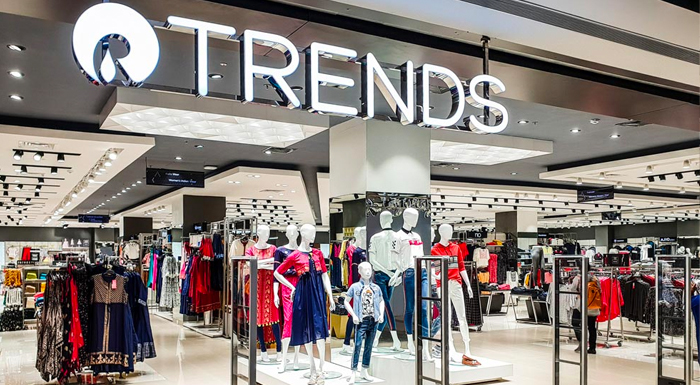
In fashion, the company is revamping its value brand Trends to better appeal to younger, tech-savvy consumers, mirroring the digital-first approach of its more urban format, Azorte.
A major contributor to the company’s improved financial metrics has been an internal “streamlining” drive, an efficiency-enhancing effort focused on pruning loss-making operations and optimizing existing store performance. This initiative has already started to bear fruit. Reliance Retail’s EBITDA margin rose to 8.3% in FY25, up from 8.1% in FY24, and significantly higher than the 7.6% and 6.2% seen in FY23 and FY22, respectively.
“We’re pretty much done with the streamlining now,” said Chief Financial Officer Dinesh Taluja during an earnings call, without disclosing specific actions taken. Another executive added that it was a one-time exercise aimed at improving EBITDA and overall financial health. “Going forward, unit economics and profitability will guide our decisions. Better margins will ultimately enhance valuations,” he stated.
Interestingly, even in cash-intensive areas like e-commerce and quick commerce, Reliance Retail is determined to maintain profitability. Taluja emphasized the company’s goal to compete in the 30-minute delivery segment “with strong unit economics and sustainable margins.” Deliveries will be routed from the nearest stores instead of dedicated dark stores, reducing infrastructure costs.
He further explained that fixed costs related to dark stores are being absorbed by existing retail outlets, while the 30-minute fulfillment model adds incremental sales with minimal added cost. This hybrid approach is expected to play a crucial role as Reliance expands its presence in the fast-paced world of hyperlocal delivery and digital retail.
Reliance Retail, Quick Commerce And Dark Stores
After reporting a substantial surge in hyperlocal and quick commerce deliveries in the March 2025 quarter, Reliance Retail is currently preparing to double down on this growth with an aggressive expansion strategy. At the heart of this plan is the rollout of dark stores, non-customer-facing fulfillment centers designed specifically to accelerate delivery times and extend serviceable geographies.
According to the company’s Chief Financial Officer Dinesh Taluja, Reliance Retail witnessed a 2.4x increase in daily orders in the March quarter alone, compared to the previous quarter. This explosive growth has come largely on the back of its 30-minute delivery promise, a model that has found favor with customers thanks to its reliability, zero hidden fees, and broad accessibility.
Taluja emphasized that order volumes are expected to rise further in the coming year as the company continues to scale up and aggressively promote its quick commerce services through the JioMart platform. Reliance’s model, which currently operates through a network of over 2,000 stores and covers more than 4,000 pin codes across India, provides the company with a unique edge over other quick-commerce players who are yet to achieve this level of geographic penetration.
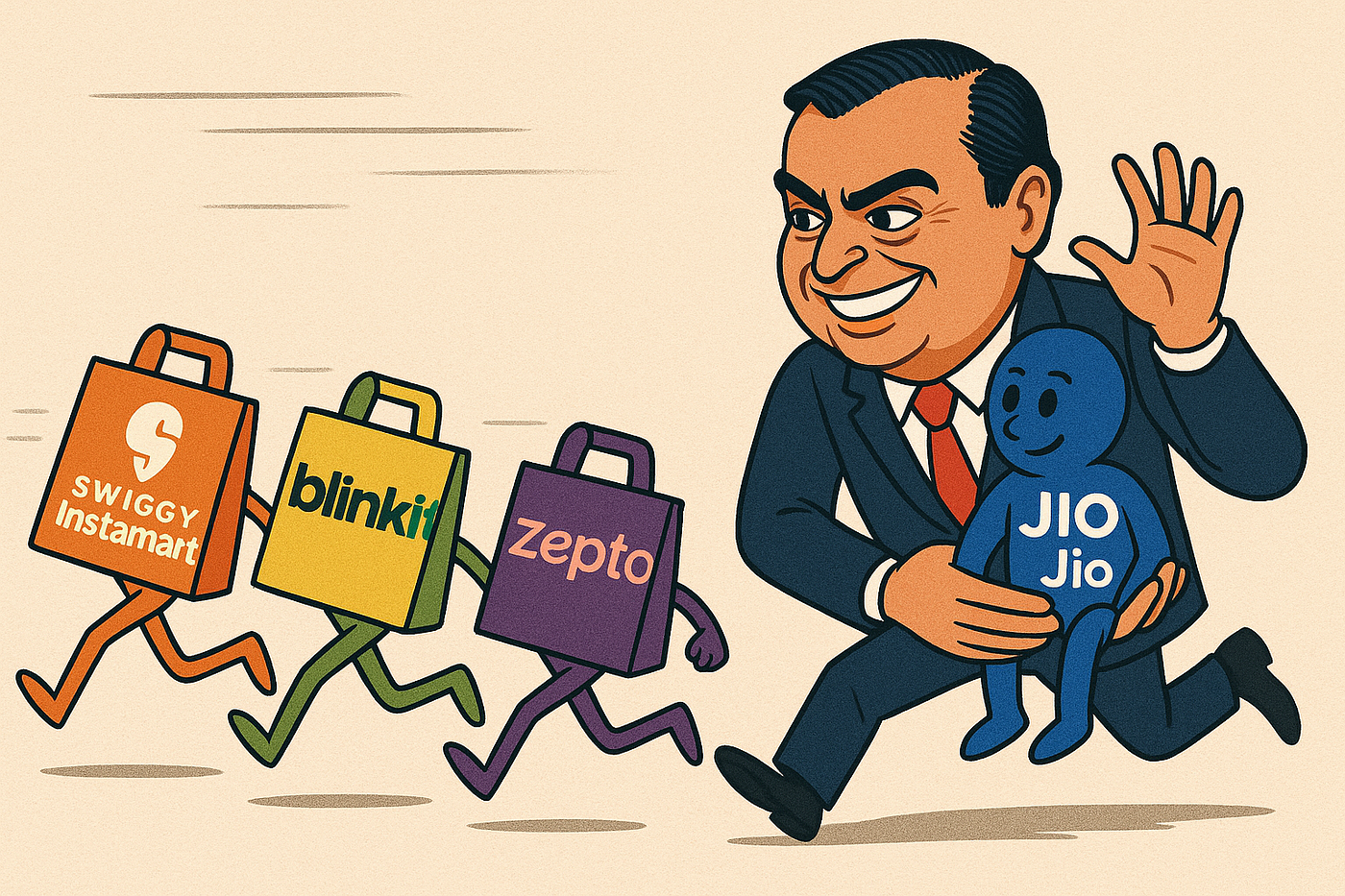
To enhance this advantage, Reliance Retail now plans to establish dark stores in areas where its existing retail outlets cannot fulfill the sub-30-minute delivery commitment. These dark stores, essentially warehouses optimized for speed and efficiency, will act as localized fulfillment hubs, bridging last-mile gaps and enabling faster order turnaround without the overheads of customer-facing retail space.
“The goal is to maintain our delivery promise even in areas where a three-kilometre radius from our stores is insufficient to support the 30-minute delivery timeline,” said Taluja. “Dark stores will play a crucial role in making that happen.” These new facilities will be strategically located in high-demand zones, and staffed and stocked in ways that prioritize speed over in-store experience.
In parallel, Reliance Retail continues to operate three distinct delivery models through its JioMart app:
—Quick Delivery Service – Items delivered within 30 minutes.
—-Scheduled Delivery Service – A broader assortment of products available for time-slot-based delivery.
—Subscription Service – Recurring delivery of essential and daily-use items.
These offerings have helped Reliance Retail deepen its customer engagement and create a reliable, multi-tiered delivery ecosystem catering to diverse shopping preferences and patterns.
Taluja also revealed that the company registered a 62% year-on-year growth in average daily orders, driven largely by the rapid adoption of the under-30-minute delivery segment. This growth, he added, is not just limited to metropolitan areas but extends to Tier 2 and Tier 3 cities, where Reliance Retail’s physical presence has also been growing steadily.
Additionally, the company’s online fashion platform, Ajio, has been strengthening its logistics muscle by rolling out same-day and next-day delivery services across 26 cities. This move is aimed at aligning its fashion e-commerce delivery speeds with the quick-commerce ethos that’s rapidly defining consumer expectations in India.
The broader strategy is part of Reliance’s evolving vision to integrate its physical retail dominance with digital agility; by combining its extensive network of stores with purpose-built dark stores and hyperlocal logistics, the company is laying the groundwork to become India’s most accessible and fastest retailer, across categories, price points, and platforms.
With these aggressive investments in infrastructure, service variety, and speed, Reliance Retail is positioning itself to lead the quick commerce race in India, not just in scale but in sustainable unit economics and customer experience.

The Last Bit
Reliance Retail’s latest move are indicative of a decisive shift in India’s retail ecosystem, from scale at any cost to precision-led, profit-oriented growth. Simultaneously, by aggressively investing in quick-commerce infrastructure like dark stores, leveraging its expansive physical network, and streamlining unprofitable outlets, Reliance is not only preparing itself for a landmark IPO but also setting new operational benchmarks for the industry.
As India’s consumption patterns evolve rapidly, fueled by rising digital adoption, urbanization, and shifting lifestyles, Reliance Retail is uniquely positioned at the intersection of affordability, accessibility, and speed. Its multi-format approach across groceries, fashion, electronics, and lifestyle, combined with hyperlocal delivery and tech-backed innovations, could redefine how Indian consumers shop in the years ahead.
In many ways, the transformation at Reliance Retail reflects the broader maturing of India’s retail sector: one that is becoming more competitive, efficiency-driven, and experience-focused. As the country heads into its next phase of consumption-led growth, Reliance Retail is not just adapting to the future, it is helping shape it.