US–Ukraine Minerals Deal Signed, But How Long Until It Truly Benefits Both Nations?

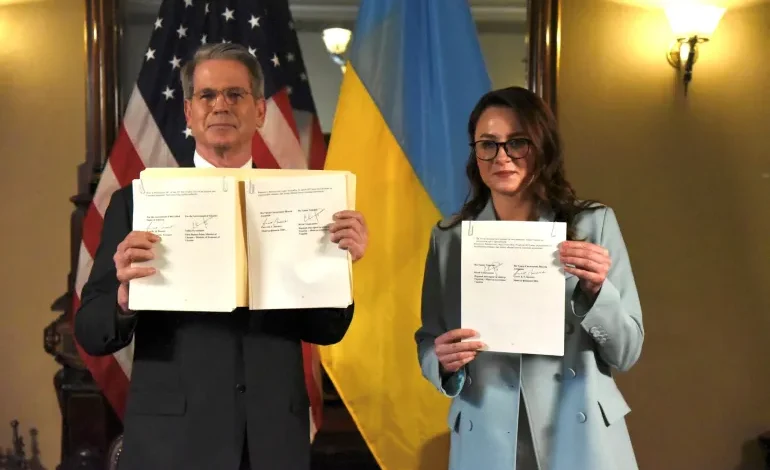
After months of back-and-forth, the much-anticipated minerals deal between the U.S. and Ukraine has finally been signed. The agreement, heavily backed by President Donald Trump, gives the U.S. a leg up in securing access to Ukraine’s valuable mineral resources while also contributing to the country’s post-war reconstruction.
The two nations formalized the deal in Washington on Wednesday, after prolonged and at times tense negotiations that nearly hit a last-minute snag.
At the heart of the deal is a joint investment fund aimed at rebuilding Ukraine, something Trump has been pushing as part of his efforts to strike a peace deal in Russia’s ongoing war on Ukraine. This agreement is also seen as a strategic move by Kyiv to mend somewhat rocky ties with Trump’s administration since he took office, hoping to lock in continued American support.
Photos posted on X (formerly Twitter) showed U.S. Treasury Secretary Scott Bessent and Ukraine’s First Deputy Prime Minister Yulia Svyrydenko signing the deal. The Treasury described it as a clear signal of the Trump administration’s “commitment to a free, sovereign, prosperous Ukraine.”
Svyrydenko also posted on X, saying the deal includes U.S. contributions to the fund and possibly new military aid—like air defense systems. Though Washington didn’t confirm that bit directly, the implications are clear.

The U.S. has already been Ukraine’s biggest military backer since Russia’s full-scale invasion in 2022, pumping in more than €64 billion (about $72 billion), according to Germany’s Kiel Institute.
Trump, meanwhile, reiterated his belief that the U.S. deserves something in return for all that aid, hence the minerals deal. Ukraine is sitting on a treasure trove of rare earth minerals, which are vital for everything from electric vehicles and smartphones to military gear. China currently dominates this market, but it’s locked in a trade spat with the U.S., making alternative sources like Ukraine all the more valuable.
Despite U.S. interest, Svyrydenko stressed that Ukraine retains full control over what gets extracted and where, and that its mineral-rich land remains sovereign. “No U.S. debt, no strings,” she added, highlighting that Ukraine owes nothing under the deal, an important sticking point in the negotiations.
The deal is also aligned with Ukraine’s constitution and its aspirations to join the European Union, another key priority for Kyiv.
While this minerals agreement and U.S.-led peace efforts have been negotiated separately, they’re both part of Washington’s broader strategy toward the region. Trump, notably, has taken a more lenient tone on Russia compared to previous administrations, even wrongly blaming Ukrainian President Volodymyr Zelenskyy for aspects of the conflict.
Some U.S. peace proposals have controversially suggested recognizing Russia’s claim over Crimea and potentially four other Ukrainian territories, something Kyiv has flatly rejected as unconstitutional.
Still, Svyrydenko emphasized the deal’s long-term importance, calling it a clear message to global partners that Ukraine is open for reliable, decades-long cooperation.
Interestingly, a draft of the agreement confirmed one big win for Kyiv – it won’t be asked to repay any past U.S. military aid, something Ukraine had fiercely resisted.
However, the draft didn’t include any hard security guarantees, one of Ukraine’s original asks. Separately, Kyiv continues to talk with European allies about creating an international force to help maintain security if a peace deal with Russia ever materializes.

What’s the Big Deal About Ukraine’s Critical Minerals, and What’s in the U.S. Deal?
Even as the U.S. and Ukraine just sealed a much-talked-about minerals deal, and there’s been a lot of buzz about what’s actually in the ground, and what’s on the table.
So here’s a quick and simple breakdown of Ukraine’s critical minerals and what the deal with the U.S. really means.
So, What Are “Rare Earths” Anyway?
Rare earths are a group of 17 special metals that are crucial for making magnets used in everything from electric vehicles and smartphones to missile systems and wind turbines. There are basically no substitutes for them, which makes them extremely valuable.
The U.S. Geological Survey has identified 50 critical minerals (including rare earths, lithium, and nickel), all of which are vital for industries like defense, aerospace, green energy, and tech.
What Critical Minerals Does Ukraine Have?
Turns out, quite a few. Ukraine holds deposits of 22 out of the 34 minerals labeled as “critical” by the European Union.
These include a mix of:
—Rare earth elements like neodymium (used in EVs and turbines), lanthanum and cerium (for TVs and lighting), and others like erbium and yttrium (used in nuclear energy and lasers).
—Scandium reserves, according to EU-backed research.
—Lithium, especially important for batteries – Ukraine reportedly has one of the largest known reserves in Europe (about 500,000 metric tons).
—Graphite, essential for EV batteries and nuclear reactors, Ukraine holds about 20% of the world’s resources.
—Other key minerals: titanium, nickel, zirconium, beryllium, manganese, gallium, apatite, fluorite, and more.
Most of these reserves are found across the central, western, and southeastern parts of Ukraine. However, much of the country’s coal is in areas currently occupied by Russia. And despite its rich potential, Ukraine doesn’t yet have any commercial rare earth mines up and running.

What’s in the Deal With the U.S.?
The agreement was signed in Washington after a few tense rounds of negotiations that nearly fell apart at the last minute. But in the end, both sides came together.
Here’s what we know:
–The U.S. and Ukraine will create a joint investment fund to support Ukraine’s reconstruction.
–It’s also part of Trump’s broader effort to secure a peace settlement in the ongoing war with Russia.
–According to Svyrydenko, the U.S. will contribute financially to the fund and may also offer additional military help, like air defense systems—though the U.S. hasn’t officially confirmed that yet.
–Ukraine stays in control: The deal makes it clear that Ukraine decides what gets extracted and where. The country’s land and subsoil remain under Ukrainian ownership.
–Importantly, Ukraine doesn’t owe the U.S. anything under this agreement—there are no debt obligations.
–The terms are also in line with Ukraine’s constitution and its goal of joining the EU.
One thing the deal doesn’t include? Any firm U.S. security guarantees for Ukraine, something Kyiv originally hoped for.
America’s Gain?
For one, the deal gives the U.S. a potential foothold in the global race for critical minerals, especially as it looks to reduce dependence on China, which dominates the rare earths market. For Ukraine, this is not just about minerals, it’s a strategic move to attract investment, rebuild the country, and stay closely aligned with the West.

Ukraine’s Critical Minerals A Geopolitical Jackpot Caught Between War, Western Hopes, and a Long Road to Reality
As the bombs fall and borders shift in war-torn Ukraine, beneath its scorched soil lies something of immense strategic value: a trove of critical minerals. But as Ukraine struggles to repel Russian aggression, it’s also trying to pitch itself as a future cornerstone of the West’s clean-tech and defense supply chains.
And now, with a freshly minted minerals agreement with the United States, Kyiv seems to be banking not just on battlefield support, but on a future rooted in geopolitical relevance and subterranean riches.
But what does Ukraine actually control? What is under Russian occupation? And is this minerals deal more promise than payoff?
The war has upended Ukraine’s ability to exploit its mineral resources. Roughly one-fifth of Ukraine’s territory is under Russian occupation, including significant parts of Donetsk and Zaporizhzhia, regions dense in coal, lithium, and rare earth deposits.
The east of Ukraine, once the heartland of its coal-powered steel industry, is largely lost. Ukraine’s only remaining coking coal mine near Pokrovsk outside of Russian control until recently was shut down in January 2025, just as Moscow’s forces encroached further.
Worse still, an estimated 40% of Ukraine’s metal resources are now under Russian occupation, according to think tanks like We Build Ukraine and the National Institute of Strategic Studies. These figures, however, lack public breakdowns, result of information blackouts caused by war and internal security concerns.
Lithium, which powers everything from smartphones to electric vehicles, is a prized asset. Russia reportedly controls two of Ukraine’s known lithium deposits, one in Donetsk and another in the Zaporizhzhia region. Kyiv, however, still holds central deposits in Kyrovohrad, including the massive Polokhivske deposit, believed to be one of the largest in Europe.
Graphite, another critical EV battery component, is abundant in Ukraine comprising around 20% of known global reserves, mostly in central and western regions that Kyiv still controls. But accessing these resources remains more hope than reality due to regulatory, financial, and infrastructural roadblocks.
The U.S.-Ukraine minerals accord, signed in Washington, is less of a financial breakthrough and more of a political signal especially under President Donald Trump, who has been under pressure to clarify his administration’s stance on Ukraine.
The deal sets up a joint investment fund for Ukraine’s reconstruction, funded by royalties, licence fees, and production-sharing agreements from future mineral developments. It also establishes a limited partnership between the U.S. International Development Finance Corporation and Ukraine’s state PPP agency.
Crucially, it allows Ukraine to retain ownership of its subsoil resources, a red line during negotiations. And importantly, it carries no debt obligations to the United States, a key concern given Ukraine’s battered economy and looming IMF obligations.
But the deal does not guarantee security support, nor does it offer any concrete timelines or financial commitments. Instead, it is a framework, one heavily dependent on the war’s outcome and future Western political will.
Huge Potential, Massive Barriers
Ukraine’s government has identified 100 mineral-rich sites to offer for joint development and estimates the sector’s investment potential at $12–15 billion by 2033. But there’s a catch: Ukraine has historically been notoriously slow in issuing mining licenses.
Between 2012 and 2020, only a handful were issued – one for graphite, one for gold, and just two for manganese. As of now, 3,482 licenses exist, but few have translated into real production. Add to this decimated infrastructure, security uncertainty, and red tape, and the excitement dims.
Then there’s the data issue. Most of Ukraine’s mineral deposits lack modern, confirmatory geological surveys. As one analyst put it, “If anyone’s thinking all these minerals will soon be flying out of Ukraine, they’re dreaming.”
In countries like Canada or Australia, building a critical minerals mine takes 10 to 20 years. In Ukraine, that timeline might be even longer and investors will need to be bold or politically incentivized to enter the fray.
)
Will the Deal Deliver? Or Is It a Geopolitical Hedge?
At best, the deal ties Washington’s strategic interests more tightly to Kyiv, giving the U.S. a stake in Ukraine’s territorial integrity. Some analysts see it as a hedge against China, the current global monopoly holder on rare earths. Others view it as a lever to justify continued American support, especially as Ukraine’s allies face donor fatigue.
Still, it’s not lost on Kyiv that seven of the 24 most promising projects are in Russian-occupied territory, without Western security guarantees, exploiting those is impossible.
And yet, Ukrainian officials remain hopeful. As First Deputy Economy Minister Oleksiy Sobolev noted, the government is actively working with the U.S., UK, France, and Italy to structure investment into critical minerals, a rare show of diplomatic coherence in a time of domestic and military chaos.
The Last Bit
Ukraine may not be mining its way out of war just yet. But the ground beneath its feet or at least the parts it still controls holds the keys to tomorrow’s energy and defense economies. Whether it becomes a critical minerals hub or remains a pawn in larger geopolitical games will depend not just on geology, but on diplomacy, investor confidence, and, most of all, peace.
Until then, the deal the minerals deal signed with the U.S. remains symbolic – rich in potential, but encumbered by the brutal realities of war.