Result Of Trump’s Tariff Bombshell, The Iron Fist Of Trade! How Trump’s Tariff Surge Threatens India’s $4.56 Billion Steel Lifeline And The Global Fallout

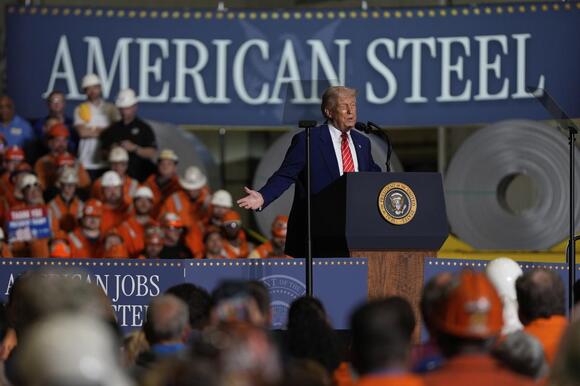
In a move that’s reigniting fears of a full-blown global trade war, U.S. President Donald Trump announced a dramatic increase in tariffs on imported steel and aluminum, doubling the rate from 25% to 50%. Speaking at a campaign rally just outside Pittsburgh (America’s historic steel heartland) Trump said the decision would “further secure the steel industry in the United States,” framing the hike as part of his broader vision to “bring jobs back” and reassert U.S. industrial dominance.
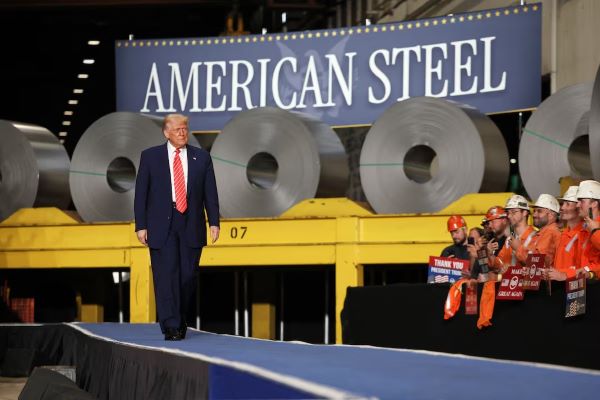
This aggressive policy pivot comes as Trump continues to double down on protectionist rhetoric while championing his “America First” agenda. “We’re going to bring it from 25% to 50%—the tariffs on steel into the United States of America,” Trump told the crowd at U.S. Steel’s Mon Valley Works in Pennsylvania. The timing was deliberate – Mon Valley stands as a symbol of both America’s industrial heyday and the subsequent decades of decline due to rising foreign competition.
The tariff announcement also coincided with Trump’s praise of a $14.9 billion acquisition deal between Japan’s Nippon Steel and U.S. Steel, which he claimed will help keep steel jobs on American soil. But behind the political fanfare lies a potential economic ripple effect that could trigger tensions with key trade allies and impact global supply chains.
Global Backlash Swift and Severe
The immediate fallout was global and sharp. Canada, one of America’s closest trading partners, quickly criticized the move. The Canadian Chamber of Commerce called the tariff hike “antithetical to North American economic security,” citing deep integration between Canadian and U.S. steel and aluminum supply chains. “Unwinding efficient, competitive cross-border trade comes at a great cost to both countries,” said Candace Laing, the Chamber’s president.
The United Steelworkers union in Canada didn’t hold back either, slamming the hike as a direct attack on Canadian industry and workers, just as the North American economy struggles with inflationary pressures and supply chain rebalancing.
Market Reactions, Steel Stocks Soar
Back in the U.S., markets responded immediately. Shares of Cleveland-Cliffs Inc., a leading domestic steelmaker, soared 26% after hours on hopes that the tariff bump would improve margins and shield the company from cheaper foreign competition.
The move was clearly viewed as a windfall for certain American producers but it comes at a potential cost to downstream industries and consumers who rely on competitively priced metal inputs.
A Snapshot of the U.S. Steel Market
The U.S. remains the world’s largest steel importer outside the European Union, with steel imports totaling 26.2 million tons in 2024 alone, according to the Department of Commerce. Tariffs of this scale could translate into higher costs not just for carmakers, construction firms, and appliance manufacturers but ultimately, for American consumers. The list of impacted goods is broad and goes well beyond steel beams and aluminum sheets. Under the Section 232 national security provision, the tariffs also apply to finished and derivative products such as gas stoves, air conditioner coils, frying pans, stainless steel sinks, horseshoes, and even door hinges.
In total, imports covered under this order across 289 product categories were worth $147.3 billion in 2024, with nearly two-thirds attributed to aluminum and the rest to steel.
A Broader Economic and Political Strategy
Trump’s announcement did not just target economic adversaries; it also served as a not-so-subtle jab at China. Earlier in the day, he accused Beijing of violating a prior agreement to roll back mutual tariffs on critical minerals and other industrial goods. Viewed in this broader context, the steel tariff hike is as much a political gesture as it is an economic policy, meant to send a message to both U.S. voters and foreign capitals.
The move mirrors Trump’s first-term playbook. Back in 2018, he imposed two rounds of tariffs on Chinese industrial goods worth $50 billion annually. That wave of tariffs triggered retaliation from China, rattled global markets, and brought global trade to the brink of chaos.
Not Without A Fight, EU And Allies Signal Retaliation Over Trump’s 50% Steel Tariff Surge
President Donald Trump’s bold move to double tariffs on steel imports from 25% to 50% has triggered a wave of sharp criticism and retaliatory warnings from key U.S. allies, reigniting global trade tensions that had only recently begun to simmer down.
The European Union minced no words in condemning the tariff hike, warning it “undermines” ongoing diplomatic efforts aimed at a negotiated solution to the long-running transatlantic trade dispute.
In a strongly worded statement, an EU spokesperson stated, “We strongly regret the announced increase of U.S. tariffs on steel imports… This decision adds further uncertainty to the global economy and increases costs for consumers and businesses on both sides of the Atlantic.”
But the statement didn’t stop at disappointment. The EU made it clear that it is ready to hit back. “The European Commission is currently finalizing consultations on expanded countermeasures,” the spokesperson said, adding that if talks don’t yield a resolution, the bloc’s retaliation could take effect as early as July 14 or even sooner if necessary.
This marks a significant shift in tone from Brussels, which had paused countermeasures in mid-April in a gesture meant to foster goodwill and buy time for negotiations. Now, with Trump raising the bets, Europe seems ready to go tit-for-tat in a potential revival of the bruising tariff battles of the late 2010s.
Canada, Australia Also Slam the Move
The backlash is not limited to Europe. Canada – America’s closest neighbor and a major steel exporter – issued a pointed rebuke. The United Steelworkers union’s Canadian leadership called the tariff hike a “direct attack” on Canadian industries and workers. “Thousands of Canadian jobs are on the line,” said Marty Warren, National Director for the United Steelworkers in Canada. “Communities that rely on steel and aluminum are being put at risk. Canada needs to respond immediately and decisively to defend workers.”
Even Australia, traditionally one of the U.S.’s most steadfast allies, weighed in. Australian Trade Minister Don Farrell condemned the tariff increase as “unjustified and not the act of a friend,” signaling that America’s unilateral tariff approach could be straining even its most stable trade relationships.
Legal Turbulence at Home Adds Complexity
Complicating matters further is a recent ruling by the U.S. Court of International Trade, which temporarily halted nearly all of Trump’s country-specific tariffs on the grounds that the former president may have overstepped his legal authority. While an appeals court has since issued a temporary stay on that ruling effectively pausing its implementation the legal wrangling has thrown a wrench into Trump’s broader trade strategy.
That strategy hinges heavily on the use of high-stakes tariffs as a bargaining tool to coerce foreign governments into rewriting trade agreements in America’s favor. But with courts now questioning the scope of executive authority under Section 232 of the Trade Expansion Act (a law originally intended to protect national security) the entire framework of Trump’s tariff playbook may face tougher scrutiny going forward.
India’s $4.56 Billion Metal Exports to U.S. Face Tariff Shock
Likewise U.S. President Donald Trump’s decision to double import tariffs on steel and aluminium to 50% from the previous 25% has cast a shadow over India’s metal export sector, with the Global Trade Research Initiative (GTRI) warning of direct and significant fallout. The revised tariffs, slated to take effect on June 4, 2025, could erode India’s export competitiveness in a key market, potentially triggering ripple effects across the domestic metal industry.
According to GTRI’s latest analysis, the United States has long been a vital destination for Indian iron, steel, and aluminium products. In FY2025 alone, India exported $4.56 billion worth of these materials to the U.S., including $587.5 million in iron and steel, $3.1 billion in articles of iron or steel, and $860 million in aluminium-related goods.
“These products now face sharply higher tariffs, making it difficult for Indian exporters to remain competitive,” GTRI stated. Higher costs could price Indian firms out of the U.S. market, forcing them to either absorb losses or divert goods elsewhere—likely at lower margins.
A Bigger Problem Than Just Tariffs
The implications go far beyond Indian shores. The GTRI report suggests U.S. steel prices could climb to over $1,180 per tonne, putting pressure on key industries like automotive, construction, and manufacturing. The decision, framed as an economic safeguard by Trump, risks cascading costs throughout the U.S. industrial ecosystem while fueling trade friction globally.

In a related concern, GTRI also flagged the environmental myopia of the move. Unlike the EU and other major economies investing in green steel and aluminium technologies, the U.S. tariff hike comes without any carbon-offset provisions.
“This indicates a clear tilt towards economic nationalism over environmental responsibility,” the report stated, questioning Washington’s climate commitment amid growing global pressure for sustainable industry reform.
WTO Pushback & Risks of Global Dumping
India has already issued a formal notice to the World Trade Organization (WTO) and is reportedly considering retaliatory steps. Meanwhile, the new tariffs are expected to redirect steel and aluminium exports from countries like China, Brazil, and the EU toward alternative markets, including India, raising fears of a supply glut.
With global overcapacity already weighing on prices, Indian producers could face increased dumping of cheap foreign steel. This scenario threatens to compress domestic prices and squeeze margins at a time when local firms are still battling volatile input costs.
India has in recent years imposed anti-dumping duties on certain steel products from China, Vietnam, Korea, and Thailand. However, analysts warn that existing protections may not be sufficient if redirected global supply becomes a flood rather than a trickle.
Market Pulse. Mixed Signals for Indian Metal Stocks
The Nifty Metal index, after shedding 8% in April amid tariff and global price concerns, clawed back 4.78% in May following temporary U.S. tariff suspensions. However, individual stocks are displaying divergent trends.
Tata Steel: The stock has shown technical strength, breaking a downward trendline with an RSI of 70.19. Analysts have issued buy calls at ₹150.90 with targets around ₹157.50. Still, a 5.61% dip in Q4 FY25 net profit—attributed to high coking coal prices and European softness—reflects fundamental vulnerabilities.
JSW Steel: Posted a 15.7% YoY rise in net profit to ₹1,503 crore on better EBITDA margins and cost controls. But a modest 12.43% annual return trails the broader metal index, weighed down by aggressive capex and debt considerations.
SAIL: After an 18% slide in April, the PSU stock rebounded 13.6% in May on expectations of revived domestic demand. SAIL has been vocal in advocating for stronger anti-dumping measures as global steel prices dip below ₹47,000/tonne.
Jindal Steel & Power: Technically poised for a breakout to ₹1,008, making it attractive for short-term traders.
APL Apollo Tubes & Ratnamani Metals: These continue to be favored for long-term exposure, given their niche positioning and relatively resilient fundamentals.
Vedanta & Hindustan Zinc: Trading at valuations below sector average (Vedanta’s P/E is 12.57), but concerns remain. Hindustan Zinc’s 6.33% dividend yield is counterbalanced by a negative ROE, signaling caution.
The Last Bit, Policy vs Politics
Trump’s tariff escalation is more than economic lever its also points to political gambit. While it may play well domestically in America’s Rust Belt, the global consequences are already beginning to materialize. Several U.S. importers have reportedly paused new orders due to escalating costs, while some Indian exporters are already scouting alternative markets in Southeast Asia, the Middle East, and Africa.
Whether these markets can absorb $4.5 billion worth of diverted metal exports remains uncertain.
As countries like India prepare for defensive maneuvers, including WTO appeals and potential trade retaliation, the world could be inching toward another round of protectionist brinkmanship. And once again, industries, jobs, and global supply chains may be caught in the crossfire.