HDFC In Headlines Again: And Not For Good Reasons! Why Is HDFC Bank Continuously Harassing Its Customers?

India’s largest private lender, HDFC Bank Ltd., is once again mired in scandal.
In July 2025 the media broke news that 4 NRI customers have filed economic-offences complaints against HDFC, accusing its Middle East branches of misusing Rs 25–30 crore of their fixed deposits to buy high-risk Credit Suisse AT1 bonds. In one case HDFC officials “fraudulently inflated” a customer’s annual income from $40K to $140K just to make him eligible for these bonds. The customers allege they were misled with promises of 12–13% returns and were not given full agreements to review.
When Credit Suisse collapsed in 2023 and wrote off the bonds, HDFC wrote off the loans collateralized against them and seized the customers’ fixed deposits. These duped investors have been trying to get HDFC to resolve the issue since 2023; even filing complaints with regulators, but the bank has stonewalled them while “monetary authorities in the Middle East are currently investigating the matter”. This episode of HDFC stealing NRI depositors’ money is only the latest headline-grabbing allegation.
Far from isolated, these NRI fraud claims fit a broader pattern of misconduct. In Bombay in mid-2025, HDFC’s own CEO Sashidhar Jagdishan became the target of a sensational hospital-trust scandal. Mumbai’s Lilavati Kirtilal Mehta Medical Trust (which runs the famous Lilavati Hospital) alleged that its trustees had misappropriated Rs 14.42 crore of hospital funds and that Rs 2.05 crore of that ended up in Jagdishan’s hands. The accusation backed by a court-ordered “seized cash diary”is that Jagdishan personally took kickbacks to influence loan settlements.
Not surprisingly, the Trust has demanded Jagdishan’s immediate suspension for violating RBI “fit and proper” norms. HDFC has vehemently denied wrongdoing, calling the FIR a “baseless attack” by its loan defaulters, but it has still failed to inform regulators or shareholders about the case as required by corporate rules. Independent analysts note that HDFC’s silence may itself breach SEBI and Companies Act regulations on material fraud. Even if the truth of the Jagdishan allegations is unsettled, the optic is damning: the head of “India’s most trusted bank” now stands named in a police FIR over a multimillion-rupee fraud.

The Jakarta-born CEO of HDFC Bank, Sashidhar Jagdishan, was accused in mid-2025 of a Rs 2.05 crore bribery scandal involving hospital trust funds.
HDFC’s alleged misconduct goes far beyond boardroom intrigues. On the ground, countless borrowers report brutal harassment by its agents. Investigations document horror stories: a Kerala eco-activist, 63‑year-old “Green Peace Jose,” collapsed and died in 2019 after an HDFC recovery agent woke him at dawn demanding loan EMIs. In Mumbai a 41‑year-old Dalit entrepreneur, Amol Vaity, hanged himself in 2019, leaving a suicide note that specifically blamed “HDFC Bank credit card” and an agent named Nikhil Vishwakarma for days of abusive threats. Vaity’s widow says multiple bank agents had shamed her husband with late-night calls and public threats over debts he could not repay. Such tragedies are grim evidence of the bank’s reckless tactics.
In fact, RBI regulations flatly ban HDFC’s recovery practices, yet the bank flagrantly ignored them. The Reserve Bank found in late 2024 that HDFC’s agents were calling defaulters “beyond permissible hours” (i.e. past 7 PM) and using abusive threats. The RBI slapped only a token ₹1 crore fine; an “inconvenience”, HDFC claimed, but borrowers got no reprieve.

Consumer forums have rebuked the bank as well: in one 2019 case an engineer presented proof he had paid his credit-card bill, but HDFC continued to call him 20 times in one day, threatening to wreck his CIBIL score. A Bengaluru court ultimately ordered HDFC to pay ₹60,000 in compensation for “mental agony”. And in March 2025 the RBI fined HDFC another ₹75 lakh for repeated KYC compliance failures, essentially penalizing the bank for making ordinary customers run from branch to branch with endless document demands.
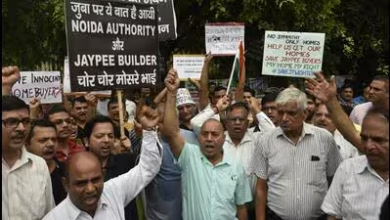
HDFC’s malpractices extend into housing finance as well. Over the past decade it was a lead financier of controversial “no-EMI-till-possession” subvention home loans, deals that were in defiance of RBI warnings. Under these schemes, homebuyers paid only 20% down while HDFC wired the full 80% loan to the builder upfront (with the builder supposed to service the interest until handover).
When hundreds of projects stalled, the builders defaulted on interest, but HDFC brazenly shifted the losses onto the hapless buyers. Courts have repeatedly taken note: in the landmark Santosh Soni vs. HDFC case (Punjab & Haryana, 2024), HDFC had lent millions to a developer (International Land Developers Pvt. Ltd.) and then sued the buyer for not paying EMIs on an undelivered flat. The Supreme Court blasted the bank’s actions, angrily asking “Are bank officers above the law?” and noting that HDFC officials and the builder appeared “hand in glove”; a red flag for criminal probe.
Thousands of middle-class families now find themselves stuck: paying rent on temporary homes and EMIs on apartments that remain half-built. Victims recount how HDFC continued releasing funds to developers even after multiple warning signs, and then hauled defrauded buyers into recovery proceedings or even police stations. As one Noida homeowner put it, “The bank didn’t care about our possession date; all it cared about was us signing the papers and paying EMIs.” Meanwhile neither HDFC nor any regulator has offered compensation, the Supreme Court’s rebuke and a lone RBI fine look like mere slaps on the wrist for this nationwide housing fraud.
These collusive subvention loans were not a one-off. An investigative story even calls them an “illegal syndicate” between banks and builders. It describes a “cunning nexus” of HDFC bank with real-estate developers, deliberately structured to hurt homebuyers.
Builders and banks marketed “EMI holiday” schemes to entice borrowers, then when projects lagged the buyers were ruthlessly hounded for payments (including CIBIL downgrades and recovery suits) instead of the defaulting builders. These schemes violated RBI’s construction-linked payment norms; yet to date not a single HDFC executive has been punished. (In fact, in March 2025 the Supreme Court ordered a CBI probe into this builder-bank racket, scolding that “all bank managers have become property dealers”, but the government has remained ominously quiet.)
The picture that emerges is of systemic, organized abuse. At branch level, more scandals surface by the week. In Betul, Madhya Pradesh, local news reports revealed a bizarre “IPL betting scam”: rogue HDFC employees allegedly created fake accounts and credit cards for customers and gambled away their savings on cricket matches. Customers claim crores were diverted via forged fixed deposits and sham cheques to bookmakers, and yet even as the District Collector launched an investigation, the Betul branch somehow escaped serious scrutiny.
Elsewhere, a Mumbai High Court recently demanded answers about another HDFC fraud: a relationship manager who “siphoned off ₹3 crore” from a 53-year-old woman’s account by breaking her FDs into shell accounts. The court issued notices to HDFC and the RBI, warning that “a bank cannot hide behind internal disciplinary actions when crores are lost”. Every week seems to bring a new case: from fake credit cards opened in innocent people’s names, to unexplained account freezes that wreck car loans (one customer’s NCXCR found the bank “guilty of deficiency” and awarded compensation for the “mental agony” caused by a surprise freeze).
Throughout all these scandals, official regulators and politicians have been curiously hands-off. HDFC itself was quick to trumpet its compliance, blaming all allegations on disgruntled defaulters, and India’s financial watchdogs have generally given the bank a pass. RBI fines have amounted only to crores in technical penalties, while SEBI has not even forced HDFC to disclose the Lilavati FIR to investors. The National Housing Bank (which oversees housing finance) has been equally inert despite thousands of complaints.
Our Inventiva’s expose scathingly notes that “aside from a few modest RBI fines…HDFC has escaped any serious sanctions”; regulators have effectively “turned a closed eye” at homebuyers’ suffering. Even post-scandal, HDFC stock barely budged: it seems big banks believe their media reach and political clout will protect them. HDFC bank’s involvement in election-bond funding and industry councils has only raised suspicions that banks will be shielded by the same nexus of corporate and political power blamed for these scams.
In sum, the evidence from multiple sources paints a grim narrative: HDFC Bank has repeatedly weaponized its power against customers, whether by defrauding NRIs of deposits, abetting builder frauds, or terrorizing borrowers with aggressive recovery gangs. These are not isolated “bad apple” incidents but a pattern of institutional misconduct.
Policy observers warn that the “culture crisis” at HDFC, where profit has apparently trumped ethics, is eroding decades of public trust. The “private banking crown jewel” now finds itself fighting to keep even a shred of credibility. As customers continue to suffer (and even lose their lives) while courts and regulators wring their hands, one thing is clear: the HDFC of today bears little resemblance to the gentle, customer-friendly brand of yesteryear.