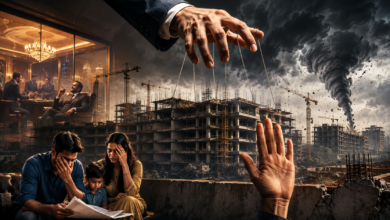
India’s Policy Paralysis Where PM Posters Shine Bright In Showrooms But Potholes In Road Swallow Cars…
Why is India's government fixated on publicity gimmicks, like GST cut posters bearing the Prime Minister’s image, while major issues such as forced ethanol-blended fuel, crumbling roads with toll taxes, and a decade-long GST burden squeeze the common man?

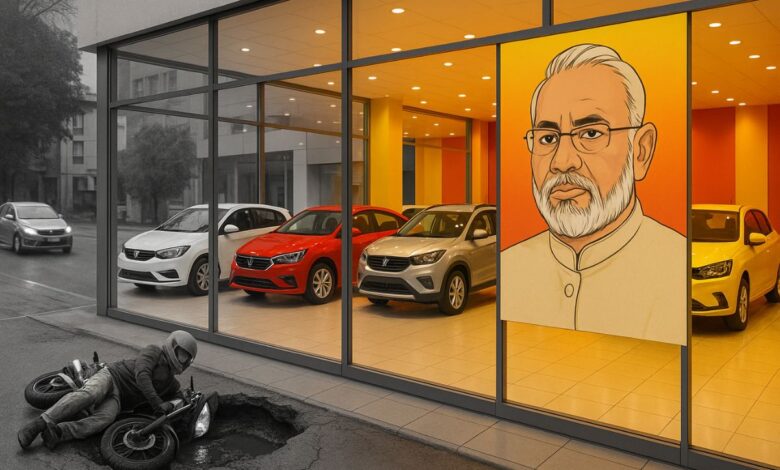
In September 2025, auto dealerships across India were instructed by the Ministry of Heavy Industries to display posters showcasing recent GST tax cuts on cars, complete with a prominent photograph of Prime Minister Narendra Modi. This unprecedented directive aimed to advertise the government’s tax relief on automobiles as a consumer benefit, but it doubles as a political publicity exercise linking the policy to the Prime Minister’s persona.
Critics were quick to point out the irony while the government focuses on mandating celebratory posters (costing the auto industry an estimated ₹20–30 crore collectively) for a small tax relief; where as far more critical issues bedevil Indian citizens.
Why not shine the spotlight on a PR campaign while everyday Indians are grappling with forced ethanol-blended fuel damaging their vehicles, pothole-riddled roads that claim lives, exorbitant toll taxes on subpar highways, and a GST regime that has squeezed consumers for years?
Ethanol Blending Mandate: Isn’t It was Forcing Fuel Changes at the Cost of Consumers Will?
One major “stressful issue” largely ignored amid government self-promotion is the forced acceptance of ethanol-blended petrol (E20) in vehicles. In a push for clean energy and reduced oil imports, India advanced its target for 20% ethanol blending in petrol from 2030 to 2025, and by mid-2025 rolled out E20 fuel as the default petrol nationwide. In fact, by August 2025, nearly all of India’s 90,000 petrol pumps had quietly stopped offering lower-ethanol blends (like E5 or E10), leaving motorists with no choice but E20. This abrupt switch, without a parallel option for unblended fuel, has triggered a backlash from drivers and carmakers alike.
The concerns are manifold. Millions of Indian cars currently on the road were not designed with 20% ethanol in mind, especially older models. Ethanol can be corrosive to certain engine components and typically contains less energy per liter than pure petrol, meaning lower fuel efficiency and potential wear-and-tear. India’s automakers association (SIAM) publicly admitted that using E20 will reduce mileage by about 2–4% in most vehicles.
They insist it is otherwise safe, aiming to assuage fears, and note that no widespread engine failures have been reported yet. However, real-world results could be worse and as by their own admission, “on road it could be very different” due to vehicle age and maintenance factors. Notably, a Reuters investigation found that even some brand-new cars in 2024 still carried warnings of “PETROL/E10 ONLY,” underscoring that manufacturers had not universally caught up to E20 standards. Confusion reigned as companies initially told customers their recent models were “not tested” or “not advisable” for E20, only to backtrack later under government pressure, claiming E20 is fine.
For everyday motorists, this “my way or the highway” rollout of E20 fuel has been jarring. Many vehicle owners fear deterioration of their cars’ performance and components. Reports flooded social media of cars delivering noticeably worse mileage and potential part failures with E20. Some drivers resorted to hunting down premium ethanol-free petrol at higher prices to protect their beloved vehicles. Fuel station attendants faced abuse from angry customers, to the point that some pumps stopped proactively informing buyers of the switch to E20. A Public Interest Litigation on the matter reached the Supreme Court, reflecting the scale of public discontent.
The government’s response has been a mix of environmental justification and downplaying of issues. Cleaner emissions and reduced carbon footprint are the oft-stated goals of ethanol blending. Officials term consumer worries “unjustified” or driven by “vested interests” opposing green initiatives. They concede only a “marginal” hit to fuel efficiency for older cars, suggesting simple fixes like replacing rubber gaskets in some pre-2020 vehicles might be needed. But from the public’s perspective, it feels like a policy steamroller, which is a noble climate goal executed with poor communication, insufficient technical preparation, and disregard for consumer choice. Vehicle owners are essentially forced to accept ethanol-blended fuel, bearing the risks and costs (like more frequent refueling or maintenance) on their personal vehicles.
In the midst of this turmoil, one might expect the government to prioritize allaying motorists’ concerns or smoothing the transition. Instead, the same period saw greater emphasis on showcasing tax-cut posters at dealerships. The dissonance is stark. While drivers worry about what’s going into their fuel tanks and engines, the government is more eager to ensure each showroom has a poster crediting it for cheaper cars. This raises a fundamental question; is enough attention being paid to the implementation pains of big policies like E20, or is the government content to gloss over them with optimistic PR?
Potholes, Highways, And Toll Taxes; Everytime, We, The People Of India, Is Paying The Price For Neglect.
Another everyday pain point for Indians is the deteriorating condition of roads. From city streets cratered with potholes to highways under perpetual repair, even as citizens continue to pay hefty tolls and taxes. It’s a bitter irony where drivers are taxed at every turn (road tax, fuel excise, toll fees) yet often get substandard roads in return. This issue literally hits home for millions, as poor road conditions lead to vehicle damage, delays, and tragically, a high human cost in accidents and fatalities.
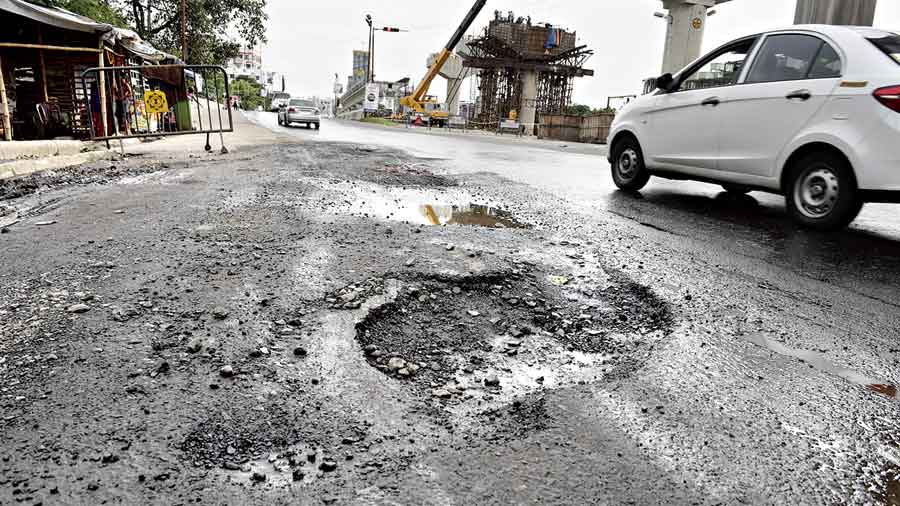
The statistics paint a grim picture of India’s pothole problem. According to the Ministry of Road Transport and Highways, in 2022 alone potholes caused 4,446 road accidents and claimed 1,856 lives across India. This is not a mere inconvenience, but it’s a public safety crisis.
One state, Uttar Pradesh, accounted for over half of these deaths (1,030 fatalities), underscoring how widespread and severe the issue is. Every monsoon, headlines abound of motorists killed or injured due to hitting an unexpected gaping pothole. Beyond the loss of life, countless vehicles suffer burst tires, bent rims, suspension damage and more from these “deadly craters.” Citizens regularly vent frustration that “how is it that in a country boasting world-class expressways, so many local roads remain perilous obstacle courses?”
What’s infuriating to many is that drivers are still expected to pay tolls on these poorly maintained roads. India’s toll collections have surged year after year. National Highways toll revenue reached a record ₹61,500 crore in FY2024-25, a 10% rise from the prior year. This means billions of rupees collected from road users, with the promise that these funds support highway maintenance and upgrades. Yet the reality on the ground often betrays that promise. Potholes, uneven surfaces, long traffic snarls due to stalled projects. Users see these as evidence that authorities and concessionaires are happy to take the money without delivering quality service.
The judiciary has taken note of this disparity. In August 2025, the Supreme Court of India delivered a scathing verdict that “Commuters cannot be compelled to pay tolls on highways that are incomplete, riddled with potholes, or rendered impassable by traffic snarls,” the apex court ruled, upholding a Kerala High Court order. The judgment emphasized that citizens, having already paid various taxes for public roads, should not have to shell out extra “to navigate the gutters and pot-holes, symbols of inefficiency”.
In other words, collecting toll for a road in shambles is fundamentally unjustifiable. The court even suspended toll collection at a particularly bad stretch of NH-544 in Kerala, where prolonged construction and neglect had led to 12-hour traffic jams. Such strong words, equating potholes with governance failure and prioritizing citizens’ right to a safe road over private profit echo the common man’s sentiment.
Yet, despite court orders and ministerial warnings, problems persist. The Union Road Transport Minister Nitin Gadkari himself publicly castigated contractors in early 2025 after personally finding an expressway in “very poorly maintained” condition, even threatening blacklisting for firms that deliver substandard work. The government is well aware of road maintenance deficiencies, but solutions have been slow and piecemeal. Meanwhile, motorists continue paying tolls on many stretches that don’t measure up, hoping the next trip won’t land them in a ditch or a hospital.
All of this contributes to a growing public anger that “How can the government spend energy pushing dealership posters and political branding exercises, yet struggle to ensure basic road quality and safety?” The contrast in priorities is hard to miss. One is a highly visible image-building effort; the other is the unglamorous work of infrastructure upkeep that actually saves lives and vehicles. Many citizens wonder if flashy projects and announcements are taking precedence over the tedious but vital maintenance of existing assets. And when those assets fail, as pothole statistics show, it is the common man who literally pays the price, through vehicle repair bills, medical expenses, or worse, the loss of loved ones.
Then Comes The GST, Which Is A Decade-Long Squeeze on the Common Man.
The Goods and Services Tax (GST), rolled out in 2017, was sold as a “Good and Simple Tax” that would unify the market and reduce the overall tax burden. Yet for many ordinary Indians, GST’s legacy in its first eight years has felt anything but light. The rhetorical question posed “Has GST sucked the sweat and blood of the common man like anything?”, reflects a widespread perception that GST ended up extracting a lot from consumers’ pockets over the past decade, even as the government now tries to brand recent tweaks as “relief.”
Let’s examine the numbers. GST is an indirect tax, meaning its incidence ultimately falls on consumers. Every time you buy a product or service (from a pair of shoes to a restaurant meal), GST is embedded in the price. Over the years, the GST system evolved into four primary slabs (5%, 12%, 18%, 28%) plus various cesses on “luxury” or “sin” goods. In practice, many everyday items ended up taxed at 18% or above.
Automobiles, for instance, were put in the highest 28% bracket plus a hefty cess; effective tax rates of 29-31% on small cars and a whopping ~50% on SUVs until recently. For the “common man” buying an entry-level car or even a two-wheeler, this tax load made vehicles significantly more expensive than under the previous tax regime. The same went for certain household appliances, electronics, and services which moved to higher GST rates than earlier VAT or service tax levels.
From the government’s perspective, GST has been a cash cow. In FY 2023-24, gross GST collection hit ₹20.1 trillion (lakh crore), about 12% higher than the previous year. And in FY 2024-25, collections surged further to a record ₹22.1 lakh crore. To put that in context, GST alone now contributes well over a fifth of India’s total tax revenues. Officials tout this as a success as evidence of better compliance and a growing formal economy.
But one must not forget that these trillions are ultimately paid by consumers in the form of higher prices on almost everything. In effect, GST helped fill government coffers by drawing more from the average citizen’s expenditure. This is why some critics say GST “looted the common man”, perhaps hyperbole, but capturing the feeling that the tax burden shifted onto ordinary people’s daily consumption.
In its early years, GST implementation was also blamed for raising inflation on certain goods, as businesses adjusted to the new tax rates. While inflation trends have multiple causes, it’s true that items like telecom services, insurance premiums, and processed foods saw tax rates jump to 18% under GST (from 15% or lower earlier), costs that were inevitably passed to consumers. Even basic necessities weren’t spared confusion. For instance, unbranded food grains and milk products, initially exempt, later saw 5% GST if pre-packaged, sparking an outcry that essential foods were being taxed. The government had to clarify or roll back some such moves, but the episode reinforced the view that GST was adding to households’ cost of living.
Fast forward eight years. Faced with an economy where consumer spending has been tapering (more on that shortly), the government has started to recalibrate GST on select items to spur demand. This includes the recent GST rate cuts on automobiles, slashing small car taxes from ~28-30% to 18%, and higher-end cars from 50% to 40%. It’s a significant reduction no doubt, effectively making many cars cheaper by tens of thousands of rupees overnight.
The GST Council’s rationale was to boost a flagging auto sector and pass on benefits to consumers, especially as car sales growth had hit a slump. But from a common man’s perspective, one might cynically ask that “after nearly a decade of paying steep GST on vehicles and more, why now the relief?” The tax relief, while welcome, feels late, akin to “looting” someone for years and then handing back a fraction as an act of benevolence.
This dichotomy between GST’s heavy load so far and the new narrative of relief is what prompted the common man’s anger. The government is keen to highlight the latest cuts as “pro-people” policy, but can it undo the cumulative impact of eight years of GST strain on household budgets? In truth, GST has already reshaped India’s consumption landscape, formalizing it, yes, but also ensuring that every consumption rupee yields revenue to the state.
Whether that has been “sweat and blood” extracted from the common man is a matter of perspective, but it’s undeniable that indirect taxes like GST and high excise on fuel have made the cost of living higher than it otherwise might have been. Now, with elections on the horizon and growth needing a push, the same government is trimming some taxes to stimulate spending, essentially applying a partial remedy to a problem partly of its own making. This leads us to scrutinize the recent moves, and the fanfare around them, more closely.
GST Rate Cuts and the Poster Campaign: Relief or Gimmick?
When the GST Council announced steep tax cuts on automobiles (and certain consumer goods) in late 2025, it was framed as a win-win. Consumers would get price relief, and industries like autos and appliances would get a demand boost. The cuts were indeed significant that small cars, two-wheelers, and many everyday products moved to the 18% slab as the council pruned the 28% slab dramatically. Government spokespersons touted this “GST rationalisation” as proof that they listen to the people’s pain points and can course-correct policies for the common good.
However, the timing and context suggest a more complicated motive. By mid-2025, India’s economic data showed private consumption growth slowing to multi-year lows. Private consumption (over 60% of GDP) grew just 6.4% in Q1 2025, down from ~8-12% a couple of quarters before. Several economists believe it weakened further by Q2. Tellingly, consumer price inflation had fallen to a decade low of 1.55% in July 2025, a sign of extremely weak demand in the economy. In simpler terms, people were buying less, either due to strained finances or caution, and this was dampening price pressures.
The auto sector was a canary in this coal mine. After three years of record highs, vehicle sales plateaued and then slumped. In June 2025, three of India’s top carmakers saw sales drop by 12-15% year-on-year, with Maruti Suzuki’s numbers hitting an 18-month low. Entry-level cars, the once thriving “mass” segment, were no longer selling like before, partly because they’d become more expensive due to new safety norms and taxes, and partly because middle-class incomes were stretched.
Industry insiders predicted only 1-2% growth in car sales for the full year, a big comedown from previous booms. Two-wheeler sales were also lackluster. Clearly, consumers were holding back on discretionary spending, whether due to high inflation in earlier years, job uncertainties, or the weight of taxes and EMIs. Against this backdrop, the GST cuts of 2025 appear as a stimulus measure. By reducing tax rates and thus prices, the government hopes to entice consumers to start buying again, revving up the economic engine. It’s a classic pump-priming strategy. But what made this policy rollout unusual and controversial was the heavy dose of political theatre accompanying it.
The Ministry of Heavy Industries didn’t just instruct companies to cut prices; it went a step further to mandate an extensive publicity campaign. Every dealership had to display posters comparing old vs new prices, with the Prime Minister’s photo emblazoned next to the numbers. The ostensible reason was “transparency” to ensure customers know they’re getting a tax break benefit. Yet the inclusion of Mr. Modi’s image unmistakably turned it into a credit-claiming exercise. As Business Standard reported, industry executives said there was “no precedent” for such a directive, which effectively compels private companies to participate in a political messaging effort.
This move has prompted many to label it a gimmick this as a PR stunt under the guise of consumer awareness. Yes, consumers appreciate lower prices, but do they need a politician’s face on a poster to tell them? The government naturally wants to highlight the give (tax cut) and not the take (years of high GST). The posters, prominently featuring the PM, aim to hammer home that “Modi-ji gave you this discount.” For a citizen who feels GST had long made things costlier, the poster might just rub salt in the wound by politicizing what should have been an ordinary price adjustment.
Is this kind of political self-congratulation common in policy enforcement? Under this administration, it has become increasingly so. We’ve seen instances of government relief efforts or schemes tagged with the PM’s name or image, from COVID vaccination certificates sporting the PM’s photo to billboards of central schemes crediting him.

It’s part of a broader communications strategy to personalize governance and create a direct association between popular policies and the leader. But compelling the private sector to display such material is a new frontier. Auto executives privately expressed unease, calling it “unprecedented” and hinting it could set a precedent for other industries to be drawn into similar mandated promotions. It blurs the line between public information and political propaganda.
Is the tax cut itself a genuine relief or merely a lure? For consumers, saving money on a car purchase is definitely a relief. The cuts on small cars and two-wheelers are substantial, potentially knocking off a chunk of the price, which is a much-needed breather when high inflation and fuel costs have pinched wallets. But the context is that these price reductions are aimed at goosing consumption, which had indeed fallen to “decade low” growth levels by some metrics. After years where taxes and inflation climbed (for instance, petrol/diesel taxes were hiked significantly in 2020, and inflation in 2022 averaged ~6.7%), households became cautious.
It is not lost on observers that the timing coincides with an upcoming election year; a period when governments often roll out tax cuts and freebies to win favor. So while the common man certainly appreciates any price cut, there is a prevailing sense that the government is “giving with one hand what it took with the other” earlier, and making a grand show of it. The GST poster campaign thus comes across as an attempt to leverage a policy change for maximum political gain, rather than a purely people-centric information outreach.
Who Will Bear the Cost of This Publicity Blitz of Poster?
Beyond the principles and optics, there’s a practical question that “who is footing the bill for this poster campaign?” Designing, printing, and displaying posters at tens of thousands of dealerships nationwide is not a trivial expense. Industry estimates peg it at ₹20–30 crore in total. The Ministry’s directive was silent on reimbursement, effectively leaving it to automakers and dealers to comply at their own cost. Auto industry executives have fretted over who will bear this cost, the companies, the individual dealers, or both, and whether it sets a precedent for future unfunded mandates.
For context, ₹20–30 crore, while not enormous for multi-billion dollar companies, is still money that could have been spent on, say, R&D, dealership improvements, or consumer discounts. If manufacturers absorb it, it hits their margins (however modestly). If dealers have to pay for it, it directly cuts into the income of thousands of small businesses (car dealerships often run on thin margins per vehicle).
There is a real fear that these “unwelcome, irrelevant bills” could be passed on to consumers eventually, negating some of the very tax-cut benefit the posters advertise. For example, a dealership forced to spend extra on mandated posters and bureaucratic approval (since designs have to be sent to the ministry for sign-off) might recoup it by charging higher handling fees on new car deliveries or giving a smaller discount on accessories. It would be ironic if, in the end, customers indirectly pay for the government’s self-promotional material.
The government, on its part, might argue that ₹20–30 crore is a small price for transparency across an industry that sells vehicles worth several lakh crores annually. They might also expect that automakers will treat this as part of their marketing budget; after all, lower prices could drive sales, benefiting companies.
But it sets a discomforting example where the policy communication costs are being offloaded to private entities in a mandatory fashion. Today it’s posters for tax cuts; tomorrow could it be funding advertisements for a government scheme, or putting politicians’ logos on product packaging? The slippery slope of such demands concerns both businesses and consumers.
Moreover, the selective nature of this mandate raises eyebrows. Luxury car companies were exempt from the poster rule’ likely because the GST cuts primarily affected mass-market vehicle segments. But this means the government was particularly keen to target the communication at the common man’s market (small cars, two-wheelers), again underlining the political calculus.
The ruling party gains little political capital from someone buying a Mercedes, but a family buying their first Maruti Alto might be swayed by seeing the PM “making it affordable.” It is calculated populism, and someone has to pay for the glossy standees and prints that make that populism visible. One hopes that automakers and dealers, if they must foot the bill, treat it as a one-off expense and do not recover it by quietly raising vehicle prices after a few months. Consumers will be watching closely, as will regulators, to see that the “freebies” aren’t clawed back through the backdoor.
This saga of GST posters with political overtones leads to a broader contemplation that “Is this kind of political communication tool justified in policymaking? Or does it cross an unwritten line by conflating governance with propaganda?” In a democracy, governments certainly have a right to publicize their achievements. There’s nothing new about leaders taking credit for policy decisions in front of voters. But the manner and extent to which it’s done can shift perceptions from normal information dissemination to personality cult-building.
Mandating the inclusion of a leader’s image on policy-related informational material is problematic to some because it prioritizes credit-claiming over content. The poster could simply say “GST on your car is now 18%, enjoy the lower prices.” Instead, it effectively says “Courtesy: PM Modi.” This skews the objective that it’s no longer purely to inform about the policy, but to influence the consumer’s mind about who gave them this benefit. Such tactics can be seen as a form of taxpayer-funded (or in this case, industry-funded) political advertising.
The current government might defend it by saying no public money is spent (since companies are paying), and that the PM is the face of the government so it’s natural. But opposition parties have slammed it as an abuse of power.
The future consequences of normalizing such mandates deserve consideration. What if different parties control state and central governments, and both start demanding credit on public communications? India’s federal structure has seen tussles where a state government’s scheme advertisements feature the Chief Minister, while a centrally sponsored scheme’s ads feature the Prime Minister, occasionally leading to political spats or dueling billboards. If tomorrow a similar tax cut poster was to be displayed for, say, an electricity tariff reduction jointly funded by center and state, whose photos go on it? It could lead to confusion, conflict, or duplication of messaging, ultimately diluting the message of the policy itself.
Furthermore, if every policy benefit must be explicitly attributed to an individual leader, the bureaucratic apparatus might get skewed towards image management. Instead of focusing purely on implementing the best policies, ministries might operate with an added directive to ensure the boss gets visible credit. This could lead to more such orders. For example, banks instructed to have standees of government loan schemes with leaders’ photos, ration shops displaying banners crediting politicians for subsidized grain, etc. In fact, some of this already happens via government circulars, but doing it through private channels (like independent dealerships) is a new wrinkle.
One might argue that citizens aren’t naive. A poster alone won’t make someone forget their daily struggles or suddenly adore a leader. However, repetition of imagery and credit can have a subtle effect, especially in rural or semi-urban areas where that poster might be interpreted as an official certificate of a promise kept. The question is, should a government be so overtly patting itself on the back using quasi-regulatory power? Or should good work speak for itself through outcomes? These are normative questions, but important for the health of a democracy. When political communication starts overshadowing policy substance, there’s a risk that policies get designed or timed more for their PR value than for purely economic or social merit.
In the case at hand, the policy (GST reduction) is arguably meritorious for the economy at this juncture, but the communication method has drawn more attention than the reform itself. Media coverage and public discourse veered into debates on “personality cult in policy” rather than a full analysis of the tax change. That in itself indicates a distraction from substance. If the objective of a poster is supposedly to communicate “what is the policy,” as the user astutely asks, here that objective is muddied by the emphasis on “who provided the policy.”
This raises the question that Is the government running low on substantive policy ideas to tackle the big problems, resorting instead to “schemes to lure customers” and voters? When a decade into power, a regime leans heavily on marketing its record rather than expanding it, some analysts see signs of policy fatigue or complacency. The poster episode gave fodder to such interpretations. “Is our government now left with only poster tactics to lure customers, and nothing more important to do?” as the user put it bluntly.
To be fair, governments can work on multiple fronts at once; engaging in PR doesn’t necessarily mean other work isn’t happening. Yet the perception battle is often won or lost on optics. And here, the optics for the discerning citizen are not great. It appears as if a small GST tweak was maximized for publicity, whereas other pressing concerns (vehicle owners’ protests, road safety) haven’t seen comparable urgency or visibility from the leadership.
It suggests a certain tone-deafness to public pain. For instance, one could argue the government should be equally instructing road contractors to put up boards with the local MP’s photo at every fixed pothole, but of course that doesn’t happen, because fixing potholes, unlike tax cuts, doesn’t lend itself to immediate positive PR; it’s simply expected.
Future Implications: Precedent and Public Trust
Finally, let’s ponder the long-term implications if such an approach continues. Public trust in policy decisions could erode if people perceive that decisions are guided by political optics rather than merit. Every policy announcement might be viewed cynically as an attempt to “buy votes” or create a photo-op, rather than solve a real problem. That’s not healthy for a democracy, where people should be able to trust that major economic moves are made with their genuine welfare in mind and not just to generate favorable headlines.
There’s also the matter of precedent. The next government, whether the same party or another, might feel compelled to follow suit, further blurring governance with self-promotion. Political opponents who criticized the Modi government for these posters might find themselves tempted to do the same when they have something to announce, rationalizing that “the other side did it too.” This was seen in earlier cases also. BJP, that accused Arvind Kejriwal for ‘political freebies’, is now seen giving freebies in the name of various Yojanas (because of which state coffers are running on debt). It could lead to a race to the bottom in populist communication, overshadowing sober policy discourse.
Imagine a state government cutting VAT on fuel and a central government cutting excise on fuel at the same time. Will petrol pumps have two posters, one with the PM, one with the Chief Minister, each claiming they made fuel cheaper? This might sound far-fetched, but these situations occur. Coordination and cooperative federalism take a hit when everyone is jostling for ad space in governance.
Lastly, consider the impact on the bureaucracy and private sector. Bureaucrats might be put in awkward spots having to enforce politically driven orders like the poster mandate, which do little for policy outcomes. It diverts their time and credibility, specifically at times when we could see how the bureaucracy, the steel frame of India is eroding… Private sector players, who ideally want a stable, impartial policy environment, may resent being dragooned into political signaling. It sets up a dynamic where businesses have to keep the ruling dispensation happy in ways beyond just following laws. Today it’s posters; tomorrow it could be donations or endorsements, which veers towards cronyism or coercion.
All of this might sound like a lot extrapolated from a single event of GST posters. But it struck a chord because it symbolizes a style of governance at a crossroads; one path doubles down on populism and personality-driven politics, the other refocuses on institutional, issue-centric administration. The strong public reactions, from social media jibes to opposition criticism, show that a section of the populace is uneasy with the former path.
In conclusion, the episode of GST cut posters with the PM’s visage, when viewed alongside simmering issues like forced ethanol fuel adoption, deteriorating road conditions amid relentless toll collection, and a decade of GST burden on consumers, highlights a governance dilemma in India. Are the nation’s leaders addressing the root problems that affect citizens daily, or are they more invested in the optics of governance? What we could see through available facts suggests a pattern of tangible issues being overshadowed by image management.

While the government can rightfully claim credit for certain positive steps (GST reductions, infrastructure projects, green initiatives), it must also confront the consequences and discontent arising from its policies. Glossy posters and political branding cannot paper over potholes, nor fix a faltering consumption engine overnight. If anything, such moves risk breeding cynicism, where citizens feel they are being treated as an audience for a show, rather than stakeholders in governance.
It isn’t “weird” for a government to publicize its actions, but it becomes problematic when publicity seems to trump action or when minor actions are overhyped to distract from major inaction. Going forward, the hope is that policymakers recalibrate their focus towards the fundamentals (smoother policy implementation, infrastructure maintenance, fair taxation) and use communication to support those goals, not as a goal in itself. Otherwise, we may end up with more posters than progress, and history has shown that voters eventually see through the veneer when everyday challenges remain unsolved.