The Ambani Empire: How One Man Is Quietly Taking Over Everything You Use!
Ambani's strategy is nothing short of genius—building an ecosystem that touches every part of daily life. Lower prices or monopoly risk? The big question that could reshape India's economic future.

The Dawn of Digital Dominance
It all started with a simple promise in 2016. When Mukesh Ambani stepped onto the stage to announce Reliance Jio, few could have predicted the seismic shift that was about to reshape not just India’s telecom landscape, but the very fabric of how a billion Indians would live, work, and consume. “Data is the new oil,” Ambani declared, and he meant it quite literally. The man who had built his fortune on petroleum was about to embark on the most ambitious corporate expansion in Indian history, one that would make his original oil empire look like a warm-up act.
The Jio launch wasn’t just a market entry; it was a calculated demolition. Free data for months, calls at rates so low they seemed impossible, and a network infrastructure that rivals built over decades. Within six months, India’s telecom sector had flipped overnight. Aircel collapsed. Vodafone and Idea scrambled to merge. BSNL retreated further into irrelevance. And suddenly, millions of Indians were holding a Jio SIM, wondering how they had ever lived without unlimited data.
Today, the numbers tell a story of unprecedented market capture. Reliance Jio commands over 40% of India’s wireless market with approximately 474 million users, making it not just the largest telecom operator in the country, but one of the largest in the world. But this is where most analysts stop looking. They see a successful telecom company. What they miss is the chess game Ambani has been playing all along.
The Ecosystem Architect
To understand Ambani’s strategy, you have to think like an ecosystem architect rather than a traditional businessman. While competitors focused on individual markets, Ambani was building something far more ambitious, a digital infrastructure that would become so deeply embedded in Indian life that extracting it would be nearly impossible. The telecom business was never the endgame. It was the foundation. Think about it. If you control how people access the internet, you have the first-mover advantage in every digital service they might need. It’s like owning the roads and then deciding what businesses can set up shop along them.
This becomes clear when you examine Ambani’s moves across sectors. Each expansion isn’t random. It’s carefully orchestrated to leverage the massive user base and data insights from the telecom business. The 474 million Jio users aren’t just phone customers; they’re a captive audience for every new venture Reliance launches.
The Money Machine: Jio Financial’s Banking Revolution
After conquering connectivity, Ambani’s next target was inevitable: money. Through Jio Financial Services, launched as a separate entity in 2023, Reliance has positioned itself to challenge traditional banks and the booming fintech sector. This isn’t just another digital wallet or lending app. Jio Financial represents a comprehensive financial ecosystem that includes lending, insurance, wealth management, and payment services. The company has already secured partnerships with major global financial institutions and is leveraging artificial intelligence to provide personalized financial products.
The genius lies in the integration. Imagine needing a loan and getting pre-approved instantly based on your Jio usage patterns, or having insurance automatically adjusted based on your travel data from Jio’s services. Traditional banks require extensive documentation and credit histories. Jio Financial has real-time behavioral data on nearly half a billion Indians. But here’s what makes it particularly powerful. Financial services have the highest customer lifetime value of almost any sector. A customer who starts with a Jio SIM and eventually uses Jio Financial for their banking needs becomes exponentially more valuable, and more locked into the ecosystem.
The disruption potential is enormous. Indian banking, dominated by state-owned giants like SBI and private players like HDFC, has been slow to innovate. Jio Financial, with its technology-first approach and deep integration with digital services, could force the entire sector to modernize or risk obsolescence.
The Fizz That Shook Giants: Campa Cola’s Calculated Comeback
Perhaps no single move better illustrates Ambani’s disruptive pricing philosophy than the revival of Campa Cola. When Reliance announced it was bringing back the defunct beverage brand in 2022, industry observers were puzzled. Why would a digital-focused conglomerate venture into the mature, competitive world of soft drinks?

The answer became clear during the 2023 IPL season. While cricket fans reached for their usual Coca-Cola or Pepsi, many found themselves grabbing a ₹10 Campa Cola bottle instead, ₹5-10 cheaper than the established brands. It wasn’t just about nostalgia; it was about ruthless market mathematics. Campa Cola has captured between 10-14% market share in key Indian cities, an extraordinary achievement in just over a year. To put this in perspective, established brands spend decades building single-digit market shares in India’s price-sensitive market. Reliance projected Campa Cola’s revenue will reach Rs 10 billion by March 2025, representing 150% growth, while Coca-Cola India’s revenue stands at approximately Rs 47 billion.
But the real story isn’t just about cola. Coca-Cola reportedly slashed prices of its flagship cola to ₹15 in select regions, helping achieve double-digit volume growth. This is the Ambani effect in action, forcing established giants to react to his pricing strategies rather than setting their own market terms. The beverage strategy reveals something crucial about Ambani’s approach. He doesn’t need to dominate every market completely. He just needs to capture enough share to force competitors to play by his rules, while simultaneously collecting data and building brand loyalty that feeds back into the larger ecosystem.
Beauty and Fashion: The Retail Revolution
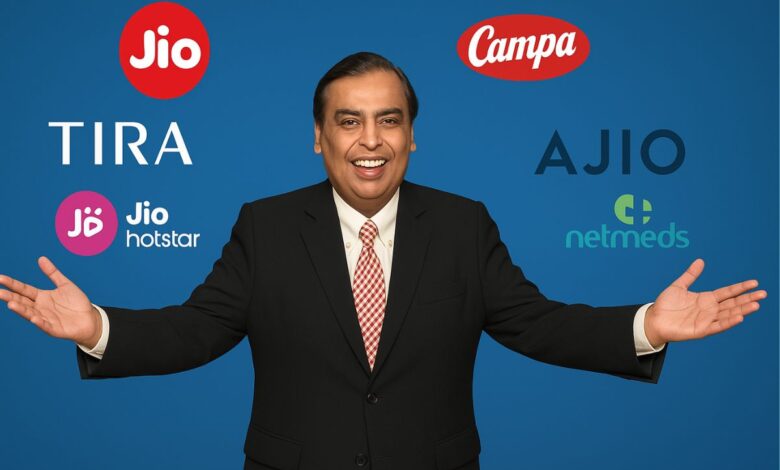
Reliance’s expansion into beauty and fashion represents perhaps the most sophisticated example of ecosystem thinking in action. The launch of Tira, Reliance’s beauty retail platform, wasn’t just about competing with established players like Nykaa. It was about creating a comprehensive omnichannel experience that leverages every aspect of the Reliance ecosystem. Tira operates both online and through physical stores, but the integration goes much deeper. Jio users get exclusive early access to sales, special pricing through Jio Financial payment methods, and personalized recommendations based on their digital behavior patterns.
The beauty platform can also cross-promote with Reliance’s fashion brand Ajio, creating bundled experiences that single-category competitors can’t match. In fashion e-commerce, the numbers are telling. While Myntra leads with approximately 30% market share, Ajio has rapidly captured around 15% of the market. More importantly, the gap is closing as Reliance leverages its ecosystem advantages.
Ajio users can pay through Jio Financial, get priority delivery through Reliance’s logistics network, and even get styling advice through AI systems trained on data from across the ecosystem. This isn’t just about selling clothes or cosmetics, it’s about understanding consumer behavior at a granular level across multiple touchpoints. When you know how much someone spends on data, what shows they watch, what they eat, and how they manage their money, predicting their fashion preferences becomes significantly easier.
Entertainment Dominance: Beyond OTT
The entertainment sector showcases the full power of Ambani’s integrated approach. When Disney’s Hotstar was the undisputed leader in Indian streaming, many questioned why Reliance needed to invest heavily in content and sports rights. The answer became clear during the 2023 IPL auction.
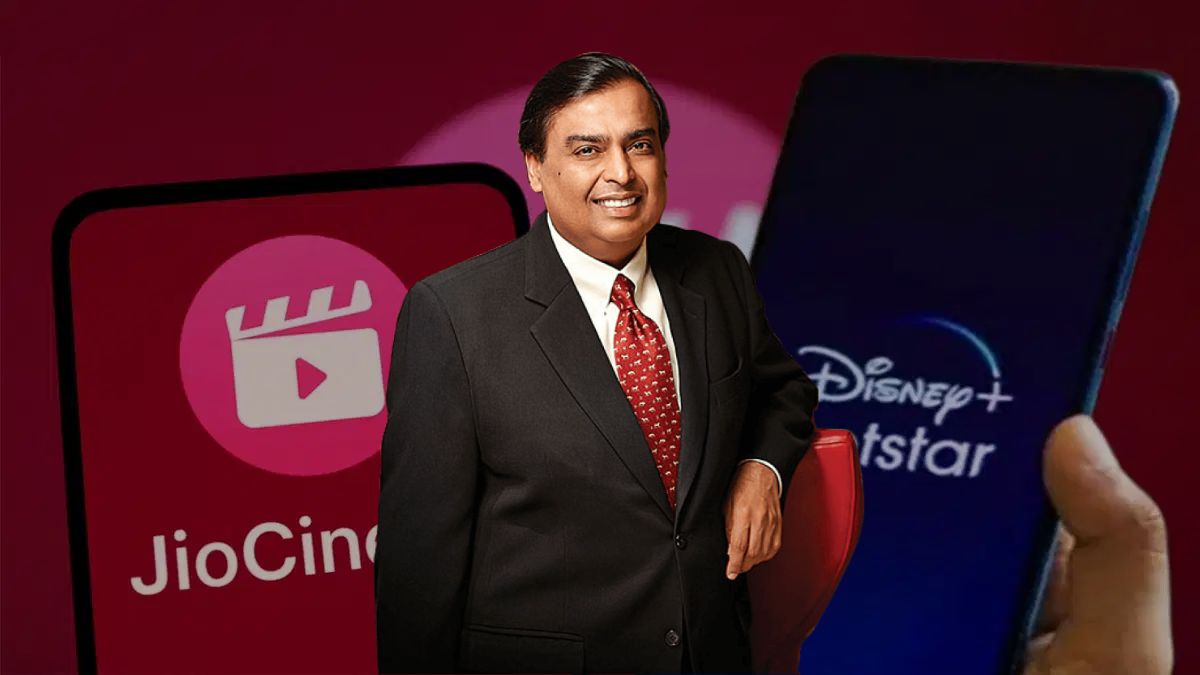
Jio’s acquisition of IPL digital rights, combined with partnerships bringing HBO, Paramount+, and other premium content to the platform, wasn’t just about building another OTT service. It was about creating appointment viewing for Jio users; content so compelling that switching to another telecom provider becomes unthinkable. But the entertainment strategy goes beyond streaming. Reliance has been investing in regional content production, music streaming, gaming, and even social media platforms. Each piece serves dual purposes of generating revenue and collecting behavioral data that improves targeting across the entire ecosystem.
A user watching IPL matches on Jio also sees targeted advertisements for Campa Cola, gets recommendations for fashion purchases on Ajio, and receives pre-approved loan offers through Jio Financial. The entertainment platform becomes the central nervous system for the entire ecosystem.
Healthcare and Pharmaceuticals: The Final Frontier
Even India’s healthcare sector isn’t immune to the Ambani ecosystem expansion. Through strategic investments and acquisitions, Reliance has been building capabilities in online pharmacy, telemedicine, and healthcare technology. While PharmEasy currently leads the online pharmacy market, Reliance’s approach through Netmeds and other healthcare ventures follows the familiar playbook: leverage the massive user base, integrate with existing services, and use competitive pricing to gain market share.
The healthcare expansion is particularly strategic because it represents one of the few remaining sectors where Indians regularly make purchases outside the digital ecosystem. By providing comprehensive healthcare services integrated with Jio’s digital platform, Reliance can capture this final piece of consumer spending. The data implications are staggering. Health data combined with financial, entertainment, and communication patterns would give Reliance unprecedented insights into Indian consumer behavior. This information advantage could be leveraged across every sector where the company competes.
The Network Effects: Why This Strategy Works
What makes Ambani’s ecosystem strategy so powerful, and potentially dangerous, is the concept of network effects. Each new service doesn’t just add revenue; it makes every other service in the ecosystem more valuable and harder to leave. Consider a typical Indian consumer in 2024 who uses Jio for mobile service. When they need a loan, Jio Financial offers instant approval with better rates than traditional banks because they already know the customer’s payment history and usage patterns. When they shop for fashion, Ajio provides personalized recommendations and convenient payment through their existing Jio account. When they want entertainment, JioCinema offers content they can’t get elsewhere, bundled with their existing services.
The switching costs become enormous. Moving from Jio to a competitor isn’t just about changing a SIM card; it means losing personalized financial services, entertainment content, shopping preferences, and ecosystem-wide benefits. This is customer lock-in at an unprecedented scale. The economic implications are profound. Traditional businesses focus on customer acquisition costs and lifetime value within their specific sector. Ambani’s ecosystem approach allows him to acquire customers at a loss in one area while generating profits across multiple touchpoints. This gives Reliance enormous competitive advantages in pricing and service quality.
The Data Goldmine: Information as the Ultimate Asset
Perhaps the most underappreciated aspect of Ambani’s strategy is the data collection across multiple touchpoints. While tech giants like Google and Facebook collect user data primarily through digital interactions, Reliance is gathering information across physical and digital experiences like telecom usage, financial transactions, entertainment preferences, shopping behavior, and even healthcare needs.
This comprehensive data profile enables unprecedented personalization and prediction capabilities. Reliance can anticipate when users need loans, what products they’re likely to purchase, when they might change service providers, and how to optimize pricing for maximum retention and revenue. The data advantage compounds over time. As users engage more deeply with the ecosystem, the accuracy of Reliance’s predictions improves, making their services more valuable and harder to replicate. Competitors can copy individual features or even match pricing, but they can’t replicate the deep behavioral insights that come from ecosystem-wide data collection.
The Competition Response: Playing Catch-Up
Established players across sectors are struggling to respond to Reliance’s integrated approach. Traditional telecom companies can match pricing but can’t offer the same ecosystem benefits. Banks can develop digital services but lack the comprehensive user data that makes Jio Financial so effective. E-commerce platforms can improve their offerings but can’t integrate with telecom, financial, and entertainment services the way Ajio does.
Some competitors have attempted to build their own ecosystems. Tata Group has made moves in this direction with its super app ambitions. Amazon has integrated shopping with Prime Video and financial services. But these efforts face a critical disadvantage: they’re building backwards from existing businesses rather than forward from a foundational infrastructure layer. The competitive response has largely been reactive rather than strategic. Price wars in individual sectors, feature matching, and incremental improvements; tactics that might work against traditional competitors but are insufficient against an ecosystem play.
The Consumer Perspective: Benefits and Risks
From a consumer standpoint, Ambani’s ecosystem strategy has delivered tangible benefits. Indian consumers enjoy some of the world’s cheapest data rates, access to premium entertainment content, competitive financial services, and integrated shopping experiences that would have been unimaginable a decade ago. The convenience factor is undeniable. Having telecom, financial, entertainment, and shopping services integrated under one ecosystem reduces friction, improves personalization, and often results in better pricing through bundled offerings. Many consumers view this as overwhelmingly positive; they get more value for less money with greater convenience.
However, the risks are becoming increasingly apparent. Market concentration at this level creates dependency relationships that can be problematic if competition decreases or service quality declines. When switching costs are high, consumers have fewer alternatives if they become dissatisfied with any aspect of the ecosystem. There’s also the question of data privacy and market power. While Reliance has committed to protecting user privacy, the sheer volume and comprehensiveness of data collection raises important questions about how this information might be used, shared, or potentially misused.
Economic and Policy Implications
The rise of the Ambani ecosystem has profound implications for Indian economic policy and competition law. Traditional antitrust frameworks focus on market dominance within specific sectors. But how do you regulate a company that doesn’t necessarily dominate any single market but has significant influence across multiple interconnected markets? Policymakers face a complex challenge. Heavy-handed regulation could stifle innovation and the consumer benefits that come from ecosystem integration. But lack of oversight could allow market concentration to reach levels that ultimately harm competition and consumer choice.
The global technology industry provides some guidance. Regulators in Europe, the United States, and other markets are grappling with similar questions about platform power and ecosystem dominance. However, India’s unique market dynamics, price sensitivity, diverse demographics, and developing digital infrastructure require locally appropriate solutions.
The Global Context: India’s Digital Sovereignty
Ambani’s ecosystem strategy also has important implications for India’s digital sovereignty. By building comprehensive digital infrastructure controlled by an Indian company, Reliance provides an alternative to dependence on foreign technology giants. This is particularly relevant in areas like financial services, where data sovereignty and regulatory control are crucial. Having domestic alternatives to American and Chinese technology platforms gives India greater autonomy in shaping its digital economy according to local priorities and regulations.
The success of Reliance’s ecosystem approach has also attracted international attention and investment. Major global technology companies are partnering with rather than competing against Reliance, recognizing the power of its integrated platform and local market knowledge.
Future Projections: Where This Leads
Looking ahead, several trends suggest the Ambani ecosystem will continue expanding and deepening its market presence. Artificial intelligence and machine learning will make the personalization advantages even more pronounced. 5G rollout will enable new services and deeper integration between physical and digital experiences. The growing Indian middle class will provide an expanding customer base for premium ecosystem services.
There are also potential new sectors for expansion. Education, mobility, energy, and agriculture all represent opportunities where Reliance could apply its ecosystem approach. Each new sector doesn’t just represent additional revenue; it provides more data points and integration opportunities that strengthen the entire platform. The international expansion potential is also significant. Reliance has already made strategic investments in technology companies globally. The ecosystem approach could potentially be exported to other developing markets with similar demographic and economic characteristics.
The Central Question: Progress or Problem?
This brings us back to the fundamental question posed at the beginning: is Ambani’s ecosystem strategy good for consumers because of lower prices and better services, or risky because of concentration of market power? The answer is nuanced and evolving. In the short term, consumers have clearly benefited from increased competition, lower prices, and improved services across multiple sectors. The ecosystem approach has accelerated India’s digital transformation and provided alternatives to foreign technology platforms.
However, the long-term implications are less clear. As the ecosystem becomes more comprehensive and switching costs increase, the competitive dynamics could shift in ways that ultimately disadvantage consumers. Market concentration, even when initially beneficial, can lead to reduced innovation, higher prices, and less choice over time. The key question is whether regulatory frameworks can evolve to maintain the benefits of ecosystem integration while preventing the potential harms of excessive market concentration. This requires sophisticated understanding of how network effects, data advantages, and cross-sector subsidization work in practice.
At the end: What can be said about The Ambani Paradigm?
What Mukesh Ambani has built over the past eight years isn’t just a business empire, it’s a new paradigm for how companies can operate in the digital economy. The integration of infrastructure, services, and data across multiple sectors represents a fundamental shift from traditional industry boundaries to ecosystem thinking. The success of this approach has implications far beyond India. Companies and policymakers worldwide are watching to understand how ecosystem strategies work at scale, what benefits they provide, and what risks they create.
For Indian consumers, the Ambani ecosystem represents both opportunity and challenge. The immediate benefits are clear: better services, lower prices, and greater convenience. The long-term implications will depend on how competition evolves, how regulation adapts, and whether the ecosystem continues to prioritize consumer value as it matures. One thing is certain; the traditional way of thinking about markets, competition, and consumer choice has been fundamentally altered. Whether this transformation ultimately proves beneficial or problematic may depend on decisions made in the coming years by regulators, competitors, and consumers themselves.

The Ambani ecosystem experiment is still unfolding, and its ultimate impact on Indian society and the global economy remains to be written. But there’s no question that it represents one of the most ambitious and successful attempts to reimagine how businesses can create and capture value in the 21st century digital economy. The question isn’t whether Ambani is taking over everything you use. In many ways, that process is already well underway. The question is what that transformation means for the future of competition, consumer choice, and economic development in the world’s most populous democracy.