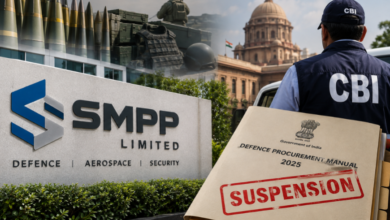
SC agrees to clear Sandesaras of bank fraud after part-payment. Setting A New Precedent For All Future Economic Offenders & Criminals. What An Idea SirJi!!!


If you are a small kirana shop owner terrified of missing one EMI, or a farmer staring at a notice from the bank, please stop reading now.
Today’s story is not for you.
Today’s story is for the visionaries – the truly “Aatmanirbhar” New India heroes – who look at a ₹10,000-crore bank fraud and say, “This sounds like a plan.”
Because the Supreme Court of India has just done something that many economic offenders could only dream of: it has agreed to drop criminal charges against billionaire brothers Nitin and Chetan Sandesara – accused in a $1.6 billion (around ₹13,000 crore) bank fraud case – if they pay roughly one-third of the dues, about $570 million (₹5,100 crore) by December 17.
Yes, you read that right: “first do a scam of 5000-10000 crores and then pay 1/3 and get all the criminal charges dropped.”
Apparently, this sounds like a plan.
The “Platinum Fraud Card”: How We Got Here
Let’s quickly recap the fairy tale.
-
The Sandesara brothers, promoters of Sterling Biotech, were accused by Indian agencies of defrauding a consortium of banks to the tune of around ₹8,100 crore initially, with total exposure later alleged to be upwards of ₹10,000–17,000 crore across various entities and loans.
-
Enforcement Directorate and CBI claimed a web of shell companies, circular transactions, inflated turnover and siphoning of bank loans.
-
A Delhi court even declared them “fugitive economic offenders” under the 2018 Fugitive Economic Offenders Act – the same law used against Vijay Mallya and Nirav Modi.
-
The brothers conveniently left India in 2017 on Albanian passports and built a flourishing oil empire in Nigeria, where their company reportedly contributes about 2.5% of Nigeria’s federal revenues.
Fast forward to November 24, 2025:
India’s top court says: pay roughly one-third of what you allegedly defrauded, and we’ll quash the criminal proceedings – CBI cases, ED cases, everything.
Or in pure WhatsApp University language:
Supreme Court has set a wonderful and amazing precedent for all the economic offenders.
“This Sounds Like a Plan”: The Unofficial New India Fraud Starter Kit
Of course, we must be very clear: this is not legal advice. This is not a how-to manual.
It’s just that, purely by coincidence, the system now appears to whisper to every ambitious scamster:
-
First, do a scam of 5000–10000 crores (more also okay, don’t be shy).
-
Park money nicely across shell companies, multiple jurisdictions, preferably with a side hustle in oil, diamonds, or luxury booze.
-
Leave India for a bit – maybe pick up a second passport or two, just for fitness.
-
Then come back and magnanimously offer to pay 1/3 and get all the criminal charges dropped.
No jail. No conviction. No criminal record. No fear of being a “fugitive” anymore. Just a rebranding exercise: from “alleged fraudster” to “visionary businessman who resolved disputes through settlement.”
If you are an honest taxpayer still standing in bank queues or filing IT returns, you may be wondering: “Wait, isn’t this actually rewarding the worst behaviour?”
Relax. Tomorrow everyone might deliberately do some billion dollars scam and will bring the same judgement and will agree to pay some part and roam free in India. Why should only a handful of early adopters enjoy this premium “Scot-Free” Plan™?
The Day of “Reform”: CJI, Image Makeover & a Deal of the Century
The timing is almost poetic.
On the same day that Justice Surya Kant takes charge as the 53rd Chief Justice of India, widely described as a jurist with “social empathy” who wants to make the court more accessible and is expected to steer key constitutional and social-justice cases, the headline is: “Supreme Court agrees to drop criminal charges against fugitive billionaire brothers if they pay ₹5,100 crore.”
Earlier, benches of the Court have themselves remarked in other matters, “Is the Supreme Court only for the rich?” when declining urgent relief to a resort.
And here we are, on Day One of the new CJI era, watching a deal where two billionaire fugitives – officially designated “fugitive economic offenders” – can wash away all criminal cases by paying a fraction of the alleged fraud.
So yes, “the shocking and surprising news came on the day when the new CJI said he wanted to eradicate the image of SC as a court only for rich. This is how he is apparently planning to improve the image of SC: agree for settlement, pay some part and go scot free.”
Image makeover, but make it premium subscription only.
Two Indias: One for EMI Defaulters, One for Billion-Rupee Defaulters
Let’s now talk about the other India – the one without Albanian passports and Nigerian oil blocks.
India 1: The EMI India
-
In 2023 alone, 10,786 farmers and agricultural labourers died by suicide, many driven by debt and economic distress.
-
News reports keep documenting how microfinance borrowers and small shopkeepers face brutal harassment by moneylenders, NBFC agents and unregulated lenders. Cases from Karnataka, Gujarat and other states show people dying by suicide with notes blaming recovery pressure and exorbitant interest.
-
In Karnataka, an SIT was set up after reports that over 25 people died by suicide in just two months due to aggressive tactics of microfinance firms; thousands of women in self-help groups complained of harassment by lenders.
For this India, one missed EMI means:
-
recovery agents at your door,
-
calls to your relatives,
-
threats, humiliation, sometimes violence,
-
and in the worst cases, death.
That too when the amount is ₹33 lakh, or ₹1 crore, not ₹10,000 crore.
India 2: The Billionaire Defaulter India
Then there is the Sandesara-type India:
-
Accused of defrauding banks to the tune of $1.6 billion.
-
Declared fugitive economic offenders by a Delhi court.
-
Left India, set up shop abroad, expand business globally, contribute to other countries’ revenue.
-
And now, negotiate at the highest court of the land: “We will pay one-third. In return, please wipe the criminal slate clean.”
Where a small borrower might get a recovery agent screaming at them in front of neighbours, a big borrower gets Senior Advocate plus video conference plus ‘composite settlement’ plus quashing of all proceedings.
But remember: I aim to eradicate the image of SC as a court only for the rich.
Sure. Totally working.
“New India, Shining India, Aatmanirbhar Bharat” – For Scamsters
We were told New India is:
-
cashless,
-
corruption-free,
-
full of digital trails and accountability.
We had demonetisation in 2016, where 86% of cash in circulation was suddenly scrapped in the name of fighting black money, corruption and fake currency.
People stood in queues for hours, businesses collapsed, ordinary citizens had weddings ruined, and countless daily-wagers lost livelihoods – all so that “black money” could be wiped out.
Later, the RBI quietly told us that over 99% of the demonetised notes came back into the system.
Fast forward to 2025:
-
Indian money in Swiss banks more than tripled in 2024 to about ₹37,600 crore, the highest level in years.
-
Government is now drafting laws to tackle illegal digital lending, harassment and predatory loans – because small borrowers are still being tortured by unregulated lenders.
-
And fugitive economic offenders can explore “settlement” with banks and then seek quashing of criminal proceedings in the Supreme Court.
So yes, this is a classic example of New India, Shining India, Aatmnirbhar Bharat – at least for those who know how to convert alleged fraud into a negotiated one-time settlement.
We demonetised small people’s savings in the name of black money, but we are now remonetising big-ticket fraud through one-third-off clearance sales.
“India as Vishwaguru” – Now Instructing the World on How to Treat Economic Offenders
We were also told India is becoming Vishwaguru – the teacher of the world.
And honestly, India is truly becoming the Vishwaguru by giving such orders and setting the precedent for all new upcoming economic offenders.
Think of the export potential of this model:
-
Why settle for boring old extradition battles when you can say:
“Come, pay some amount, we will make everything disappear.” -
Why go through years of trial, evidence, witnesses, cross-examination, when a clean, elegant OTS (One Time Scam-settlment) can resolve it all?
Foreign media already frames this as “India’s top court allows settlement in $1.6 billion fraud case, dropping charges if one-third is paid.”
Imagine economic offenders in other countries reading this and thinking:
“Wow, in India, even being declared a fugitive economic offender can potentially be cured by a lump-sum payment. Maybe we should incorporate in Gujarat next time.”
Truly, Vishwaguru level innovation.
“Wonderful Precedent” for the Whole Fraud Ecosystem
Let’s be brutally honest about what many people will hear, regardless of what the judgment carefully says:
“Supreme Court has set a wonderful and amazing precedent for all the economic offenders.”
Because if this works for one of the biggest bank fraud cases in India, what stops others from trying the same?
Tomorrow every economic offender –
-
illegal betting app owners,
-
bank loan defaulters,
-
shell-company champions,
-
crypto-Ponzi architects –
will come for settlement by paying 1/3 of the amount to settle and live a respected life.
There will, of course, be legal niceties:
-
Each case will be “fact specific”.
-
Article 142 powers are “extraordinary” and “not precedent”.
-
Courts can always distinguish future cases on subtle grounds like “different prayer”, “different stage”, “different cooperation level”.
But on the street, the message is simple:
Big scam? Don’t worry. Just grow it big enough so that it becomes “systemic” and “too entangled to unwind”. Then negotiate.
The bigger the hole, the more desperate banks become to accept whatever is on offer. And if the Supreme Court blesses such a deal, you don’t just save your skin – you get judicial certification.
Meanwhile, The “Ordinary Offender” Gets No Discount
Compare this to how the system treats:
-
a driver who defaults on a ₹2 lakh bike loan,
-
a farmer who cannot repay a ₹1 lakh crop loan,
-
a street vendor who is cornered into taking a ₹50,000 microloan at usurious interest.
They don’t get:
-
Senior counsel arguing “to get rid of all proceedings.”
-
One-third settlement with a full discharge of criminal cases.
-
Courts bending over backwards to find “innovative” solutions.
They get:
-
constant calls,
-
house visits,
-
public shaming,
-
threats of criminal cases,
-
and sometimes, death.
The Supreme Court has not (and cannot) tell their lenders:
“Please accept one-third, drop all proceedings and don’t ever trouble them again.”
Yet for a giant, systemic bank fraud, that is now literally the headline outcome.
If you’re a small borrower, what does that teach you?
“Tomorrow Everyone Might Deliberately Do Some Billion Dollar Scam…”
The user’s own punchline captures the fear perfectly:
“Tomorrow everyone might deliberately do some billion dolloars scam and will bring the same judgement and will agree to pay some part and roam free in India.”
Again, the Court may insist that this is not the message. It may say this is a one-off, based on special facts, an attempt to recover assets, reduce litigation, and stabilise the banking system.
But incentives matter.
If youngsters see that:
-
crime + scale + smart lawyering = negotiable,
-
whereas honesty + poverty + default = harassment + jail + suicide risks,
then you are engineering incentives for more economic crime.
You are telling people:
-
Don’t steal ₹10,000; that’s petty and risky.
-
Steal ₹10,000 crore, and then you can talk.
Because only when the amount is enormous do you become “systemically important” enough to negotiate with the State.
From Vijay Mallya to Nirav Modi: The Growing Gallery of “Inspirations”
India already has an impressive gallery of economic offenders whose life arcs are well publicised:
-
Vijay Mallya, accused in cases tied to over ₹6,000 crore of unpaid loans linked to Kingfisher Airlines, fighting extradition in the UK while courts in London handle bankruptcy proceedings and Indian banks chase partial recoveries.
-
Nirav Modi and Mehul Choksi, accused in the ₹13,000-crore Punjab National Bank scam, whose extradition battles and global movements have been followed for years.
Till now, the message was:
“If you run, you may never come back. Your life will be stuck in litigation and extradition.”
After the Sandesara settlement, a new thought may quietly creep in:
“Hang on. Instead of dying in some foreign legal limbo, why not come back, offer a slice of the alleged loot, and seek a full wash of criminal cases? If one set of fugitives can obtain such a deal, why not us?”
No one is saying courts will accept that logic for every case. But will such offenders try? Obviously yes.
And once more and more such deals are attempted, “settlement culture” in criminal economic offences will become normal.
Black Money, White Robes, Grey Outcomes
Let’s zoom out.
-
We demonetised the economy to fight black money.
-
We increased compliance burdens for small businesses – GST, e-invoicing, TDS, TCS – in the name of curbing evasion.
-
We chase small IT mismatches and late filing penalties.
And yet:
-
Indian money in Swiss banks tripled in 2024, indicating substantial outbound financial flows, not all of which are necessarily illegal, but certainly showing that global asset parking remains alive and well.
-
Economic offenders have figured out how to use multiple jurisdictions, citizenships and complex structures to shield themselves from straightforward prosecution.
The net result?
-
For lakhs of small citizens, the State is all-powerful, merciless, and non-negotiable.
-
For a handful of mega offenders, the State becomes a counterparty in a sophisticated commercial settlement.
Black money is evil when a mason hides ₹2 lakh in cash at home.
Black money becomes… “subject to settlement negotiations” when it is routed via shell companies, letter-of-credit chains, and offshore oil blocks.
Law vs Optics: What Could the Court Say?
To be fair, if we strip away the sarcasm, one can imagine the legal logic:
-
The banks have agreed to the one-time settlement, possibly on the ground that this is the best realistic recovery they can get.
-
Civil and commercial disputes are routinely settled; if all parties consent, why should the criminal law continue to hang indefinitely?
-
Supreme Court under Article 142 has broad powers to “do complete justice,” including quashing of criminal proceedings in appropriate cases.
But even if the logic is internally coherent, the optics are devastating:
-
You are using the heaviest moral machinery of the State – criminal law – as a bargaining chip.
-
You are visibly more forgiving to fugitives with billions at stake than to ordinary defaulters with thousands at stake.
-
You are telling the world that in India, economic crime can be monetised and netted off.
In a vacuum, the Court can say, “We are just resolving a specific case.”
In society, however, judgments live as signals.
And this signal is loud and clear:
“Big scams are negotiable. Big offenders are redeemable. Big money can buy you peace.”
The Human Cost: Poor People Don’t Have “Settlement Options”
It is easy to say “the banks are getting some money back, what’s the problem?”
The problem is the double standard of compassion.
Where is this creativity, this generosity of spirit, when:
-
A farmer is crushed under debt and takes his own life because he cannot pay back a few lakhs?
-
A woman borrower in Karnataka dies by suicide blaming microfinance harassment?
-
A tobacco vendor is mis-sold a high-interest loan and then hounded by agents until he ends his life?
Nobody offers them:
-
66% haircut,
-
waiver of future legal action,
-
and the chance to come back as respected entrepreneurs.
Their families don’t sit across the table with the Supreme Court and banks to restructure their fate. They get condolence tweets (if that), maybe a small ex-gratia and then oblivion.
“What an Idea, SirJi!” – The New Aspirational Dream
For years, the aspirational dream in India was:
-
Study hard,
-
Work hard,
-
Climb slowly,
-
Pay taxes,
-
Build a respectable life.
Now there is a new aspirational track:
-
This sounds like a plan:
-
First do a scam of 5000–10000 crores,
-
then pay 1/3 and get all the criminal charges dropped.
-
Why break your back building a ₹50 lakh business when a ₹5,000 crore fraud gets you:
-
private jets,
-
global parties,
-
and – if things go south – a Supreme Court-blessed settlement?
Of course, this is satire. Obviously, crime is risky, immoral and illegal. Obviously, not everyone will manage such a deal. Obviously, prosecutors, ED, CBI, and other regulators will resist many such attempts.
But incentive structures are being televised in 4K. Young minds don’t parse Article 142 doctrines; they see who gets punished, who negotiates, and who walks out smiling.
And right now, the scoreboard reads:
-
Small borrower: fear, harassment, sometimes death.
-
Mega alleged fraudster: world tour, negotiations, conditional absolution.
Where Do We Go From Here?
So what now?
-
Legislative clarity:
Parliament needs to think deeply about whether large-scale economic offences can or should be “settled” with criminal quashing, and if so, under what tightly controlled framework. Right now, it looks like we’re improvising with the biggest cases in the country. -
Consistency in compassion:
If the system can bend for billionaires in the name of “economic pragmatism”, it should bend far more for small borrowers, farmers, and micro-entrepreneurs crushed by debt. -
Real deterrence:
If offenders learn that at worst they’ll lose one-third of what they allegedly took, and at best they gain time abroad plus profits from foreign ventures, the deterrent value of criminal law collapses. -
Transparency:
Every such settlement should be fully transparent – who agreed, on what terms, what was recovered, what was written off, what will happen if deadlines are missed. Public institutions cannot run billion-dollar compromise deals on vibes. -
Judicial messaging:
The Supreme Court may believe it is doing “complete justice” in a single case. But it must also reckon with what this looks like to people standing outside ATMs, recovery agents at their door, or in queues outside the local court.
In Conclusion: A Precedent Wrapped as “One-Off”
The Court can write in the order that this is “not a precedent”.
But in the real world, it is already a precedent – in people’s minds.
It is a precedent that says:
-
Scale your fraud big enough, and the system will treat you as an economic problem, not a criminal one.
-
Stay rich, stay mobile, stay lawyered-up, and “settlement” will always remain on the table.
-
Be poor and indebted, and you get recovery agents, humiliation, and sometimes a news paragraph about your suicide.
So yes, the title writes itself:
SC agrees to clear Sandesaras of bank fraud after part-payment.
Setting A New Precedent For All Future Economic Offenders & Criminals.
What An Idea SirJi!!!
New India. Shining India. Aatmanirbhar Bharat.
Just make sure your scam is big enough.