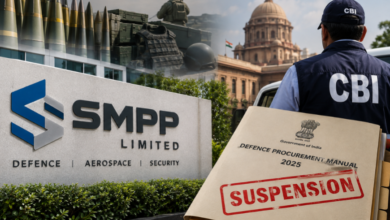
Pay Amount And Buy Your Freedom From Pending Criminal Cases: Is It Justified Justice?


If you were a creative consultant for white-collar crime, you’d probably frame the Sandesara playbook like this: “first do a scam of 5000-10000 crores and then pay 1/3 and get all the criminal charges dropped.”
This sounds like a plan.
Because that is more or less the message India’s legal system or India’s justice system has just broadcast with the Supreme Court’s order in the Sterling Biotech / Sandesara brothers saga.
What exactly has the Supreme Court done?
Let’s start with the dry facts before the sarcasm sets in fully.
On 24 November 2025, the Supreme Court agreed to drop all criminal proceedings against fugitive businessmen Nitin and Chetan Sandesara, the promoters of the Sterling Biotech group, if they deposit ₹5,100 crore by 17 December 2025 as a one-time settlement with lender banks.
That includes:
- CBI cases for alleged bank fraud and corruption
- ED cases and ECIRs under the Prevention of Money Laundering Act (PMLA)
- Attachment orders and prosecution complaints
- Proceedings under the Fugitive Economic Offenders Act (FEOA)
- Cases under the Companies Act, Income Tax, Black Money laws, etc.
In one stroke, everything goes, from FEO tag to money-laundering prosecutions, wiped clean, provided the money lands in time. The court describes this as a matter of “peculiar facts and situation” and solemnly instructs that the order “shall not be treated as a precedent.”
On paper, it’s simple: pay ₹5,100 crore, and the Indian justice system and state forgets that you allegedly cheated banks, laundered money, fled the country on foreign passports, and were declared fugitives.
But don’t worry, we are told, this has no precedential value. Of course not. It’s just a real-life, practical manual for every large economic offender now watching very, very closely.
The maths of forgiveness: how cheap is justice?
Now the numbers.
- The CBI’s FIR pegged the Sterling Biotech bank fraud at ₹5,383 crore.
- Various One-Time Settlement (OTS) packages for the wider Sterling group add up to ₹6,761 crore in dues (₹3,826 crore for Indian entities + ₹2,935 crore for foreign guarantor entities).
- The Enforcement Directorate has, at different points, claimed that the broader Sandesara group cheated Indian banks to the tune of over ₹14,500 crore, making it larger than even the original PNB–Nirav Modi fraud in quantum.
- Reuters and others have repeatedly referred to the saga as a $1.6-billion bank fraud – roughly ₹13,000 crore.

Against that backdrop, the settlement is ₹5,100 crore, or about one-third of the alleged $1.6-billion fraud, and substantially lower than the highest estimates of total exposure.
Even this amount is not some heroic, fresh sacrifice. A large part of the lenders’ recovery has already happened:
- ~₹3,508 crore deposited earlier under previous OTS and Supreme Court-monitored payments
- ~₹1,192 crore recovered via insolvency (NCLT) processes
- The “unpaid” component before this latest proposal: about ₹2,061 crore
Yet, based on a sealed-cover proposal from the Solicitor General (after consulting the banks), the court blesses a ₹5,100-crore “full and final” settlement and instructs that all those massive criminal cases across multiple statutes and agencies should simply vanish once the money is in.
It’s presented as a recovery triumph: lakhs of crores of NPAs, endless “haircuts” and here, at last, some money back. But the larger signal is brutally clear:
If you’re big enough, systemically important enough, and rich enough after fleeing, you can buy your way back into the system.
For everyone watching from the outside, Supreme court has set a wonderful and amazing example for all the economic offenders; no matter how many times the judgment insists otherwise.
“Peculiar facts”, Article 142, and the magic eraser of ‘no precedent’
The order leans heavily on a familiar judicial trick: call the case “peculiar”, invoke Article 142 (“complete justice”), and then add the line: this shall not be treated as a precedent.
In theory, lawyers will tell you:
- Only the ratio decidendi (core legal reasoning) is binding.
- Consent orders, fact-specific compromises, and Article 142 orders are often said to have “no precedential value”.
In practice, everyone knows:
- The message, not the footnote, is what survives.
- When the Supreme Court of India wipes clean the slate of two FEO-tagged billionaires in an alleged multi-billion dollar fraud because they agreed to pay part of the money, that is the takeaway – not the polite disclaimer about “peculiar facts”.
Law review commentary has been warning for years that this whole “no precedential value” self-certification is shaky. The Constitution and Supreme Court Rules don’t actually create an exception where the Court can declare its own rulings non-precedent in some magical, absolute way.
But let’s keep it simple.
If tomorrow a Vijay Mallya, a Nirav Modi, a Winsome Diamonds-type promoter, or some brand-new fintech fraudster turns up and says:
- “Look, I’ll pay you X% of what I allegedly defrauded; now please also give me quashing across CBI, ED, PMLA, FEOA, IT, Companies Act etc,”
does anyone seriously believe their lawyers won’t wave this case around in court?
On the ground, for economic offenders, the perceived rule now reads:
“Pay a chunk, erase the rest.”
“Not a precedent,” of course. Just a roadmap.
The moral hazard: how to design a ‘smart’ scam in New India
If you were to turn this order into a “How To” guide for ambitious fraudsters, the bullet points practically write themselves:
- Float companies, build a vast group, and take loans from consortia of public sector banks.
- Allegedly divert funds, round-trip money, build a profitable overseas asset – Nigerian oil fields are a nice touch – and keep enjoying the cash flows.
- When the house of cards starts to wobble, quietly exit India on alternative passports.
- Let ED and CBI do their thing. Let the banks classify you as NPA. Become a Fugitive Economic Offender for maximum drama.
- Much later, when valuations are clear and litigation has exhausted everyone, send word: I can pay 30–35% now – interested?
- Negotiate through banks, the government, and eventually the Supreme Court.
- Secure an order that not only lets you settle financially but washes away all criminal liability.
Again: This sounds like a plan.
And so the dark joke almost writes itself: “first do a scam of 5000-10000 crores and then pay 1/3 and get all the criminal charges dropped.”
Why bother with honest business in a system where the risk-reward curve for mega-fraud is this generous?
No wonder critics are worried that “Tomorrow everyone might deliberately do some billion dolloars scam and will bring the same judgement and will agree to pay some part and roam free in India.”
The Court might say, no, no, these are unique facts. But that’s not how incentives work in the real world. In the real world, people read outcomes, not footnotes.
The “New India” branding: deterrence or discount sale?
Politically and rhetorically, we’re told this is “New India”: tough on corruption, unforgiving to economic offenders, determined to bring fugitives back.
And yet, here we are with a template where alleged fraud of ₹13,000–14,500 crore results in a ₹5,100-crore payment and a promise of complete legal detox.
If you are a small borrower, you lose your home over a few lakh of unpaid EMI. If you are a small businessman, you get hounded for GST dues. But if you’re big enough to trigger the “systemic importance” radar, the very same state is willing to waltz you into a bespoke global settlement.
Honestly, This is a classic example of New India, Shining India, Aatmnirbhar bharat, where you are aatmanirbhar enough to flee, prosper abroad, and then return on your own terms.
It’s hard to imagine a more corrosive message to honest taxpayers and compliant borrowers than this:
- Crime pays, as long as it’s on a sufficiently extravagant scale.
- The state, which lectures citizens daily about “discipline” and “morality”, is perfectly prepared to negotiate with fugitives behind sealed covers – and then portray the result as a victory for “public money”.
The access-to-justice irony: rich, poor, and timing
Now add the timing.
The same news cycle carries two parallel narratives:
- The Supreme Court green-lights a conditional amnesty for billionaire fugitives, wiping out a forest of criminal cases if they pay.
- The new CJI-designate, Justice Surya Kant, is celebrated as a champion of access to justice, legal aid, and changing the perception that the Supreme Court is “only for the rich.”
Headlines over the past months have highlighted his rise from modest beginnings, his work in legal services authorities, and his image as someone who wants to democratise access to the apex court.
And so, on the day this bombshell settlement becomes public, critics can’t resist the sarcastic caption:
The shocking and surprising news came on the day when the new CJI said in that “I aim to eradicate SC image as a court only for rich: New CJI Kant”
This is how he is planning to improve the image of SC, agree for settlement, pay some part and scot free.
Is that line slightly exaggerated? Sure. That’s what sarcasm is. But you can see why it bites.
Earlier this year, another bench of the Supreme Court bluntly asked in open court, “Is the Supreme Court only for the rich?”, while refusing to fast-track a resort company’s case and warning against listing practices that favour wealthy litigants.
Now contrast that with what happened here:
- A complex, multi-agency, multi-statute web of cases is not just fast-tracked but fully resolved by a lump-sum cheque.
- The system bends over backwards to “do complete justice” – not for undertrials in overcrowded jails, not for wage disputes, not for bonded labourers – but for alleged defrauders of the banking system.
If this is how we are “eradicating the image” of being a court of the rich, the PR strategy might need a minor tweak.
Vishwaguru of white-collar forgiveness?
For several years now, India has been branding itself as “Vishwaguru” – a sort of moral teacher to the world.
The Sandesara case provides a different kind of global leadership: a shiny example of how alleged mega-fraudsters can be fugitives in one country while thriving in another, running oil businesses, contributing 2–2.5% of a foreign nation’s federal revenue, and then negotiating their way back home by offering a discounted cheque.
It’s hard to avoid the punchline:
India is truly becoming the Vishwaguru by giving such orders and setting the precedent for all new upcoming economic offenders.
Other jurisdictions will, of course, claim they’re tougher. But every time a foreign court looks at an Indian extradition request against a “fugitive economic offender”, they will now have one more question:
- “If your own Supreme Court is open to wiping criminal records in exchange for partial repayments, how serious is your system really about deterrence?”
This doesn’t just weaken moral authority; it undercuts the very credibility of the Fugitive Economic Offenders Act – a law that was sold politically as a strong, uncompromising tool to send a message that fleeing the jurisdiction would backfire.
Instead, the signal looks dangerously close to the opposite: Run first, negotiate later.

What about the banks and “public money”?
Defenders of the order will argue:
- Banks have already taken huge hits.
- Overseas assets are hard to seize and monetise.
- Litigation is costly and slow.
- If you can bring home ₹5,100 crore now, it’s better than waiting for some hypothetical full recovery later.
Fair enough – at the level of raw commercial pragmatism.
But the Supreme Court is not a debt recovery tribunal. It is not a committee of bankers trying to maximise short-term cash inflows. It is supposed to be the guardian of the rule of law, including the idea that:
- Large-scale financial crime is not just a spreadsheet issue; it is an attack on the integrity of the financial system and, indirectly, on every small saver whose money sits in those public sector banks.
By reducing the entire problem to “public money must come back, so let’s wash our hands of everything else”, the Court has essentially monetised criminality:
A price has been discovered at which the state is willing to forget.
The fact that banks and investigators jointly agreed to this figure in sealed cover doesn’t fix the deeper problem. It simply means the executive and the judiciary have together decided that in truly large economic crimes, civil compromise can swallow criminal accountability whole.
Ordinary citizens vs billionaire fugitives: a tale of two justices
Consider, for contrast:
- Undertrials rot in jail for years over petty theft, low-value cheque bouncing cases, or minor NDPS offences.
- Street-level fraudsters are paraded, remanded, and prosecuted with full theatrical force.
- Small borrowers face instant asset seizures, auctions, and humiliating notices over relatively tiny defaults.
They cannot say, “I’ll pay one-third of the alleged amount, please quash the FIR, attachments, and all future consequences.” The system doesn’t even hear them at that level.
But if you are a billionaire with cross-border assets, the state will:
-
Fight for years, on the pretext of justice,
-
Fail to extradite you, and forget the justice,
-
Watch your foreign business flourish, and laugh at justice,
-
Ultimately accept a “compromise” in which you pay a negotiated sum and walk away from criminal liability and get above from Indian Justice System!
One might forgive a cynical citizen for thinking that the real definition of “Vishwaguru” is a system that teaches the world how efficiently it can forgive the powerful while suffocating the powerless.
The future: who lines up at the settlement counter next?
This order is likely to open the floodgates for similarly placed defaulters and fugitives to seek comparable deals.
If you are:
- A big-ticket hawala operator
- A promoter of an illegal betting app
- A glamorous fintech founder whose lending empire just imploded
- A serial bank loan defaulter with overseas assets
why would you not try your luck?
And that brings us to another of those darkly comic lines that now sums up the moment:
Tomorrow every economic offenders, hawala operators, illegal betting app owners, bank loan defaulters will come for settlement by paying 1/3 of the amount to settle and live a respected life.
Of course, not everyone will succeed to overcome this justice system; not everyone has the same leverage, bargaining power, or geopolitical importance. But even if a handful manage similar outcomes, the message to the ecosystem is fatal:
- Fraud is negotiable.
- Criminal law is optional for the very rich.
- At a certain scale, everything is a commercial dispute.
Is it any wonder that people feel “Supreme court has set a wonderful and amazing precedent for all the economic offenders”, whatever the judgment itself may claim?
So where does this leave the idea of deterrence?
The usual defence of harsh economic-offence laws – PMLA, FEOA, powerful attachment provisions – is that they deter misconduct.
You endure draconian bail provisions, broad presumptions, and sweeping investigative powers on the argument that the stakes are high and the system must hit hard.
But that logic collapses when, at the very top of the pyramid, the state is seen as quick to compromise once the numbers look tempting.
Think of the social psychology where justice is just a toss:
- If you are a mid-level banker, why stick your neck out to call out politically-connected fraud, when you know that ten years later the system might quietly sign it off with a negotiated settlement?
- If you are a promoter, why agonise over staying on the right side of every regulation, when the upside of cutting corners can be massive and the downside can be partially offset by a late-stage “OTS plus quashing” package?
In other words, “Tomorrow everyone might deliberately do some billion dolloars scam and will bring the same judgement and will agree to pay some part and roam free in India.”
That sentence isn’t a prediction; it’s a description of the moral hazard this order creates.
Conclusion: sarcasm as self-defence
At the end of the day, sarcasm is just a coping mechanism for a public that watches, helplessly, as institutions send mixed signals.
You can call this order technically sound under Article 142. You can argue that banks needed closure. You can say that in purely financial terms, some recovery is better than endless paper victories against fugitives abroad.
All of that might be technically true. And yet, for the average citizen, what lands is much simpler:
- There is one criminal justice system where petty offenders are crushed.
- And there is another where, if you’re big enough, you negotiate your own exit package from Indian Justice System.
So yes, in that bleakly comic sense:
- This sounds like a plan.
- Supreme court has set a wonderful and amazing example for all the economic offenders.
- This is a classic example of New India, Shining India, Aatmnirbhar bharat.
- India is truly becoming the Vishwaguru by giving such orders and setting the precedent for all new upcoming economic offenders.
The Court can repeat “peculiar facts” and “no precedent” as often as it likes. But for the people who actually have to live with the consequences, the precedent is not what the judgment says it is – the precedent is what it does.
And what it has just done is tell every future mega-fraudster in the country that there may one day be a hearing where their lawyer can stand up in court, shrug politely, laugh on justice and say:
“My clients are ready to pay… to get rid of all proceedings.”
For a justice system that claims to stand for equality before law, that’s not just unfortunate. It’s devastating.