India’s AI Dilemma: Hosting The Future, Owning Nothing? From IT Back Office To AI Backend – Is India Repeating History?
India is racing to position itself at the heart of the artificial intelligence revolution — hosting summits, attracting billions in data centre investments, and scaling compute capacity at speed. Yet beneath the momentum lies a harder question: is India building AI power, or merely providing infrastructure for others to wield it?

India today is one of the largest AI markets in the world, hosting global summits, attracting billions in data centre investments, and positioning itself at the centre of the next technological wave. Yet a deeper question emerges beneath the momentum: is India building AI power or merely renting capacity in someone else’s system?
What Makes an AI Superpower?
To understand India’s position, it is necessary to first define what constitutes an AI superpower. Artificial intelligence is not a single industry but a layered technological stack. Power is distributed unevenly across those layers and not all layers confer the same strategic leverage.
The AI hierarchy can be broadly divided into five levels:
1. Semiconductors: At the foundation are advanced chips – particularly GPUs and AI accelerators – that enable large-scale model training. These are designed by firms such as Nvidia and AMD and manufactured at highly specialized fabrication facilities. Control over advanced chip production represents a structural chokepoint in the AI economy.
2. Compute Infrastructure: Above chips sit hyperscale data centres and cloud platforms. These facilities provide the raw computational capacity required to train and deploy AI systems. While capital-intensive, compute infrastructure is replicable across jurisdictions.
3. Foundation Models: This layer holds disproportionate power. Frontier models – large language models and multimodal systems – set technical standards, influence global AI deployment patterns, and shape downstream innovation. Model builders determine access, pricing, and usage norms.
4. Applications: Applications adapt foundation models for sector-specific uses – healthcare diagnostics, financial risk analysis, logistics optimisation, or conversational agents. While commercially valuable, applications depend on underlying models.
5. Data: Data fuels the entire stack. High-quality, diverse datasets improve model performance and contextual reliability. However, raw data without compute and modelling capacity does not automatically translate into power.
Where Power Actually Concentrates
While each layer contributes to the ecosystem, leverage concentrates at two points:
- Advanced semiconductor production
- Frontier foundation models
Those who control chips and models influence standards, licensing, pricing, and geopolitical alignment.
The United States currently spans multiple layers simultaneously – dominant chip design firms, leading cloud providers, and frontier model labs. China, in response, has pursued domestic semiconductor capacity and state-backed model development. Taiwan has secured global relevance by controlling a chokepoint in advanced semiconductor manufacturing.
In contrast, hosting compute infrastructure alone – however large – does not automatically translate into strategic control. Data centres can be built in multiple jurisdictions. Tax incentives can be matched. Energy pricing advantages can shift.
The distinction is subtle but critical: Running AI workloads is not the same as defining the systems that run them.

India’s Real Strength
India’s AI position begins with scale.
The country now has over one billion internet users. It is among the largest user bases globally for generative AI platforms, ranking second only to the United States in usage for systems such as ChatGPT and Claude. Yet this scale does not proportionately translate into revenue capture or model ownership.
India’s digital population generates enormous volumes of:
- Multilingual text and speech
- Digital payment behaviour
- E-commerce interactions
- Public service data
- Human feedback that improves AI systems
Few countries combine demographic size, linguistic diversity, and digital adoption at this magnitude. And yet, ownership remains elsewhere.
India exports two key inputs into the global AI system:
- Talent — engineers, researchers, and technical leadership who frequently operate within foreign firms or relocate abroad.
- Data — behavioural, linguistic, and interaction data that improves foreign-built foundation models.
In return, it imports:
- Access to frontier models
- Proprietary intellectual property
- Pricing frameworks set by foreign companies
This pattern echoes an older economic template, the export of raw materials followed by the import of value-added goods.
The risk is not simply economic. India’s linguistic diversity – more than 20 official languages and dozens more widely spoken – makes model accuracy deeply dependent on local data. If foreign systems are trained disproportionately on Indian behavioural inputs but remain governed externally, India risks becoming indispensable in contribution but peripheral in control.
The structural question therefore is not whether India participates in AI. It clearly does – at massive scale. The question is whether participation alone confers power.
Budget Reality: Are We Building or Renting?
If strategy is intent, budgets are proof.
India’s AI ambition must ultimately be assessed not through summit declarations or investment announcements, but through sustained public spending patterns and institutional design.
India’s overall R&D expenditure stands at roughly 0.6 per cent of GDP — significantly lower than the 3 to 4 per cent typical of advanced innovation-driven economies. That gap matters because frontier AI development is capital-intensive, long-horizon research, not short-cycle deployment.
The IndiaAI Mission, positioned as the government’s flagship programme for artificial intelligence, carries a total outlay of approximately ₹10,371.92 crore over five years. Within that framework, the largest single allocation – ₹4,563.36 crore – is dedicated to compute capacity.
By contrast, allocations for foundation models, datasets, and skilling initiatives remain comparatively smaller. The signal is consistent: infrastructure first, model-building later.
The 2026–27 Union Budget reduced the IndiaAI Mission’s allocation to ₹1,000 crore, roughly half of the previous year’s level. More strikingly, official budget documents show that in 2024–25, 96 per cent of the allocated funds remained unspent.
Under-spending in itself does not indicate failure; large technical missions often take time to operationalise. But persistent execution gaps weaken claims of urgency.
The pattern suggests that while India is investing in AI-enabling infrastructure – particularly compute – it has yet to demonstrate sustained, scaled commitment to frontier model research.
This distinction is not cosmetic. Training large foundation models requires significant capital. Public estimates have placed training costs for frontier systems such as GPT-4 at tens of millions of dollars, with newer multimodal systems crossing substantially higher thresholds. Even adjusting for purchasing power differences, the scale of funding required to compete meaningfully at the frontier dwarfs current domestic allocations.
Compute capacity expansion, including the reported acquisition of tens of thousands of GPUs, signals intent to host and deploy AI workloads. But hosting compute is different from sustaining long-term research laboratories capable of defining new architectures, advancing safety science, or shaping global technical standards.
The budgetary split between “AI-enabling infrastructure” and “AI-creating capacity” reflects a strategic choice – whether deliberate or incremental.

Direct vs Indirect AI Spending
A useful analytical distinction is between:
- Direct AI spending — programmes explicitly designed to build AI capabilities (model development, datasets, research institutions, training pipelines).
- Indirect AI spending — adjacent infrastructure such as semiconductor incentives, cybersecurity frameworks, digital public infrastructure, and data centre support.
India’s recent budgets demonstrate considerable emphasis on the indirect layer. Semiconductor manufacturing incentives, cloud capacity, and digital connectivity expansion are politically visible and economically tangible. They generate capital inflows, jobs, and immediate signalling value.
But frontier AI capability emerges from sustained institutional ecosystems — universities, research labs, defence-linked innovation programmes, and long-term funding that tolerates experimentation.
In the United States, AI advancement has been deeply intertwined with defence research funding through agencies such as DARPA, alongside private-sector hyperscalers. China’s 2017 State Council plan outlined integrated targets through 2030, explicitly prioritising domestic capability across the AI stack.
India’s approach so far appears more deployment-oriented than discovery-oriented.
The Compute-First Strategy
The IndiaAI Mission’s emphasis on compute capacity is not irrational. Given India’s strength in IT services and infrastructure execution, building a domestic compute ecosystem:
- Attracts foreign AI firms
- Preserves relevance in global supply chains
- Creates an alternative to traditional outsourcing
- Positions India as a stable hosting jurisdiction
However, compute hosting is replicable. Data centres can be built in the Gulf, Southeast Asia, or Eastern Europe. Tax incentives can be matched. Energy subsidies can be recalibrated. Frontier model IP, by contrast, compounds in advantage.
The question therefore becomes sharper: Is India’s compute-first strategy a transitional base from which it will climb upward into model ownership or is it the destination itself?
If the latter, the trajectory begins to resemble an updated version of the IT services model: high capacity, strong execution, but limited control over intellectual property and standards.
The Compute Pivot: A Defensive Move?
If budgets suggest a compute-first orientation, corporate capital flows confirm it.
In early 2026, India announced a sweeping incentive: foreign firms using Indian data centres to provide cloud services to global clients would receive a tax holiday extending to 2047. The policy was positioned as a long-term signal of stability and openness – an invitation to anchor AI infrastructure in India.
The timing was not accidental.
India currently commands roughly 55 per cent of the global IT outsourcing market. For decades, that dominance rested on labour arbitrage: skilled engineers delivering services at competitive cost. Generative AI, however, introduces structural disruption to that model. A 2025 Gartner projection estimated that nearly 80 per cent of customer queries could be resolved by AI agents by 2029. If realised, that transformation would directly erode large segments of India’s IT-enabled services industry.
Markets have already begun pricing this risk. In early 2026, Indian IT stocks experienced sharp corrections amid investor concerns that AI-driven automation could compress margins and reduce headcount demand.
Against that backdrop, the compute pivot begins to look less like ambition alone and more like adaptation.
If AI threatens traditional outsourcing, hosting AI workloads becomes a hedge.
The Investment Wave
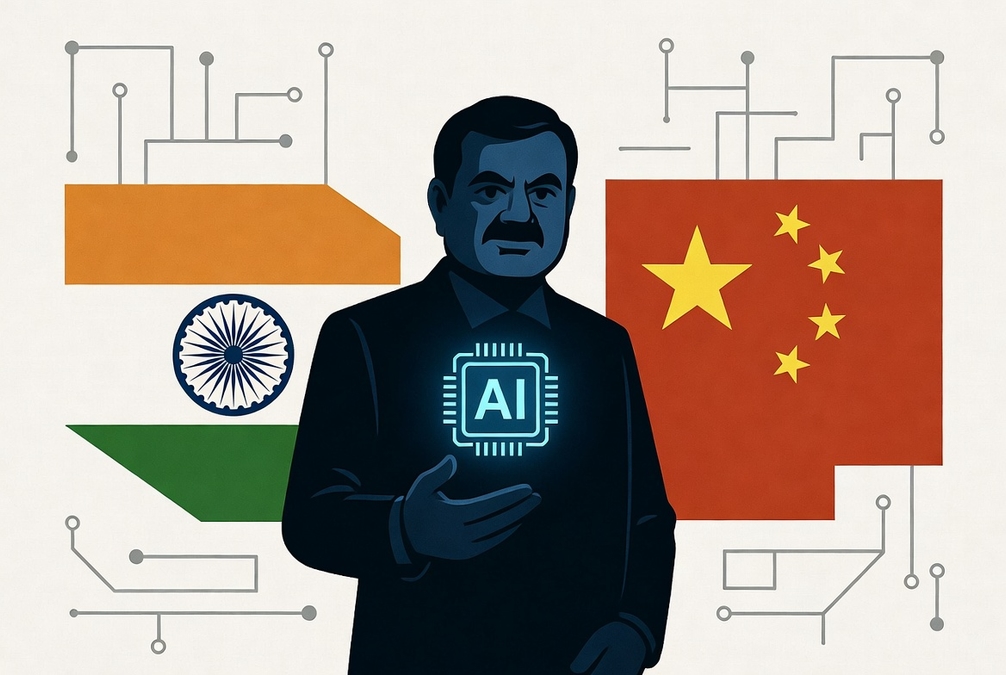
The scale of announced infrastructure commitments is striking: Reliance Industries has outlined over $100 billion in AI and data infrastructure expansion.
The Adani Group has committed tens of billions toward AI data centre campuses. Yotta Data Services announced a multi-billion-dollar AI compute hub using Nvidia chips.
Major hyperscalers – Google, Microsoft, Amazon – have pledged tens of billions in AI and cloud infrastructure investments in India through 2030.
OpenAI has partnered with the Tata Group to secure substantial AI-ready data centre capacity, with ambitions to scale significantly.
Collectively, these announcements position India as: A stable jurisdiction, a large digital market, a power-and-land-capable host for AI infrastructure, a politically aligned partner in Western-led AI supply chains
The signing of the Pax Silica Declaration at the India AI Impact Summit further formalised this alignment. The initiative, focused on securing critical mineral and semiconductor supply chains, integrates India into a geopolitically structured technology bloc led by the United States.
In effect, India is signalling that it can be a reliable node in the global AI supply chain.
Hosting as Strategy
There is strategic logic here.
Data centres generate: Capital inflows, Construction and infrastructure employment, Grid modernisation investments, Secondary ecosystem growth (cooling, power, telecom). They also help ensure domestic availability of compute capacity for startups and public-sector use.
But hosting capacity alone does not create chokepoints.
Unlike advanced semiconductor fabrication, which requires decades of process knowledge and extreme capital concentration, data centre infrastructure is geographically mobile. Jurisdictions compete on energy pricing, water access, regulatory clarity, and tax incentives.
India’s comparative advantage in this layer rests on scale and policy stability, not exclusivity.
Outsourcing 2.0?
The pattern bears resemblance to India’s Y2K-era IT rise.
Then: India serviced global software systems, value capture concentrated in Western intellectual property. India scaled execution capacity.
Now: India may service global AI workloads. Frontier model IP remains abroad. India scales compute and deployment.
The difference is that generative AI automates services more rapidly than traditional software ever did. The outsourcing model is no longer insulated from technological substitution.
Hosting AI workloads could preserve India’s relevance but it does not necessarily increase bargaining power.
That leads to a deeper question: Is India positioning itself as indispensable or simply available?
/dq/media/media_files/2025/06/05/N3rk0K0Xim7sbRMwPwXq.jpg)
The Government’s Case: Why Delhi Believes India Is AI-Ready
From the government’s perspective, India is not entering the AI race tentatively. It is already in the first tier of AI-ready nations.
At the Artificial Intelligence Impact Summit in New Delhi, ministers and industry leaders framed AI as a kinetic enabler of India’s next growth cycle – an engine powering productivity, entrepreneurship, public services, and long-term competitiveness.
The argument rests on three pillars: global recognition, market expansion, and foundational infrastructure.
1. Global Rankings and Readiness Indicators
- Several international benchmarks place India among the leading AI-enabled economies.
- Stanford University’s 2025 Global AI Vibrancy Index ranks India third globally, behind only the United States and China, citing growth in research, talent, and economic activity.
- The IMF’s AI Preparedness Index assigns India a score of 49.3 — significantly higher than the 42.1 average for emerging and developing economies.
- The Oxford Government AI Readiness Index (2025) ranks India 27th globally and first in South and Central Asia, with a score of 66.55, reflecting improvements in policy frameworks and digital capacity.
Together, these indicators suggest that India possesses the institutional and human capital base necessary to adopt and deploy AI at scale.
However, such indices primarily measure adoption, ecosystem vibrancy, and policy frameworks — not frontier capability ownership. Readiness to deploy AI differs from control over its core intellectual property.
2. Market Expansion and Growth Projections
The economic case for AI in India is compelling.
According to reports cited by policymakers:
- The global AI market expanded from approximately $103.6 billion in 2020 to $288.8 billion in 2024.
- India’s AI market grew from roughly $2.97 billion in 2020 to $7.63 billion in 2024.
- Projections estimate the Indian AI market could reach over $131 billion by 2032, growing at a compound annual growth rate exceeding 40 percent.
Such figures indicate not marginal participation but exponential integration.
India is not a passive consumer. AI is already embedded across fintech, logistics, health-tech, agritech, and governance platforms. Venture funding into AI-driven startups has accelerated, and domestic enterprises are integrating generative AI into service delivery.
Yet market growth reflects demand, not necessarily strategic leverage.
A rapidly expanding domestic AI market can coexist with dependency on external foundational systems.
3. Demography as Strategic Capital
India’s demographic profile strengthens its AI readiness argument.
More than 65 percent of the population is under 35, creating one of the world’s youngest workforces. A large, digitally literate, English-proficient talent pool supports rapid adoption and scalable deployment.
India has also historically produced high-end technical talent that shapes global AI development – though often from within foreign firms.
The startup ecosystem reinforces this direction. More than 200,000 startups are recognised by the Department for Promotion of Industry and Internal Trade (DPIIT), with a growing segment focused on AI applications. Entrepreneurial density enhances diffusion and localisation.
However, demographic advantage becomes strategic only when combined with research retention and deep R&D ecosystems. Talent supply alone does not guarantee model ownership.
4. Digital Public Infrastructure and Connectivity
One of India’s strongest claims to AI leadership lies in its digital backbone.
Internet connections have crossed the 100 crore mark, expanding nearly fourfold over the past decade. India now hosts over 400 million 5G subscribers, ranking among the fastest adopters globally. Optical fibre network expansion has more than doubled in route length, and broadband connectivity now reaches over 200,000 Gram Panchayats.
At the government level, the National Informatics Centre operates National Data Centres in Delhi, Pune, Bhubaneswar, and Hyderabad, with storage capacity expanded to approximately 100 petabytes, including advanced enterprise storage systems.
These are not trivial statistics. AI deployment requires connectivity, storage, and digital identity frameworks. India’s digital public infrastructure – including payment systems, identity layers, and governance platforms – provides a foundation that many emerging economies lack.
The acquisition of approximately 38,000 GPUs further signals intent to scale compute availability.
5. Infrastructure Momentum
Large-scale investment announcements from domestic conglomerates and global hyperscalers reinforce the infrastructure narrative. Data centres are proliferating. AI-ready capacity is expanding. Power and cooling ecosystems are being modernised.
From Delhi’s vantage point, this layered infrastructure – chips procurement, compute expansion, connectivity growth, startup dynamism, and global recognition – places India in what policymakers describe as the first cohort of AI-ready nations.
The official position is therefore clear: India may not yet dominate frontier model research, but it is building the ecosystem required to participate fully in the AI economy.
The Open Question
The divergence between critics and policymakers is not about whether India is progressing.
It is about whether readiness and deployment scale will translate into structural influence over standards, intellectual property, and value capture.
Being AI-ready is not the same as being AI-defining. That distinction becomes central to assessing whether India is positioning itself as indispensable or merely integrated.
Indispensability: What Would Real AI Power Require?
In technology geopolitics, scale matters. But indispensability matters more.
The global AI hierarchy is not simply about who participates – it is about who cannot be substituted.
Taiwan offers the clearest illustration. It does not dominate AI applications, nor does it produce the largest language models. Its strategic leverage stems from advanced semiconductor manufacturing – a chokepoint capability that underpins the entire AI stack. Because the world’s most advanced chips depend on fabrication capacity concentrated there, Taiwan’s stability carries global economic consequence.
The lesson is not that every country must build everything. It is that power accrues to those who control critical nodes others cannot easily replicate.
Is Compute Hosting Indispensable?
India’s current trajectory emphasises compute infrastructure and data centre expansion. While economically significant, this layer does not inherently create chokepoints.
Data centres can be constructed across geographies with:
- Competitive electricity pricing
- Stable regulation
- Land and cooling capacity
- Tax holidays, even extending to 2047, are policy instruments that other jurisdictions can match. Hosting capacity is valuable – but it is contestable.
Indispensability requires something harder to replicate.
Where Could India Build Leverage?
India’s potential structural advantages lie elsewhere.
1. Linguistic and Cultural Data Depth
India’s linguistic diversity is unmatched among major digital economies. More than 20 official languages and hundreds of dialects create a complex training environment for AI systems.
If India systematically builds high-quality, locally governed language datasets – particularly in low-resource languages – it could anchor a segment of global AI development that cannot easily be substituted.
Today, much of this data flows into foreign-trained systems. Without governance frameworks or negotiated value capture, India contributes to model improvement without shaping model ownership.
2. Sector-Specific High-Impact Datasets
Healthcare, agriculture, logistics, and financial inclusion are areas where India possesses unique digital footprints at scale.
Structured, privacy-protected access to anonymised public-sector and institutional datasets – if designed responsibly – could create specialised AI capabilities deeply contextualised to Indian conditions. That would move India from deployment to domain-specific innovation.
However, sensitive data remains fragmented, inaccessible, or underutilised. Unlocking it requires institutional design, not just political rhetoric.
3. Research Retention and Institutional Depth
India has consistently produced elite AI talent. Yet many of its most prominent AI leaders operate abroad or within foreign-owned firms.
Indispensability requires research ecosystems capable of:
- Sustained long-horizon funding
- Advanced doctoral pipelines
- Cross-disciplinary AI safety and governance research
- Public-private laboratories that tolerate experimentation
Without institutional gravity, talent flows outward.
4. Standards and Governance Leadership
There is also a regulatory dimension.
As AI governance norms evolve – covering safety, transparency, evaluation, and liability – countries that shape standards influence global deployment patterns.
India, representing a large digital population within the Global South, could leverage its scale to define governance principles suited to multilingual, high-density, developing economies. That would create normative influence even if frontier model development remains elsewhere.

Substitutability vs Power
The central question returns: Is India building something others cannot replace?
Compute hosting is replaceable. Tax incentives are replaceable. Market size is influential but not exclusive.
Advanced chip manufacturing is difficult to replace. Frontier model IP compounds in advantage. High-quality structured datasets with governance frameworks could become difficult to replicate.
Power in AI is cumulative. Once ecosystems of talent, capital, and intellectual property cluster, they reinforce themselves. India’s challenge is not lack of participation. It is moving from scale to leverage.
A Fork in the Road
At present, India appears positioned as:
- A major AI deployment market
- A large-scale compute host
- A digitally connected economy
- A geopolitically aligned supply-chain node
These are strengths.
But indispensability demands at least one layer of the stack where India shapes global direction rather than accommodates it.
If it does not claim such a layer, it risks remaining a high-capacity backend in a system whose standards, pricing, and core technologies are defined elsewhere.
VIII. What Would Moving Up the Stack Actually Require?
If India’s current trajectory positions it strongly at the deployment and compute layers, the question becomes whether it intends to remain there — or use that base to climb higher in the AI hierarchy.
Moving up the stack would require structural shifts across funding, institutions, and governance.
1. Sustained, Not Symbolic, R&D Investment
Frontier AI research cannot be built through episodic allocations.
India’s R&D spending, at roughly 0.6 per cent of GDP, limits the scale at which domestic institutions can compete globally. Increasing this ratio is not merely a budgetary decision; it is a signal of long-term technological seriousness.
Model development requires: Multi-year funding cycles, Access to high-end compute dedicated to research, Faculty recruitment and retention packages competitive globally, Doctoral pipelines that feed into domestic labs, Compute acquisition without research ecosystems risks becoming infrastructure without innovation.
If India intends to develop foundational AI capability – even selectively – funding must move from short-term programmatic announcements to sustained institutional capital.
2. Public–Private Frontier Labs
No major AI power relies solely on the state or solely on the private sector.
The United States benefits from a hybrid ecosystem – private hyperscalers, venture-backed model labs, and defence-linked research funding. China’s model integrates state direction with private firms.
India would require a similar hybrid approach:
- Public seed capital
- Domestic corporate participation
- Long-term compute access
- Governance frameworks that balance innovation and safety
Rather than attempting to replicate the largest frontier models immediately, India could focus on selective domains – multilingual models, sector-specific large models, safety research – where it can differentiate rather than imitate.
3. Treating Data as Strategic Infrastructure
India’s demographic and digital scale is a structural advantage but only if data governance frameworks prevent unstructured extraction.
This does not require digital isolationism.
It requires:
- Transparency mandates on how foreign model builders use Indian data
- Structured licensing models for high-value datasets
- Privacy-protected research sandboxes
- Incentives for domestic dataset creation
Language datasets, particularly for low-resource Indian languages, could become shared national infrastructure. If built and governed domestically, they would anchor AI deployment within local control rather than external dependency.
The shift is conceptual: data is not exhaust; it is infrastructure.
4. Retaining and Repatriating Talent
India’s AI diaspora is influential globally. Yet domestic research ecosystems struggle to retain elite researchers.
Retention requires more than patriotic appeal. It demands:
- Competitive compensation structures
- Intellectual freedom
- Advanced compute access
- Global collaboration networks
If domestic labs cannot match these conditions, talent will continue flowing toward foreign frontier institutions.
5. Linking Compute to Innovation
India’s aggressive expansion of data centre capacity and GPU procurement can become a foundation for domestic innovation — but only if access is structured.
Subsidised compute should not function solely as hosting infrastructure for foreign workloads. Portions of that capacity could be earmarked for:
- Indian research institutions
- Startup experimentation
- Model training consortia
- Public-interest AI research
Without such integration, compute capacity becomes an economic asset but not a strategic one.
6. Governance as Leverage
India also possesses an opportunity in regulatory design.
With one of the world’s largest digital populations, India can influence global AI governance conversations – particularly on inclusion, multilingual fairness, and deployment in developing economies.
Norm-setting can create influence even when frontier model development remains concentrated elsewhere. But governance leverage depends on credibility – which in turn requires domestic expertise in AI safety, evaluation science, and technical standards.

Avoiding the IT 2.0 Trap
India’s IT sector built scale, employment, and global brand recognition. But it largely occupied the execution layer of the technology stack rather than the intellectual property layer.
The risk in AI is not that India participates – it clearly does. The risk is that participation once again concentrates in:
- Services
- Hosting
- Deployment
While model architecture, chip design, and core intellectual property remain external.
Unlike the Y2K era, AI is explicitly recognised as geopolitical infrastructure. Standards, safety norms, and computational power are tied to national competitiveness and security.
If India wishes to avoid becoming the AI backend of the world – indispensable in volume but peripheral in control – it must identify at least one layer of the AI stack where it seeks structural leverage.
The Strategic Choice Ahead
India stands at a technological inflection point.
It has scale.
It has infrastructure momentum.
It has global attention.
It has capital flowing in.
What remains unsettled is the nature of the position it ultimately seeks to occupy in the AI order.
Two trajectories are visible.
Path One: The Reliable AI Backend
Under this model, India consolidates its strengths in:
- Large-scale compute hosting
- Data centre expansion
- AI-enabled services exports
- Application-layer innovation
- Deployment at population scale
Foreign frontier labs continue to build foundational models. Advanced chip design remains concentrated abroad. India becomes a preferred jurisdiction for AI workloads, cloud routing, and large digital market access.
This path is not trivial. It could:
- Preserve relevance as automation reshapes outsourcing
- Generate infrastructure employment
- Attract long-term capital commitments
- Position India as a stable node in US-aligned supply chains
In economic terms, it may be rational. In geopolitical terms, it provides participation. But participation is not the same as power. Compute hubs are valuable. They are not decisive.
Path Two: Selective Structural Leverage
The alternative is not unrealistic self-sufficiency. It is strategic focus.
Instead of attempting to dominate every layer of the AI stack, India could identify one or two areas where it builds depth that is difficult to substitute.
Possibilities include:
- High-quality multilingual foundational models for complex, low-resource language environments
- Sector-specific AI systems rooted in uniquely structured domestic datasets
- AI governance frameworks tailored to large developing democracies
- Safety and evaluation research suited to multilingual, high-density digital populations
Each of these requires sustained institutional investment. None deliver immediate headlines. But all generate compounding leverage.
The difference lies in ownership.
In the first path, India hosts the future.
In the second, it shapes parts of it.
The Data Question Returns
Underlying this strategic fork is a deeper economic logic.
India exports: Talent, Behavioural data, Linguistic diversity, User feedback loops
It imports: Frontier model access, Licensing terms, Intellectual property, Pricing structures
If this pattern persists unchanged, India risks replicating a familiar cycle – exporting inputs cheaply and importing value-added outputs at premium cost.
The analogy to earlier phases of economic development is uncomfortable but instructive. Countries that failed to convert raw resource abundance into processing capability remained dependent despite scale.
Data in the AI era is not merely exhaust from digital activity. It is a strategic input into systems that automate work, shape information flows, and influence productivity.
How India governs, licenses, structures, and protects that input will determine whether it becomes a bargaining asset or a passive contribution.
AI as Power Infrastructure
Artificial intelligence is no longer a niche technological sector. It is becoming infrastructure – embedded in finance, defence, healthcare, logistics, governance, and communication.
In such systems, control over standards, safety protocols, and computational capacity shapes economic sovereignty.
The United States frames AI explicitly as a contest for dominance. China frames it as national capability consolidation. Smaller economies seek indispensability within supply chains.
India’s policy documents emphasise readiness and growth. The infrastructure buildout is undeniable. But readiness must evolve into strategic clarity.
Is the ambition to: Host AI efficiently? Deploy AI widely? Or define components of the AI stack?
These are different levels of power.
Scale Is Not Enough
India’s demographic advantage, digital connectivity, and startup ecosystem are real strengths. The acquisition of GPUs, the expansion of optical fibre networks, the growth of 5G subscribers, and the surge in AI startups collectively demonstrate acceleration.
But scale, without structural leverage, risks reinforcing dependency.
- A large user base improves foreign models.
- A large compute base runs foreign workloads.
- A large services base deploys foreign systems.
Control lies where architecture, chips, and standards are set.
_20250128003436_original_image_35.webp)
The Last Bit, A Moment That Will Not Repeat
The early IT era allowed India to ride global software demand into services dominance. That strategy generated jobs, foreign exchange, and middle-class expansion.
AI is different.
It is explicitly recognised as a strategic technology. It automates the very services that built India’s previous technological ascent. It concentrates intellectual property rapidly. It compounds advantage.
The window to shape position in a new technological order is narrow.
India has the advantage of awareness. Policymakers, industry leaders, and economists openly debate AI’s structural implications. That debate itself signals maturity.
What remains is alignment between ambition and allocation — between summit declarations and sustained institutional funding — between hosting capacity and ownership intent.
Hosting the Future — or Owning a Piece of It?
India does not need to dominate every layer of the AI hierarchy to exercise influence.
But it must decide which layer it seeks to control.
If it remains content to be a high-capacity, low-ownership node in a global system designed elsewhere, it may secure economic relevance but limited strategic autonomy.
If it identifies and builds one or two layers of indispensable capability – whether in multilingual modelling, governance standards, or domain-specific AI – it can convert scale into leverage.
The dilemma is not whether India will participate in artificial intelligence. It already does. The dilemma is whether participation will mature into power — or settle into hosting. The answer will not be determined by headlines, summits, or announcements.
It will be determined by where capital, policy, and institutional focus persist over the next decade. And that, more than any ranking or investment figure, will decide whether India becomes an AI superpower – or simply the world’s AI backend.